Four Point Inspection Procedures for Woven Linen Greige Cloth Quality Control
Standardized four-point greige inspection prevents downstream finishing losses by enforcing objective ASTM D5430 defect scoring before cloth conversion.
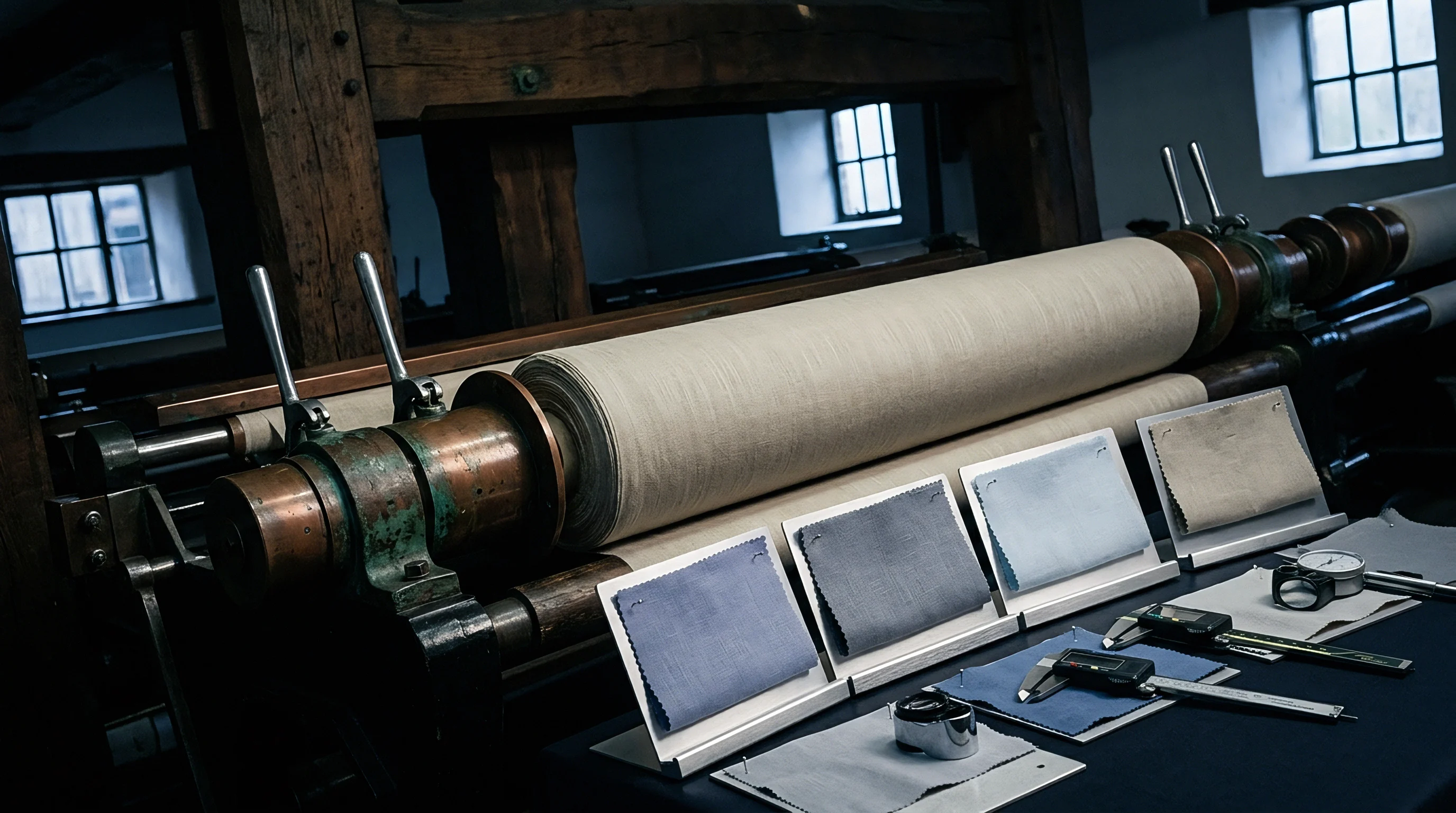
Frame
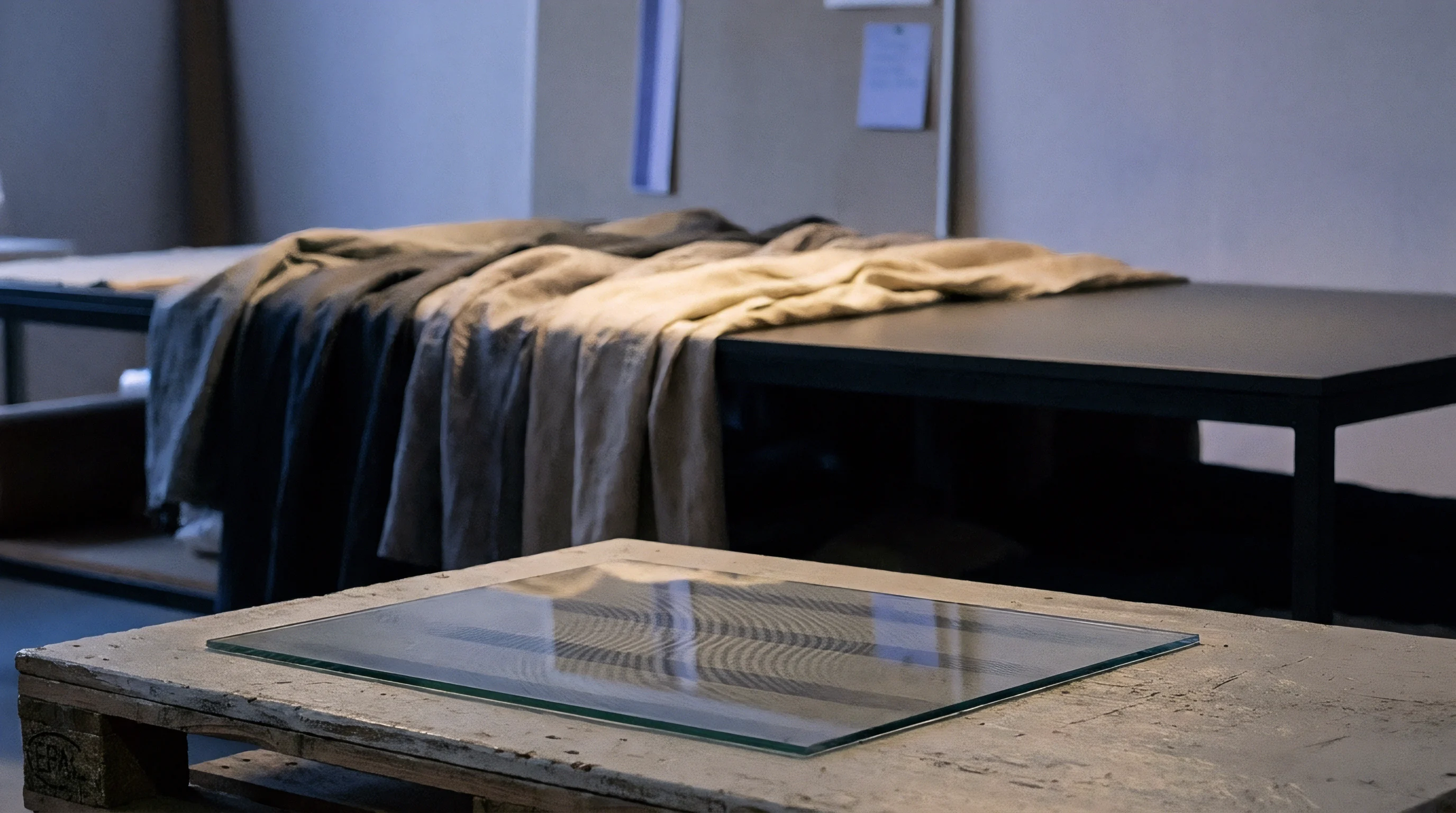
Mounting woven linen greige on an inspection table requires careful control of tension and lighting so structural defects show up without distorting the fabric. Compared to cotton or wool, linen yarn has little elasticity, yielding after less than three percent elongation on a stress-strain curve. If un-scoured greige unrolls under too much drag, the stretched warp sheet temporarily masks slubs and thin spots while warping the true pick count per centimeter.
Standard inspection perches handle normal industrial throughput by using a driven feed roller and an adjustable back-tension bar to keep the sheet flat across its full width.
Lighting standards specify exact sources and angles to bring out fine surface flaws without blinding the operator. ASTM D5430 calls for overhead diffuse daylight fluorescent lamps providing at least 1075 lux at the inspection plane. Raw linen usually requires a dual-source setup: top-mounted cool white daylight tubes paired with under-table trans-illumination.
Lighting from below shines through the weave grid, exposing missing warp threads, double ends, and pick density shifts that overhead light misses beneath the raw flax fibers.
The light angle determines how clearly defects appear on both open weaves and heavy canvases. Setting lamps at forty-five degrees to the cloth casts small shadows across the weft channel, making slubs and knots stand out. Flat forty-five-degree perches work well for mid-weight apparel fabrics between 150 and 220 grams per square meter.
For heavy industrial duck and upholstery greige over 350 grams per square meter, vertical inspection frames use gravity to help hold wide sheets ~ up to 320 centimeters ~ flat against the frame.
Light intensity dropped below one thousand lux masks fine warp end misdraws across dark unbleached flax strands.
Line speed determines how accurately an operator can scan the moving sheet. Keeping speeds between fifteen and twenty yards per minute lets the eye track single-pick flaws without fatigue. Running a frame above twenty-five yards per minute cuts defect detection by more than thirty percent, especially for small faults under five millimeters.
Variable-speed foot pedals let operators slow down instantly to touch suspicious areas or verify pick counts with a hand magnifier.

Illumination Geometry and Lux Thresholds
Fixtures on quality control frames need regular monitoring to maintain spectral output and illuminance. Overhead banks use high color rendering index tubes with a CRI above ninety-two to allow reliable shade matching across grey cloth lots. In a weaving mill, dust on optical diffusers can drop light levels by up to fifty lux a week, so protocols call for weekly calibration across nine points on the inspection surface to keep light distribution within ten percent of target.
Glass panels built into the table surface use frosted diffusion layers to eliminate hotspots from underlying LED or tube banks. The frosted glass needs to cast an even light field across the full usable reed width and extend at least five centimeters past the selvedges. For lightweight linen sheers, dimmable bottom panels prevent glare from blinding the operator while still revealing thin picks or reed marks.
Side-glance lighting mounted along the line of travel provides the low-angle light needed to spot subtle loom stops. Setting edge lamps at fifteen degrees highlights horizontal filling bars left by tension spikes when a loom starts up. On dense linen twills, low-angle light hits raised weave floats, casting noticeable shadows whenever pick spacing varies by even half a millimeter.
Drive Speed and Mechanical Tension Calibration
Unwind tensioners need active electronic braking or calibrated friction disks to keep warp tension steady. As the supply roll shrinks, line speed and tension shift. Sensor arms resting on the web adjust brake torque automatically to prevent fabric necking or loose selvedges from curling.
Unwind web tension is held under twenty Newtons per meter of cloth width during greige evaluation to avoid artificial warp distortion.
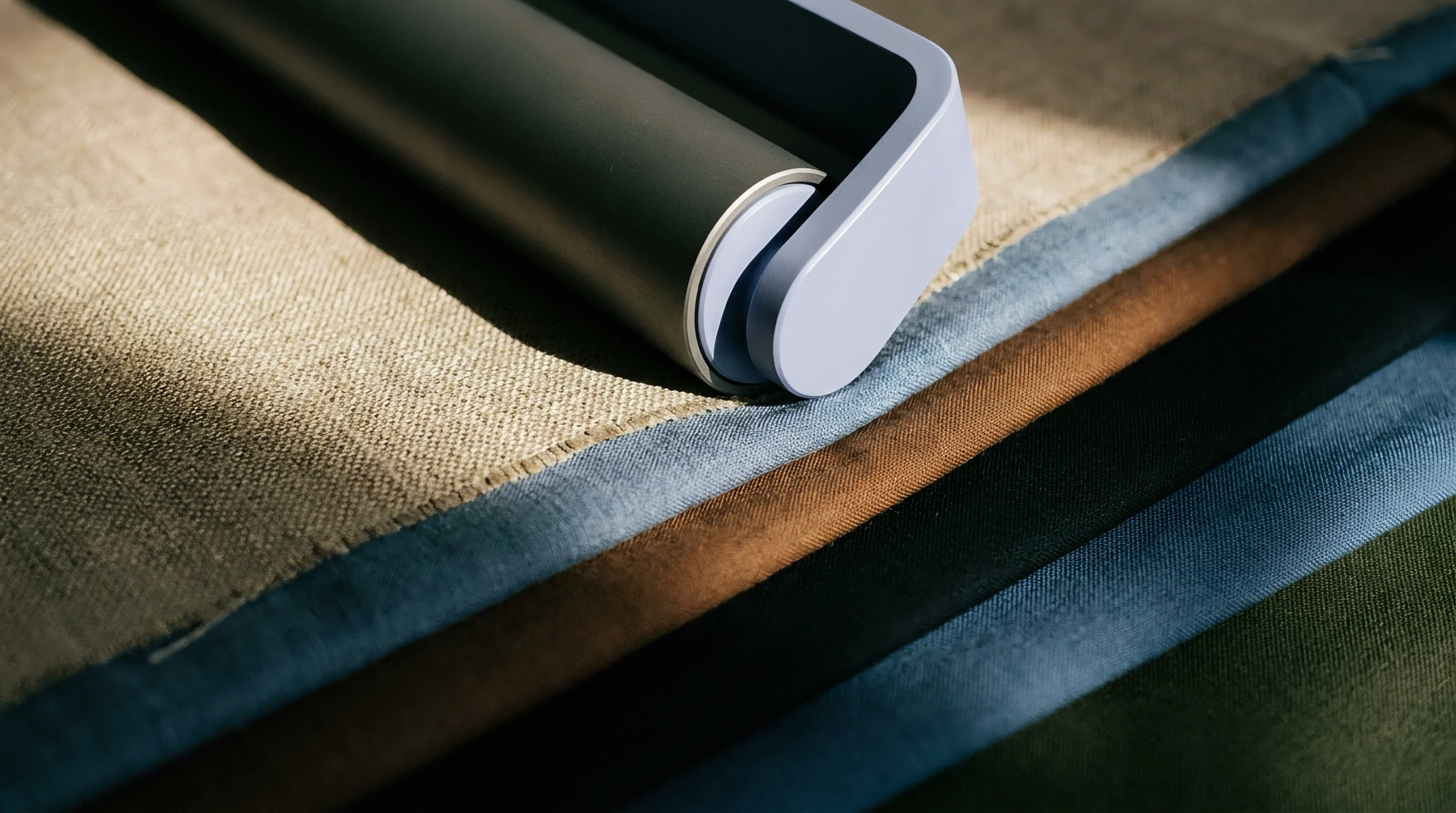
Rewind stations use synchronized center-driven rollers fitted with anti-static bars. Flax fibers carry micro-dust and loose shives that build up heavy static charges against metal guide bars. Static discharges pull ambient dust onto the raw greige and give operators shock hazards when using manual pick counters.
Grounded copper tinsel or active ionizers placed across the rewinding bolt discharge static before the roll packs down.
Digital measuring wheels running along the cloth surface track true linear length. Rubber-coated encoder wheels riding the fabric centerline avoid the slippage typical of shaft counters. Monthly calibration checks wheel circumference against a ten-meter steel tape; uncalibrated tension settings can cause length errors exceeding one percent.
Variable-speed drives need smooth acceleration profiles to prevent mechanical shock during starts and stops. Sudden stops cause the cloth to bounce, shifting the scanning position and throwing off the operator’s line of sight. Re-inspecting flagged sections requires smooth reverse motion at speeds under five yards per minute to re-evaluate point assignments accurately.
Inspecting greige without calibrated tension risks missing structural loom marks while undercounting yarn variations. Operators adjust frame speed based on weave complexity, slowing down for jacquards and running faster on basic plain weaves.
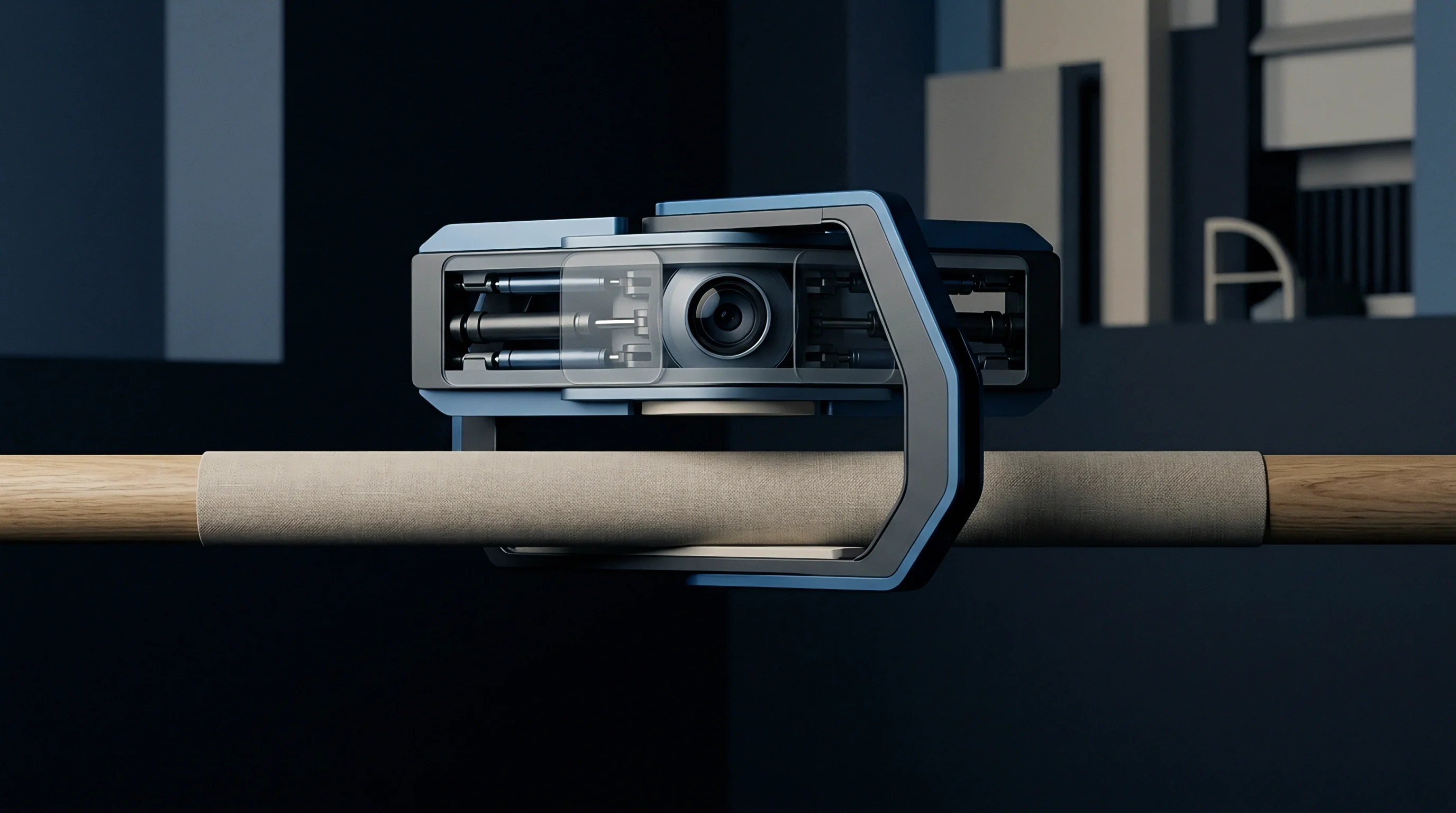
Scale
ASTM D5430 standardizes defect severity in greige linen using a four-point penalty scale. Points are assigned based on the physical length of a flaw along or across the warp. Minor imperfections draw small penalties, while longer structural breaks take maximum point deductions.
No single linear yard can be charged more than four points, no matter how many small faults fall within it.
Flaw size is measured directly with calibrated steel rules rather than estimated visually. Defects up to three inches long carry a one-point penalty. Those measuring three to six inches receive two points, and flaws between six and nine inches draw three points.
Any defect longer than nine inches incurs the maximum four-point penalty, and continuous defects running down the roll take four points for every yard they pass through.
Grading linen greige requires distinguishing natural yarn slubs from mechanical weaving flaws. Slubs inherent to wet-spun flax are not penalized unless they exceed twice the nominal yarn diameter or run longer than allowed thresholds. True processing faults ~ such as dropped warp ends, broken picks, oil spots, and reed marks ~ receive immediate point deductions.
ASTM D5430 offers two methods for calculating defect allowances. Option A scores penalties per hundred linear yards, shifting thresholds based on nominal fabric width. Option B bases limits on one hundred square yards of surface area.
Sourcing contracts for technical and apparel greige generally specify Option B because it normalizes defect limits across different loom widths, keeping wide-loom shipments from being unfairly penalized under linear yardage rules.

Point Assignment Tiering for Linear Imperfections
Linear defects along warp or weft threads are scored strictly by physical length. A broken warp thread extending two inches takes one point. If that same break creates a continuous pick flaw seven inches across the fabric, the penalty increases to three points.
The table below shows point allocations across defect length categories under ASTM D5430.
| Defect Length Range | Assigned Penalty Points | Typical Linen Greige Fault Types | Option B Area Adjustment Impact |
|---|---|---|---|
| Up to 3.0 inches (75 mm) | 1 Point | Minor slubs, short thick picks, single drop knots | Base point value applied to square yard calculation |
| 3.1 to 6.0 inches (76 to 150 mm) | 2 Points | Coarse filling bars, double picks, short oil streaks | Doubled penalty impact per linear incidence |
| 6.1 to 9.0 inches (151 to 225 mm) | 3 Points | Local reed marks, severe weft slubs, multi-end floats | Tripled impact; approaches single-yard ceiling |
| Greater than 9.0 inches (225 mm) | 4 Points | Broken warp ends, continuous loom stop bars, oil bands | Maximum penalty per linear yard reached |
Inspectors must watch defect spacing closely. Flaws less than an inch apart on the same thread line are measured as one continuous fault. For instance, if two one-inch oil spots sit half an inch apart along the weft, the inspector measures the total two-and-a-half-inch span and assigns a single one-point penalty rather than two separate points.
Holes and tears represent severe fabric failure. Under ASTM D5430, any hole or pinhole caused by loom elements automatically receives a four-point penalty regardless of size. A one-eighth-inch pinhole takes the same four-point penalty as a three-inch tear because both ruin fabric integrity during bleaching and finishing.

Full Width Violations and Continuous Fault Rules
Full-width flaws create severe waste during cutting. Broad crosswise defects like heavy starting marks, filling shade bands, or full-width temple cuts take four points per linear yard. If a starting mark affects a three-inch strip across the full ninety-inch width of a roll, that yard receives the maximum four-point penalty.
Longitudinal defects running down a roll add up quickly during tallying. A bent reed wire leaving a gap down seventy yards of fabric adds four points to every yard it touches. That single flaw accumulates two hundred and eighty penalty points, causing immediate rejection of the roll.
Selvedge flaws are treated differently from body defects. Damaged or torn selvedges that lie outside the net trimming width do not draw penalty points. If a ragged selvedge pulls into the main weave body, however, the resulting distortion is graded as a body defect and scored by length.
Does Dry Spun Linen Greige Require Modified Point Thresholds?
Dry-spun flax yarns carry far more density variation, hairiness, and nepps than wet-spun yarns. Dry-spun greige ~ used for heavy upholstery, wall coverings, and sacking ~ contains natural thick-and-thin sections throughout. Scoring dry-spun cloth under strict wet-spun visual standards would unfairly inflate point totals and reject runs that meet commercial requirements for coarse textiles.
Quality agreements adjust allowable point thresholds rather than altering the four-point scale itself when evaluating dry-spun greige. An apparel threshold capped at twenty points per hundred square yards for wet-spun fabric often expands to thirty-five or forty points for dry-spun decorative cloth. Contracts define acceptable slub dimensions ahead of time, excluding natural yarn necking under one millimeter from scoring.
Yarn count variations in dry-spun fibers cause frequent visual shifts across large lots. Inspectors check that coarse picks result from natural fiber bundles rather than misloaded bobbins during filling insertion. Separating natural fiber traits from mechanical faults prevents dry-spun greige from being wrongly flagged as defective.
A standard quality specification clause bases fabric acceptance on ASTM D5430 Option B totals, stipulating that any roll exceeding twenty-eight penalty points per hundred square yards is subject to rejection at the mill gate.


Morphology
Identifying greige defects requires understanding flax fiber processing, roving, and loom mechanics. Flax fibers are multicellular bast structures bound together by pectins, lignins, and hemicelluloses. Unlike synthetic filaments or combed cotton, raw flax yarn has natural dimensional variations that complicate inspection.
Grading accuracy depends on separating mechanical weaving faults from normal fiber variations.
Wet-spun flax yarns are drawn through hot water during spinning, softening pectins so fiber bundles slide smoothly past each other. This creates a smooth, high-tenacity yarn with minimal surface fuzz and uniform diameter. Dry-spun yarns skip hot attenuation, producing a bulkier strand with frequent fiber clusters and variable thickness.
In wet-spun greige, sudden thickness spikes reflect true roving or slub faults rather than normal texture, calling for full point penalties.
Mechanical flaws trace back to specific points in warping, sizing, or shedding. Broken warp ends happen when peak tension exceeds yarn strength; the snapped thread rolls back into adjacent warp ends, creating a clumped misdraw. Weft insertion errors on rapier or air-jet looms cause short picks, loop fills, or double insertions that break up the flat grid of plain and twill weaves.
The sequence below outlines the calibration steps required before starting a formal four-point greige inspection.
- Verify perch illumination across nine table coordinates with a calibrated lux meter to confirm uniform light above 1075 lux.
- Measure nominal roll width at three locations to establish net usable body width excluding selvedges.
- Adjust unwind brake tension to keep the web flat without exceeding twenty Newtons per meter of fabric width.
- Zero the digital optical encoder against the leading edge of the cloth before starting perch drive motion.
- Inspect the first five meters at low speed to spot warp-wise tension bands or reed misalignment across the width.
Distinguishing Natural Flax Neps from Loom Defect Modes
Natural flax neps are small, tightly coiled fiber bundles bound to the yarn body. They form during scutching and hackling when dry fibers break and tangle under carding pins. A true nep shares the pigmentation of surrounding yarn and measures under three millimeters long.
As long as neps remain under diameter thresholds, they do not compromise fabric structure and are not penalized.
Slubs are processing defects created during spinning or roving splicing when un-drafted roving passes through spinning rings. They swell yarn diameter by three to five times over lengths ranging from ten to fifty millimeters. These slubs weaken yarn strength, leading to thread breaks during dyeing and wet processing, and draw point deductions based on length.
Bark bits and shives are woody stem fragments left behind after decortication and hackling. These rigid wood particles trapped in bast fibers show up as dark, sharp inclusions in greige cloth. They can puncture calender rolls or cause dye resist spot faults.
Shive inclusions over five millimeters long or with sharp points draw one-point penalties.
Warp End Snapouts and Pick Accumulation Spikes
Warp end snapouts leave empty channels through the reed during weaving. If a thread breaks behind the drop wires without tripping the stop motion, the loom keeps inserting picks across the gap. Adjacent warp ends shift into the space, creating an open warp line.
A missing warp end running down a roll receives four points for every linear yard it traverses.
Pick accumulation spikes, or starting marks, show up as dense horizontal bars along the weft. When a loom stops to fix a warp break or reload filling, the reed remains pressed against the cloth fell under tension. On restart, the beat-up strikes the fell before the drive shaft reaches full speed, leaving either a dense pick band or an open gap across the width.
Starting marks exceeding half a pick space deviation across full loom width draw maximum four-point deductions for every affected yard.
Reed marks show up as continuous vertical lines running warpwise down a roll. When individual reed wires bend, nick, or clog with sizing paste, warp threads crowd together in some dents while leaving adjacent gaps empty. This creates alternating dense and sparse stripes that remain visible after bleaching.
Damaged reed sections require loom repair and take a continuous four-point penalty per yard.
Temple marks form near selvedges where spiked wheels grip the cloth fell to maintain width during beat-up. Worn or misaligned pins snag and tear yarns along the edges. If pin punctures extend past the designated selvedge trim line, the damage is scored by length, with severe tears taking four-point deductions.
Natural bast fibers cannot achieve synthetic filament uniformity, leaving raw flax variations outside standard four-point penalty structures when slub dimensions stay within natural limits.

Tally
Point totals per unit area provide the basis for accepting or rejecting greige shipments. Raw point counts mean little until normalized against square yardage or square meter formulas. Converting raw scores into standard point density metrics allows fair comparison between narrow seventy-inch apparel rolls and wide one-hundred-and-twenty-inch home textile bolts.
Calculating penalty points per one hundred square yards under ASTM D5430 Option B involves multiplying total roll points by 3600, then dividing by total inspected linear yards times net fabric width in inches. Net width excludes selvedges, counting only usable body width:
Points per 100 Square Yards = (Total Roll Points x 3600) / (Inspected Linear Yards x Usable Body Width in Inches)
Under metric specifications, raw point counts are converted to penalties per one hundred square meters. The formula multiplies total points by 10,000, then divides by total inspected linear meters times usable body width in centimeters:
Points per 100 Square Meters = (Total Roll Points x 10,000) / (Inspected Linear Meters x Usable Body Width in Centimeters)
Point thresholds dictate whether greige rolls qualify as First Quality or face downgrading. For wet-spun plain weave linen, First Quality is usually capped at twenty-eight points per hundred square yards. Rolls scoring twenty-nine to forty points draw price debits, while those over forty points face rejection and return to the mill.

Mathematical Formulas for Square Yardage Normalization
Accurate width measurement is essential for reliable point calculations. Checking width at only one spot can introduce errors if the fabric varies across the roll. Inspectors measure usable width at the start, middle, and end of each roll, taking the average for calculations.
Any narrowing or necking along the bolt shifts calculated surface area and changes the final score.
Verifying roll length is equally important. Tension during inspection can stretch fabric by one to two percent. Using stretched length artificially inflates total square yardage, diluting point density scores and underreporting defect severity.
Reliable evaluation depends on digital optical wheels measuring under controlled zero-tension conditions.
Converting between imperial and metric four-point scores requires adjusting for area differences. One hundred square meters equals roughly 119.6 square yards, so a metric score of 33.5 points per 100 square meters corresponds to twenty-eight points per 100 square yards. Missing this offset during cross-border trade leads to misread contract terms.
Acceptance Threshold Matrices for Industrial Linen Supply
Acceptance thresholds vary by fabric weight and end use. Fine apparel linens enforce tight point limits to prevent visible flaws in finished garments. Heavy duck and upholstery greige tolerate higher point densities because dense covers and mechanical finishing hide minor flaws.
The matrix below outlines standard point limits across major greige linen categories.
| Fabric Construction Category | Nominal Yarn Count (Nm) | Target Weight (g/m²) | First Quality Ceiling (Pts / 100 sq yd) | Maximum Demerit Point Limit |
|---|---|---|---|---|
| Apparel Sheer Plain Weave | Nm 36 / 1 Wet Spun | 110 – 140 | 20 Points | 28 Points |
| Standard Shirting Plain Weave | Nm 26 / 1 Wet Spun | 150 – 180 | 24 Points | 32 Points |
| Medium Suiting / Bedding Twill | Nm 26 / 2 Wet Spun | 200 – 240 | 28 Points | 36 Points |
| Heavy Upholstery / Decorative | Nm 14 / 1 Dry Spun | 320 – 400 | 40 Points | 50 Points |
Outlier rolls ruin consignment consistency. Even if a shipment’s average point score stays within limits, individual rolls exceeding maximum demerit caps face rejection. Sourcing contracts usually specify that no single roll in a First Quality lot may exceed the demerit threshold by more than fifteen percent.
Consecutive defect rules apply when small faults cluster in a short section. If a roll accumulates over sixteen points within ten consecutive yards, that section is considered scrap. The inspector flags it for cut-out and deducts the linear yardage from the billable roll length.
Worked Example of Greige Roll Yardage Point Calculation
Consider an audited bolt of Nm 26/1 wet-spun linen greige plain weave labeled at 120 linear yards long and 60 inches wide. On the perch, width measurements show 58.5 inches at the header, 58.0 inches at the midpoint, and 58.5 inches at the trailer, giving an average usable width of 58.33 inches. Unwound length measurement confirms an actual distance of 118.5 linear yards.
During inspection across the 118.5 linear yards, the following defects are logged:
- Three isolated slubs under two inches long, earning one point each (3 total points).
- Two coarse filling bars four inches long, earning two points each (4 total points).
- One continuous reed mark running through eight linear yards, earning four points per yard (32 total points).
- One heavy starting mark spanning the full width, earning four points for that yard (4 total points).
- Two local oil spots one inch each, four inches apart, earning one point each (2 total points).
These items total 45 raw penalty points. Applying the ASTM D5430 Option B formula converts raw points to standardized density:
Points per 100 Square Yards = (45 x 3600) / (118.5 x 58.33) = 162,000 / 6,912.1 = 23.43 Points per 100 Square Yards
Against standard shirting limits, the overall roll qualifies as First Quality, coming in under the twenty-four points per hundred square yards threshold. However, the eight-yard section containing the continuous reed mark accrued thirty-two points by itself. This local section exceeds the consecutive defect cap, requiring a mandatory eight-yard cut-out before sending the roll to finishing.
Accepting raw linear point tallies without adjusting for net usable width leads buyers to take substandard narrow rolls that cause heavy scrap loss during garment cutting.
Flaw
Major defects in greige linen lower manufacturing efficiency and weaken finished fabric. Because unbleached grey cloth retains natural flax waxes, pectins, and loom lubricants, identifying contaminants requires physical and chemical analysis. Severe structural flaws cannot be scoured or bleached out later, making early detection at the perch essential to prevent losses during wet processing.
Loom oil contamination is common in high-speed shuttleless weaving. Lubricants from rapier drives, shed cams, or temple pins drip or spray onto moving warp sheets. Standard loom oils bake into un-scoured flax fibers during grey storage or heat setting, creating water-repellent spots that block dye penetration and leave light streaks in finished cloth.
The list below outlines critical defect types found during four-point greige inspection, including their physical appearance and mechanical causes.
- Hydrocarbon Oil Splatter shows as dark fluid drops or streaks from excess oil on rapier guide pins or shedding cams.
- Continuous Reed Misdraw forms vertical warp gaps down the roll caused by damaged, bent, or missing reed wires.
- Heavy Loom Stop Bar appears as dense weft-wise bands caused by beat-up tension spikes when restarting the loom after thread repairs.
- Double Pick Insertion leaves two filling threads in a single shed due to rapier timing errors or improper cutter settings.
- Slack Warp Strand causes raised loops across the fabric surface from uneven warp beam winding or improper drop wire weight.
- Selvedge Pin Tear produces edge punctures extending into usable fabric due to misaligned temple wheels or worn pins.
Hydrocarbon Staining and Chemical Degreasing Feasibility
Assessing oil spots means checking whether they are clear mineral oil or dark, graphite-laden grease. Clear oil spots under half an inch can be emulsified and scoured out in alkaline surfactant baths at eighty degrees Celsius. Grease containing graphite holds microscopic metal particles in the flax fiber bundles, resisting normal scouring and leaving permanent gray stains.
Inspectors use 365-nanometer ultraviolet lamps to spot oil contamination invisible under standard daylight. Mineral oils glow brightly under long-wave UV. Finding widespread oil misting under UV light justifies rejecting entire lots before heat setting, which permanently bakes hydrocarbons into the cellulose fibers.
Spot-cleaning trials test whether heavy oil stains can be removed manually before scouring. A fast-evaporating solvent is applied to a sample swatch backed by an unbleached cotton pad. If an oil ring remains or fibers show damage, manual cleaning is ruled out and full length-based penalties apply.
Beam Tension Skewing and Continuous Streak Defect Modes
Uneven tension across the beaming frame creates continuous streaks parallel to the selvedges. If threads unwind from creel bobbins with variable drag, groups of yarn wind loosely onto the beam. During weaving, these loose bands sag under harness movement, altering pick density and creating alternating tight and slack stripes down the roll.
Spotting tension streaks requires checking the cloth under low-angle light across wide perches. Slack warp bands look different and feel softer, while tight bands pull filling threads up into raised ridges. Tight warp bands lower tear strength along the thread line, causing breaks during continuous dyeing.
Distorted selvedges caused by uneven warp beams create severe handling problems in scouring and bleaching. Loose edges buckle through rollers, forming permanent creases when squeezed by padder rolls. Tight or ragged selvedges snap under processing tension, stopping machinery and causing scrap.
Determining whether warp streaks stem from temporary sizing variations or permanent yarn count shifts remains a key challenge in raw flax inspection.

Settlement
Financial claims and debit notes in greige linen disputes depend on verified four-point inspection records. When roll scores exceed First Quality thresholds, buyers enforce contract remedy clauses. Remedies range from yardage allowances for local cut-outs to full lot rejection and invoice credits.
Yardage allowances compensate for isolated four-point defects in otherwise good rolls. Standard contract terms give a one-yard credit allowance for each four-point flaw. If a hundred-yard roll has three isolated four-point starting marks, the supplier credits three yards and bills for a net ninety-seven yards.
Cut-outs apply when defect clusters make sections of cloth unusable for marker layouts. When a roll accumulates over sixteen points within ten yards, the buyer cuts out the damaged length. Contracts require mills to credit the removed yardage and pay a fixed labor fee for each cut-out.

Commercial Yardage Deductions and Cut out Criteria
Filing claims requires clear documentation showing roll numbers, piece identification, exact readings, and photos of logged defects. Quality control teams compile tally sheets into formal dockets sent to mill sales offices. Mandatory claim documentation includes:
- Master Inspection Summary detailing roll serial numbers, measured lengths, net usable widths, raw points, and normalized scores.
- Defect Map Register logging yardage coordinates, physical dimensions, assigned points, and flaw classifications.
- Calibrated Light Log confirming that light levels, color temperatures, and drive speeds met ASTM D5430 standards during testing.
- High Resolution Photographs showing defects alongside measuring scales under standard daylight lighting.
- Laboratory Physical Test Dossier containing verified pick counts, fabric weights, fiber analysis, and UV fluorescence findings.

Dossier Compilation for Supplier Credit Adjustment
Supplier negotiations follow strict timelines under standard trade rules. Quality claims on greige linen must be submitted within thirty calendar days of receipt and before bleaching, dyeing, or cutting. Processing or converting the cloth signals formal acceptance and waives the right to submit defect claims later.
When buyer and mill inspection scores clash, independent accredited testing labs perform binding joint audits. Auditors pull a ten percent random sample of contested rolls and evaluate point totals on neutral perches under ASTM D5430 Option B. If the lab’s scores fall within five percent of the buyer’s tallies, the supplier pays for the audit and honors the claim.
Financial debit notes adjust landed costs by subtracting yardage deductions, cut-out labor penalties, and downgrade discounts from outstanding balances. Standard rules apply a twenty-five percent discount to Second Quality rolls scoring twenty-nine to forty points per hundred square yards. Rolls over forty points require replacement or full credit within fourteen business days of audit confirmation.
Systematic four-point inspection protects investment by enforcing clear, measurable quality standards before raw linen enters value-added finishing.