Standardized Visual Defect Classification Methods for Greige Cloth Inspection
Standardized greige inspection combines calibrated D65 illumination and 4-point scoring to convert visual cloth defects into precise commercial deductions.


Frame
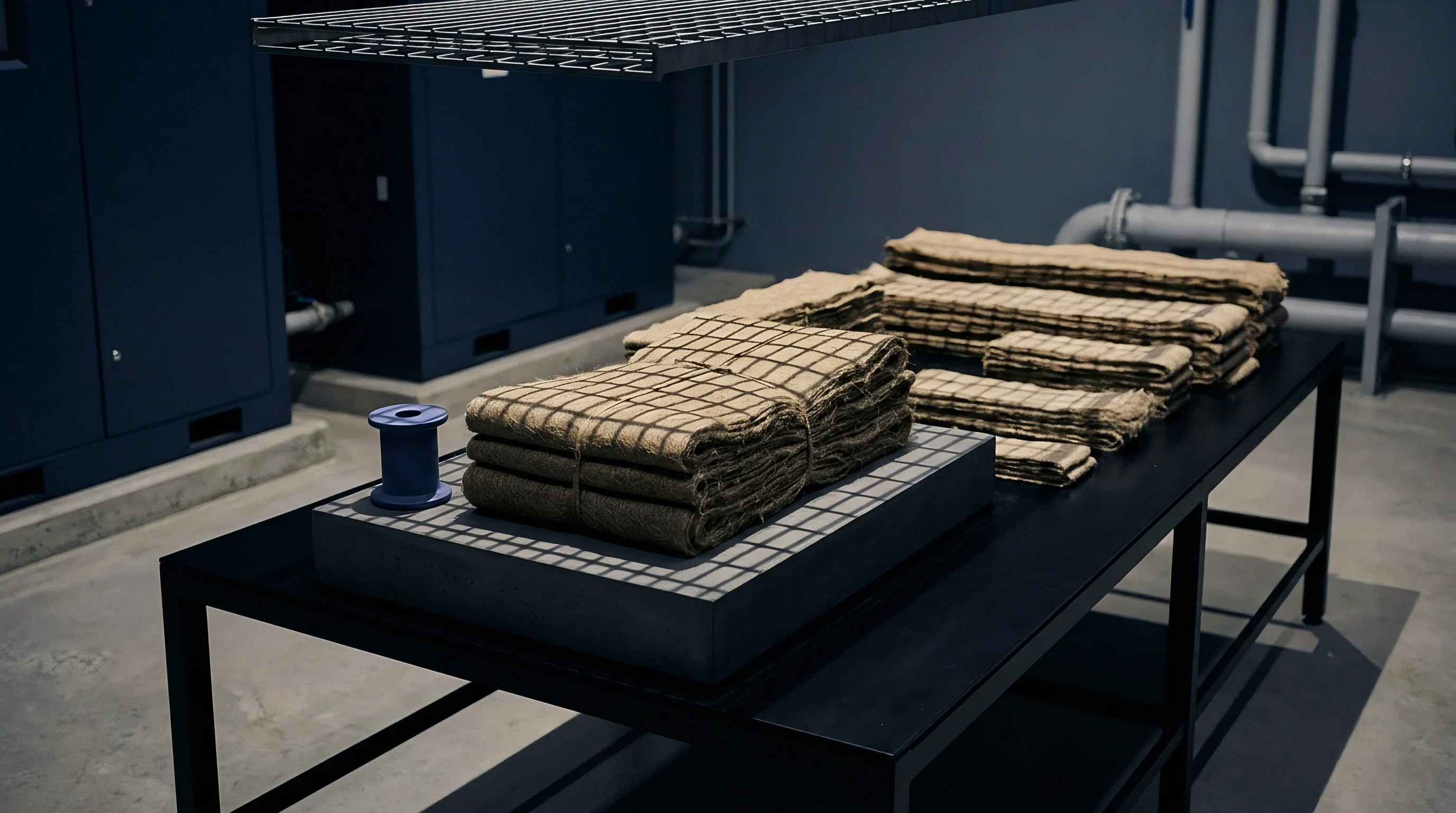
Mounting an unwashed roll of raw linen cloth onto an inspection table exposes every irregularity left by the loom. The physical geometry of the frame dictates whether a fine warp streak registers to the human eye or rolls past unnoticed at production speed. Standardized defect classification relies on controlled illumination, calibrated mechanical tension, and fixed viewing angles to turn subjective observation into repeatable data.
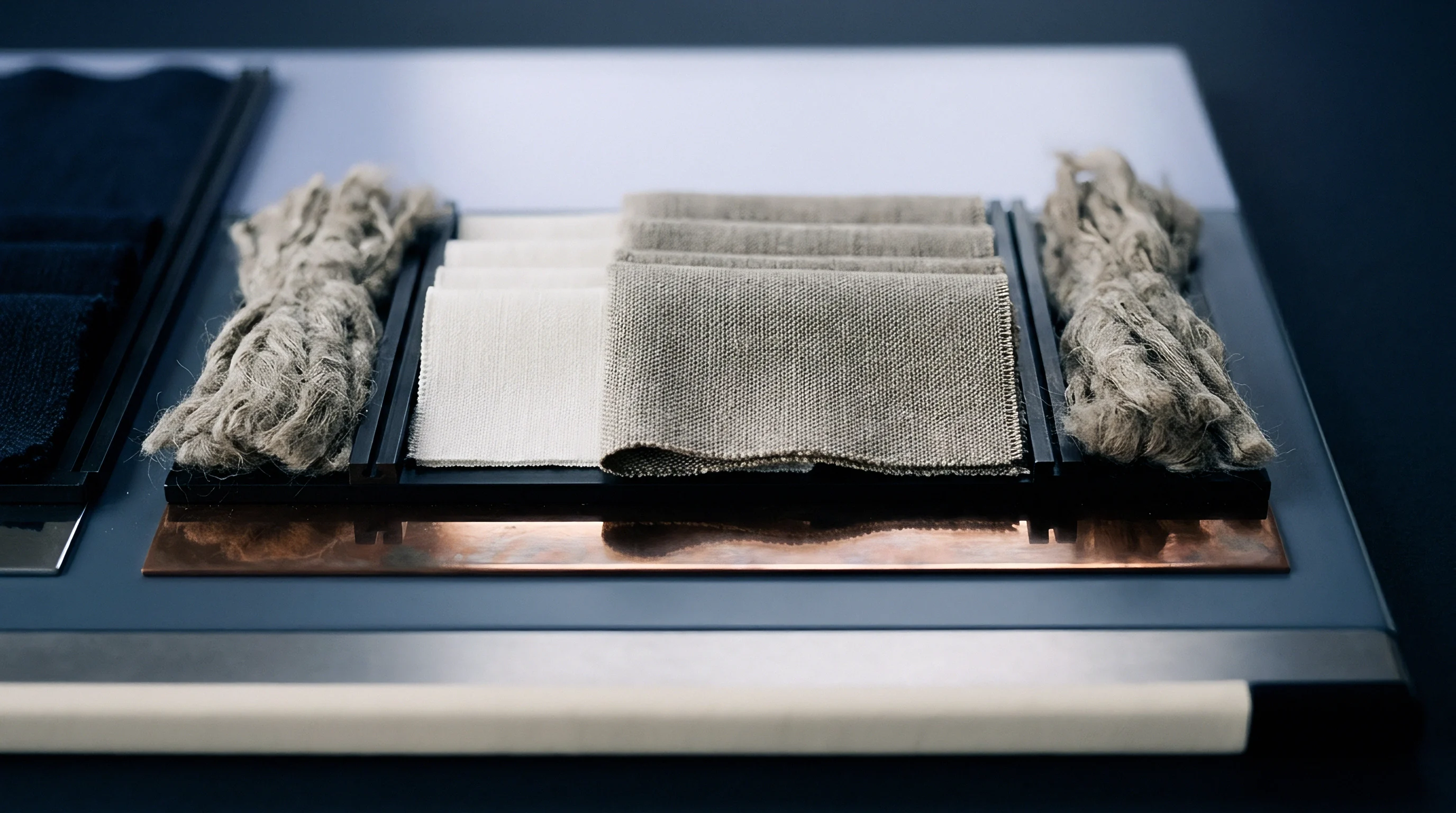
Fresh out of the weaving shed, greige fabric carries yarn size variations, residual spinning oil, starch sizing, and natural flax shives that clutter the surface. Inspection frames catch these structural flaws before wet processing shrinks, bleaches, or raises a nap on the web.
A standardized inspection station follows physical parameters set under ASTM D5430 and ISO 20706. The fabric web travels over an inspection board inclined between 45 degrees and 60 degrees off horizontal, putting the operator’s line of sight perpendicular to the cloth and cutting down parallax distortion across wide widths. Overhead lights run parallel to the board, illuminating the roll’s entire cuttable width.
Specifications mandate cool-white fluorescent or LED lamps operating at a color temperature of 6500 Kelvin ~ matching standard daylight spectrum D65 ~ with light intensity at the cloth surface held between 1500 lux and 2000 lux, checked at five points across the bed with a calibrated lux meter.
Illumination Geometry and Transmitted Light Mechanics
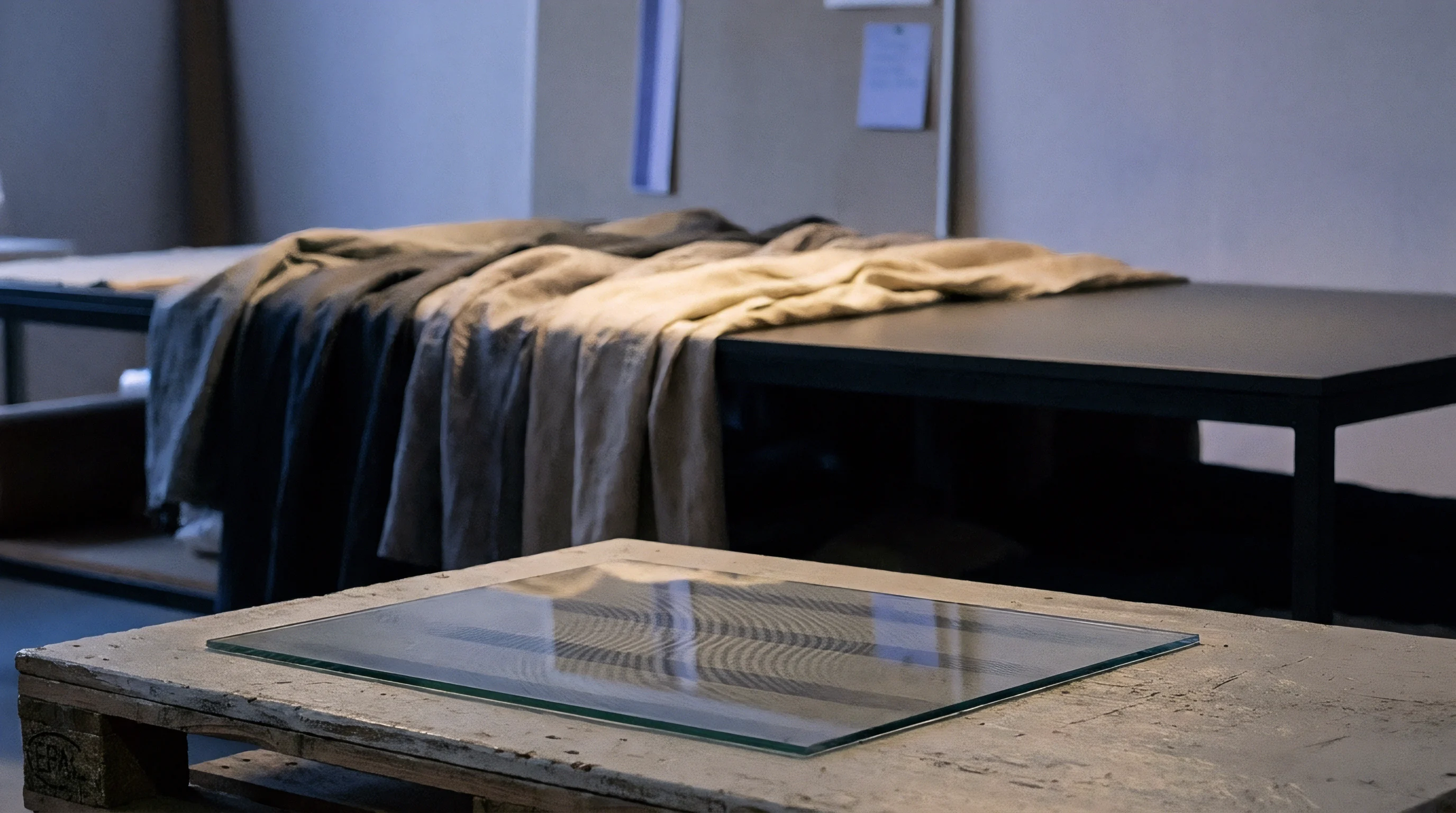
Reflected light alone misses faults buried in dense weaves. Standard greige inspection tables pair top-reflected light with bottom-transmitted backlighting. For transmitted light, a frosted glass or acrylic panel sits flush in the inspection board, backlit by high-output diffuse tubes.
Turning on the bottom light immediately exposes reed marks, thin places, missing warp ends, and cracked picks that stay hidden under top light. High-count plain weaves rely heavily on balanced dual lighting: top light catches surface slubs, while backlighting brings out spacing variations in the warp ends.
Glare control prevents operator fatigue and keeps detection rates reliable over an eight-hour shift. Unbleached greige fiber reflects far less light than finished synthetic material, but high illuminance levels will still cause blinding glare if light hoods lack baffles. Standard frames use baffle plates to keep the light source out of the inspector’s direct line of sight, aiming it straight down at the fabric.
Ambient room lighting is kept at about one-third the bed’s intensity so the inspector’s pupils don’t dilate rapidly when looking back and forth between the moving roll and the recording panel.
| Specification Parameter | ASTM D5430 Standard | ISO 20706 Specification | BS 6396 Benchmark |
|---|---|---|---|
| Primary Overhead Light Source | D65 Daylight / 6500 K LED | D65 Artificial Daylight | Illuminant C / 6700 K |
| Min Surface Illuminance (Reflected) | 1075 lux (100 foot-candles) | 1500 lux ± 10% | 1200 lux uniform |
| Transmitted Backlight Standard | Optional, recommended for light weights | Mandatory for weights < 200 g/m² | Optional via frosted panel |
| Inspection Board Inclination Angle | 45° to 60° from horizontal | 60° fixed or adjustable | 45° fixed plane |
| Web Running Speed Range | 15 to 20 metres/minute | 12 to 18 metres/minute | 10 to 15 metres/minute |
Running speed directly dictates how many defects an operator will catch. Variable-frequency inverter drives on rubber-coated draw rollers control web movement. Running raw cloth faster than 20 metres per minute drops human defect detection probability by more than 40 percent, especially for brief faults like short broken picks or small drop stitches.
Operating protocols set maximum speed by fabric mass per unit area and weave complexity: a heavy 350 grams per square metre greige canvas can run up to 18 metres per minute, while a fine 90 grams per square metre sheer linen must drop near 12 metres per minute to ensure complete coverage across all warp ends.

Mechanical Tensioning and Web Alignment Controls
Unwinding rolls straight off loom beams causes tension to drift as the supply roll shrinks. Controlled tension drives keep the cloth from sagging, skewing, or creasing over the glass panel. Pneumatic expansion shafts grip the supply core while magnetic particle brakes adjust drag torque based on roll-radius sensors.
Bowed or skewed filling yarns mask loom start-off marks and pick spacing errors by distorting the grid geometry of the weave. To counter lateral drift, frames use manual or automatic web-guiding edge sensors that hold the cloth edge within a three-millimeter tracking window throughout the run.
Tension settings have to account for the elastic recovery of the specific fiber blend. Pure linen greige exhibits low stretch under tension; pulling it too hard elongates reed marks without letting them relax back to their rest state. Calibrated load cells under guide rollers track web tension continuously, displaying real-time values in Newtons per meter of cloth width.
For lightweight plain weaves, line tension stays below 50 Newtons per meter to prevent structural distortion during visual inspection.
Standardized visual inspection protocols require calibrated lighting intensity between 1500 and 2000 lux at the fabric surface to ensure full detection of structural faults.
Operator posture affects both endurance and visual accuracy over a shift. Modern frames accommodate both seated and standing operators by incorporating motorized height and angle adjustment. The viewing distance between the inspector’s eyes and the fabric plane should measure between 600 millimeters and 900 millimeters.
Leaning closer introduces peripheral blind spots on 320-centimeter wide-width goods, while standing further back impairs resolution of fine yarn defects like micro-neps and thin filaments.
Preparing a standardized inspection table for a production batch requires a set calibration sequence.
- Verify light intensity using a calibrated lux meter placed flat on the upper, center, and lower sections of the inspection board under full light output.
- Clean the translucent glass panel for transmitted lighting with isopropyl alcohol to remove accumulated yarn lint, sizing dust, and grease residue.
- Check pneumatic core chuck pressure and engage the supply roll lock, ensuring axial alignment between the unwinding roll center and the take-up drive shaft.
- Thread the greige leader fabric through the tension control rollers, edge-guiding sensors, and over the inspection board without introducing structural twisting.
- Set the digital yardage or meter counter to zero while aligning the physical starting edge of the cloth cut with the baseline mark on the frame.
- Adjust variable speed control to the target velocity matching the cloth weight specification before initiating the inspection run.
Fluorescent tubes degrade silently long before they burn out. Phosphor decay shifts color spectrum toward yellow, killing contrast when trying to spot dark lignified shives in unbleached fiber. Reliable facilities establish bulb replacement schedules based on logged burn hours rather than visual filament failure, swapping tube sets every 2000 operating hours to maintain strict D65 spectral compliance across shifts.
Inspection room environment alters both fabric behavior and visibility. Keeping relative humidity between 60 percent and 65 percent prevents electrostatic charge buildup on synthetic and blended greige rolls, which otherwise attracts airborne lint to the inspection board surface. Ambient temperature maintained at 21 degrees Celsius prevents moisture accumulation on the frosted glass panel during continuous backlit operation.
Dust extraction hoods mounted directly above the unwind station capture loose sizing dust released as the web unwinds, preserving air clarity and optical glass transparency.
Short broken picks visible only under bottom lighting are sometimes argued to be harmless on the grounds that wet processing collapses open pick spaces, but finishing trials show the open space retains distinct yarn displacement despite washing shrinkage.

Demerit
Turning visual flaws into an objective numerical grade demands a standardized demerit system. Raw counts of defects fail to capture commercial severity: a half-inch slub impacts garment cutting efficiency far less than a continuous three-yard warp streak. The global textile trade relies on standardized scoring frameworks to calculate penalty points per unit area of greige cloth.
The ASTM D5430 four-point system stands as the prevailing international standard for visual defect classification, providing clear mathematical rules for scoring faults regardless of fabric width or end-use application.
The four-point system assigns penalty scores from one to four points based exclusively on the maximum linear dimension of an individual defect, treating warp and weft flaws identically. Defects measuring up to 3 inches in length receive 1 point. Defects measuring over 3 inches but not exceeding 6 inches receive 2 points.
Flaws measuring over 6 inches but not exceeding 9 inches receive 3 points. Any flaw whose length exceeds 9 inches receives 4 points. No single linear yard or meter of cloth can incur more than 4 points, regardless of how many individual flaws appear within that specific length segment.

Defect Length Classification and Penalty Allocation
Specific structural faults carry mandatory point assignments independent of simple linear measurement. Continuous defects such as broken ends, visible reed marks, warp streaks, or systematic pick finding marks running down the roll receive 4 points for every linear yard or meter in which they occur. Hole defects, punctures, or torn selvages measuring up to 1 inch in diameter receive 2 points, while larger holes measuring over 1 inch incur the maximum penalty of 4 points per occurrence.
Critical holes that compromise structural integrity across multiple pattern repeats automatically trigger roll rejection protocols.
Alternative scoring frameworks exist within specific regional supply chains, notably the Graniteville ten-point system and the ISO 13690 two-point system. Graniteville assigns higher point values to length thresholds, penalizing continuous warp faults at 10 points. The ISO two-point system simplifies scoring into minor and major categories.
The four-point system remains dominant because its mathematical structure yields a linear relationship between total points scored and cuttable fabric yield for apparel and home textile manufacturers.
| Defect Size / Condition | ASTM D5430 (4-Point) | Graniteville (10-Point) | ISO 13690 (2-Point) |
|---|---|---|---|
| Flaw length up to 75 mm (3 in) | 1 Point | 1 Point | 1 Point (Minor) |
| Flaw length 75 mm to 150 mm (3-6 in) | 2 Points | 3 Points | 1 Point (Minor) |
| Flaw length 150 mm to 230 mm (6-9 in) | 3 Points | 5 Points | 2 Points (Major) |
| Flaw length over 230 mm (> 9 in) | 4 Points | 10 Points | 2 Points (Major) |
| Continuous warp streak (per yard/meter) | 4 Points | 10 Points | 2 Points (Major) |
| Holes/Punctures < 25 mm (1 in) | 2 Points | 5 Points | 1 Point (Minor) |
| Holes/Punctures > 25 mm (> 1 in) | 4 Points | 10 Points | 2 Points (Major) |
Calculating the final demerit score requires normalizing total points against inspected area. Raw point totals mean nothing without factoring in roll length and usable cloth width. Standard ASTM D5430 equations express demerit points per 100 square yards or per 100 square meters.
The calculation for demerit points per 100 square yards uses total penalty points multiplied by 3600, divided by the product of inspected roll length in yards and cuttable fabric width in inches.
Metric calculations follow parallel logic: demerit points per 100 square meters equals total penalty points multiplied by 10,000, divided by the product of inspected roll length in meters and cuttable fabric width in centimeters. Cuttable width excludes selvages, measuring only usable woven fabric between inner selvage pins. If a roll measures 160 centimeters from edge to edge but features 3-centimeter dense leno selvages on each side, the cuttable width used in the denominator equals 154 centimeters.

Commercial Quality Grades and Acceptance Thresholds
Standard commercial contracts establish maximum allowable demerit points per 100 square yards for first-quality greige cloth. The baseline limit for standard cotton and linen plain weaves sits at 28 to 30 points per 100 square yards. High-density twill or satin constructions operating under tighter quality requirements specify limits of 20 to 24 points per 100 square yards.
Any individual roll exceeding the agreed threshold earns second-quality classification, subjecting the roll to contractual price penalties or outright rejection.
Demerit evaluation categorizes defects into distinct groups to manage cutting room yields.
- Point-scored defects represent isolated localized flaws such as short slubs, minor oil spots, or single broken picks that reduce aesthetic grade without stopping automatic cutting knives.
- Cuttable defects comprise full-width flaws or severe localized defects like thick bars, machine stop marks, or large grease patches that require cutting out full width segments during apparel marker spreading.
- Continuous defects include warp end missing lines, reed drag marks, or long double ends running past three linear yards that indicate systemic machinery failure in the weaving shed.
- Selvage defects cover torn selvage threads, loose selvage loops, or wavy edges that interfere with automatic loom temples and inspection frame feed rollers.
Commercial contracts define lot acceptance criteria alongside individual roll thresholds. A shipping lot containing 50 rolls may yield an average point count below 28 points per 100 square yards, yet fail overall acceptance if more than 10 percent of individual rolls exceed 40 points. Rejection rules prevent mills from blending severely defective rolls with immaculate rolls to pass average batch limits.
Commercial cloth grading contracts define lot rejection thresholds based on maximum allowable demerit points per 100 square meters, preventing defective rolls from masking behind batch averages.
In one evaluation of a 12,000-meter lot of 100% linen plain weave, average point calculations passed while localized clusters of missing ends appeared across five rolls. Inspection scores confirmed four individual rolls exceeded 42 points per 100 square meters due to persistent warp tension drop off during beam changes.
Under standard mill practice, defects occurring within 1 meter of either roll end do not incur point penalties, as finishing plants trim lead edges during batching onto stenter frames. However, continuous faults extending into the body of the roll receive full point penalties from their exact point of origin. Inspectors mark defect locations on the fabric edge using color-coded plastic stickers or metallic stickers detectable by automatic spreading machines in garment factories.
A standard quality specification contract line specifies: First-quality greige fabric shall not exceed 28.0 demerit points per 100 square yards as determined by ASTM D5430 four-point inspection, and any individual roll exhibiting continuous defects exceeding 3 consecutive yards shall be classified as second-quality material subject to immediate credit allowance or return.


Taxonomy
Greige cloth defects stem directly from physical breakdowns in yarn preparation, warping operations, sizing chemistry, or loom shedding mechanisms. Identifying a flaw on an inspection frame demands tracing its visual geometry back to the specific loom component or process phase that created it. Classifying greige faults into warp-wise, weft-wise, yarn-derived, and mechanical shedding categories provides the diagnostic foundation for corrective maintenance in the mill.
Warp-wise defects run parallel to the cloth selvage, originating in the creel room, warping frame, sizing machine, or drop wires. A missing warp end presents as a thin, empty channel running down the length of the roll where a single warp thread snapped and failed to trigger the automatic drop-wire stop motion. Conversely, a double end occurs when two warp yarns thread through the same heddle eye or reed dent, creating a raised ridge that doubles local warp density and alters the weave repeat structure.

Warp-Direction Machine and Preparation Faults
Reed marks manifest as continuous, fine warp-wise stripes spaced at regular intervals across the fabric width. They occur when damaged, bent, or misaligned reed wires pinch warp ends together during beat-up, altering thread spacing within individual dents. Reed marks remain prominent in greige state because raw sizing holds pinched ends in their distorted positions.
Sizing balls present as dense, hard clusters of dried starch paste adhering to warp yarns, caused by incomplete size cooking or dirty squeeze rollers in the slasher room. As sizing balls pass through the heddle eyes, they chafe neighboring warp ends, creating localized fuzz balls and causing thread breakages.
Warp streaks appear as broad, faint vertical bands of varying shade or density across the web. Variations in yarn tension during section warping cause thread density variations across the warp sheet: warping sections wound at higher tension pack tighter on the loom beam, resulting in higher warp crimp during weaving. When viewed on an inspection frame, these tension bands alter light transmission through the greige web, producing persistent streaks that survive wet processing.

Weft-Direction Insertion and Beat-Up Faults
Weft-wise defects run perpendicular to the selvage, arising from filling insertion mechanisms, main nozzles, rapiers, or weft feelers. A broken pick occurs when the insertion yarn snaps mid-flight across the shed, leaving an incomplete pick line across part of the fabric width. High-speed air-jet looms introduce broken picks when insertion air pressure exceeds yarn tensile strength, snapping fine weft yarns near the right-hand receiving side of the shed.
Pick finding marks, commonly called stop marks or starting marks, present as dense or open transverse bands across the entire cuttable width. They happen whenever the loom stops due to a warp break or weft failure and restarts without perfect tension compensation. A heavy stop mark contains an over-packed row of picks caused by excessive reed beat-up against a stationary cloth fell, while a light stop mark exhibits an open crack caused by insufficient cloth take-up pull upon machine restarting.
Loom controllers use computerized pick-finding cycles to equalize fell position, yet improper setting leaves visual bars scoring 4 penalty points per occurrence.
Does Air Jet Insertion Increase Weft Loop Frequency?
Air-jet weaving machinery relies on continuous pulses of compressed air through relay nozzles to propel the weft yarn across the shedding gap. Improper timing between the main insertion nozzle and auxiliary relay nozzles creates air turbulence within the shed. When auxiliary air pressure drops prematurely, the tip of the inserted weft yarn loses axial tension and folds back on itself before beat-up.
This mechanical action creates a weft loop, visible as a small protrusion or curling loop standing proud of the cloth plane.
Excessive weft yarn twist compounds loop formation during air-jet insertion. High-twist yarns exhibit torsional liveliness, causing the yarn to curl instantly whenever insertion air streams drop below critical transport velocity. Inspecting lightweight greige fabrics on a backlit table highlights weft loops as tiny double-thickness spots scattered across the fill plane.
Correcting loop formation requires adjusting relay nozzle pulse duration and fine-tuning main nozzle pressure profiles rather than altering sizing formulations.
| Defect Nomenclature | Visual Characteristics | Root Cause Component | ASTM D5430 Typical Score |
|---|---|---|---|
| Broken End | Empty warp channel parallel to selvage | Drop wire failure or thread snap | 4 Points (Continuous) |
| Double End | Raised linear ridge parallel to selvage | Heddle eye threading error | 4 Points (Continuous) |
| Heavy Stop Mark | Dense transverse bar across full width | Loom start-off beat-up over-advance | 4 Points (Full Width) |
| Light Stop Mark | Open transverse crack across full width | Loom start-off take-up under-advance | 4 Points (Full Width) |
| Weft Loop | Curled yarn loop protruding from pick line | Air-jet relay nozzle pressure drop | 1 to 2 Points per spot |
| Slub (Yarn) | Thick yarn segment with un-drafted fiber | Spinning frame drafting roll defect | 1 to 3 Points (by length) |
| Temple Mark | Pin pricks or thread distension at selvage | Damaged temple ring pins | 2 to 4 Points (if in body) |
Yarn-derived faults stem from spinning mill defects that pass through winding clearers into the warping creel. A slub presents as an abnormally thick, short segment of yarn containing un-drafted fiber bundles. Slubs score 1 to 3 points depending on their linear length under 4-point rules.
Foreign matter defects, including foreign fiber contamination, oil stains, and metal flakes, degrade greige appearance. Grease stains caused by leaking loom drive gears or over-lubricated rapier tapes transfer carbonized oil onto the cloth web, leaving dark spots that require spot-cleaning before bleaching.
Temple marks occur near fabric selvages where mechanical temple rolls hold fabric width constant against weft contraction forces. Worn, bent, or clogged temple pins puncture threads or push warp yarns apart, creating small clustered pinholes along both edges of the greige web. If temple pins penetrate beyond the selvage margin into the cuttable width field, the affected length incurs penalty points for continuous structural damage.
Greige inspection facilities maintain detailed defect classification checklists to standardize reporting across shift inspectors.
- Verify structural continuity by checking that pick counts per centimeter match specification using a illuminated thread counting glass at three positions across the web.
- Inspect selvage integrity for cut threads, loose leno loops, or wavy tension lines that cause edge curl during continuous roll handling.
- Distinguish yarn slubs from sizing lumps by picking at the anomaly with a counting needle; starch lumps break down into powder while fiber slubs retain structural core twist.
- Locate machine-repeating defects by measuring the distance between recurring flaws; a repeat distance matching the harness cycle points to heddle damage, while a repeat matching reed circumference indicates roller indentation.
- Log oil stain frequency to isolate specific loom positions suffering from drive seal degradation or oil mister over-saturation.
Flaw signatures on raw cloth point directly to machine maintenance status. When an inspector identifies systematic double picks occurring every sixteen inches, the maintenance team isolates the cause to a slipping weft detector clutch on the weaving loom. Addressing mechanical failure at the loom head prevents hundreds of meters of fabric from incurring second-quality penalty scores.
Fixing warp-wise tension streaks requires re-leveling the loom back-rest roller before tightening section warping beam brakes.


Arithmetic
Translating visual inspection records into commercial settlements requires precise lot-level arithmetic. Fabric buyers and mill owners must compute accurate point totals, evaluate standard deviation across roll populations, and derive financial allowances to settle quality disputes. A standard lot inspection protocol relies on statistical sampling where complete 100 percent inspection proves cost-prohibitive or impractical.
Calculating batch penalty metrics under ASTM D5430 demands application of yardage formulas, cuttable width subtractions, and commercial credit algorithms.
Consider a practical commercial inspection scenario involving a batch of 100% linen plain weave cloth destined for high-end shirting production. The order contract specifies a nominal grey fabric width of 160 centimeters, a nominal fabric weight of 145 grams per square meter, a sett of 14 ends per centimeter by 13 picks per centimeter, woven from 14 Lea pure flax yarn on high-speed rapier looms. The shipping lot comprises 100 rolls totaling 10,000 linear meters.
Under standard qualification rules, an independent testing laboratory or buyer inspection desk selects a representative 10 percent sample size, physically inspecting 10 full rolls totaling 1,000 meters on a standardized inspection frame.
Worked Multi-Roll Batch Settlement Calculation
The inspection desk measures each sample roll for gross length, edge-to-edge overall width, and cuttable fabric width excluding selvages. An inspector records every visual defect, assigning penalty points under the 4-point system. The table below presents raw inspection data gathered across the 10 sample rolls drawn from the 10,000-meter linen lot.
| Roll Number | Inspected Length (m) | Cuttable Width (cm) | 1-Pt Faults | 2-Pt Faults | 3-Pt Faults | 4-Pt Faults | Total Points | Points / 100 m² |
|---|---|---|---|---|---|---|---|---|
| Roll 01 | 100.0 | 154.0 | 8 | 3 | 1 | 2 | 25 | 16.23 |
| Roll 02 | 100.0 | 154.0 | 12 | 5 | 2 | 1 | 32 | 20.78 |
| Roll 03 | 100.0 | 154.0 | 5 | 2 | 0 | 1 | 13 | 8.44 |
| Roll 04 | 100.0 | 153.5 | 15 | 8 | 4 | 3 | 57 | 37.13 |
| Roll 05 | 100.0 | 154.0 | 6 | 4 | 1 | 0 | 17 | 11.04 |
| Roll 06 | 100.0 | 154.0 | 10 | 4 | 2 | 2 | 32 | 20.78 |
| Roll 07 | 100.0 | 154.0 | 18 | 9 | 3 | 4 | 61 | 39.61 |
| Roll 08 | 100.0 | 153.0 | 7 | 3 | 1 | 1 | 20 | 13.07 |
| Roll 09 | 100.0 | 154.0 | 9 | 2 | 1 | 1 | 20 | 12.99 |
| Roll 10 | 100.0 | 154.0 | 11 | 6 | 2 | 3 | 47 | 30.52 |
Calculating penalty points per 100 square meters for each roll highlights variations in weaving quality across the production run. For Roll 01, total penalty points equal 8 times 1 point, plus 3 times 2 points, plus 1 times 3 points, plus 2 times 4 points, summing to 25 total points. The cuttable area of Roll 01 equals 100 meters length multiplied by 1.54 meters cuttable width, yielding 154 square meters.
Dividing 25 points by 154 square meters and multiplying by 100 gives 16.23 points per 100 square meters.
Analyzing Roll 07 demonstrates severe defect accumulation. Roll 07 contains 18 one-point flaws, 9 two-point flaws, 3 three-point flaws, and 4 four-point continuous flaws, resulting in 61 total penalty points. Operating on a cuttable width of 154 centimeters, Roll 07 yields 39.61 points per 100 square meters.
If the sales contract sets the maximum allowable threshold at 28.0 points per 100 square meters, Roll 07 exceeds acceptable limits, earning immediate second-quality classification.
Statistical Batch Settlement and Financial Deductions
Evaluating the entire 1,000-meter sample requires computing the mean point score and standard deviation across all 10 rolls. Summing total points across all sample rolls yields 324 points over a total inspected area of 1,539.5 square meters. The overall batch average equals 324 multiplied by 10,000, divided by the product of 1,000 meters and 153.95 average cuttable centimeters, resulting in a mean score of 21.05 points per 100 square meters.
While the overall batch mean of 21.05 sits safely below the contractual upper limit of 28.0 points, individual roll variance reveals quality risks within the lot.
Computing standard deviation exposes roll-to-roll consistency across the weaving shed run. The sample standard deviation for this dataset equals 11.42 points per 100 square meters. Under statistical process control rules, when the standard deviation exceeds 50 percent of the mean score, the lot exhibits unstable weaving conditions.
Rolls 04, 07, and 10 exceed the 28.0 point limit, representing 30 percent of the sampled lot volume. Standard commercial contract clauses dictate that if more than 10 percent of sampled rolls fail first-quality criteria, the buyer retains the right to reject the entire shipment lot or demand 100 percent inspection at the seller’s expense.
Financial adjustments follow math formulas defined in commercial master purchase agreements. Allowance systems convert demerit points into yardage credits or monetary price reductions per roll.
- Standard Allowance Rate grants a 1 percent price credit on the total roll value for every 3 points per 100 square meters exceeding the baseline quality target up to the rejection cap.
- Cuttable Segment Penalty requires the mill to credit 0.5 meters of fabric for every 4-point full-width stop mark or smash, compensating the buyer for cutting waste during garment marker laydown.
- Linear Yardage Credit adds physical extra length to the invoice roll tally, supplying unpaid bonus fabric at the end of the roll equal to calculated defect waste.
- Demerit Surcharge Tier applies a compounding 5 percent financial penalty against the total batch invoice if sample standard deviation exceeds 10.0 points per 100 square meters.
Calculating the financial settlement for the 10-roll sample demonstrates how point scoring impacts landed metre costs. Assuming a contract price of 4.50 Euros per finished metre of greige linen cloth, the base value of the 1,000-meter inspected sample totals 4,500.00 Euros. Roll 04 (37.13 points) and Roll 07 (39.61 points) incur standard second-quality price downgrades of 25 percent against their individual invoice values.
Roll 10 (30.52 points) incurs a 5 percent minor allowance credit. The total financial credit calculated across the sample equals 253.12 Euros, reducing net payable value by 5.62 percent.
Commercial credit adjustment agreements require extra unpaid fabric length or direct invoice price deductions whenever lot demerit points exceed agreed baseline targets.
Formulating a commercial settlement dossier requires documenting all physical inspection metrics within a structured financial summary.
- Itemize total inspected meters, overall fabric width, and calculated cuttable width for every sampled roll in the shipment batch.
- Record individual counts for 1-point, 2-point, 3-point, and 4-point defects, alongside total penalty score totals per roll.
- Calculate demerit points per 100 square meters or per 100 square yards using verified cuttable width dimensions.
- Identify rolls exceeding contractual first-quality thresholds and categorize them for credit allowance or physical return.
- Compute batch mean point score, standard deviation, and percentage of non-conforming roll volume across the sample size.
- Apply agreed contract credit rates to derive net payable invoice adjustments across the shipment.
In one instance, a buyer suffered heavy losses on a 15,000-meter shipment of heavy linen duck because the purchase agreement lacked a cuttable width calculation clause. The mill measured total points over gross 165-centimeter roll width including dense 5-centimeter selvages, understating true defect density per cuttable square meter by 6.4 percent and invalidating the credit claim.
Defect arithmetic converts visual physical observation into absolute financial accountability between mills and buyers.
Automation
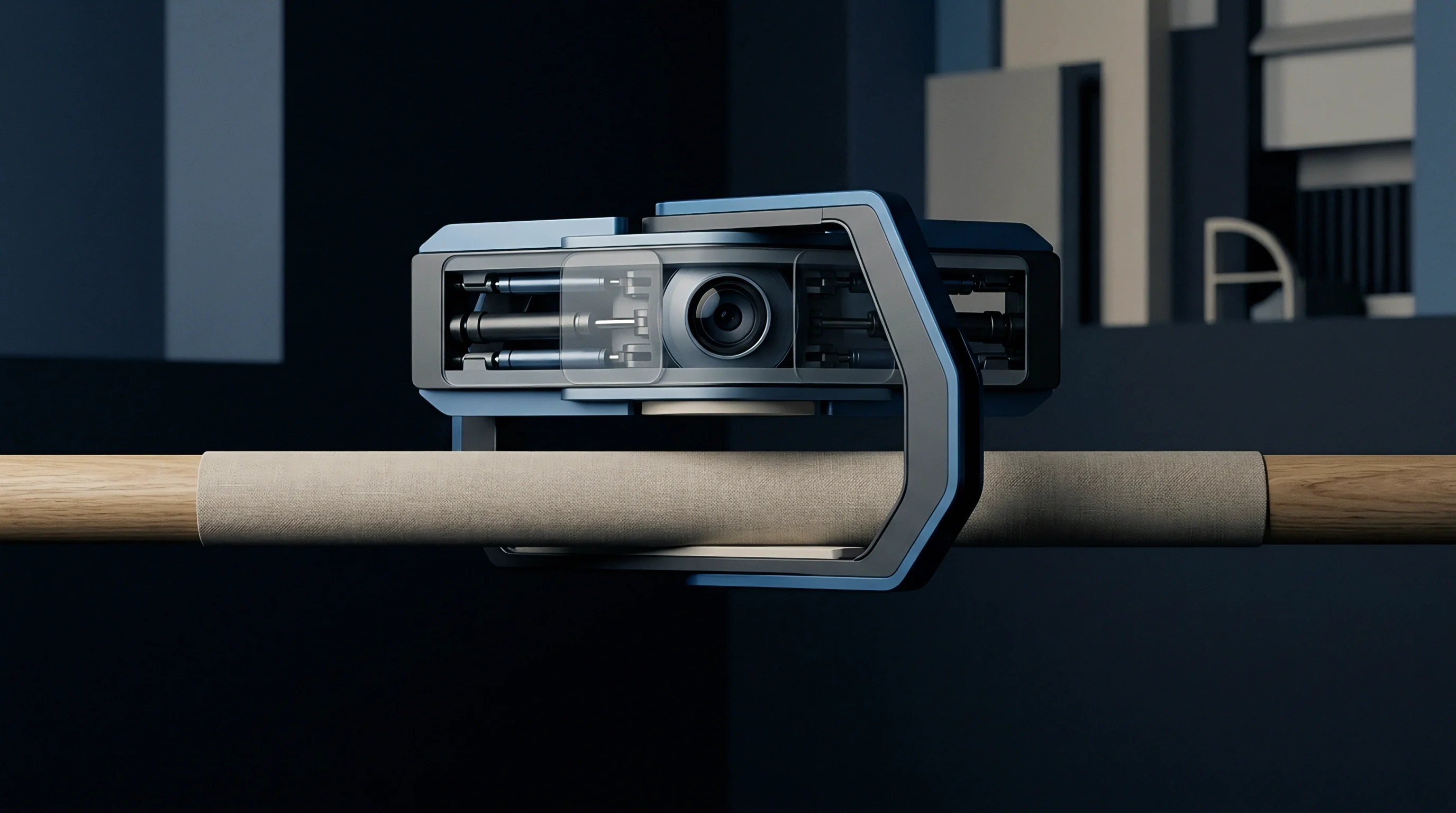
Automated visual inspection systems replace variable human sight with line-scan cameras, structured LED light arrays, and real-time image processing algorithms. Inspecting high-speed greige webs on manual frames exposes visual grading to human fatigue, shift variations, and speed limits near 20 meters per minute. Machine vision systems mounted directly on loom off-roll take-up units or dedicated high-speed re-rolling frames inspect fabric at speeds reaching 120 meters per minute while maintaining consistent sub-millimeter fault resolution across wide widths.
Modern machine vision setups use high-resolution CMOS line-scan cameras operating at line rates exceeding 80 kilohertz. A 16k pixel line-scan camera positioned above a 320-centimeter greige web captures spatial resolutions down to 0.2 millimeters per pixel. Camera arrays mount on rigid optical bridges designed to isolate sensor optics from loom floor vibrations.
Dedicated linear LED illumination bars project high-intensity, uniform light pulses synchronized to camera line trigger signals, delivering illuminance levels above 50,000 lux across the scanning field.
Machine Vision Optical Hardware and Lighting Schemes
Detecting fine greige flaws requires optical configurations tailored to unwashed fiber textures. Transmission lighting arrays positioned beneath translucent inspection plates highlight internal structural gaps, thin ends, and missing picks. Top-reflected dark-field lighting positions LED beams at shallow angles between 10 degrees and 15 degrees relative to the fabric plane.
Shallow lighting angles cause raised fiber slubs, broken ends, and knots to cast distinct highlights against the dark background texture of the plain weave matrix.
Coaxial bright-field lighting arrays direct light beams through beam splitters parallel to the camera optical axis. Coaxial light penetrates deep into twill and satin weave structures, capturing subtle pick density shifts and oil stains that absorb light differently than raw sizing starch. Combining bright-field reflected light, dark-field grazing light, and transmitted light within a multi-channel strobe capture cycle allows machine vision algorithms to capture three optical channels in a single pass.

Deep Learning Algorithms and Real-Time Defect Classification
Early automated inspection software relied on fixed spatial frequency filters and threshold segmentation. Modern automation integrates deep convolutional neural networks trained on vast optical datasets of greige fabric faults. Convolutional networks analyze spatial feature maps, extracting structural texture patterns despite natural fiber variations present in raw linen and unbleached cotton.
Machine vision systems classify detected anomalies into standard fault taxonomies instantly, logging exact roll coordinates, linear dimensions, and severity scores within a digital quality map.
Real-time machine learning inference engines filter out benign natural surface variations, such as isolated flax shive fragments or loose surface lint, preventing false-positive stops. Deep learning models distinguish a structural broken pick from a harmless surface lint cluster by analyzing background yarn continuity across neighboring pixels. Systems achieve classification accuracy rates exceeding 96 percent for major structural defects while reducing false-positive defect calls below 1.5 percent across continuous production shifts.
Integrating automated vision output directly into factory enterprise resource planning software transforms mill quality control workflows. Automated frames generate digital fabric roll maps, recording every defect coordinate on a cloud ledger. When rolls transfer to garment cutting facilities, automatic spreading machines read the digital roll map, dynamically adjusting pattern marker layouts to steer cutting knives away from flagged 4-point defects without manual operator intervention.
Should online machine vision systems operating directly on loom take-up units replace off-line final inspection frames in high-density linen weaving sheds? Direct loom-mounted inspection detects systematic mechanical breakdowns such as broken harness cords or damaged reeds after the first few centimeters of weaving, sending immediate stop signals to the loom controller before hundreds of meters of defective cloth collect on the take-up roll.