Reconciling Mechanical Combing Waste in Bast Fiber Processing
Reconciling mechanical combing waste requires dry-mass conservation formulas corrected for moisture regain to prevent financial leakage and scope failure.


Noil
Rectilinear combing machinery processes hackled bast sliver by extracting short plant fragments and tangled fibre groups. The resulting secondary material consists primarily of short flax fibres measuring under 25 millimetres alongside residual shive particles and unretted cortical tissue. In long-staple linen spinning, raw scutched flax enters the combing preparation line after initial hackling frames have straightened the fibre bundles.
Comb aprons pinch long filaments while rotating circular pin beds drag out short strands, generating a clear separation between continuous hackled sliver and short extraction drops.
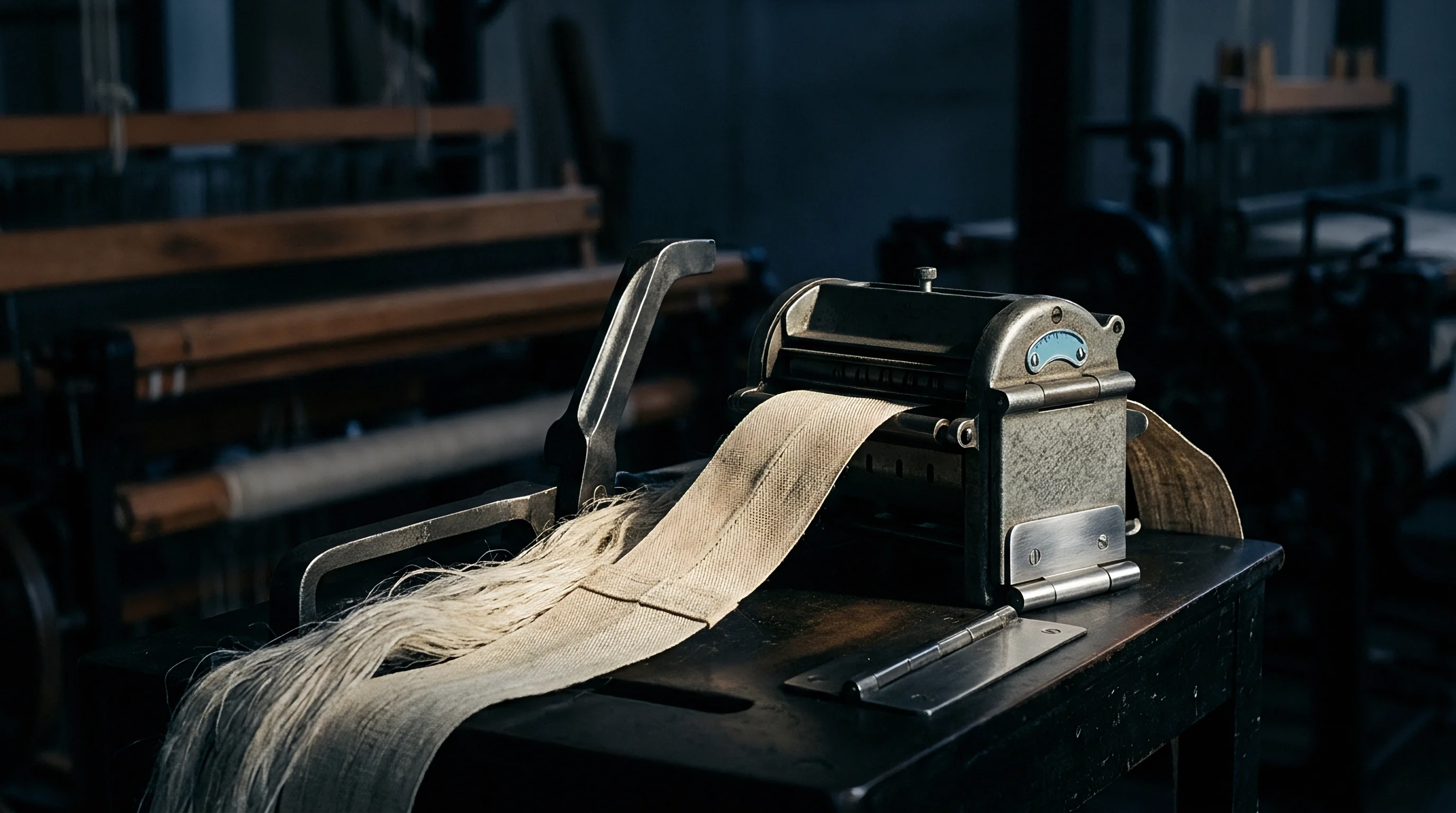
Mechanical Separation Kinematics in Rectilinear Combing
Hackling pin beds open the scutched bast structure before rotary nip rollers catch individual long filaments. Machine speeds, pin density settings, and top comb penetration depth directly govern the volume of material dropped into the waste box beneath the combing head. Scutched bales vary by harvest.
When ret quality drops or water-retting yields uneven fiber separation, mechanical resistance across the pin beds increases, forcing a higher percentage of sound fibres to break and drop into the short fraction. Shive counts drop during hackling.
Relative humidity inside the mill floor dictates fibre flexibility during high-speed comb passes. Processing bast fibres at ambient relative humidity levels below 60 percent increases static charge and brittleness, escalating the proportion of long strands broken into short extraction drops. Conversely, operating above 70 percent relative humidity causes damp fibres to cling to pin surfaces, altering pin geometry and driving continuous extraction variance.
| Process Stage | Mean Fibre Length (mm) | Extraction Rate (% Dry Weight) | Primary Impurity Content (% Mass) | Typical Standard Regain (%) |
|---|---|---|---|---|
| Scutched Fibre Input | 450 – 750 | 100.0 | 2.5 – 4.5 Shive / Dust | 12.0 |
| Hackling Line Sliver | 250 – 500 | 68.0 – 78.0 | 0.5 – 1.2 Shive | 12.0 |
| Rectilinear Combing Sliver | 180 – 350 | 50.0 – 62.0 | 0.1 – 0.3 Shive | 12.0 |
| Combing Short Extraction | 12 – 35 | 18.0 – 32.0 | 4.0 – 8.0 Shive / Cortical | 12.0 |
| Carding Filter Dust | < 5 | 1.5 – 3.5 | 65.0 – 85.0 Mineral / Shive | 8.5 |
Combing drops carry high trash. Standard mill accounting splits mechanical output into three distinct streams: long combed sliver destined for fine yarn wet spinning, short extraction drops redirected to coarse dry spinning or non-woven insulation lines, and unspinnable card dust collected by pneumatic filtration systems. Reconciling these streams requires tracking physical mass immediately as material exits the machine aprons.
Dew-retted European flax subjected to secondary rectilinear combing yields a short fibre extraction fraction between 22 and 28 percent when processed at ambient relative humidity above 65 percent.
Spinning technicians frequently claim that sudden increases in short fibre accumulation stem entirely from seasonal variations in crop retting uniformity rather than aggressive comb pin settings or improper atmospheric control inside the mill module.


Balance
Mathematical tracking of mass across mechanical processing stages relies on establishing an unyielding physical conservation baseline. Scutched bast fibre entering a spinning mill contains variable levels of moisture, stem shive, and extraneous field dust. Direct scale weight comparison between raw input bales and output combed sliver yields false discrepancy figures unless every fraction is corrected to dry mass or standardized commercial regain values under ISO 6741.

Quantitative Formulations for Mass Conservation
Input tonnage of scutched flax carries an intrinsic moisture value that fluctuates with ambient warehouse humidity. Mass conservation applies to wet sliver. Calculating real mechanical loss requires determining oven-dry mass for raw input, long combed sliver, short extraction drops, and solid filter waste.
Moisture alters dry weight figures. The underlying mass conservation equation for bast fibre combing appears as:
M_scutched (1 – MC_input) = M_sliver (1 – MC_sliver) + M_noil (1 – MC_noil) + M_trash (1 – MC_trash) + Loss_unaccounted
Where M represents total scale mass in kilograms, and MC represents the fraction of moisture content measured via moisture meter or oven-drying under standardized testing conditions. Loss_unaccounted isolates uncollected airborne dust, lint transfer to machinery aprons, and scale calibration errors. In well-maintained mills, Loss_unaccounted remains under 0.8 percent of total dry input mass.
| Material Stream | Gross Scale Weight (kg) | Measured Moisture Content (%) | Calculated Dry Mass (kg) | Commercial Mass at 12% Regain (kg) | Share of Input Dry Mass (%) |
|---|---|---|---|---|---|
| Raw Scutched Flax Input | 10,000.0 | 13.5 | 8,650.0 | 9,688.0 | 100.00 |
| Combed Long Sliver | 5,820.0 | 11.8 | 5,133.2 | 5,749.2 | 59.34 |
| Combing Short Extraction | 2,650.0 | 12.2 | 2,326.7 | 2,605.9 | 26.90 |
| Hackling Shive & Trash | 1,180.0 | 9.5 | 1,067.9 | 1,196.0 | 12.35 |
| Pneumatic Filter Dust | 110.0 | 8.0 | 101.2 | 113.3 | 1.17 |
| Unaccounted Process Loss | 240.0 | N/A | 21.0 | 23.5 | 0.24 |
Consider a worked case involving a 10,000 kilogram input lot of scutched European flax delivered to a spinning facility at 13.5 percent moisture content. Moisture meters require standard calibration. The actual dry mass entering the line is 8,650 kilograms.
Following hackling and rectilinear combing, the plant records 5,820 kilograms of combed sliver at 11.8 percent moisture (5,133.2 kilograms dry mass), 2,650 kilograms of short extraction drops at 12.2 percent moisture (2,326.7 kilograms dry mass), and 1,180 kilograms of heavy shive waste at 9.5 percent moisture (1,067.9 kilograms dry mass). Filter dust captures 101.2 kilograms of dry mass.
Summing the output dry masses yields 8,629.0 kilograms. Scale drift alters batch numbers. Comparing the 8,650.0 kilogram dry input to the 8,629.0 kilogram dry output reveals an absolute unaccounted physical loss of 21.0 kilograms dry mass, representing exactly 0.24 percent of the original fibre consignment.
Converting these figures back to commercial mass at the standard 12 percent regain figure establishes that the mill produced 5,749.2 commercial kilograms of combed sliver and 2,605.9 commercial kilograms of short fibre waste from the original lot. Tare weights distort ledger records.
Unadjusted weight measurements taken directly at the machine apron systematically undercount waste ratios because bast fibres rapidly exchange moisture with ambient plant air during friction-intensive mechanical combing.
How do audit teams verify whether an unaccounted mass loss exceeding two percent stems from legitimate ambient dust dispersion or from covert physical diversion of certified high-grade sliver into conventional processing lots?


Attestation
Chain of custody standards mandate strict separation protocols for certified bast fibre batches moving through multi-tenant spinning facilities. When European Flax certified scutched material enters a comb room that processes uncertified conventional flax on adjacent lines, physical co-mingling and waste allocation rules govern certification validity. Scope certificates issued under ISO 17065 confirm a mill’s operational capacity, but individual batch claims depend entirely on transaction certificates linking input bale weights directly to output sliver and short fibre volumes.

Scope Boundaries across Chain of Custody Schemes
European Flax rules mandate that certified origin attributes follow physical lots from scutching mills through intermediate combing facilities. Masters of Linen certification adds a stricter geographical mandate, requiring every processing stage from field scutching to final fabric weaving to occur within European Union or Western European territories. Under Masters of Linen protocols, shipping raw European flax to Asian spinning facilities for hackling and combing permanently severs the certification chain, invalidating origin branding regardless of transaction paperwork continuity.
| Scheme Standard | Allowed Origin Scope | Waste Stream Accounting Method | Transaction Certificate Linkage | Allowed Secondary Waste Claim |
|---|---|---|---|---|
| European Flax | Western Europe Growth | Physical Segregation or Mass Balance | Mandatory per Lot / Batch | Certified Recycled / Bast Fiber |
| Masters of Linen | 100% European Processing | Strict Physical Segregation Only | Mandatory EU Facility Chain | Forbidden Outside EU |
| Global Organic Textile Standard | Certified Organic Harvest | Physical Segregation (Max 5% Blend) | Mandatory TC via Accredited Body | GOTS Organic Waste Input |
| Global Recycled Standard | Pre-Consumer Mill Drops | Mass Balance with Volume Reconciliation | Transaction Certificate Required | GRS Certified Pre-Consumer Content |
Global Organic Textile Standard (GOTS) version 7.0 enforces explicit mass balance thresholds for mechanical comb drops. Short fibre extraction drops generated from certified organic flax retain organic status only when collected in dedicated, sealed waste bins marked with organic lot identifiers. Uncertified lots mix easily.
If an organic combing line shares a common pneumatic filter exhaust with a conventional fibre line, the resulting filter waste drops lose organic attestation immediately. Global Recycled Standard (GRS) version 4.0 permits short combing extraction drops to enter recycled yarn lines as pre-consumer recycled content, provided the spinning mill maintains auditable mass balance ledgers audited under ISO 17025 accredited laboratory protocols.
Under ISO 20920 mass balance rules, any uncertified short fibre fraction mixed into a certified hackled sliver lot immediately downgrades the entirety of the resulting yarn consignment to conventional status.
Section 4.2 of the European Flax standard specifies that transaction certificates issued for long combed sliver must explicitly deduct the certified mass fraction assigned to short extraction drops, preventing double-counting of origin claims across primary and secondary yarn markets.


Inspection
Physical audits on the factory floor begin at the raw fibre receiving dock. Auditors inspect weighbridge tickets, gross bale weights, and moisture readings against incoming transaction certificates before fibre bales enter opening rooms. Discrepancies between certified documentation and physical scale weights frequently originate during initial comb room breakdown, where plant clerks fail to track exact mass drops across shift handovers.

How Do Mill Floor Records Reveal Undocumented Waste Swaps?
Discrepancies between raw bale weights and downstream sliver output signal unauthorized material blending inside processing lines. In high-volume mills operating in Jiangsu or Zhejiang provinces, facilities often run European Flax lines parallel to conventional domestic or regional flax lines. Unscrupulous operators can substitute lower-grade conventional short fibres into certified recycled waste bins while diverting high-grade certified short drops into uncertified lines to artificially elevate yarn strength parameters.
Audit verification relies on four fundamental mill floor checks:
- Moisture Discrepancy Gaps ~ Comparing moisture meter logs taken at bale opening against sliver comb output logs reveals whether mills artificially inflate output mass by spraying water mists during pin carding.
- Tare Weight Inflation ~ Verifying wooden pallet and plastic wrap tare deductions prevents mill ledgers from masking five to eight percent physical short fibre losses as packing tare weight.
- Unmapped Waste Diversion ~ Tracking short fibre drop collection bins to their final warehouse storage bay confirms whether certified pre-consumer noil matches outbound waste sale invoices.
- Batch Identity Splitting ~ Auditing machine allocation records prevents managers from assigning one certified scutched lot to multiple comb heads simultaneously without recording split mass ratios.
Scale calibration logs form the primary defense against systemic ledger drift. Auditors demand continuous calibration records for inline comb weighers and bale scales, executed using certified test weights. Price margins narrow on fine counts.
When an auditor uncovers uncalibrated scales, every mass reconciliation calculation generated during the preceding shift window becomes invalid.
Systemic yield discrepancies uncovered during physical audits trigger immediate scope suspension until physical mass ledgers align with verified scale receipts.


Penalty
Commercial contracts governing linen yarn manufacturing establish financial adjustments linked directly to measured waste yields. Long hackled flax sliver commands market prices between 5.50 and 8.00 US dollars per kilogram depending on fibre finesse, length uniformity, and color. Short combing extraction drops sell for 1.80 to 2.40 US dollars per kilogram into coarse open-end spinning, carpet backing, or needle-punched insulation manufacturing.
Exceeding contracted waste extraction limits shifts substantial financial liability onto the spinner.

Financial Reconciliation and Contractual Adjustment
Raw material cost structures in bast fibre spinning assign substantial economic value to long-staple sliver while treating short extraction drops as secondary commodities. When a comb room runs poorly maintained machinery or un retted flax, the extraction drop ratio rises from a standard 22 percent to 30 percent or higher. Scale tickets determine final billing.
The buyer pays for high-value long fibre input but receives a lower mass yield of combed sliver, escalating the net landed cost per kilogram of finished spun yarn.
| Parameter / Metric | Standard Baseline Target | Elevated Waste Yield | Severe Process Defect |
|---|---|---|---|
| Scutched Fibre Input Cost ($/kg) | 6.50 | 6.50 | 6.50 |
| Combing Short Extraction Rate (%) | 22.0 | 28.0 | 34.0 |
| Combed Sliver Mass Yield (%) | 65.0 | 60.0 | 54.0 |
| Recovered Short Fibre Value ($/kg) | 2.10 | 2.10 | 2.10 |
| Net Fibre Cost per kg Combed Sliver ($) | 9.32 | 10.15 | 11.31 |
| Finished Fabric Cost Surcharge ($/m at 180 g/m²) | 0.00 | 0.28 | 0.67 |
Reconciling these financial variances requires applying a formal contractual adjustment formula during final invoice settlement. The standard recovery procedure follows four operational steps:
- Establish baseline scutched mass and standard moisture regain prior to opening bale wires.
- Calculate gross comb extraction ratio using continuous inline load cell outputs corrected for ambient humidity.
- Deduct market value of recovered secondary short fibre from the raw material surcharge account.
- Apply contract adjustment factors when waste fractions exceed contractual tolerance bounds.
Consider a contract specifying 10,000 kilograms of long combed flax sliver with an agreed maximum short waste extraction allowance of 22 percent. If actual mill processing yields a 28 percent short fibre drop due to aggressive machine settings, the mill generates 600 kilograms less combed sliver and 600 kilograms more short waste than contracted. The economic loss equals the price difference between long sliver mass and short waste credit, amounting to thousands of dollars in unabsorbed material costs.
For a 180 gram per square metre woven fabric, this waste variance increases finished cloth landed costs by 0.28 US dollars per linear metre.
Secondary mill waste sold without lot-specific transaction paperwork creates immediate origin exposure for any buyer claiming certified recycled content downstream.
Failure to establish clear waste reconciliation clauses in spinning purchase contracts leaves buyers fully exposed to unrecoverable fibre cost surcharges whenever low-grade crop harvests drive mill combing yields below standard parameters.