Reconciling Moisture Regain Deviations in Industrial Caustic Scoured Flax Packages
Reconciling scoured flax regain deviations requires adjusting dock weights to bone-dry fiber mass plus statutory 12 percent commercial allowance per ISO 6741.


Chemistry
Caustic scouring strips non-cellulosic constituents from industrial flax packages, altering the fundamental fiber structure. Raw flax contains approximately 70% to 75% cellulose, while the rest consists of pectins, hemicellulose, lignin, waxes, and water-soluble compounds. Treating package-wound flax yarns or roving with hot sodium hydroxide saponifies natural fats and hydrolyzes intercellular pectins.
Removing these encrusting materials breaks down the outer layer of the ultimate fiber bundles, opening previously shielded hydroxyl groups along the cellulose chains as the amorphous pectin matrix dissolves. As a result, natural wax content drops from an initial 1.5% to below 0.3% by dry fiber weight.
Cellulose accessibility increases directly as hydrophobic surface lipids are removed. Water molecules bind to these accessible hydroxyl sites through hydrogen bonding, forming primary sorption layers. At elevated temperatures, caustic solutions alter the fiber’s supramolecular structure.
The cell wall’s amorphous regions swell, expanding the microfibrillar network and increasing internal pore volume. Micro-voids left behind by extracted middle-lamella pectins then act as capillary channels, driving rapid liquid transport and vapor condensation during later conditioning.
Industrial alkaline scouring expands accessible cellulose hydroxyl sites, driving equilibrium moisture regain upward compared to unretted or unrefined greige yarn.
Caustic treatment permanently alters how the fiber absorbs moisture. Under standard atmospheric conditions of 20 degrees Celsius and 65% relative humidity, raw flax fiber shows an equilibrium moisture regain around 12%. After industrial caustic scouring, removing non-hygroscopic waxes and expanding internal pore networks boosts this sorption capacity.
Processed flax packages reach equilibrium moisture regain values between 12.5% and 13.8% under those same conditions. Measuring regain without adjusting baseline expectations for scoured material causes systematic accounting errors between buyer and seller.
Rinsing efficiency further shifts this baseline. Residual sodium hydroxide or sodium carbonate salts trapped in dense package cores remain hygroscopic, absorbing ambient moisture through chemical hydration and artificially inflating gravimetric weight reconciliation. Purity tests evaluate residual ash content to separate true cellulose regain from moisture pulled in by entrapped processing aids.
Without thorough washing, residual alkali causes dry mass overestimates during thermal testing because bound water fails to volatilize completely at standard temperatures.

Surface Pectin Extraction and Hydroxyl Site Exposure
Pectin removal follows a steep concentration and temperature curve during package processing. Scouring liquors containing 3 to 6 grams per liter of sodium hydroxide at 95 degrees Celsius dissolve primary wall polygalacturonans within 45 minutes. As this cementing pectin matrix breaks down, individual ultimate fibers loosen within the technical bundle.
Consequently, accessible surface area for vapor sorption expands from 25 square meters per gram in raw fiber to over 40 square meters per gram in fully scoured packages.
Hydroxyl availability governs initial monolayer formation. In unrefined flax, crystalline cellulose regions and pectin-lignin complexes shield most hydrogen bonding sites. Scouring cleaves ester linkages within the cross-linked hemicellulose network, relaxing internal fibrillar tension so moisture vapor penetrates the fiber interior faster and reaches equilibrium sooner.
The resulting moisture sorption isotherm shifts upward across all relative humidity ranges, showing a pronounced hysteresis loop during desorption.
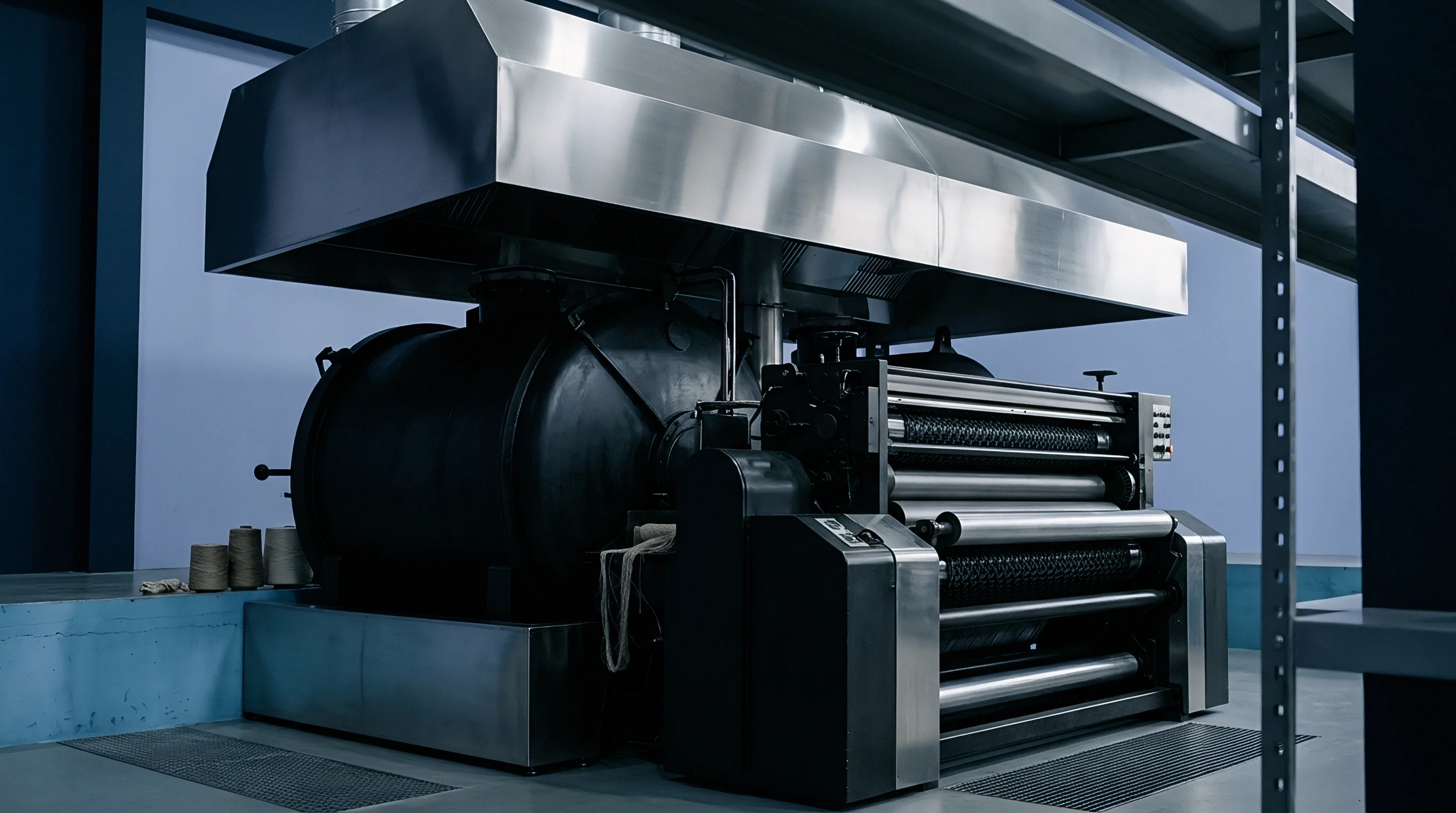
Shifts in Moisture Sorption Isotherms
Determining commercial weight requires precise isotherm curves calibrated to a lot’s chemical history. Non-scoured flax follows a standard Type II BET isotherm, whereas caustic scoured packages absorb more moisture at lower relative humidities because of monolayer sorption on newly exposed cellulose sites. At 35% relative humidity, scoured flax retains roughly 1.5% more moisture than greige fiber at thermal equilibrium.
Failing to account for this shift can lead buyers to reject incoming packages as over-conditioned when the material is merely displaying its modified chemical sorption capacity.
Commercial disputes often arise when storage conditions fluctuate in transit. High humidity causes scoured flax to absorb water vapor much faster than unrefined yarn, with exposed cell wall pores rapidly condensing capillary moisture above 80% relative humidity. When ambient humidity drops later on, hysteresis prevents the fiber from losing moisture at the same rate, leaving packages heavier at arrival than their dispatch certificates indicated.
Overlooking chemical changes in fiber sorption leads to miscalculated commercial mass, causing financial errors on invoices or operational failures in high-speed spinning.


Drying
Accurate verification of moisture regain relies on standardized gravimetric oven-drying methods. ISO 6741-1 establishes the testing procedure for determining the commercial mass of textile fiber shipments. Technicians take representative core samples from sealed package containers upon arrival and weigh them on calibrated analytical balances to record initial wet mass.
The samples then go into a ventilated oven operating at 105 degrees Celsius plus or minus 2 degrees, where drying continues until consecutive weighings at fifteen-minute intervals show less than 0.05% mass change.
Hot-stage weighing prevents atmospheric moisture re-absorption during testing. Standard ventilated drying ovens extract moisture by circulating heated air across the sample bed. Once absolute dry mass is reached, exposure to open air instantly pulls ambient humidity back into the porous cellulose.
Testing protocols therefore mandate weighing inside the closed oven chamber or transferring samples rapidly to sealed desiccators containing active silica gel or molecular sieves. A delay of thirty seconds in ambient air invalidates the dry mass reading.

Standardized Mass Determination Protocols
Commercial mass calculations adjust oven-dry mass using standard moisture regain allowances. International trade rules set the official commercial regain allowance for flax yarn at 12.00%, calculated by dividing oven-dry mass by 100 and multiplying by 112.00. This statutory figure frequently diverges from the actual equilibrium moisture of caustic scoured packages, and that gap between scoured regain and contractual allowance lies at the heart of trade weight reconciliation.
Corrections for non-aqueous volatile matter must complement oven drying. Caustic scoured yarns often retain residual processing oils, surfactants, or low-molecular-weight organic fragments that volatilize at 105 degrees Celsius. Standard oven drying records these losses as moisture, artificially inflating the calculated regain.
Solvent extraction with dichloromethane per ISO 3071 isolates non-water volatiles to prevent false moisture determinations in processed yarn packages.
Which Test Conditions Eliminate Residual Sodium Hydroxide Errors?
Residual caustic soda inside package cores alters thermal drying dynamics. Sodium hydroxide forms hydrates that hold bound water past the standard 105 degree drying threshold. Neutralization testing involves boiling 10 grams of fiber in 200 milliliters of distilled water, then measuring extract pH and titration.
Values above pH 7.8 indicate residual alkali, requiring correction factors in gravimetric formulas.
| Parameter / Condition | Greige Standard | Caustic Scoured Standard | Impact on Calculated Regain |
|---|---|---|---|
| Oven Temperature | 105 ± 2 °C | 105 ± 2 °C | Baseline thermal drying standard |
| Residual Alkali Level | < 0.05% NaOH | > 0.15% NaOH | Understates dry mass by bound water retention |
| Non-Cellulosic Ash Content | 1.20% to 1.80% | 0.30% to 0.60% | Alters baseline bone-dry matrix mass |
| Solvent Extractables | 1.50% natural wax | < 0.35% residual oil | Volatiles misclassified as moisture loss |
| Desiccator Cooling Time | 20 Minutes | 30 Minutes | Prevents thermal buoyancy balance errors |
Buoyancy forces inside high-temperature balances introduce weighing errors. Hot air rising from the sample vessel exerts an upward force on the balance pan, artificially reducing the apparent dry mass. Standard procedures require samples to cool in airtight desiccators to ambient room temperature before recording final figures, though automated oven balances with integrated airflow control can also eliminate convection currents during weighing.
Gravimetric dry mass determinations without solvent extraction overstate moisture content by misclassifying residual volatile processing agents as evaporated water.
Under International Confederation of Linen and Hemp rules, commercial mass calculations must apply certified laboratory oven-drying values using a fixed 12.00% regain allowance, regardless of atmospheric moisture levels measured on arrival.


Gradient
Wound flax packages introduce physical resistance to fluid flow during scouring. Yarn wound onto perforated plastic or stainless steel dye tubes forms a package with varying density across its radius. Inner layers next to the core tube experience higher winding tension and fluid pressure during circulation, while outer layers expand more freely into the bath.
This density gradient results in uneven chemical exposure, irregular pectin removal, and variable moisture regain across the package.
Liquor circulation alternates during scouring cycles, with pumps forcing caustic solution inside-out and outside-in through package walls. Inside-out flow exposes core layers to maximum fluid pressure and fresh chemical concentrations. As liquor moves outward, reactant strength drops while dissolved pectins build up in the stream.
Core yarns consequently undergo deeper scouring, higher wax extraction, and greater hydroxyl exposure than peripheral yarns on the same cone.

Density Differential across Wound Package Radii
Package density governs fluid retention and drying uniformity. Cross-wound flax packages typically target a winding density of 0.32 to 0.38 grams per cubic centimeter, but tension fluctuations create localized high-density zones exceeding 0.42 grams per cubic centimeter. These dense zones restrict caustic penetration, leaving patches of unscoured, hydrophobic fiber surrounded by fully hydrophilic, low-density yarn.
Hydroextraction does not remove water uniformly from dense package centers. Centrifugal extractors and radio-frequency dryers pull moisture from outer surfaces faster than internal vapor can migrate outward, establishing a steep moisture gradient. Core yarns may retain 22% moisture while outer layers dry to 8%.
Although ambient conditioning eventually evens out this distribution, early sampling yields severe regain deviations depending on sample depth.
- Core Channeling creates preferential chemical bypass routes, leaving dense package zones partially scoured and hydrophobic.
- Differential Shrinkage restricts liquor flow near the tube surface as inner yarn layers contract tightly under hot caustic alkali.
- Thermal Layering retards moisture evaporation from package centers during radio-frequency drying, establishing stable internal wet spots.
- Solute Migration draws dissolved salts outward toward the package surface during thermal drying, concentrating residual alkalinity on exterior yarn layers.
Cross-wound package density variations generate internal moisture differentials up to six percentage points between core and outer yarn layers prior to long-term atmospheric conditioning.
Sampling location determines testing accuracy. Taking swatches only from outer wrappings records artificially low regain values if hydroextraction over-dried the exterior. Slicing through the entire package wall to extract radial wedge samples ensures representative moisture data, whereas partial sampling leads directly to commercial disputes over conditioning compliance.
Package-to-package weight variances are often attributed to atmospheric absorption during transport, though internal moisture density gradients from core hydroextraction bottlenecks play an equal role.


Invoice
Commercial reconciliation aligns physical invoice weights with legally enforceable standard mass values. Flax yarn is bought on invoice mass derived from oven-dry weight plus official regain allowances. Sellers weigh packages right after drying and conditioning to invoice based on net scale weight, while buyers re-weigh shipments at destination ports to verify delivered mass.
Temperature and humidity shifts during ocean transport alter physical package weights, producing invoice variances that require systematic mathematical reconciliation.
Calculating commercial mass relies on applying standard formulas to lab test results. The primary equation balances scale weight, tested moisture content, and statutory regain allowances to ensure invoices reflect actual dry fiber delivered rather than absorbed atmospheric water.

Commercial Mass Calculation Mechanics
Reconciliation begins with determining the dry fiber mass of a lot. Lab testing provides the moisture percentage from representative package samples, which converts net dock weight into total oven-dry mass. Contractual commercial mass is then calculated by applying the statutory 12.00% regain allowance to that dry figure.

Worked Scoured Package Reconciliation
Consider a commercial shipment of 10,000 kilograms net scale weight of caustic scoured flax yarn arriving at a receiving warehouse. Destination testing reveals an average moisture regain of 14.50% following damp ocean transport, compared to the contractual standard allowance of 12.00%. The reconciliation calculation proceeds as follows:
- Determine the current total oven-dry mass of the incoming lot: Oven-Dry Mass = Net Scale Mass / (1 + (Tested Regain / 100)) Oven-Dry Mass = 10,000 kg / (1 + (14.50 / 100)) = 10,000 kg / 1.1450 = 8,733.62 kg bone-dry fiber.
- Calculate the contractual Commercial Mass using the statutory 12.00% allowance: Commercial Mass = Oven-Dry Mass x (1 + (Standard Regain / 100)) Commercial Mass = 8,733.62 kg x (1 + (12.00 / 100)) = 8,733.62 kg x 1.1200 = 9,781.65 kg billable mass.
- Calculate the financial adjustment required against the seller’s initial scale invoice: Billable Difference = Net Scale Mass – Commercial Mass Billable Difference = 10,000.00 kg – 9,781.65 kg = 218.35 kg overcharge.
The buyer then issues a debit note for 218.35 kilograms multiplied by the agreed price per kilogram, preventing payment for excess water absorbed above the contractual limit.
| Shipment Net Scale Mass | Tested Moisture Regain | Calculated Dry Mass | Contractual Commercial Mass (12%) | Invoice Adjustment Value |
|---|---|---|---|---|
| 5,000 kg | 13.00% | 4,424.78 kg | 4,955.75 kg | -$663.75 |
| 10,000 kg | 14.50% | 8,733.62 kg | 9,781.65 kg | -$3,275.25 |
| 20,000 kg | 11.00% | 18,018.02 kg | 20,180.18 kg | +$2,702.70 |
| 50,000 kg | 15.20% | 43,402.78 kg | 48,611.11 kg | -$20,833.35 |
Customs duties and import tariffs depend directly on correct mass reconciliation. Because duty assessments apply to declared weight, over-declaring mass due to excess moisture leads to overpaying tariffs at the border. Submitting audited gravimetric lab reports alongside customs declarations adjusts the tariff base to official commercial mass, lowering overall landed costs.
Contractual commercial mass reconciliation adjusts physical shipment weight to dry fiber mass plus standard allowance, eliminating water weight overcharges from landed material costs.
Commercial mass adjustments apply symmetrically to under-conditioned and over-conditioned shipments alike.


Audit
Documenting package provenance and conditioning logs ensures transparency across supply chains. Auditing scoured flax lots requires matching mill floor records against laboratory test reports and shipping documentation. An unbroken record chain verifies that received fiber matches the scouring intensity, yarn count, and weight metrics listed on commercial certificates.
Gaps occur when mills mix scoured lots with differing residual alkali or pectin levels, corrupting lot-wide moisture standards.
Tare mass verification forms the foundation of physical weight auditing. Wound yarn packages use internal cores made of extruded polypropylene, stainless steel, paper, or cardboard. While plastic dye tubes absorb negligible moisture, paper cores take up ambient humidity rapidly.
Auditors verify tare weights by stripping yarn from sample packages, baking the core tubes to absolute dry mass, and weighing them independently. Relying on assumed or average core weights introduces systematic errors into net fiber calculations.

Verification of Tare Mass and Ambient Conditioning Logs
Spinning mills maintain continuous humidity and temperature tracking within conditioning areas. Environmental logs verify that packages achieved equilibrium before final cartoning and weighbridge certification. Standard conditioning requires exposure to moving air at 20 degrees Celsius and 65% relative humidity for at least 48 hours; sudden humidity spikes or shortened conditioning times signal potential moisture imbalances across the lot.
Auditors review third-party laboratory accreditations to confirm test validity. ISO 17025 accreditation ensures that facilities maintain calibrated drying ovens, certified balances, and climate-controlled conditioning rooms. While scope certificates under European Flax or Masters of Linen frameworks document physical chain-of-custody, moisture compliance relies on accredited chemical verification.
Auditing analysis certificates involves checking scope validity, sampling dates, and tracking codes against container bills of lading.
- Tare Calibration checks actual physical core tube weights against mill declarations to prevent structural core mass from distorting net yarn weight.
- Conditioning Vault Logs confirm continuous 48-hour climate control compliance before final export packaging.
- Chemical Residue Analysis verifies residual alkali levels below 0.10% to prevent chemical hyper-reactivity to ambient atmospheric humidity.
- Cross-Dock Weighbridge Audits validate net scale weights at origin port exit against receiving dock entry figures.
Discrepancies in moisture regain claims trigger formal dispute resolution protocols defined in international yarn contracts. Independent accredited laboratories draw split-control samples from disputed shipments held in neutral bonded warehouses. Tests conducted under joint supervision establish final binding figures for commercial invoice adjustment, eliminating speculative arguments and anchoring financial settlements in verifiable gravimetric science.
How do subtle changes in industrial caustic rinsing temperatures alter the long-term equilibrium moisture regain hysteresis curve during extended cross-border transit?