Gravimetric Mass Measurement Methods for Scutched Flax Fibres
Verify dry mass through oven desiccation at 105C and apply a 12% moisture regain formula to protect mill yield and block transit water charges.

Tare
Bale moisture content and packaging tare determine whether an invoice pays for dry cellulose or wet transit air. Scutched flax arrives from the scutching turbine as untangled parallel stricks gathered into pressed bales, typically wrapped in polypropylene sheeting or bare-tied with sisal twine. The commercial mass of each bale rests on gravimetric determination under standard atmospheric conditions, defined by ISO 6741 as an oven-dry state corrected by the official moisture regain allowance of 12.00 percent.
Water evaporates under ventilation, whereas bound cellular moisture responds strictly to relative humidity and ambient temperature.
A shipping lot of 20 metric tons of long-line flax carries significant financial exposure in moisture variance alone. Mills that skip tare verification at bale intake absorb transit moisture swings directly into their raw material expenditure. If a delivery of 100 bales weighing 20,000 kg gross is billed at 14.50 percent moisture content against the commercial baseline of 12.00 percent, the purchasing balance pays for 440 kg of water billed as scutched line fibre.
At a prevailing European spot value of 4.80 EUR per kilogram for grade 4 long-line scutched dew-retted flax, that deviation extracts 2,112 EUR per truckload in unrecoverable inventory loss.
A commercial regain contract of 12.00 percent mandates that certified dry weight governs final settlement.
Direct gravimetric determination of whole bales requires calibrated platform scales with a minimum verification scale interval of 0.1 kg. The gross mass is recorded immediately upon container destuffing. Inspectors strip the strapping, plastic films, corner boards, and timber pallets to establish the actual tare mass of each unit.
Calculated tare estimates based on vendor packing slips introduce systematic positive errors: strapping tension degrades during sea voyages, moisture collects in corrugated liners, and stretch film picks up warehouse debris. Gross mass minus true physical tare establishes the net delivered mass of raw flax stricks before atmospheric moisture correction takes place.
The gross weight registered on intake dockets varies dynamically across seasonal deliveries. Scutched fibre dispatched from storage warehouses in Normandy during damp winter months frequently arrives at coastal spinning mills carrying moisture contents exceeding 15.00 percent. The identical fibre class shipped during July dry periods registers moisture contents below 10.50 percent.
When accounting records treat net intake mass as an invariant dry figure, the spinning mill distorts its raw material cost basis, hackling efficiency projections, and financial yield metrics across every operating quarter.
Contracts that permit suppliers to bill across nominal bale weights without mandatory tare weighing generate constant administrative friction during year-end inventory reconciliations.

Desiccation
Oven drying provides the absolute benchmark for separating moisture mass from dry bast matter. Secondary methods such as electrical resistance probes, capacitive moisture meters, and microwave attenuation scanners provide convenient speed, yet their electronic calibrations drift when confronted with variable retting depths, uneven shive loads, and fluctuating mineral salt concentrations. Gravimetric desiccation procedures enforce precision through controlled thermal dehydration inside ventilated ovens operating at 105 degrees Celsius plus or minus 2 degrees, in conformance with ISO 6741-1.
The measured mass loss between the unconditioned sample and the anhydrous residue defines the moisture content of the fibre bundle.

Sampling Stricks across the Bale Core
Taking test specimens from the outer surface of a compressed flax bale produces heavily skewed results. Ambient humidity alters surface layers within hours of container opening, while the dense interior core retains shipping moisture for several weeks. Reliable sampling extracts fibre tufts from multiple depths across the bale matrix.
The technician inserts a core sampling probe or splits the bale manually to pull representative stricks from three distinct strata: 50 mm below the top wrap, the exact geometric center, and 50 mm above the base pallet.
Ten composite samples of 100 grams each are pulled across every five-bale sampling increment. These subsamples undergo gross mechanical blending by hand, shaking loose unattached shive dust and ambient sand before splitting into duplicate laboratory test specimens of 50.000 grams. Analytical balances used for this stage operate inside controlled weighing enclosures with a display resolution of 0.001 g.
Specimen transfer from bale to balance occurs inside hermetically sealed containers to halt ambient water exchange during transit between warehouse and laboratory benches.
Drying Kinetics and Constant Mass Criteria
Flax fibres do not release water linearly. Free surface water flashes off within the opening twenty minutes of thermal exposure, while bound water held in inter-microfibrillar hemicellulose matrices desorbs slowly under thermal agitation. Rapid dehydration cycles above 110 degrees Celsius induce cellulose degradation, releasing volatile organic matter and decomposing pectin polymers into gaseous byproducts.
This pyrolytic mass loss falsely inflates the recorded moisture percentage, masking true fibre yield behind volatile decomposition.
The drying routine subjects specimens to forced convection air exchanges at 105 degrees Celsius. Weighing cycles recur every 15 minutes after an initial two-hour thermal soak. ISO 6741 dictates that constant mass is reached when two consecutive weighings, separated by a 15-minute heating interval, do not differ by more than 0.05 percent of the specimen mass.
Analytical scales mounted inside the oven envelope or equipped with high-speed sample extraction carousels prevent specimen re-absorption of ambient water vapor during measurement steps. Dried flax cellulose acts as a vigorous desiccant: open-air transfers drop accuracy within three seconds of ambient contact.
| Lot Designation | Initial Mass (g) | 120 Min Mass (g) | 135 Min Mass (g) | Constant Mass (g) | Moisture Content (%) | Moisture Regain (%) |
|---|---|---|---|---|---|---|
| Lot A-44 Line | 50.024 | 44.112 | 44.095 | 44.090 | 11.86 | 13.46 |
| Lot A-52 Line | 50.018 | 43.210 | 43.165 | 43.160 | 13.71 | 15.89 |
| Lot B-19 Tow | 50.031 | 44.825 | 44.790 | 44.785 | 10.49 | 11.71 |
| Lot C-08 Line | 50.020 | 42.618 | 42.550 | 42.545 | 14.94 | 17.57 |
Moisture content and moisture regain express two distinct mathematical realities. Moisture content measures the mass of water as a percentage of the original moist material mass. Moisture regain measures the mass of water as a percentage of the anhydrous oven-dry material mass.
The commercial settlement arithmetic relies exclusively on moisture regain. The formula defines commercial mass as oven-dry mass multiplied by the sum of 100 plus official regain, divided by 100.
Commercial invoices that report raw percentage moisture loss directly in the commercial invoice line instead of converting through the standard regain equation create a structural variance of over 1.50 percent in final invoiced mass.


Fineness
Bundle linear density, expressed in tex, determines the drafting limits and yarn counts achievable in the wet-spinning room. Scutched flax differs from cotton or synthesized filaments: it does not possess an invariant single-fibre cross-section. Flax fibres exist within the plant stem as composite bundles cemented together by calcium pectate and hemicellulosic matrices.
Gravimetric linear density measurements capture the mass-to-length ratio of these composite strands, quantifying the technical fineness attained through field retting and turbine scutching before mechanical hackling begins.

Bundle Preparation and Parallelization
Gravimetric fineness assessment adheres to ISO 2370. The laboratory technician extracts parallelized fibre ribbons from the mid-span of conditioned scutched stricks. A precise comb with hardened steel pins set at 1-millimeter pitches removes loose tow fibres, unreted bark fragments, and broken cortical tissue.
Operators align the bundle along a velvet board, smoothing out crimp with light manual tension that does not exceed 5 centinewtons.
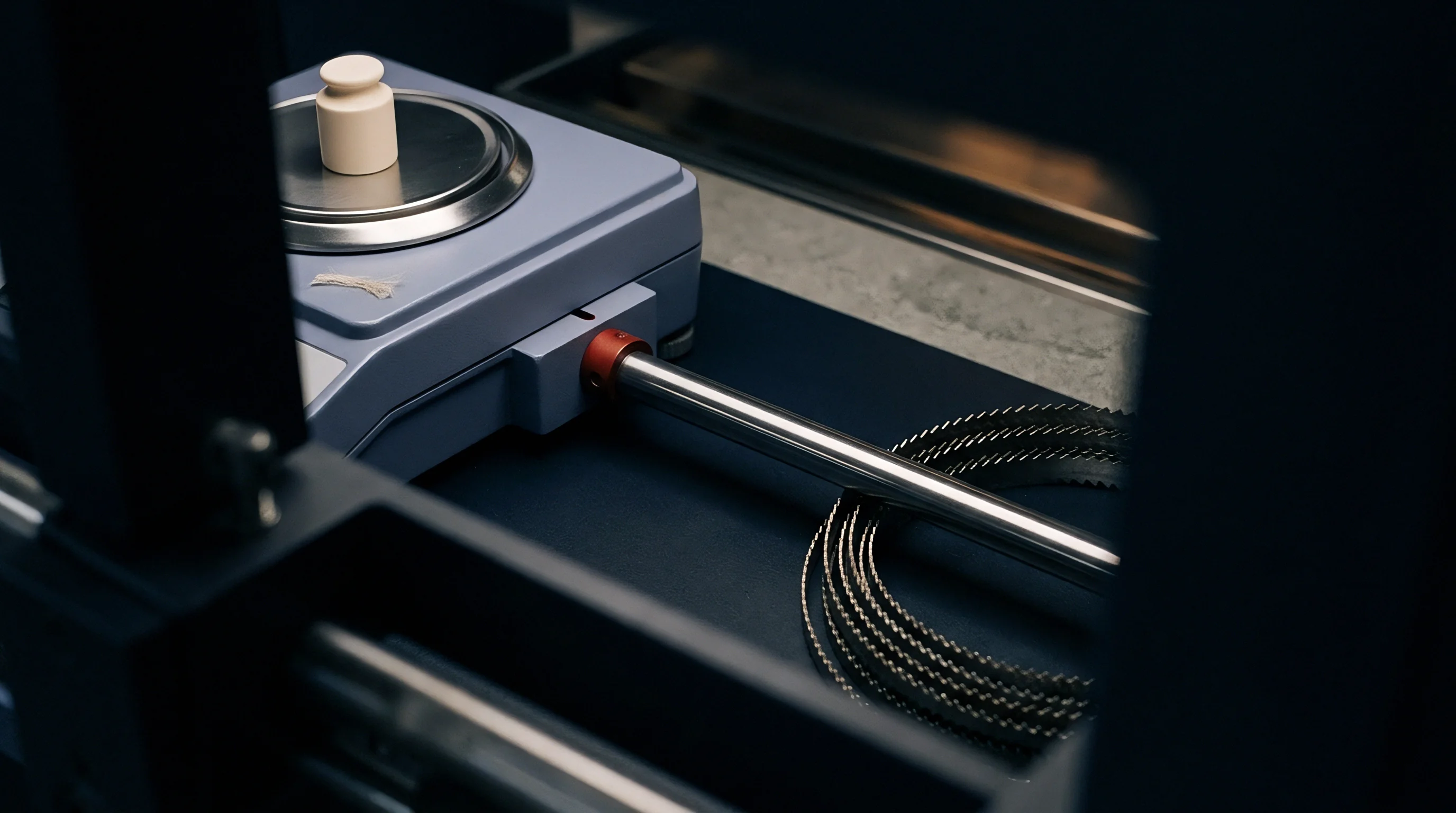
The central zone of the straightened bundle is clamped inside a dual-blade cutter block. The parallel cutting blades, manufactured from tungsten carbide with calibrated ground spacers, sever the fibres at an exact span of 50.00 millimeters. Technicians discard the severed ends, retaining the central span of absolute length.
This cut section must contain zero broken, bent, or unaligned filaments, as misaligned fibres increase mass without spanning the full gauge, distorting the linear density calculation.
Count Economics and Drafting Boundaries
The cut bundle is split into test tufts weighing between 5 and 15 milligrams. An analytical microbalance with a verification scale interval of 0.001 mg records the mass of each tuft. Technicians then count the individual fibre filaments under a stereo microscope equipped with fine tweezers, separating technical bundles into their constituent units.
Linear density calculates directly as tuft mass divided by the cumulative length of all counted fibres within that specific specimen.
Finer scutched bundles carry lower tex values, directly yielding higher metric yarn counts (Nm) during wet spinning. Coarse scutched line flax evaluating at 2.80 tex restricts ring spinning frames to maximum yarn counts around Nm 26. High-grade scutched bundles testing at 1.40 tex allow stable drafting down to Nm 60 without excessive end-breakage rates.
In fine line wet-spinning, breakages on the frame cost both lost production time and human intervention hours, raising spinning room operating costs by as much as 0.18 EUR per spindle hour.
Drafting stability on wet-spinning frames breaks down when bundle fineness exceeds two tex at counts above metric forty.
Bundle fineness also dictates hackling machine yield. Coarser scutched bundles resist progressive comb pins during industrial hackling, shattering into short tow fibres instead of dividing into fine line slivers. A lot exhibiting poor gravimetric fineness will shift hackling yield downward: line flax recovery falls from an expected 55 percent down to 42 percent, inflating the mass of low-value hackling tow produced at the line head.
The commercial impact reflects in the raw material cost per kilogram of hackled line sliver entering the drawing frames.
If bundle count numbers fall short of laboratory verification, the mill faces reduced machine speeds and excessive roving waste before producing a single kilogram of salable yarn.
Shive
Non-cellulosic woody core fragments, designated as shive, represent dead mass that lowers spinning yield and creates thick defect nodes on the ring rail. Scutching machines break the inner woody core of the flax straw and beat it away using rotating bladed scutching wheels. Incomplete scutching leaves residual shive adhering tenaciously to the bast bundles, pinned by unhydrolyzed pectin bonds.
Evaluating shive mass gravimetrically separates actual spinning potential from unspinnable vegetative debris.

Can Gravimetric Sorting Isolate Shive Contamination Accurately?
Mechanical screening devices separate shive from scutched bundles by physical agitation, though rigorous gravimetric confirmation demands manual sorting to isolate microscopic bark inclusions. A gross sample of 500 grams of scutched flax undergoes systematic manual inspection on an illuminated examination bench. Technicians strip every visible woody particle, epidermis fragment, and cuticle flake using precision laboratory forceps, depositing the non-fibre fractions into closed weighing bottles.
The extraction process groups shive particles into three defined size classes based on mesh interception: coarse shive exceeding 5 mm in length, medium shive spanning 2 to 5 mm, and dust-like epidermal fragments below 2 mm. The cumulative dry mass of all sorted fractions divided by the starting gross mass of the test bundle gives the absolute shive contamination percentage. The test is executed at standard atmosphere: 20 degrees Celsius plus or minus 2 degrees, and 65 percent relative humidity plus or minus 4 percent.
High shive loads alter both processing behavior and commercial value across industrial preparation stages:
- Coarse woody fragments jam gill box faller pins during initial drawing, forcing line stoppages and bending expensive pin fields.
- Adhering cortical scales survive chemical boiling and peroxide bleaching stages, generating dark speck defects across natural woven canvas.
- Epidermal cellular debris disrupts spinning triangle cohesion in the wet-spinning trough, causing immediate roving breaks at the delivery roller nip.
- Excessive unseparated bark forces aggressive hackling pin schedules, lowering line yield by converting premium long fibres into cheap carding tow.
The mechanical removal of shive generates mass loss that must be integrated into inventory calculations. A scutched lot containing 4.50 percent gravimetric shive delivers only 955 kg of net fibrous bast matter for every 1,000 kg received. When purchasing offices pay line flax prices for unremoved core fragments, the effective price of the spinnable fibre increases proportionately before hackling machines even engage.
A four percent shive contamination rate elevates the effective cost of spinnable long line by exactly four point one seven percent before hackling loss.
Processing waste calculations frequently omit the energy cost of running air filtration networks to pull shive particulate out of carding zones. Fine shive particles broken down by drawing fallers settle inside mechanical gear casings and load suction nozzles, compounding maintenance downtime. Gravimetric verification of shive content establishes a strict barrier against paying premium fiber prices for under-scutched straw.
The supplier provides no settlement adjustments once uncleaned bundles pass uninspected into the opening line blending hoppers.
Insolubles
Scutched flax bundles consist of more than pure alpha-cellulose: they contain hemicellulose, lignin, pectin complexes, waxes, and embedded mineral dust collected during dew retting. Industrial bleaching, scouring, and wet-spinning processes extract non-cellulosic components through hot water dissolution and alkaline saponification. Gravimetric chemical extraction measures this mass differential directly, determining the exact proportion of permanent cellulose versus temporary binding matrices.
Solvent and Aqueous Extraction Procedures
The analytical determination begins with Soxhlet solvent extraction to quantify surface waxes and lipophilic oils. A conditioned 10.000 g specimen of scutched flax is placed inside a porous cellulose extraction thimble. Extraction runs for four hours using petroleum ether or toluene-ethanol mixtures at a cycle rate of six siphons per hour.
The solvent flask is then dried at 105 degrees Celsius and weighed to a tolerance of 0.0001 g. The accumulated greasy residue quantifies the wax fraction, which typically registers between 1.20 and 2.50 percent in sound dew-retted European flax.
Following solvent extraction, the dewaxed residue undergoes boiling water extraction to desorb water-soluble pectins and free sugars. Specimens boil in distilled water under reflux for two hours at a liquor ratio of 50 to 1. The solution is filtered through a pre-weighed, sintered glass crucibles with a porosity rating of 16 to 40 microns.
The dried fibrous residue provides the net dry matter mass, identifying what percentage of the scutched fibre will naturally survive exposure to the wet-spinning trough.
| Chemical Treatment Stage | Reagent Chemistry | Process Duration | Temperature (°C) | Mass Loss Range (%) | Target Extraction Component |
|---|---|---|---|---|---|
| Solvent Extraction | Toluene-Ethanol (1:2) | 4 Hours | 85 | 1.20 – 2.40 | Surface waxes, fats, lipophilic terpenes |
| Aqueous Desorption | Distilled Water | 2 Hours | 100 | 2.80 – 5.10 | Water-soluble gums, free monosaccharides |
| Chelating Extraction | 0.05 M Ammonium Oxalate | 2 Hours | 80 | 3.50 – 6.20 | Calcium pectate, intercellular middle lamella |
| Caustic Delignification | 1.0% Sodium Hydroxide | 1 Hour | 100 | 4.10 – 7.80 | Alkali-soluble hemicellulose, residual lignin |
The cumulative mass loss across these four analytical extraction regimes defines the total soluble loading of the scutched fibre. Dew-retted flax typically surrenders between 12.00 and 21.00 percent of its total starting dry mass when subjected to complete wet preparation. Under-retted fibre exhibits elevated ammonium oxalate and sodium hydroxide extraction losses, proving that mechanical scutching was forced against stems whose pectins were never degraded by fungal pectinases.
Excessive pectin retention stiffens the fibre bundles, elevating mechanical drafting force inside drawing heads. In wet spinning, hot water within the trough dissolves these residual pectins during yarn attenuation. If the dissolved solid load in the spinning bath rises unchecked, the liquor turns viscous and discolors yarn roving, lowering winding speeds and staining package surfaces.
Gravimetric extraction numbers warn the spinning master whether chemical wetting agents in the trough must be elevated to handle refractory pectins.
Oils and waxy lipids perform a distinct lubricating role on dry-spinning systems. Dewaxed bundles exhibit dry inter-fibre friction coefficients exceeding 0.45, generating severe static charges and bundle breakage across cards and draw frames. Gravimetric checks prevent sourcing departments from buying over-retted or chemical-washed scutched lots stripped of the endogenous waxes required for smooth ring-rail drafting.
Failure to establish extraction baselines leaves the plant manager helpless when spinning-line roving mass fluctuates across incoming lots without mechanical changes to draft gearing.

Settlement
A purchase order specifies the mass of long-line flax, but invoices settle on absolute dry matter adjusted to standard moisture regain. Without strict gravimetric reconciliation protocols, a spinning mill inevitably buys water, dirt, and combustible shive at prime long-line prices. Commercial reconciliation converts raw platform weight tickets into legal settlement weight using standardized moisture and non-fibre deduction parameters.

Invoice Mass Adjustment Calculations
Commercial settlement mass calculations apply the formula stipulated by the European flax trade: Commercial Mass equals Net Delivered Mass multiplied by 112, divided by the sum of 100 plus Certified Moisture Regain. If external testing verifies certified regain below the 12.00 percent allowance, the buyer issues a credit note to the supplier. If the certified regain exceeds 12.00 percent, the billed weight must be marked down to the commercial equivalence line.
Consider a practical purchasing construction: a contract calls for 50,000 kg of grade 4 scutched long-line flax at an agreed price of 5.10 EUR per kg, delivered terms to mill. The platform scale confirms gross delivered weight at 51,200 kg. Tare weighing of pallets, straps, and wraps records 1,100 kg, leaving a net physical mass of 50,100 kg.
Laboratory core testing establishes an average moisture regain of 14.80 percent alongside a gravimetric shive load of 3.80 percent, against a contractually guaranteed maximum shive allowance of 2.00 percent.
The standard commercial moisture correction scales the net mass down to its allowable regain volume:
- The net mass of 50,100 kg is divided by 1.148, establishing the true oven-dry cellulose mass at 43,641.11 kg.
- The oven-dry mass is multiplied by the legal regain factor of 1.120, yielding an adjusted commercial mass of 48,878.04 kg.
- The shive contamination penalty is applied: excess shive of 1.80 percent deducts an additional 901.80 kg from invoiceable material mass.
- Final billable mass settles at 47,976.24 kg, reducing the initial invoice by 2,123.76 kg.
The adjustment preserves 10,831.18 EUR in working capital on a single delivery. Without verified laboratory certificates, that financial variance leaks silently into spinning overhead. When hackling machines convert this wet, shive-heavy lot into line sliver, hackling line yield drops from an estimated 52 percent to an actual 44 percent.
The realized price per kilogram of hackled line sliver climbs from a projected 9.80 EUR up to 11.59 EUR per kilogram, eliminating the operating margin on downstream yarn contracts.
A standard woven fabric contract weighing 180 grams per square meter requires 0.21 kg of line yarn per finished linear meter. When line sliver prices climb by 1.79 EUR per kilogram due to uncorrected moisture and shive losses, the raw fibre cost of the finished fabric rises by 0.38 EUR per meter. On a seasonal volume run of 200,000 meters, failure to execute intake gravimetric checks costs the enterprise 76,000 EUR in unrecoverable cloth margins.
A commercial linen contract that lacks dry weight conversion terms forfeits all legal grounds for moisture debits.
Intake quality auditors preserve mill profitability by applying these measurement steps directly to receiving manifests. When suppliers contest deduction figures, verified desiccation coupons, sealed shive vials, and microbalance weight dockets provide legally binding proof that withstands trade arbitration panels. Laboratory precision on the gravimetric bench dictates financial success inside the weaving shed.
Trading contracts governed by international flax arbitration rules dismiss all post-spinning quality claims if incoming bales were mixed into the raw inventory pool without prior independent moisture certification.