Modifying Flax Tenacity Thresholds under Climate Degradation
Modifying flax tenacity thresholds requires lowering spinning count limits, adjusting wet draft bath temperatures, and applying graduated invoice discounts.


Rupture
Drought during rapid stem elongation cuts short secondary cell wall synthesis in flax bast. When temperatures climb above thirty-two degrees Celsius, cellulose synthase complexes along the stalk stall. Bast fibres formed under these conditions show uneven secondary thickening, lower degree of polymerization, and marked loss of tenacity.
Historically, Western European dew-retted straw yielded long-line bundles testing between 52 and 65 centinewtons per tex under standard conditions. Repeated heat waves and sustained field drought pull those values down to between 34 and 44 centinewtons per tex. Spinning mill laboratories now routinely receive hackled line lots that sit well below customary acceptance baselines yet make up most of the crop.
Bundle tenacity depends on both the elementary fibres and the pectin-rich middle lamella cementing them together, and heat affects both at once. In elementary flax cells, cellulose microfibrils typically run at an angle of eight to eleven degrees off the fibre axis. Accelerated maturation under drought triggers early lignification, pushing the microfibrillar spiral angle out toward fourteen degrees.
That wider angle weakens tensile efficiency under axial load: fibres slip early and cleave cleanly at much lower breaking forces.
Under sixty-five percent relative humidity and twenty degrees Celsius, drought-affected scutched line bundles record an average tensile drop of seventeen centinewtons per tex across thirty consecutive breaks.
Dry summer conditions also disrupt the retting cycle. Dew retting relies on night condensation and saprophytic fungi to break down calcium polygalacturonate in the middle lamella. Hot, dry winds stop colonization, leaving the straw parched before enzymes can act evenly.
When rain finally falls in sudden storms, opportunistic bacteria take over the stems irregularly. Outer layers over-ret and lose cellulose strength, while the inner bundles stay glued to the woody shive.
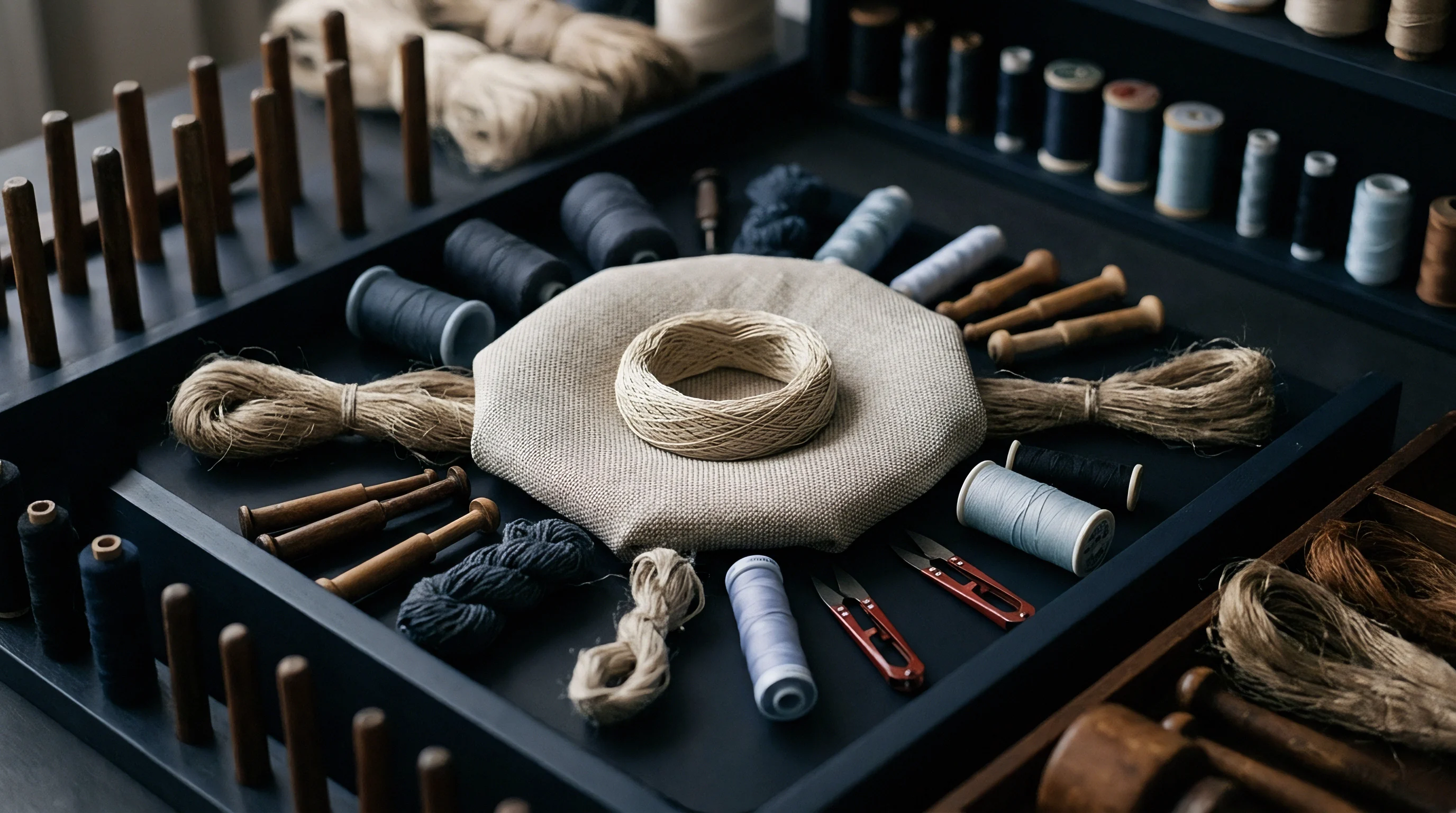
Seasonal Retting Variations in Bast Bundles
The resulting hackled sliver shows wide swings in bundle strength. Where conventional dew-retted line held tenacity variation below twelve percent, climate-stressed crops yield spreads between eighteen and twenty-six percent within single harvest lots. One bundle can test at fifty centinewtons per tex while the next from the same scutching lot breaks at twenty-eight centinewtons per tex.
Fed into standard gill drawing heads, this raw fibre fractures under the pins, flooding the drafting zone with floating short fibres.
Spinning mills operating on legacy purchase contracts struggle to enforce tenacity minimums during widespread drought seasons. The sub-forty centinewton values stem from regional atmospheric moisture deficits rather than baling negligence.


Clamp
Assessing damaged bast fibre tenacity requires separating true bundle strength from friction between adjacent filaments. Clamping geometry is critical on both Stelometer jaws and modern electronic tensile frames. ISO 3060 sets the bundle tenacity gauge length at 3.2 millimetres; ISO 5079 governs single elementary fibres.
Testing degraded flax at zero gauge length produces falsely elevated figures because the fibres wedge and bind against one another. Inserting the standard 3.2 millimetre spacer exposes the underlying damage, letting shear stresses work on cell wall dislocations and cross cracks.
| Fibre Growth Condition | Mean Tenacity (cN/tex) | Elongation at Break (%) | Dislocation Density (per mm) | Hackling Yield (%) | Work of Rupture (mJ/tex) |
|---|---|---|---|---|---|
| Temperate Baseline (2014-2018 Mean) | 56.4 | 2.8 | 4.2 | 48.5 | 0.82 |
| Moderate Water Deficit (Late Stem Elongation) | 44.1 | 2.1 | 8.6 | 41.2 | 0.48 |
| Severe Thermal Spike (Flowering Stage >33°C) | 36.8 | 1.7 | 13.4 | 34.0 | 0.31 |
| Desiccation with Erratic Dew Retting | 32.5 | 1.5 | 17.1 | 29.5 | 0.24 |
Clamp design directly skews test results. Rubber-lined pneumatic jaws conform across uneven bundle thicknesses, preventing edge pinching. Serrated steel faces cut straight into brittle bast bundles and induce premature shear failure.
Pressure needs to sit strictly between 0.6 and 0.8 megapascals. Excessive clamping pressure collapses the hollow lumens of degraded fibres, creating stress-concentration points where fractures start; low pressure lets fibres slip, which artificially stretches out the strain trace.
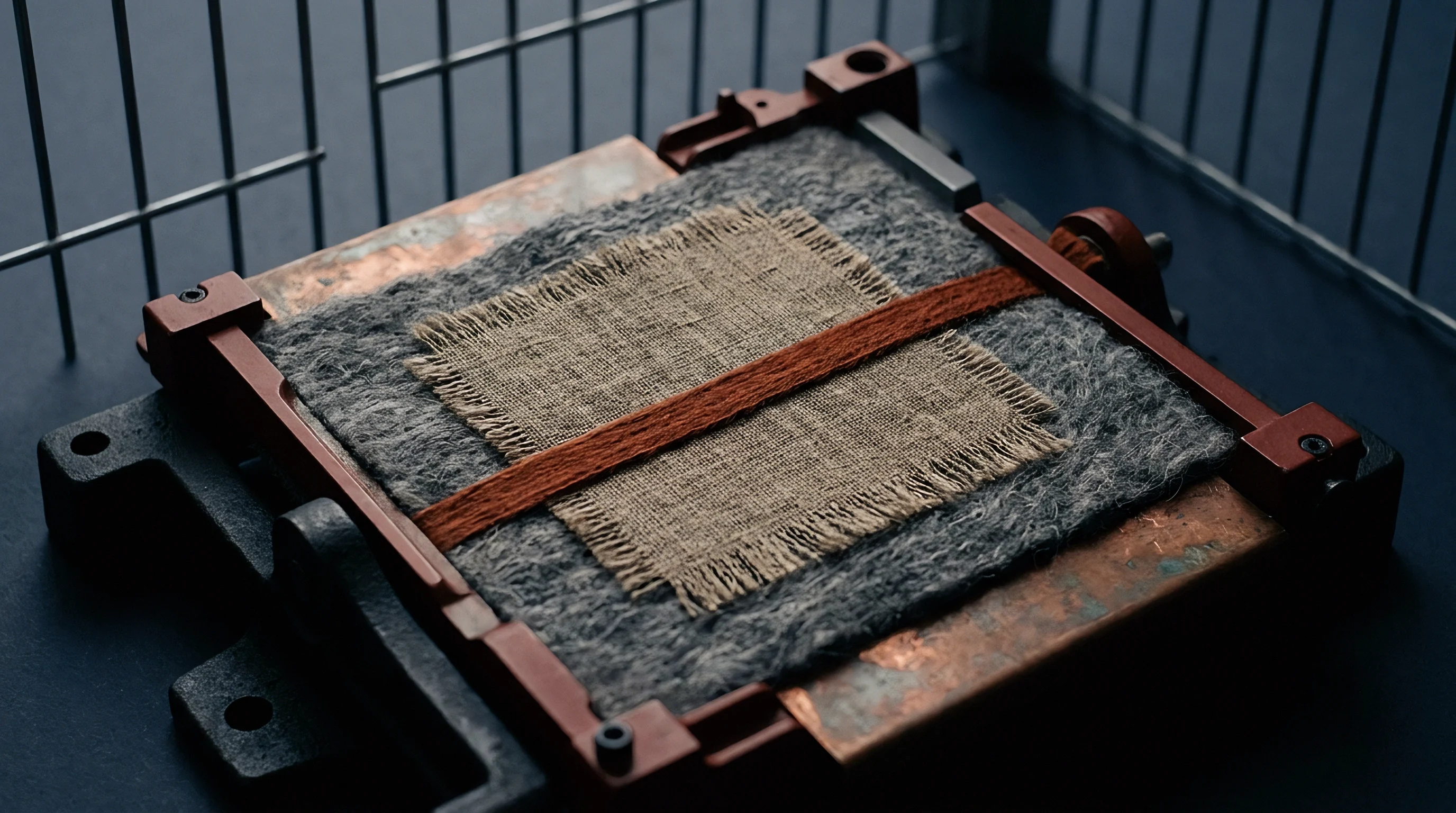
Could Reduced Gauge Lengths Mask Fibre Embrittlement?
A zero-gauge setup hides the microstructural damage caused by heat and water stress. With the jaws touching, the instrument records local wall shear instead of overall fibril alignment, leaving transverse kink bands invisible. Testing the same lots at a ten-millimetre gauge length on single-fibre automated instruments shows the full drop in tenacity: drought-stressed fibres record a sixty percent reduction in work of rupture compared to temperate reference samples.
The gap confirms that heat stress seeds dislocation nodes right along the stem.
Single-fibre testing systems determine linear density by vibroscopic resonance under ISO 1973 before applying tensile load. Degraded fibres vary widely in cross-section along their length, and a single localized constriction can throw off the linear density value and distort the resulting centinewtons per tex calculation. Taking several linear density readings across each five-centimetre test specimen averages out local thinning before testing begins.
- Vibroscopic resonance calibration eliminates mass distribution errors along irregularly thickened elementary fibres prior to tensile loading.
- Pneumatic clamp cushioning isolates the test bundle from mechanical crushing forces across the steel jaw boundary.
- Pre-tension leveling weights remove crimp slack without inducing premature plastic strain in brittle bast structures.
- Constant rate of extension drives maintain precise strain velocities of twenty millimetres per minute during elongation.
Incoming fibre lots require conditioning for forty-eight hours in standard atmosphere. Moisture regain usually sits between seven and twelve percent, but heat-stressed cell walls exhibit irregular porosity that binds moisture unpredictably through dry-spun and wet-spun lines.
Contractual dispute settlements adhere to ISO 3060 methods, invalidating raw test dockets that omit jaw face cushion specifications.
Commercial contracts citing ASTM D1445 commonly specify that lots testing between 38 and 42 centinewtons per tex face a seven percent base-price deduction rather than rejection at the warehouse door.
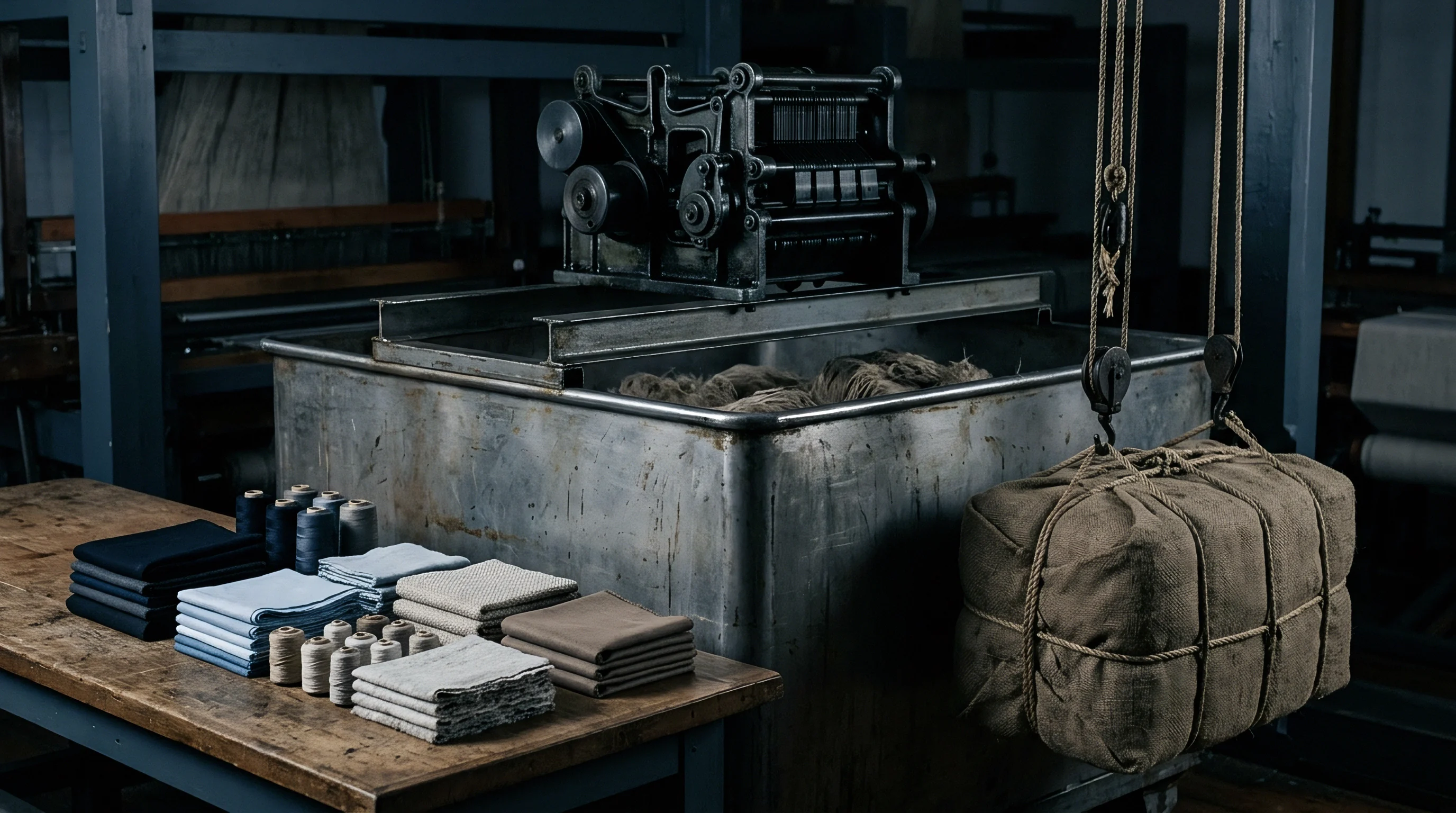

Lumen
Linen yarn quality depends fundamentally on the cellular structure of the raw stalk. Bast fibres sit in the stem cortex in bundles of ten to forty elementary cells. In a normal growing season, elementary fibres build thick secondary cell walls containing almost ninety percent crystalline cellulose, narrowing the central lumen to a slit.
Sustained high heat slows the necessary enzymes and arrests wall deposition prematurely, leaving thin-walled cells wrapped around wide, hollow lumens.
Enlarged lumens reduce cross-sectional density and make bundles brittle. Under the nip of drawing rollers, these hollow cells collapse into ribbons and split longitudinally along cell boundaries. Instead of attenuating into fine, supple strands, the bundles splinter into stiff, coarse fragments.
Field winds also buckle fibrils at weak points along the stem, forming transverse kink bands. Thermal stress roughly doubles the frequency of these defects, creating fracture points that fail under normal drafting tension.
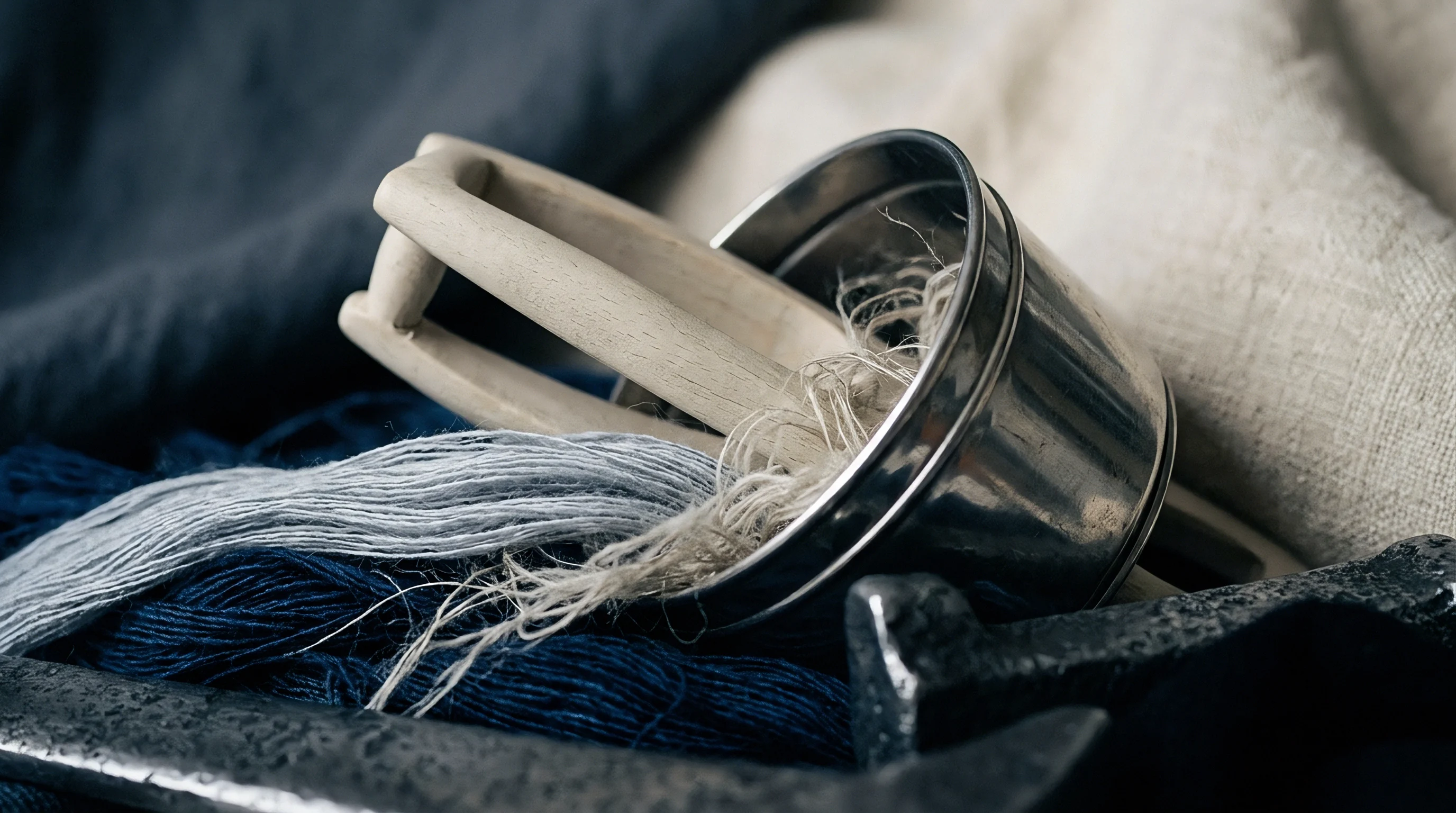
Can Wet Spinning Troughs Compensate for Cell Wall Thinning?
Wet-spinning frames run roving through hot-water troughs kept between fifty-five and sixty-five degrees Celsius to soften the middle lamella. The warm bath dissolves pectin bridges and loosens hemicelluloses, letting elementary cells slide past each other during drafting. Thin-walled fibres with wide lumens take on water fast, swelling internally and losing modulus.
Raising the bath above seventy degrees Celsius strips out too much pectin, leaving the thin elementary cells without enough binder to hold together; bundles shear apart under the drawing nip, generating thick and thin yarn faults.
- Roving immersion timing governs the exact depth of middle lamella softening within the hot-water spinning trough.
- Draft zone tension adjustment accommodates lower wet-bundle shear limits to prevent premature roving breakages.
- Spindle speed moderation reduces centrifugal ballooning stress imposed on the weak, water-saturated yarn core.
- Drying cylinder temperature profiling preserves structural cellulose hydration, avoiding thermal re-crystallization and surface brittleness.
Pectin chemistry sets the thermal limits of the middle lamella. Stressed flax crops pull excess divalent cations from dry soil, packing calcium into the pectin matrix. This hyper-calcification leaves the middle lamella stiff and slow to hydrate.
The mill faces a dilemma: the secondary walls are delicate and fragile, yet the cement holding them together resists softening. Routine spinning chemistry cannot plasticize the bundles cleanly, leaving technicians to choose between yarn coarseness and regular frame stops.
Whether enzyme pre-treatments on hackled sliver can selectively dissolve calcified pectin without accelerating hydrolytic breakdown of thin-walled cellulose remains an open engineering question.
Spindle
Raw fibre quality dictates line efficiency on the spinning floor. When compromised flax enters the wet-spinning room, line speeds have to come down. Mills configured to spin European long line at forty-five metres per minute front-roller delivery must drop to thirty-one metres per minute for lots testing below forty centinewtons per tex.
Running full speed pushes end-breakage past seventy breaks per one thousand spindle-hours, overwhelming operators and generating excessive roller laps.
Fibre degradation also caps yarn fineness. Straw harvested at 58 centinewton line strength spins clean yarn up to metric count Nm 39 (twenty-three lea) within normal CVm tolerances. Lots degraded to 38 centinewtons per tex top out between Nm 18 and Nm 26.
Drafting weakened sliver toward finer counts leaves too few elementary fibres in the strand cross-section: past Nm 32, fewer than twelve fibres support the load, and axial stress settles onto isolated kink bands until the yarn breaks.
Spinning frames decelerate twelve percent for every drop of five centinewtons per tex below the forty-five centinewton benchmark.
Embrittled straw also drives up comb waste. In multi-head hackling machines, pins strike the bundles to align fibres and clear tow and shive. Drought-hardened bast splinters on contact.
Long-line fibre breaks down into hackled tow, dropping hackling yields from forty-eight percent to thirty-two percent. That twelve-to-sixteen percent shift from line to tow sends usable raw material straight to low-value byproduct bins, skewing production costs.
| Bundle Tenacity Tier (cN/tex) | Hackling Line Yield (%) | End Breaks (per 1,000 Spindle-Hours) | Maximum Economical Count (Nm) | Yarn Unevenness (Uster CVm %) |
|---|---|---|---|---|
| Tier A: >52 (Temperate Standard) | 47.5 | 18 | Nm 39 | 13.8 |
| Tier B: 44-51 (Mild Climate Stress) | 42.0 | 32 | Nm 32 | 15.4 |
| Tier C: 36-43 (Severe Thermal Impact) | 33.5 | 68 | Nm 24 | 18.9 |
| Tier D: <36 (Extreme Desiccation) | 28.0 | 115 | Nm 16 | 23.5 |
Adjusting the twist multiplier offers only limited relief. Increasing the alpha metric twist from 110 up to 135 traps loose fibre fragments within the yarn core, reducing hairiness and restoring single-yarn tensile values. But the extra twist hardens the yarn, giving the finished linen a harsh, stiff hand.
Weaving sheds also suffer: warp yarns with high twist snarl under low tension, demanding heavy sizing to keep the shed clear.
Operating wet-spinning lines on degraded raw material without adjusting mechanical drafting drafts results in catastrophic roller wrapping, damaged fluted steel cylinders, and widespread yarn rejection across the entire delivery lot.
Penalty
Purchase specifications have to reflect the state of the crop. Contracts that hold out for forty-eight centinewtons during drought years lead to unfilled orders and stalled deliveries. Modern agreements use stepped price penalties tied directly to certified lab tenacity bands.
Instead of cancelling shipments, buyers adjust landed costs to offset expected comb waste and reduced spinning speeds.
The cost carries straight through to the finished cloth. Take an order of forty metric tonnes of dew-retted Western European scutched long flax priced at a benchmark 6.20 euros per kilogram for fifty centinewton fibre. If incoming tests show an average of thirty-eight centinewtons per tex, hackling yield drops from forty-six percent to thirty-four percent.
Spinning twenty tonnes of Nm 26 wet-spun yarn then requires 58.8 metric tonnes of raw fibre instead of 43.5 metric tonnes. The resulting fourteen-tonne tow surplus sells for just 1.40 euros per kilogram on the open market, locking up working capital.
Weaving costs climb along the same curve. A plain weave shirting fabric at 150 centimetres finished width and 140 grams per square metre takes 182 grams of yarn per linear metre, waste included. High-tenacity yarn runs at 0.72 euros per finished woven metre.
Yarn spun from thirty-eight centinewton fibre causes frequent loom stops, dragging weaving efficiency from ninety-two percent down to seventy-nine percent. Between lost loom output, extra sizing, and higher hackling loss, the yarn cost rises to 1.04 euros per linear metre. Contract schedules absorb this gap using sliding discount scales.
- Tenacity band verification clauses prescribe third-party lab certification under ISO 3060 before commercial invoice validation.
- Moisture regain baseline normalization recalculates gross invoiced weights back to twelve percent official commercial regain.
- Sliding scale margin discounts assess a two percent invoice reduction per centinewton below forty-six centinewtons per tex.
- Tow value adjustment credit calculates the financial delta between long-line yield targets and actual hackling bin scale readings.
Purchase orders must factor in regional weather data. Buying fibre on traditional grade numbers alone exposes mills to heavy losses when drought hits an entire river valley. Mills check sliver under the test clamp and project spinning yields before releasing payment on arriving straw.
Line flax testing below forty centinewtons belongs in heavy domestic weaves rather than fine shirting counts.
Fine yarn counts demand dense cell walls that no downstream mill adjustment can recreate once dry heat has thinned the growing stem.