Commercial Value Adjustments from Cut Length Gravimetric Linear Density Variance in Flax Line Sourcing
Gravimetric cut-length linear density variance above twelve percent CV drives wet-spinning breaks and triggers contractual invoice debits up to lot rejection.


Sliver
Standard hackled flax bundles entering wet-spinning preparation show gravimetric non-uniformity along their longitudinal axes because of biological growth gradients and uneven retting. Line flax processing depends on structural alignment, where bast fiber bundles bound by plant pectins and hemicellulose run continuously down the strick. Cut-length gravimetric linear density testing on fixed segments along the strick reveals substantial mass variations that directly affect drafting behavior in roving frames and final yarn evenness.
High-grade long-staple line flax typically displays linear density values between 1.5 dtex and 4.0 dtex per individual ultimate fiber, but bundle structures in commercial cut-length tests present much higher aggregate values, often running from 15 tex to 40 tex per 100 mm segment.
Biological factors during growth create density gradients from root to tip in the flax stem. Root segments have thicker cell walls, higher lignin concentrations, and coarser fiber bundles. Tip segments taper off, showing low gravimetric density alongside reduced tensile strength.
The middle stem sections yield the most uniform linear density, setting the baseline for high-count line spinning. When field conditions vary during dew-retting, pectin breakdown stays spotty. Under-retting leaves dense pectin bridges intact, making fiber bundles resist splitting during hackling.
Over-retting breaks down cellulose chains, weakening the fibers and causing erratic density profiles from premature strand disintegration.
Commercial hackling combs out short fibers, known as tow, to align long fibers into continuous strands. Mechanical combing splits coarse bundles into finer technical strands, dropping the average linear density across the strick. Still, hackling cannot eliminate linear density variance if raw fiber lots come from mixed origins or suffered uneven retting.
In cut-length gravimetric testing, technicians trim hackled fiber bundles into precise lengths ~ typically 50 mm or 100 mm ~ under controlled tension and humidity. Measuring each segment’s mass on microbalances calibrated to 0.01 mg precision converts directly to tex or dtex values. Variance across these segments exposes structural irregularities that automated optical scanners often miss.

Gravimetric Measurement Mechanics in Flax Bundle Segmentation
Testing flax linear density by cut-length gravimetric methods requires strict moisture conditioning. Bast fibers readily absorb atmospheric moisture, shifting their mass by up to 12 percent depending on relative humidity. Under ISO 2370 and ISO 6741 standards, samples condition at 20 degrees Celsius and 65 percent relative humidity for at least 24 hours before cutting and weighing.
Technicians apply a standardized pretension of 0.5 cN/tex across the bundle to take out crimp without stretching the underlying cellulose structure. A specialized guillotine cutter then cuts 100 mm segments from predefined zones along the strick: root, lower middle, upper middle, and tip.
These mass measurements plot out a distribution curve for the lot. The coefficient of variation (CV%) across 100 mm cut lengths gives a direct figure for fiber uniformity. A low CV% shows uniform bundle splitting and consistent cross-sections along the strick.
A high CV% points to dense, unsplit technical bundles scattered among over-drafted, thin zones. In wet spinning, where draft ratios exceed 10 to 1, localized spikes in linear density trigger severe drafting waves. Heavy sections resist the drafting pins and pass through as thick places, while adjacent thin sections draft too far, leaving weak spots that snap under tension.
ISO 2370 testing under standard atmosphere of 20 degrees Celsius and 65 percent relative humidity establishes baseline line flax linear density at 1.8 dtex with a permissible variation floor of 11.2 percent.
Fibre mass fluctuates significantly along the strick.
Evaluating raw material through gravimetric cut lengths catches physical defects before committing to spinning. Sourcing that relies strictly on average linear density misses internal variance. Two lots of hackled line flax might share the same average linear density of 25 tex per 100 mm segment.
Yet Lot A can have a cut-length CV% of 10 percent while Lot B sits at 22 percent. Lot A spins cleanly into fine wet-spun yarns up to metric count Nm 60. Under identical drafts, Lot B causes excessive end breakage, repeated frame shutdowns, and unacceptable Uster mass variation.
Naturally, the commercial value of Lot B collapses.

Anatomical Mass Distribution across Stem Zones
Where cut segments come from anatomically dictates how they behave during drafting. Bundles from the lower third of the stem carry higher proportions of non-cellulosic impurities like epidermal remnants, lignified shive particles, and calcium pectates. These add mass without contributing strength.
Cuts taken from root zones yield artificially elevated linear density figures that do not reflect usable spinnable units. During hackling, coarse root ends frequently resist splitting, remaining as stiff bundles that ruin sliver cohesion.
Stem middle sections consist of long ultimate fibers with thick secondary cell walls of highly oriented alpha-cellulose. These offer high tensile strength per tex and stable density across cut lengths, splitting cleanly into fine technical fibers under the hackling pins. Tip sections have thin cell walls and narrow lumens, giving low linear density per segment.
While tip fibers split easily, their low individual breaking strength leaves them prone to snapping during carding or hackling. That breakage generates short fiber waste and pushes overall linear density variation higher.
Testing teams evaluate error sources in gravimetric cut-length protocols to prevent commercial misinterpretation:
- Inadequate Moisture Equilibration causes localized mass discrepancies across test specimens because ambient water absorption stays uneven through dense bundle cores.
- Variable Specimen Pretensioning changes the fiber length captured inside the guillotine, introducing systematic mass errors in volumetric calculations.
- Blunt Cutting Blade Shear crushes bundle terminals instead of shearing them cleanly, pulling adjacent fibers out of the test zone and skewing segment mass values.
- Unremoved Epidermal Shive Fragments cling to lower stem segments, artificially raising mass without contributing usable fiber.
- Static Electrical Charge Accumulation during handling forces fine strands to disperse, causing mass loss on balance transfer plates.
Analyzing incoming stricks through cut-length segmentation clarifies what a lot can actually spin. High-density bundle clusters surviving hackling act like rigid pins during drafting, disrupting adjacent fiber movement. In wet spinning, a hot water bath at 60 degrees Celsius softens residual pectins to help fibers slide.
But if gravimetric linear density variance across cut lengths remains too high, hot water softening cannot overcome the mechanical imbalance of large mass differentials. Thick sections drag extra strands into the drafting zone, causing sudden surges followed by thin, depopulated gaps.
Weather variations during field dew-retting create stem tapering, though whether this makes linear density fluctuations commercially defensible remains a point of contention.


Clamp
Precision cut-and-weigh testing isolates mass gradients along hackled flax strands with strict analytical accuracy. Technicians lock conditioned fiber strands into rigid double-clamp fixtures set at exact intervals ~ typically 100 mm apart ~ so strands cannot shift as blades pass through. Clamping pressure must remain even across the bundle width to prevent edge fibers from slipping.
Slippage distorts the fiber length enclosed in the sample zone, invalidating tex calculations. Once clamped under tension, tungsten carbide blades drop vertically to isolate the target segment.
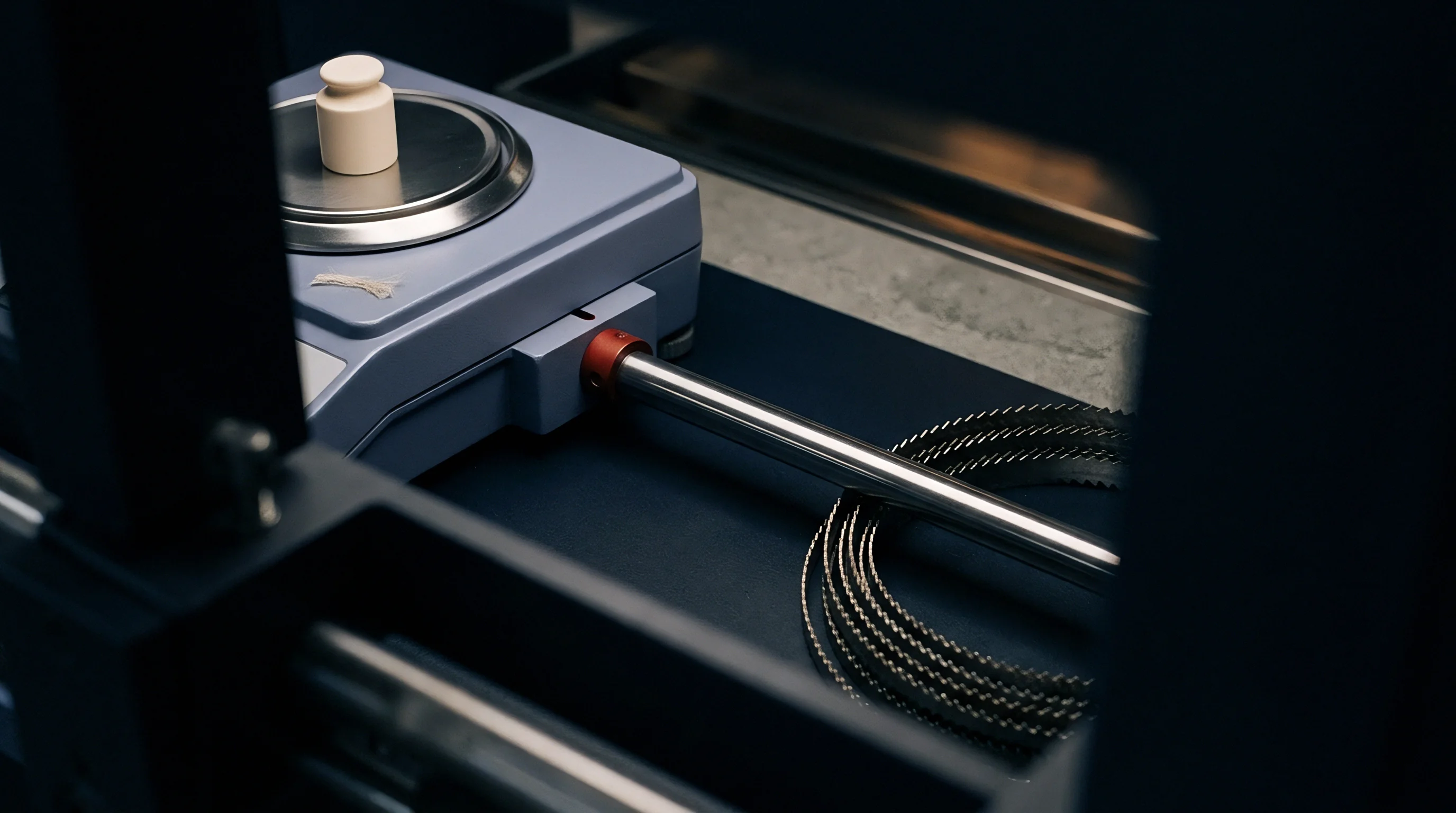
Determining linear density on clamped specimens relies on accurate micro-gravimetric analysis. Draft-shielded balance chambers with 0.001 mg digital scales keep air currents from disturbing measurements. Segment masses recorded in milligrams convert directly to metric tex (g/km) or decitex (dtex).
Taking 50 consecutive cuts along a single strick maps out a longitudinal profile of linear density variance. Statistical analysis of these points gives the mean linear density, standard deviation, and CV%, forming the core metric for commercial price adjustments.
The microbalance provides an indisputable mass measurement.
Sourcing engineers use the clamp protocol to verify true material characteristics before issuing production release orders. Automated optical analyzers often struggle with flax because bundles overlap and cross-sections are irregular. Optical systems measure projected strand width under the assumption of a circular fiber profile, which flax simply lacks.
Gravimetric measurement via precision clamping skips optical assumptions by weighing true mass per unit length. When optical and gravimetric figures conflict, gravimetric mass stands as the definitive standard in trade disputes.

Precision Cut Length Gravimetric Protocol
Cut-length gravimetric testing requires strict procedural control to eliminate operator error. Sampling rules call for taking stricks randomly from at least 10 percent of bales in a consignment. Technicians shake selected stricks gently by hand to clear loose, unaligned fibers before mounting them on the preparation board, then attach a pretension clamp to take up slack without stretching the cellulose.
A standardized sequence governs specimen processing during laboratory evaluation:
- Extract representative hackled line stricks from five distinct sampling points within the opened bale core.
- Condition specimens inside a climate-controlled chamber at 20 degrees Celsius and 65 percent relative humidity for 24 hours.
- Mount the fiber bundle onto the linear preparation frame, securing the root end in the fixed tensioning clamp.
- Apply a calibrated 0.5 cN/tex tension weight to the opposing bundle end to fully extend fiber crimp.
- Engage the double-clamp assembly at fixed 100 mm gauge intervals along the extended fiber axis.
- Actuate the dual tungsten carbide shearing blades to cleanly sever the isolated 100 mm bundle section.
- Transfer the severed bundle segment immediately into an enclosed microbalance weighing chamber using anti-static tweezers.
- Record segment mass to 0.001 mg precision and calculate gravimetric linear density in tex units.
- Repeat cutting procedures at sequential 100 mm intervals along the remaining length of the strick.
- Compute mean linear density, standard deviation, and coefficient of variation across all harvested segments.
Data gathered through this ten-step procedure provides the empirical basis for assessing drafting performance in wet spinning. When cut-length gravimetric CV% exceeds tolerance limits, spinning frames run unstably. High linear density variance induces draft perturbation waves: thick bundle segments alter roller pressure and force fine adjacent fibers through undrafted, driving up yarn irregularity and spiking end-breakage rates.

Drafting Dynamics under Linear Density Irregularity
Flax line drafting requires precise mechanical control over fiber movement between back and front rollers. In wet spinning, slivers pass through a hot water trough heated to 60–70 degrees Celsius to soften inter-fiber pectins before entering the drafting zone. As rollers pull tensile draft, the softened pectins allow ultimate fibers to slide past one another.
But if incoming bundles carry high cut-length linear density variance, drafting forces fluctuate violently across the nip line.
Thick bundle clusters require greater mechanical force to pull apart. When a thick section enters the front roller nip, localized pressure spikes force the rollers slightly apart. This separation reduces holding friction on adjacent thin fibers, allowing draft surges to drag them through uncontrolled.
Conversely, when thin sections hit the drafting zone, roller pressure crushes the sparse layer, shearing fibers and ruining strand length. These constant oscillations ruin spinning efficiency and degrade yarn tensile strength.
Finer line flax requiring high drafting ratios demands strict gravimetric uniformity to prevent roller slippage and catastrophic strand separation during wet drafting.
Spinning frames halt quickly when strands break.
The relationship between linear density variance, drafting performance, and yarn quality parameters follows predictable patterns across different processing setups:
| Flax Line Grade | Mean Tex (100mm Cut) | Cut-Length Tex CV (%) | Applied Wet Draft Ratio | Spinning End Breaks / 1,000 Spindle Hours | Yarn Mass CV (%) (Uster) |
|---|---|---|---|---|---|
| Normandy Grade 5 Line | 18.2 | 9.5 | 14.0 | 12 | 11.4 |
| Normandy Grade 4 Line | 22.4 | 12.8 | 12.5 | 22 | 13.1 |
| Courtrai Dew-Retted Line | 26.1 | 16.2 | 11.0 | 45 | 15.8 |
| Baltic Dew-Retted Line | 31.5 | 21.4 | 9.5 | 88 | 19.2 |
| Commercial Mixed Tow/Line | 38.0 | 26.8 | 8.0 | 142 | 24.5 |
Spinning trials confirm that elevated gravimetric variance directly drives operational failures. As cut-length linear density CV% rises from 9.5 percent to 26.8 percent, end breakage jumps by over 1,000 percent. Frame operators must slow machine speeds to handle the breaks, cutting throughput and raising labor costs per kilogram of yarn.
Yarns spun from high-variance raw lots end up with high Uster mass CV% values, making them unfit for high-density weaving or fine apparel knits.
Whether high-speed optical scanners can reliably replace gravimetric cut-and-weigh methods on heavily pectinized fiber ~ without mistaking optical opacity for actual linear mass ~ remains unproven in commercial mills.


Scale
Linear density fluctuations alter mechanical conversion efficiency and commercial yield on flax processing lines. Contracts price hackled line flax on dry mass metrics adjusted for standard moisture regain. But when material shows substantial gravimetric variance along cut lengths, actual yield strays sharply from contract projections.
Fiber with high tex variance generates elevated hackling waste, higher comb losses, and larger tow fractions during preparation.
Yield losses begin right in the comb and drawing passages. Dense bundles resist the hackling pins, causing whole segments to shear off into tow rather than splitting into line slivers. That rejection turns premium line flax into low-value hackling tow.
Standard hackling expects 60–65 percent line output from scutched flax. When cut-length gravimetric variance exceeds 18 percent CV, line yield drops below 52 percent, spiking net fiber costs per usable kilogram.
Excessive tension snaps weakened strands.
Spinners track conversion economics down to the cost per metre of finished woven cloth. Raw fiber purchase price is only part of the final fabric cost. Waste losses, reduced frame efficiency, and yarn mass irregularities turn minor raw material variations into major finished product price spikes.
Sourcing managers have to plug gravimetric variance directly into baseline costing to judge the true landed value of raw lots.

Yarn Count Yield and Processing Losses
Commercial flax spinning categorizes yarn fineness using the metric count system (Nm), which measures length in metres per gram. Line yarns run from coarse industrial numbers (Nm 10) up to fine apparel counts (Nm 60 and above). Spinning fine counts demands raw fiber with exceptionally low linear density and tight variance.
Trying to spin high Nm yarns from fiber lots with wide cut-length tex variance leads to structural frame breaks.
When spinning fine counts like Nm 39 or Nm 60, the average number of ultimate fibers in the yarn cross-section drops to critical minimums ~ for Nm 60, as few as 20 to 25 ultimate fibers. If raw material cut-length variance is high, thin sections along the strand fail to supply enough fibers to fill the cross-section during drafting. The strand drops below the minimum threshold required to carry twisting tension, snapping instantly at the spinning triangle.
ISO 6741 commercial mass adjustments enforce direct price reductions when moisture regain discrepancies compound gravimetric mass variances in raw fiber shipments.
Processing yield economics across standard linen yarn counts reveal the severe financial impact of raw material gravimetric variance:
| Target Yarn Count (Nm) | Raw Fiber Mean Tex | Cut-Length Tex CV (%) | Hackling Line Yield (%) | Spinning Waste Allowance (%) | Final Net Fiber Cost Multiplier |
|---|---|---|---|---|---|
| Nm 26 | 28.5 | 12.0 | 64.2 | 4.5 | 1.22 |
| Nm 26 | 28.5 | 20.5 | 53.8 | 9.8 | 1.51 |
| Nm 39 | 21.0 | 11.0 | 66.0 | 5.2 | 1.25 |
| Nm 39 | 21.0 | 18.5 | 54.5 | 12.4 | 1.62 |
| Nm 60 | 16.5 | 9.8 | 68.5 | 6.0 | 1.28 |
| Nm 60 | 16.5 | 16.0 | 51.0 | 18.5 | 1.88 |
The net fiber cost multiplier converts raw fiber purchase price into actual net fiber cost per kilogram of spinnable yarn. At Nm 60, raising cut-length linear density CV% from 9.8 percent to 16.0 percent drives the multiplier from 1.28 up to 1.88. That 46.8 percent cost escalation wipes out spinning margins if not corrected through raw material price adjustments.

Financial Valuation Shifts per Finished Metre
Weavers feel the final impact of yarn mass variance. High-speed looms running past 600 picks per minute require strong, uniform warp yarns. Mass fluctuations originating from cut-length gravimetric variance leave localized weak spots in the yarn.
During shedding and beat-up, these weak points snap under tension, causing loom stops, fabric defects, and costly downtime.
Operating margins erode rapidly under high defect rates.
Audit records covering five lots highlight the cost impact.
Evaluating commercial value requires converting raw fiber gravimetric variance metrics into concrete price adjustments. Sourcing practices utilize standardized decision frameworks to determine appropriate invoice value adjustments based on laboratory test results:
- Standard Material Acceptance applies when cut-length gravimetric CV% stays below 12.0 percent, incurring zero price penalty.
- Minor Quality Surcharge Debits activate when cut-length gravimetric CV% sits between 12.1 and 15.0 percent, triggering a 2.5 percent invoice deduction.
- Major Quality Penalty Adjustments take effect when cut-length gravimetric CV% reaches 15.1 to 18.0 percent, resulting in an 8.0 percent contract debit.
- Downgrade to Tow Classification applies when cut-length gravimetric CV% spans 18.1 to 21.0 percent, repricing the entire lot at tow fiber rates.
- Mandatory Shipment Rejection triggers when cut-length gravimetric CV% exceeds 21.0 percent, returning the lot to the supplier at their expense.
Structured value adjustments make sure contracts reflect actual material utility. Sourcing managers protect margins by writing pre-agreed debit schedules into purchase contracts. Without explicit testing clauses, buyers absorb processing losses while paying premium rates for substandard fiber.
Failing to run cut-length gravimetric screening on a mixed lot of Normandy dew-retted line resulted in a four cent per metre surcharge across an entire weaving run.


Debit
Commercial valuation models translate physical mass irregularities directly into financial adjustments. Sourcing agreements for raw hackled line flax need clear formulaic provisions governing settlement when delivered lots miss gravimetric specs. Standard industry contracts frequently specify average linear density while ignoring cut-length variance.
Modern procurement uses dual-parameter specs, combining absolute target tex with maximum permissible cut-length CV% limits.
When lab testing finds excessive gravimetric variance in incoming shipments, commercial debit mechanisms kick in automatically. Calculations modify baseline market pricing through a variance penalty coefficient. Penalty formulas scale linearly or quadratically based on the measured variance and the target yarn count.
For fine line spinning, penalty slopes run steep to reflect the severe operational penalties of unstable drafting strands.
Contractual terms govern quality disputes.
Enforceable debit structures require standardized sampling, transparent test protocols, and clear claim submission windows. Sourcing contracts mandate drawing samples within 14 calendar days of port arrival or warehouse delivery. Testing must take place at accredited independent textile laboratories following agreed ISO standard test methods.
Reports detailing individual segment masses, mean tex values, standard deviations, and final CV% figures constitute legal proof of non-conformity.

Commercial Adjustment Formulas and Variance Penalties
Financial adjustments for cut-length gravimetric variance rely on models mapping physical non-uniformity directly to economic loss. Baseline pricing assumes a standard cut-length CV% of 12.0 percent for premium long line flax. Variance above this baseline triggers progressive price cuts per metric ton.
The standard commercial value adjustment equation uses the following formulation:
Adjusted Price = Base Price (1 – K (Measured CV% – Baseline CV%)^P)
Where Base Price represents the contracted purchase price per metric ton, Measured CV% is the lab-verified cut-length gravimetric coefficient of variation, Baseline CV% is the contractual variance threshold (typically 12.0%), K is the penalty factor (typically 0.015 to 0.035 depending on target Nm count), and P is the severity exponent (P = 1.0 for linear adjustments, P = 1.5 for quadratic fine-yarn adjustments).
Commercial penalty matrices structure price adjustments across standard quality tiers:
| Measured Cut-Length Tex CV Range (%) | Quality Classification Status | Contract Penalty Multiplier (K) | Direct Invoice Discount Applied (%) | Commercial Dispute Resolution Action |
|---|---|---|---|---|
| Less than 12.0 | Full Conformance – Premium Grade | 0.00 | 0.0 | Full Invoice Payment Approved |
| 12.1 to 14.0 | Minor Non-Conformance | 0.015 | 1.5 to 3.0 | Automatic Credit Note Issued |
| 14.1 to 17.0 | Moderate Non-Conformance | 0.025 | 5.25 to 12.5 | Mandatory Invoice Adjustment |
| 17.1 to 20.0 | Severe Non-Conformance | 0.035 | 17.85 to 28.0 | Commercial Re-grading to Tow Rate |
| Greater than 20.0 | Critical Failure – Off-Spec | N/A | 100.0 (Rejection) |
Applying this adjustment matrix protects procurement budgets from quality deflation. For a 20 metric ton shipment of Normandy line flax priced at 4,500 Euros per metric ton, a measured cut-length CV% of 16.5 percent results in an automatic 11.25 percent price discount. The supplier issues a credit note for 10,125 Euros, offsetting the extra mill waste incurred while spinning the high-variance lot.

When Does Linear Density Variance Mandate Lot Rejection?
The boundary between price-discounted material and mandatory rejection comes down to mechanical spinning limits. When cut-length linear density CV% exceeds 20.0 percent, physical drafting control collapses on wet-spinning frames. The material stops functioning as long line flax, behaving like unstable carded tow strands instead.
Trying to run fiber above 20.0 percent CV% leads to catastrophic breakage rates past 100 breaks per 1,000 spindle hours, making production unviable no matter the price discount.
Gravimetric analysis showing a cut-length linear density coefficient of variation above 22 percent led to the rejection of 14 tonnes of dew-retted long line.
The test figures fell short of specification.
When cut-length linear density variance crosses the critical 20.0 percent limit, buyers trigger rejection protocols under international bast fiber trade terms. Rejection calls for immediate formal notice to the seller, securing sample retains for joint re-testing, and isolating rejected bales in clean, dry storage. Seller representatives have the right to inspect isolated lots within 10 business days.
If independent re-testing confirms initial lab findings, the seller covers all freight, port handling, storage, and lab testing costs while replacing the off-spec fiber with certified material.
Commercial contracts must define strict claim evidence documentation standards to prevent supplier disputes during quality rejections:
- Certified ISO 17025 Test Certificates displaying individual segment weighings, calculated tex values, and statistical CV% figures from independent accredited labs.
- Chain of Custody Sampling Logs verifying sample collection executed under ISO 2859 inspection level II procedures by licensed surveyors.
- Conditioning Calibration Records proving test specimens underwent full 24-hour climate equilibration at standard atmospheric parameters before cut-and-weigh testing.
- Mill Processing Trial Reports detailing mechanical frame settings, recorded end-breakage frequencies, and yarn mass irregularity curves generated during trial runs.
- Photographic Strand Documentation showing structural defects, unsplit pectin clusters, or visible root/tip mass imbalances across test stricks.
Putting explicit wording into procurement documents enforces commercial adjustments without drawn-out disputes. Clear terms eliminate ambiguity over quality definitions and enforcement rights.
Standard European Flax commercial clause 14B converts any line flax lot showing cut-length gravimetric linear density variation over 21 percent to tow-rate pricing, applying a mandatory 28 percent credit against the landed invoice.

Transit
Environmental shifts during maritime container transport alter moisture equilibrium and mass distribution inside packaged flax bales. Compressed at 300 bar density and wrapped in polypropylene, bales trap atmospheric moisture as ships cross changing climate zones. When containers move from European ports through tropical sea lanes, internal humidity gradients form inside the dense fiber mass.
Water migrates toward cooler outer layers, creating localized moisture pockets that throw off gravimetric mass measurements upon destination unboxing.
Moisture shifts alter measured segment mass.
Unloading high-density flax bales requires systematic environmental stabilization before quality testing. Taking cut-length samples from freshly opened, unconditioned bales yields distorted linear density numbers. Outer strands absorb excess moisture, showing falsely high tex values, while dry core strands present artificially low figures.
Sourcing teams must enforce a mandatory 72-hour warehouse equilibration period before crews pull test stricks for lab evaluation.
Stabilizing moisture regain eliminates false variance readings caused by maritime transit. Holding bales in storage facilities controlled at 20 degrees Celsius and 65 percent relative humidity allows trapped moisture to equalize naturally through the core. Once moisture equilibrium reaches standard 12 percent regain across all fiber layers, cut-length tests reveal true physical linear density without transport artifacts.
Bale Storage Microclimates and Mass Stabilization
Monitoring internal temperature and humidity in stored fiber shipments confirms that compressed flax bales need considerable time to reach thermal and hygrometric equilibrium. A core density over 400 kilograms per cubic metre creates strong resistance to ambient air penetration. Moisture movement inside compressed fiber blocks follows Fickian diffusion mechanics, creeping slowly from outer boundaries into the core.
Incoming quality verification requires strict protocol management during warehouse conditioning. Technicians place temperature and relative humidity data loggers inside sample bale cores at receiving. Sampling begins only after core sensors confirm stability matching ambient warehouse conditions for at least 24 continuous hours.
Premature sampling corrupts gravimetric data, leading to erroneous financial debits against suppliers.
Trade valuations depend on conditioned mass measurements.
Gravimetric analysis records true physical mass.

Sourcing Strategy and Vendor Qualification
Building resilient supply chains for high-grade long line flax requires thorough vendor qualification grounded in objective physical fiber metrics. Relying on traditional hand-classing leads to recurring quality disputes and unpredictable mill performance. Advanced sourcing operations set up qualification frameworks evaluating suppliers on statistical process control capability, hackling pin maintenance, and field retting consistency.
Qualified suppliers consistently deliver hackled line flax within tight cut-length linear density variance bands across multiple harvest years. High-capability vendors run internal cut-and-weigh protocols during hackling, adjusting pin density and comb speed dynamically to correct bundle irregularity before baling. Sourcing contracts reward these suppliers with long-term volume allocations and reduced inspection sampling frequencies.
Bale conditioning prior to testing stabilizes regain values across raw stricks and eliminates false linear density variance readings caused by localized moisture gradients.
Evaluating vendor capability means tracking continuous gravimetric test data across consecutive shipments. Suppliers delivering cut-length tex CV% values consistently under 12.0 percent earn preferred status, qualifying for automated invoice settlement without holding periods for destination lab testing. Vendors with erratic variance profiles face intensified inspection, bearing full financial liability for testing fees and quality debits.
Sourcing strategies combining rigorous cut-length gravimetric specs with automated financial penalty mechanisms secure high mill efficiency, predictable processing costs, and stable fabric quality across global supply networks.
A buyer who verifies cut-length gravimetric uniformity at the raw strick stage protects yarn strength and fabric yield far better than one relying on post-spinning price deductions.