Airflow Porosimetry Test Procedures for Raw Bast Stricks
Airflow porosimetry on cut bast stricks determines bundle fineness and spinnable count by measuring differential pressure across an isotropic chopped plug.
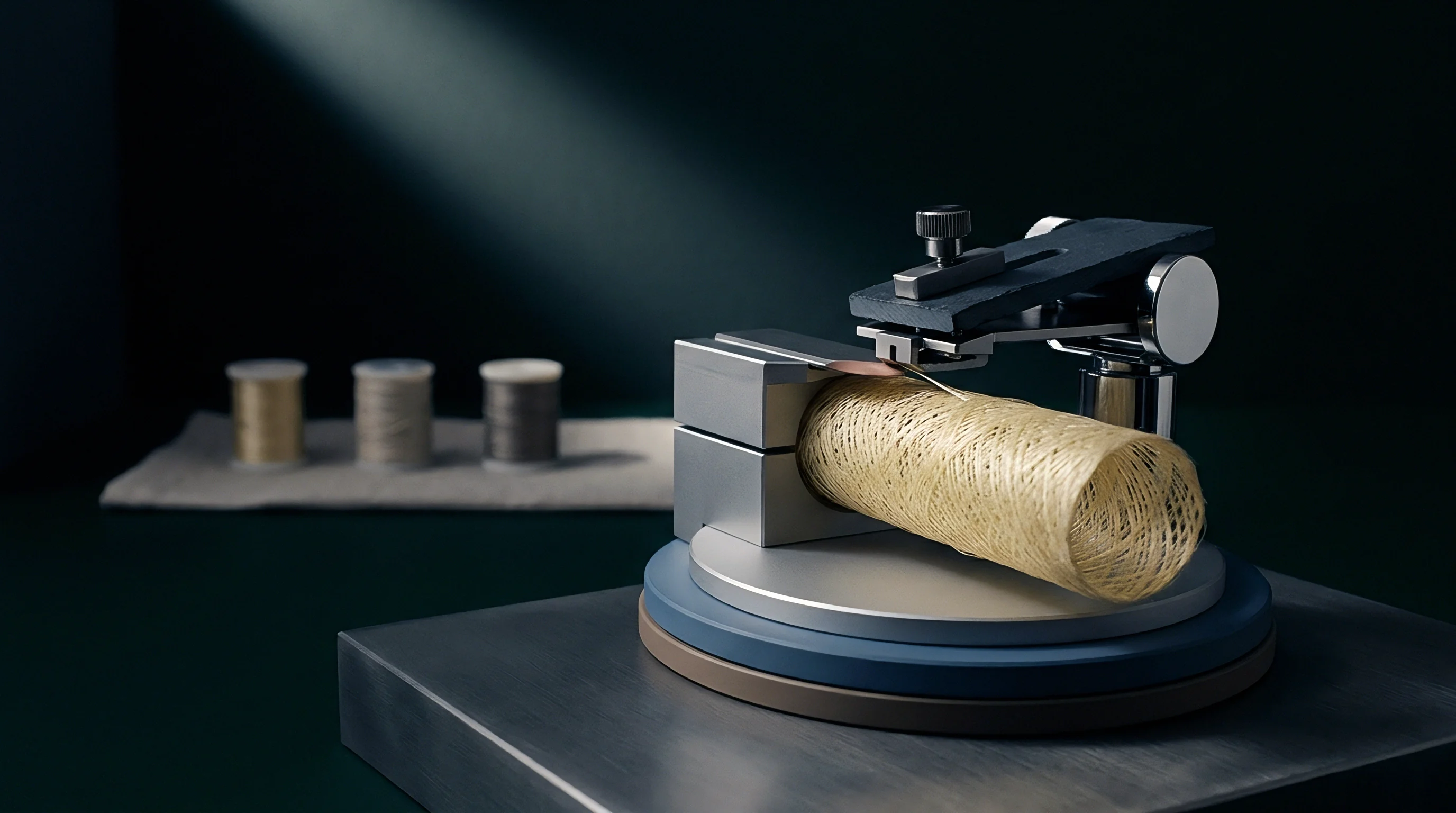
Tube
Airflow porosimetry determines bast bundle fineness by measuring pneumatic resistance through a packed specimen column. Scutched long flax forms an anisotropic network of elementary cells bound by pectin-rich middle lamellae. Loaded with these raw bundles, standard cotton airflow chambers ~ built for isotropically distributed single fibres ~ give erratic readings.
Air channels straight down the bundle axes, causing rapid pressure drops that register as falsely fine readings. Testing raw stricks requires a dedicated cylindrical cell with a fixed volume, perforated boundary plates, and an arrangement that controls bundle orientation.

Pneumatic Resistance across Anisotropic Fibre Plugs
Forcing a steady volume of air through a packed cylinder creates a measurable pressure drop between the inlet screen and the exhaust port. The Kozeny-Carman equation links this differential directly to the specific surface area of the test mass. When bundles lie parallel to the flow vector, laminar air hugs their perimeters with minimal drag.
Packing them perpendicularly or at random forces the stream across the bundle contours, generating the viscous dissipation needed for an accurate test.
At a packing porosity of 0.48 inside a 25.4-millimeter cell, scutched dew-retted flax bundles generate a differential pressure of 2.15 kilopascals under a constant air delivery of 4.0 litres per minute.
The cell geometry governs boundary layer behavior. Standard test barrels use internal diameters between 25.0 and 32.0 millimeters with a bore tolerance of 0.02 millimeters. Compression pistons feature sintered bronze or photo-etched stainless steel screens with open areas above 42 percent to prevent orifice turbulence, ensuring that fine bundles develop clean backpressure while coarse stricks bleed air without edge vortices.

Differential Pressure Dynamics and Darcy Flow
Within the laminar regime, where Reynolds numbers stay strictly below 2.0, viscous losses dictate the pressure profile. Differential pressure transmitters or piezoresistive sensors record the drop across the specimen plug, while flow velocities must remain low enough to keep bundles from shifting mid-test. Inside the specified packing envelope, a regulated differential transmitter operating from 0 to 5.0 kilopascals yields an output that scales linearly with specific surface area.
| Instrument Configuration | Bore Diameter (mm) | Test Mass (g) | Flow Rate (L/min) | Operating Pressure (kPa) |
|---|---|---|---|---|
| Modified WIRA Bast Tester | 25.4 | 2.50 | 4.00 | 1.20 to 3.80 |
| Constant Mass Sheffield Cell | 28.5 | 3.00 | 5.20 | 0.80 to 2.90 |
| Variable Volume Permeameter | 32.0 | 5.00 | 6.50 | 1.50 to 4.20 |
| High-Density Guillotine Barrel | 22.0 | 2.00 | 3.00 | 2.10 to 4.90 |
Repeatable aerodynamic drag depends on how bundles lie across the flow path. Compression pistons drive against positive mechanical stops, fixing the bed depth to secure a reproducible void fraction. The operator must pack the chamber without twisting the fibres, since torsion pinches flow paths and inflates resistance.
Driving the charging rod straight down keeps the face of the specimen flush with the screen.

Preparation
Preparing representative test material begins at the grading table. A whole scutched strick measures between 600 and 900 millimeters in length and varies considerably from root to tip. The root region is coarse and heavily lignified, the mid-section exhibits the best technical division, and the apical tip runs brittle and branched.
Loading unconditioned, full-length stricks yields erratic test data, so the laboratory reduces these uneven bundles into an isotropic, clean specimen plug.
Strick Sampling across Morphological Zones
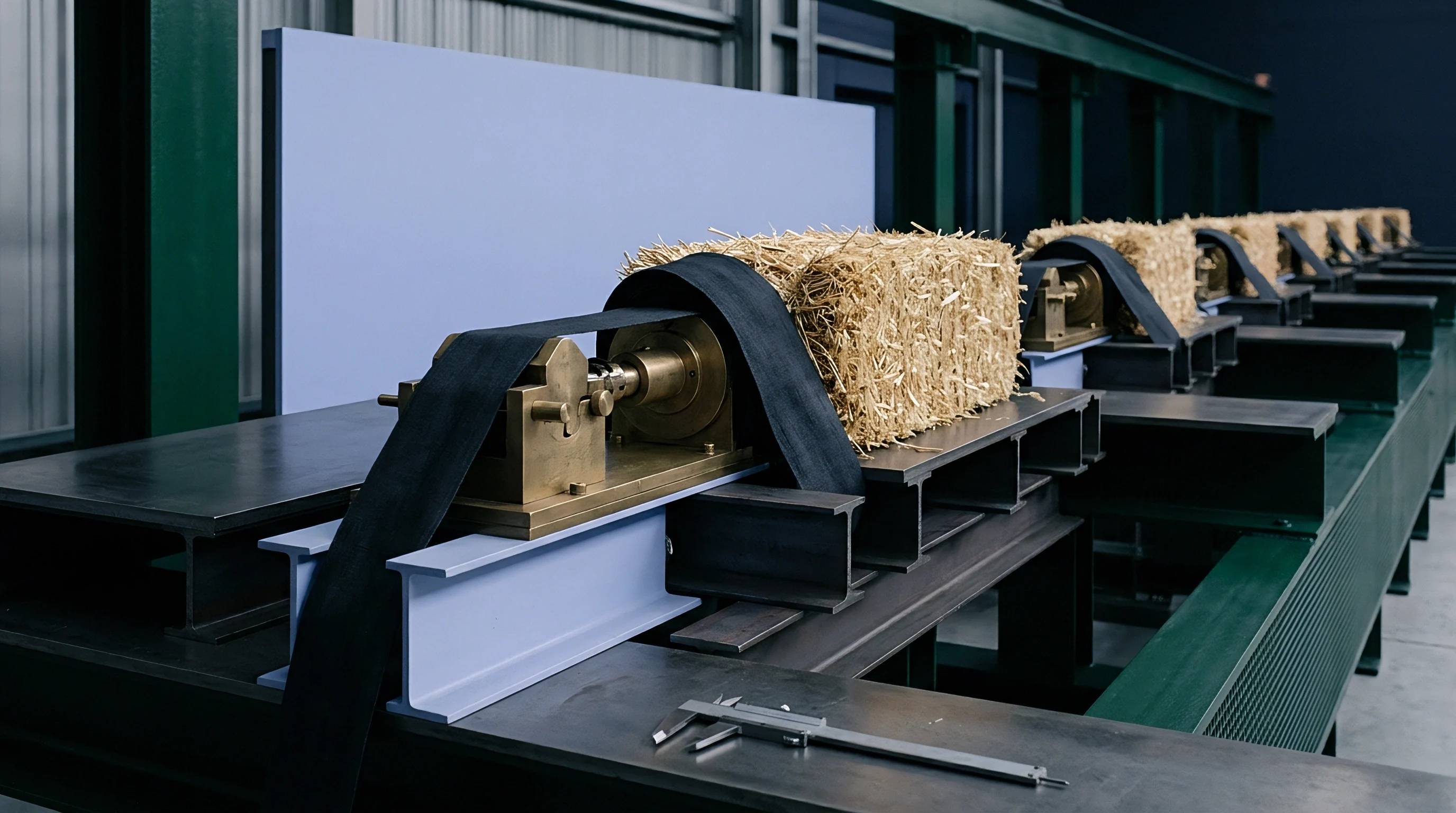
Subsampling requires systematic cuts taken across stricks drawn from multiple bale locations. Technicians reject root ends showing soil contamination or excessive woody debris bruised during scutching. Drawing five-gram handfuls from twenty randomly chosen stricks provides the composite laboratory lot for evaluation.

Mechanical Cleaning and Guillotine Cutting
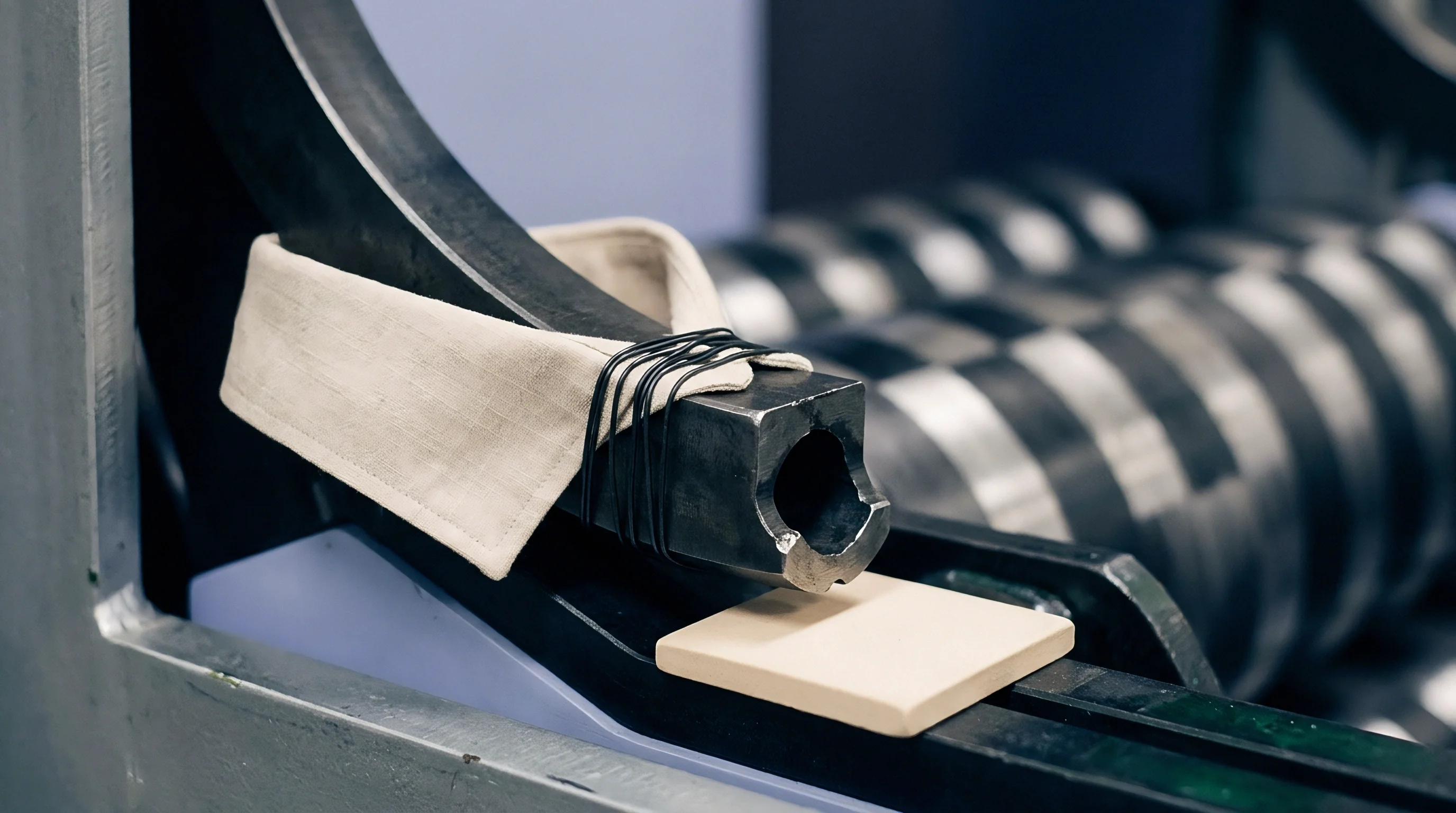
Shive particles, epidermal peelings, and unseparated cortex add weight without producing fibrous aerodynamic drag. Technicians dress the composite sub-lots over a coarse pinned hand-hackle, drawing bundles across five pins per centimeter to dislodge non-fibrous debris without combing out fine primary fibres. Because aligned, full-length stricks channel air along their axes, a heavy-duty rotary or lever guillotine cuts the dressed mid-sections into uniform 25.0-millimeter lengths.
Randomizing these chopped segments in a pneumatic tumble chamber eliminates directional flow bias.
- Segment the hackled mid-sections using a dual-blade rotary cutter set to 25.0 millimeters with a cutting error under 0.2 millimeters.
- Separate the chopped bundles in a low-velocity mechanical blender running dry for six seconds to untangle parallel arrays into an isotropic mass.
- Sift the randomized batch across a 1.0-millimeter mesh sieve to drop detached shive dust and broken cortical fragments.
- Weigh the conditioned specimen plug on an analytical balance to 2.500 grams plus or minus 0.002 grams inside the weighing room.

Standard Atmosphere Conditioning
Moisture absorption shifts the bundle cross-section and changes cell wall flexibility. As pectins in the secondary wall take up water, they swell into peripheral flow passages, constricting air movement through the chamber. Because sorption hysteresis leaves fibres approaching equilibrium from a wet state with higher regain than dry-conditioned lots, chopped bast specimens must equilibrate under an ISO 139 standard atmosphere of 20.0 degrees Celsius and 65.0 percent relative humidity for at least 24 hours before weighing.
Testing outside standard moisture limits introduces substantial errors in calculated fibre count. Unstable moisture levels distort the assumed porosity, prompting spinning mills to miscalculate the drafting behavior of line flax lots and suffer high roving failure rates during wet-spinning.
Calibration
Deriving absolute specific surface area from differential pressure relies on empirical porous-media relationships. As formulated by Kozeny and Carman, fluid passing through a random porous bed undergoes frictional dissipation directly related to the surface area of the solid phase. Flax bundles depart from ideal cylinders, exhibiting polygonal, kidney-shaped, and ribbon profiles with irregular lumens that complicate flow geometry.
Kozeny Carman Modeling for Bast Geometries
The Kozeny constant, typically taken as 5.0 for smooth cylindrical filaments, shifts markedly in bast plugs. Longitudinal surface grooves, residual parenchyma, and partly detached elementary fibrils add drag beyond what ideal geometric models predict. Calculating specific surface area per unit volume requires inputs for pressure drop, dynamic air viscosity, bed porosity, and column length, which convert mathematically to specific surface area per unit mass ~ a figure inversely proportional to bundle linear density in millitex or decitex.
Coarse line bundles pass fluid freely while thin split elementary cells choke permeability through cumulative hydrodynamic surface drag.
Accurate hydraulic radius calculations depend directly on solid density values. Helium pycnometry measures the skeletal density of pure cellulose at 1.55 grams per cubic centimeter, whereas raw scutched bast with residual non-cellulosic encrustations typically measures between 1.50 and 1.52 grams per cubic centimeter. Errors in this baseline density skew the calculated porosity, which enters the Kozeny-Carman denominator as a cubed term and magnifies errors in estimated fineness.

Decitex Derivation from Reference Bales
Laboratories calibrate airflow meters against reference flax bundles evaluated gravimetrically by cut-and-weigh methods under ISO 2370. While international cotton standards confirm instrument baseline stability, accurate bast calibration requires native flax references. Constructing an operational curve calls for three reference tiers: coarse scutched tow, mid-range line flax, and extra-fine dew-retted stricks.
- Low Porosity Baseline captures heavily retted, refined elementary bundles that produce high backpressure across the bed.
- Median Calibration Point tracks standard dew-retted water-hackled line flax yielding between 18 and 24 decitex.
- High Permeability Benchmark calibrates unrefined, coarse industrial flax displaying linear density above 35 decitex.
| Commercial Grade | Differential Pressure (kPa) | Specific Surface (m²/g) | Calculated Fineness (dtex) | Practical Spinnable Count (Nm) |
|---|---|---|---|---|
| Water-Retted Courtrai Line | 3.85 | 0.54 | 14.2 | 65 |
| Dew-Retted Normandy Line 1 | 3.10 | 0.46 | 18.5 | 48 |
| Dew-Retted Normandy Line 2 | 2.45 | 0.39 | 23.0 | 36 |
| Baltic Scutched Tow Blend | 1.65 | 0.28 | 34.5 | 20 |
How split bundle ends flex and restrict microscopic channels under pressure gradients remains difficult to isolate, leaving hydrodynamic flow models open to adjustment as empirical testing advances.
Discrepancy
Discrepancies between airflow readings and downstream mechanical fineness arise from the composite structure of raw bast stricks. While individual elementary fibres measure between 1.2 and 2.4 decitex, scutching leaves them grouped in bundles of ten to forty cells cemented by pectins. The airflow test senses only the hydrodynamic boundary of these intact groups, not the single cells later liberated in chemical boiling or wet-spinning troughs.

What Deviations Signal Incomplete Bast Retting?
When retting is incomplete, intact middle lamellae keep bundles broad, flat, and resistant to mechanical division. Packed into a test barrel, these large bundles leave wide interstitial channels that allow air to pass with little drag. The porosimeter interprets this high flow as low specific surface area and reports a falsely coarse linear density, even though aggressive hackling or alkaline roving treatments can later divide those bundles into fine fibres.
Under standard purchase terms, a differential pressure variance exceeding 8 percent across three consecutive strick draws invalidates the certificate of analysis.
Over-retting produces the reverse error. Once microbial action degrades both inter-bundle pectins and parts of the primary wall, the dry fibre becomes brittle. Chopping and blending fracture these over-retted bundles into short fragments and loose fibrils that lodge in the compression screens.
The resulting restriction generates high backpressure, mimicking premium fine line fibre on the gauge while setting up the mill for severe hackling waste and end-breakage on the spinning frame.

Shive Fraction Mass Distortions
Shive fragments are dense pieces of woody core that offer very little external surface area per unit mass. Because testing requires a fixed specimen weight, each milligram of shive displaces an equal mass of high-surface bast fibre in the chamber. With fewer fibres occupying the volume, the plug presents a larger void fraction and lower flow resistance than clean flax of the same fineness.
- Screen Blindness Defect occurs when fine particulate dust clogs the microscopic perforations in the downstream compression piston, creating artificial backpressure unrelated to fiber bed density.
- Specimen Channeling Defect emerges when non-uniform packing creates localized vertical fissures through which air bypasses the bulk mass at elevated velocity.
- Sorption Gradient Defect develops when a cold laboratory sample absorbs moisture inside the warm air stream of the permeameter during prolonged flow sweeps.
Discrepant low airflow readings can reflect natural growth differences across Normandy field sectors rather than mechanical adjustment errors on the scutching turbine.


Contract
Mill buyers use raw strick airflow values to anchor purchase specifications before fibre leaves the scutching yard. Contracts tie minimum specific surface area or maximum decitex limits directly to target yarn counts. Wet-spinning mills running fine shirting yarns between Nm 60 and Nm 80 set narrow airflow tolerance bands, while dry-spinning plants making upholstery yarns from Nm 10 to Nm 20 tolerate lower differential pressures to balance fibre costs against spinning waste.

Yarn Boundaries and Fineness Guarantees
Purchase contracts commonly apply sliding price scales tied to porosimetry readings. When a delivery contracted at 18 decitex tests at 24 decitex, the mill loses spinning capacity, because roller drafting becomes unstable once bundle counts drop below twenty-five fibres per roving cross-section.
| Airflow Fineness (dtex) | Maximum Count (Nm) | Hackling Line Yield (%) | Raw Fibre Cost ($/kg) | Delivered Grey Cloth Cost ($/m) |
|---|---|---|---|---|
| 15.0 to 17.0 | 60 to 75 | 58 | 8.40 | 3.15 |
| 17.1 to 20.0 | 45 to 55 | 52 | 6.80 | 2.45 |
| 20.1 to 24.0 | 30 to 40 | 45 | 5.20 | 1.95 |
| 24.1 to 30.0 | 16 to 26 | 38 | 4.10 | 1.55 |

Mill Floor Conversion to Finished Metre Costing
In a mill producing a 140-centimeter plain weave shirting at 130 grams per square metre from Nm 50 wet-spun line flax, fibre testing at 18 decitex on the permeameter delivers a 53 percent hackling yield with roving waste kept to 4.5 percent. If a delivery instead grades at 23 decitex, spinning technicians must lower the draft ratio, insert extra roving twist, and cut spindle speeds by 18 percent to contain yarn breakage, causing weaving efficiency to drop from 91 percent to 82 percent under increased warp breaks.
Each point lost in hackling line yield pushes the raw material requirement from 1.88 kilograms of scutched strick per kilogram of finished yarn up to 2.22 kilograms. On the weave room ledger, that shift adds 0.38 dollars per linear metre of finished fabric entirely through raw fibre fineness drift.
Fibre lots failing to meet verified porosimetry tolerances enter processing solely under signed technical deviation agreements.
Standard delivery terms mandate that certified porosimetry data, drawn from five representative strick samples per five-tonne shipment, take legal precedence over visual hand classing in resolving contract fulfillment.