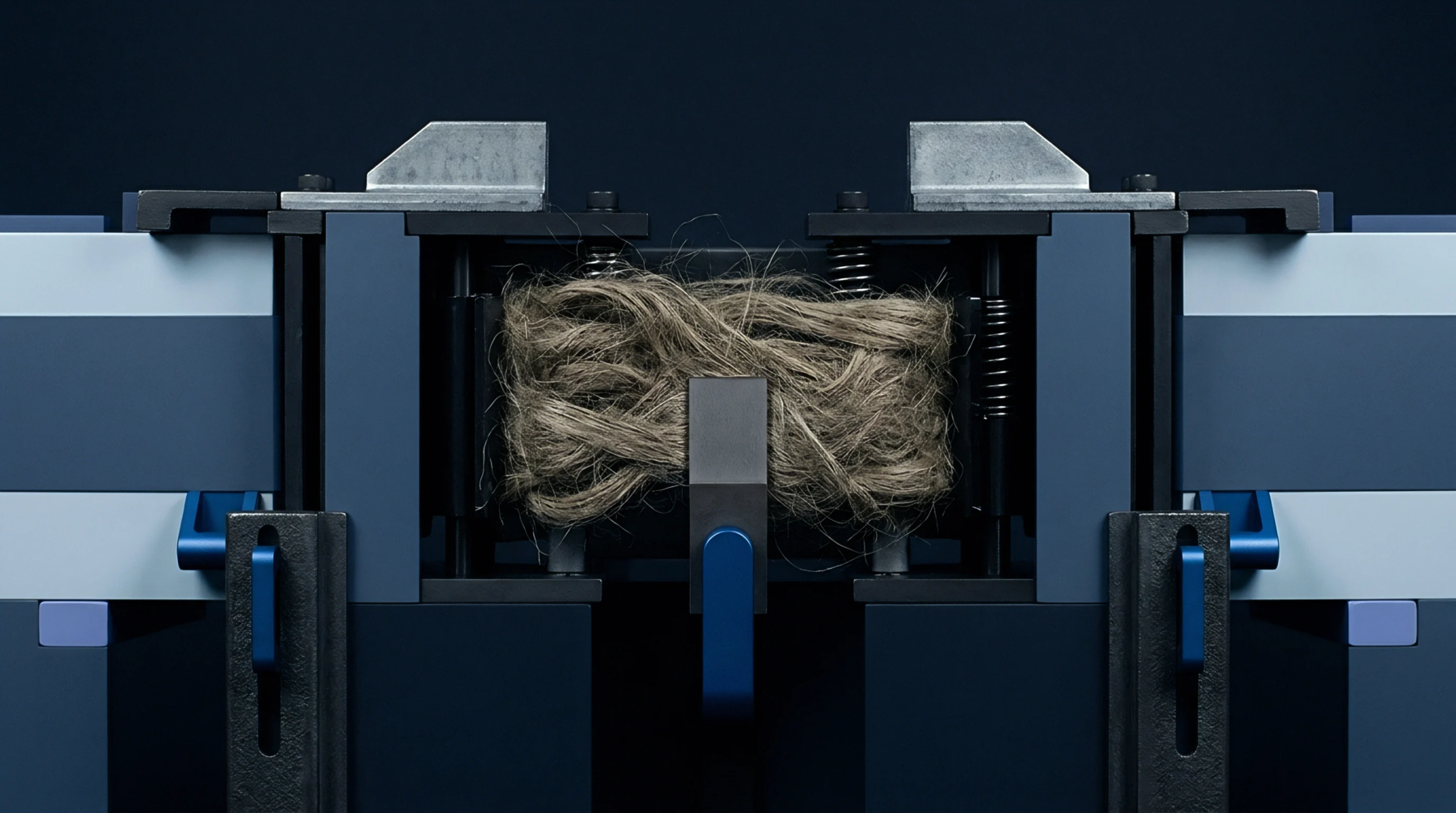
Fibre Sorting
Raw flax straw entering the scouring shed requires a measurable optical fiber fibrogram to establish staple length distribution before drawing frames begin processing the harvest. Optical fiber fibrogram technology maps light attenuation across randomized beard arrays to quantify length uniformity ratios alongside upper half mean values. Chinese mill auditors inspect this output sheet during bale receipt because short fiber percentages dictate subsequent drafting force parameters.
A staple length below twenty millimeters triggers rejection at the weighbridge. Spinning technicians rely on length index curves to prevent excessive breakage during high speed combing passes.
Yarn Tension
Finished single yarn batches undergo optical fiber fibrogram evaluations inside the quality control laboratory to verify twist regularity before wet spinning lines release cops to the winding room. Testing heads project infrared beams through vertical filament bundles to register density fluctuations per centimeter. Mill management maintains strict tolerance bands for mass variation coefficients across every export lot.
Customer acceptance contracts mandate maximum allowable irregularity limits calculated directly from sensor amplitudes. Weaving sheds refuse bobbins showing high amplitude spikes because uneven thickness causes warp breakage on air jet looms.
Cloth Density
Woven linen fabric leaving the finishing range receives final optical fiber fibrogram scans to certify areal weight uniformity prior to garment manufacturer delivery. Optical sensors track surface hairiness and pick spacing consistency across sixty inch grey goods widths. Exporters attach the resulting densitometric profile to shipping documentation to satisfy international trade specifications.
Fabric grades differ fundamentally from raw material classifications because mechanical finishing alters surface reflection characteristics permanently. Higher absorption indices denote superior bleaching depth across finished linen exports.