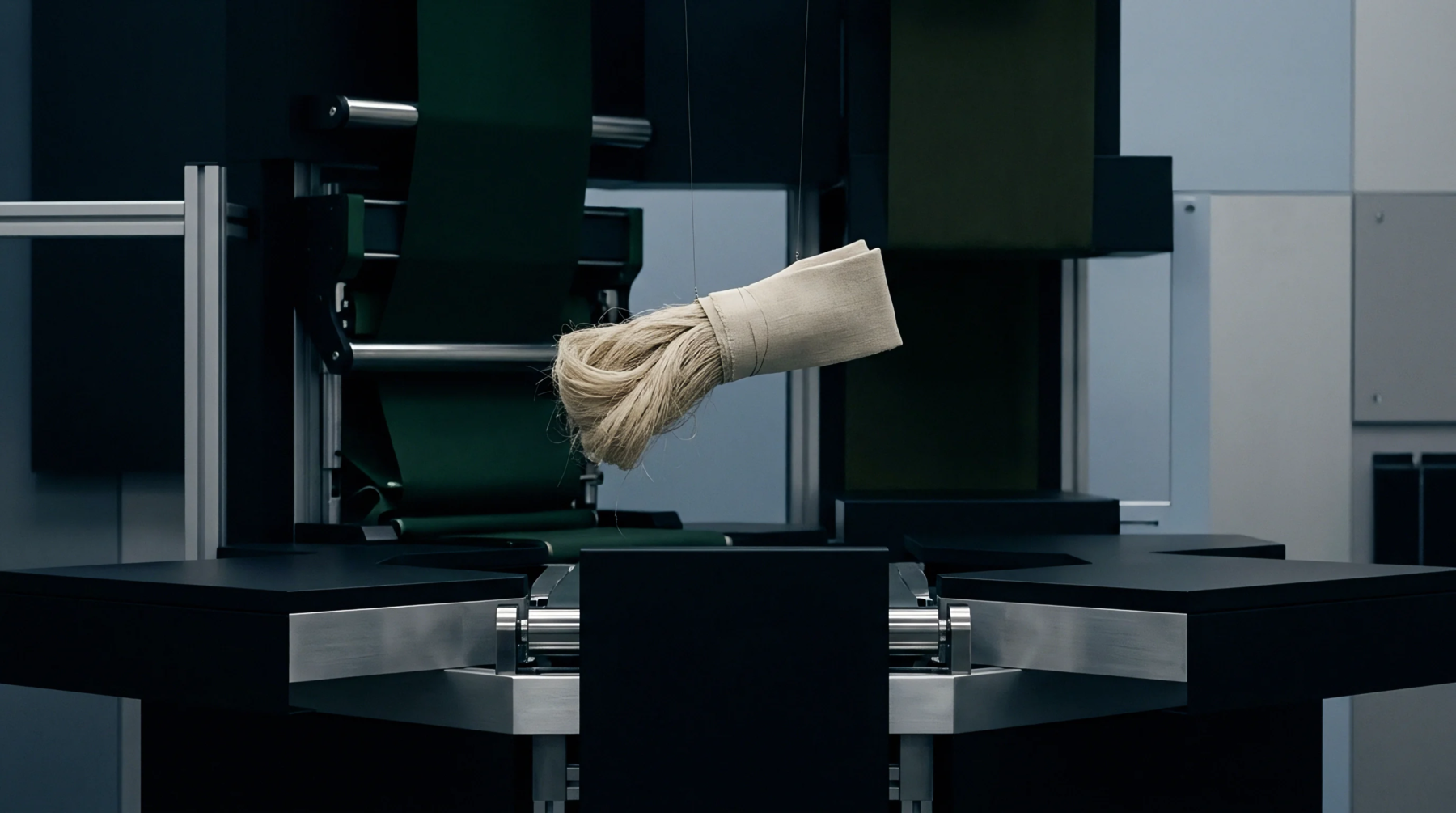
Intermediate Strand
Mechanical refinement of long flax fibers produces a continuous, slightly twisted ribbon of parallel material ready for wet spinning. This intermediate strand is the hackled flax roving, which must exhibit high uniformity to prevent breaks on the spinning frame. The structure consists of aligned long fibers held together by weak cohesion and minimal twist.
It represents the final stage of preparation before chemical treatment and drafting.
Preparation Process
Combing through progressively finer pins prepares the long fiber bundles for drafting into a cohesive sliver. This sliver is then drawn out and given a light protective twist on a roving frame to form the hackled flax roving. In Chinese linen mills, this roving is wound onto perforated plastic bobbins designed to withstand the high temperatures of subsequent boiling and bleaching.
The precision of the roving density determines the eventual fine yarn count that can be spun from the fiber. Any variation in roving thickness translates into thick and thin places in the woven fabric, which degrades the final cloth.
Spinning Performance
Wet spinning of high-quality linen yarns relies on the structural integrity of the prepared roving bobbins. These packages undergo chemical scouring to soften the natural pectins that bind the individual fiber filaments together. While a weak roving will disintegrate during this chemical treatment, a correctly prepared hackled flax roving maintains its package form and permits uniform penetration of the boiling liquor.
The strength of this strand governs the efficiency of the spinning room.