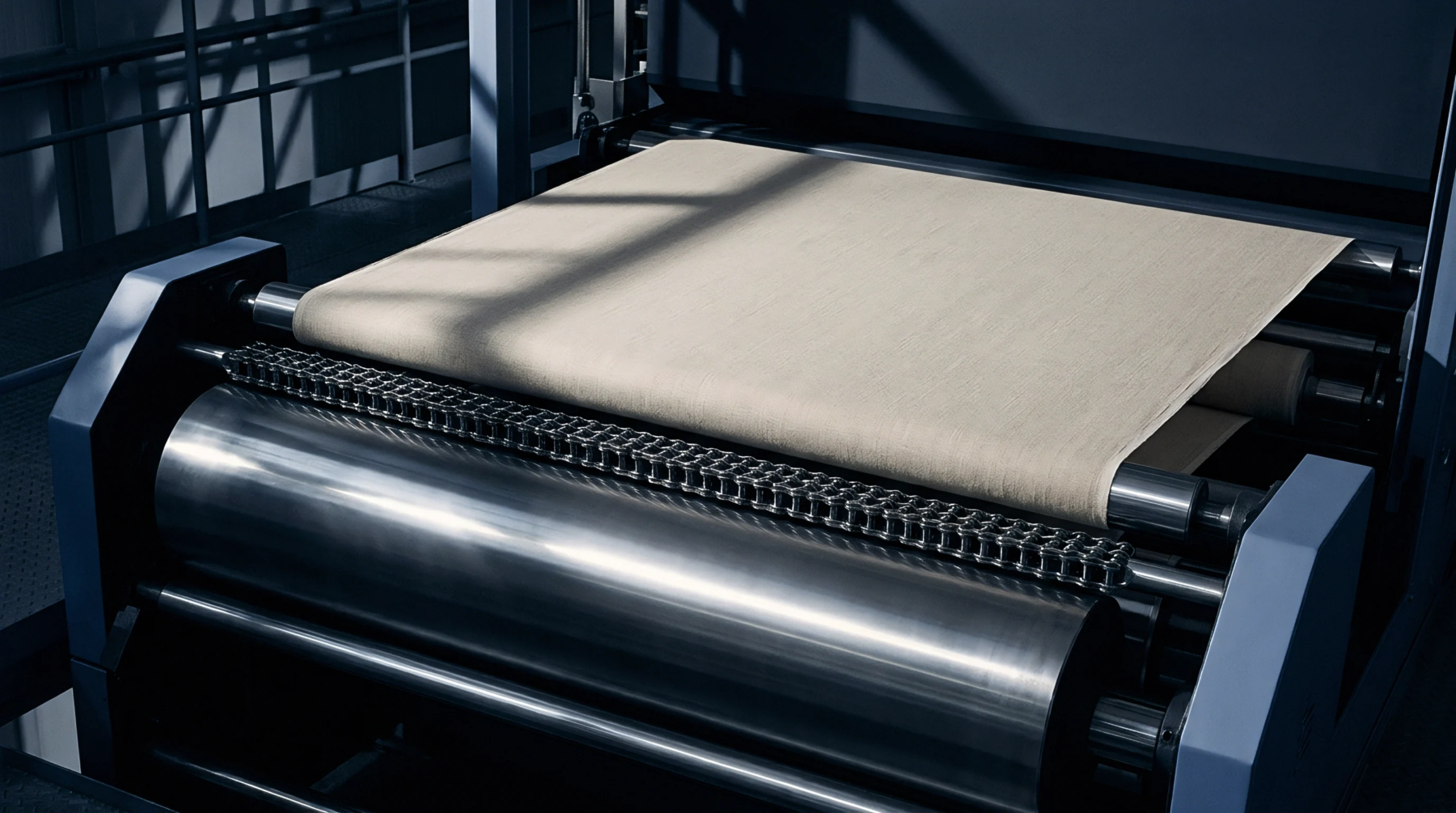
Lateral Gradient
Mechanical deviation in warp yarn strain across the outer boundary of a weaving shed defines a localized force imbalance during high-speed loom operation. In Chinese linen weaving mills, edge tension drift develops when selvedge spools or dedicated tensioning arms fail to maintain equal pull against the main warp sheet. Because flax fibres possess low elasticity compared to cotton, even minor force variances at the selvedge create irregular shed geometry.
The condition destabilizes pick insertion.
Weaving Disruption
Unbalanced forces at the fabric boundary generate immediate structural faults during air-jet or rapier insertion. Excess strain causes end breakage in selvedge yarns, whereas deficient tension produces slack loops that get caught inside the shed. On wide-width linen looms operating above five hundred picks per minute, edge tension drift distorts the cross-wise alignment of weft yarns near the temple cutter.
This misalignment causes wavy selvedges, which complicate subsequent stenter frame processing and lead to uneven dye penetration during wet finishing operations. Machine operators continuously monitor tension sensors to catch force shifts before fabric distortion becomes permanent.
Edge Boundary
Tension stabilization mechanisms limit drift within fixed operating parameters. Automated load cells adjust selvedge let-off rates dynamically, stopping the loom if warp tension exceeds tolerance limits. When warp preparation or sizing is uniform, selvedge deviation remains minimal across full beam runs.