Real Time Sizing Wet Pick up Controls for Flax Warps
Real-time wet pick-up controls for flax warps balance nip pressure with machine speed, holding size add-on within 2.5% to maximize loom efficiency.


Squeeze
Flax yarn possesses an irregular cross-sectional morphology: thick cell walls, central lumen voids, and distinct structural nodes distributed along the bast fiber length. Unlike uniform staple cotton, dry flax strands exhibit high initial hydrophobic surface variance due to residual plant waxes, pectins, and variable retting levels. Sizing liquor penetration into a 100 percent flax warp relies on displacing air within fiber bundles during the momentary dip inside the size box, where liquor viscosity and the balance between capillary uptake and mechanical film rejection dictate the initial wet pick-up percentage before the warp enters the drying cylinder multi-pack.
Fine counts like Nm 39 line demand entirely different sizing liquor dynamics than coarse Nm 14 tow yarns. Coarse yarns contain larger void volumes between fibers that draw in free liquid under low nip pressures, pushing wet pick-up values past 110 percent if uncalibrated. Fine wet-spun line flax warps resist deep penetration, leaving liquor to ride the outer boundary layer as a heavy surface shell.
Squeeze roller hardness, expressed in Shore A durometer units, determines the nip width and pressure distribution profile across the warp sheet. A soft roller cover of 60 to 65 Shore A creates a broad nip contact zone, increasing hydraulic dwell time but leaving surplus liquid within the yarn core. A harder cover of 75 to 80 Shore A compresses the fiber bundle tighter, forcing excess liquor back into the size box and leaving a thin, consolidated coating on the fiber periphery.
| Yarn Count (Nm) | Warp Density (ends/cm) | Liquor Viscosity (mPa·s at 85°C) | Nip Pressure (daN/cm) | Target Wet Pick-Up (%) | Dry Add-On (%) |
|---|---|---|---|---|---|
| Nm 14 Tow | 22.0 | 115 | 3.8 | 105.0 | 11.5 |
| Nm 26 Line | 28.5 | 85 | 4.2 | 92.0 | 9.8 |
| Nm 39 Line | 34.0 | 65 | 4.8 | 84.0 | 8.5 |
| Nm 50 Line | 40.0 | 50 | 5.2 | 78.0 | 7.6 |
Liquor temperature stability directly influences viscosity inside the squeeze zone. Formulations based on modified potato starches and synthetic binders display thixotropic thinning under the high shear stress of the roller nip. When bath temperatures drop below 80°C, starch retrogradation increases chemical viscosity rapidly, causing elevated wet pick-up without improving binder adhesion to the smooth flax fiber nodes.
Maintaining the bath between 85°C and 88°C stabilizes flow resistance. Over-saturation causes yarn migration during drying, generating hard yarn-to-yarn size bridges that rupture during lease rod splitting.
Wet pick-up values exceeding 95 percent on fine Nm 39 line flax warps increase drying energy consumption by 28 percent while accelerating size shedding at the loom reed.
Double nip squeeze boxes are standard for dense flax setts. The first nip expels trapped air bubbles from the dry yarn web to establish deep core wetting. The second high-pressure nip regulates final film volume and removes loose surface fibers before yarn alignment enters the pre-drying section.
Speed variations during creeling create transient wet pick-up spikes. When the sizing machine decelerates to creep speed, extended dwell time inside the bath causes excessive liquor sorption, swelling flax fibers by up to 15 percent in diameter. Correcting this imbalance demands immediate, automatic nip force adjustment linked directly to running speed metrics.
Incorrect squeeze pressure fractures the fibers, while excess moisture retention inside the wet warp beam initiates mildew growth and structural yarn degradation within forty-eight hours of storage.


Gauge
Online measurement of moisture absorption and chemical mass distribution across running warp sheets relies on non-contact sensor arrays mounted immediately past the final squeeze nip. Transducer heads on traversing frames sweep across the warp width to record continuous cross-machine density profiles. Microwave attenuation sensors detect polar water molecule resonance within the wet yarn web, calculating water mass per unit area in real time.
Beta backscatter gauges utilize krypton or strontium isotope sources to measure total area mass, yielding combined fiber, water, and solid chemical values. Subtracting dry yarn weight density from total wet mass isolates the net wet pick-up percentage instantaneously.

Transducer Calibration and Multi-Spectrum Sensor Arrays
Infrared absorption sensors operate at specific spectral bands where liquid water and starch hydroxyl groups demonstrate characteristic photon absorption peaks. Differential measurement comparing a non-absorbing reference wavelength against the primary absorption band isolates surface wetness from internal fiber core moisture. Dual-wavelength infrared units mounted above and below the warp sheet yield split measurement profiles, exposing top-to-bottom pick-up asymmetry caused by uneven squeeze roller wear or unbalanced steam chest heating.
Beta gauges drift over time, and optical windows readily pick up chemical splash back, requiring air-purge assemblies to keep optical path elements clear during extended continuous runs.
- Optical window contamination alters baseline light absorption intensity, creating artificial wet pick-up measurement spikes across specific warp width zones.
- Yarn sheet vibration introduces distance fluctuations between the sensor head and running threads, introducing high-frequency signal noise into the control loop.
- Ambient steam condensation droplets falling onto sensor lens optics register as localized wet spots, triggering false squeeze roll pressure adjustments.
- Substrate count variations within raw flax lots shift base fiber mass density, causing baseline offset errors in single-frequency microwave attenuation calculations.
Sensor calibration requires strict empirical correlation with gravimetric laboratory balance tests. Sizing machine operators slice five-metre warp samples immediately past the squeeze box, weighing wet yarn inside sealed containers before drying to constant mass. High-density flax warps demand multi-point calibration matrices incorporating yarn count, fiber origin, retting method, and warp end density.
A single calibration curve fails when switching between wet-spun line flax and dry-spun tow yarns due to structural density variations between fiber types.
Machine speed directly affects sensor reading accuracy. At high line speeds reaching 100 metres per minute, liquid surface turbulence behind the squeeze nip creates micro-foam layers that disperse infrared signals. Integrating high-speed digital signal processors suppresses foam noise, passing stabilized average pick-up readings to the primary process controller every 50 milliseconds.
Whether sensor reading drift stems from raw flax moisture variation or from thermal expansion inside the scanner frame assembly remains an operational dispute.

Loop
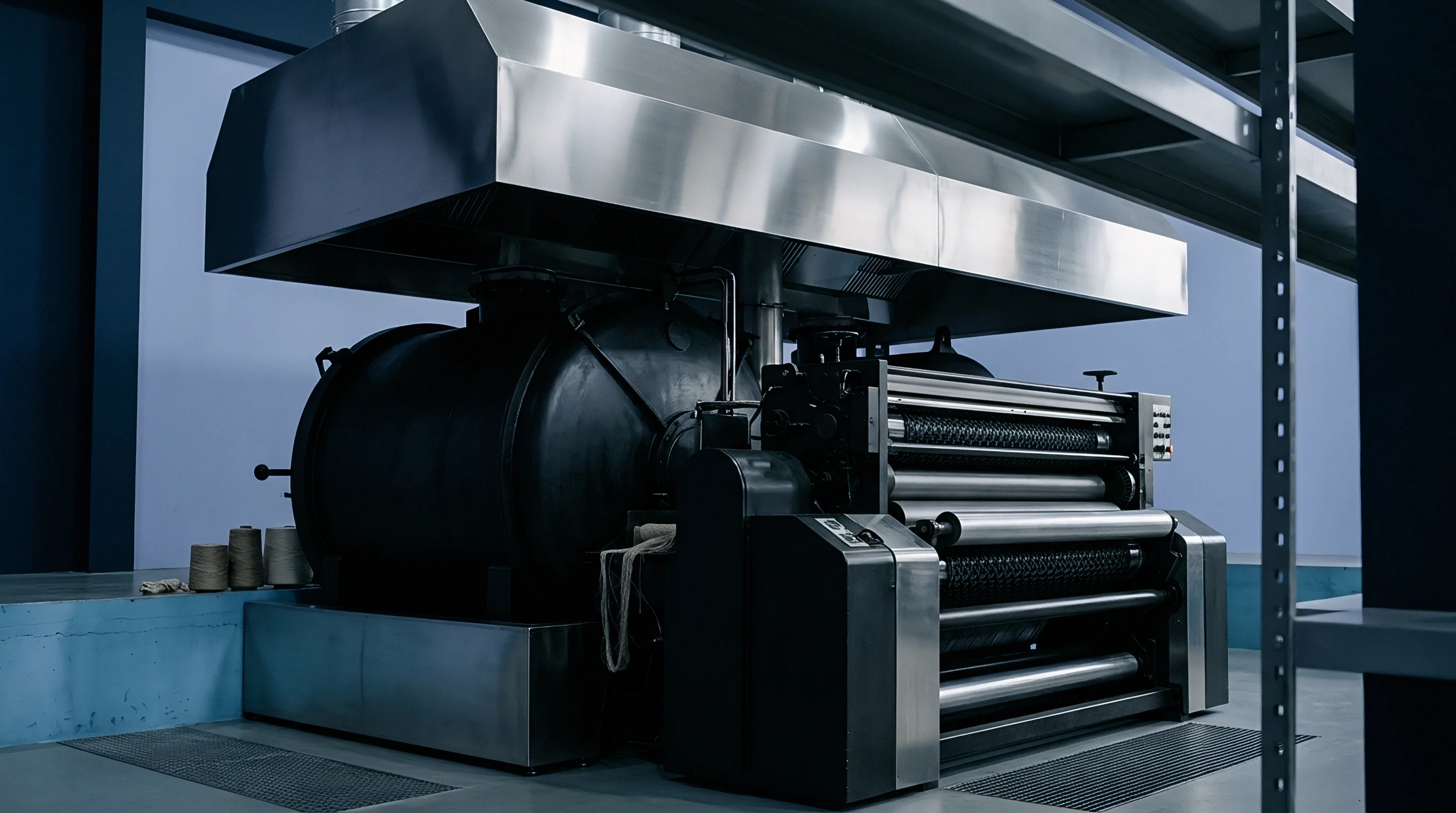
Closed-loop control systems match squeeze nip pressure directly to measured wet pick-up deviation from setpoint targets. The primary programmable logic controller calculates continuous error signals by comparing multi-point sensor averages against the target wet pick-up profile. When measured pick-up exceeds target thresholds, proportional-integral-derivative algorithms send dynamic pressure increase signals to electropneumatic servo valves governing the squeeze roll pressure cylinders.
Mechanical actuation response time must match line acceleration rates to prevent over-sizing during machine acceleration transitions.

Dynamic Speed Compensation Curves
Sizing machine acceleration from creep speed to full production speed changes liquid hydrodynamics inside the squeeze nip. As yarn velocity increases, hydrodynamic lift forces liquid into the nip entry zone, thickening the liquid film passing under the roll. Automatic speed-compensation modules alter the setpoint pressure based on a non-linear velocity lookup table tailored to flax yarn properties.
| Line Velocity (m/min) | Target Wet Pick-Up (%) | Base Pneumatic Pressure (bar) | Speed Compensation Factor | Calculated Nip Force (daN/cm) |
|---|---|---|---|---|
| 2.0 (Creep) | 90.0 | 1.2 | 0.65 | 1.8 |
| 15.0 (Thread-up) | 90.0 | 2.1 | 0.82 | 2.9 |
| 45.0 (Low Run) | 90.0 | 3.4 | 1.00 | 4.2 |
| 75.0 (High Run) | 90.0 | 4.3 | 1.18 | 5.1 |
| 100.0 (Max Run) | 90.0 | 5.0 | 1.32 | 5.9 |
Extended dwell at creep speed enriches size pick up, yet pressure modulation must occur without introducing pneumatic chatter, which causes cross-machine thick-and-thin sizing bars along the warp length. Servo-actuated hydraulic cylinders offer higher stiffness than pneumatic actuators, eliminating roller bounce when processing coarse flax knots or slubs passing through the nip.
Standard mill operations executing flax sizing contracts mandate wet pick-up variation control within a strict range of plus or minus 2.5 percent across the full length of a 5000-metre beam.
Roll deflection compensation maintains uniform pick-up across wide warp beams up to 360 centimetres in width. Heavy squeeze pressures bend steel roll cores, causing reduced force at the center and elevated liquor application along middle warp ends. Crowned squeeze rollers, shaped with slightly larger center diameters, offset mechanical bending under maximum load.
Modern systems utilize variable-crown hydraulic rolls, adjusting internal fluid pressure along individual roll zones based on real-time feedback from traversing cross-machine sensor arrays.
Proper nip calibration balances liquid volume across the width while yarn speed adjustments maintain uniform chemical concentration throughout the warp run.

Shed
Weaving shed efficiency on modern high-speed rapier and air-jet looms correlates directly with the uniform quality of the size film protecting individual flax ends. Flax fibers lack natural elasticity, exhibiting ultimate tensile elongation values below 3.0 percent. Sizing must not attempt to increase yarn elasticity, but must instead provide high film tenacity and surface smoothness to survive shed opening tensions and high-frequency reed beat-up impacts.
Irregular wet pick-up control creates alternating soft-sized sections vulnerable to abrasion and hard-sized sections prone to brittle yarn fracture under drop wire stress.

Yarn Hairiness Encapsulation and Lease Splitting Mechanics
Protruding surface fibers on flax yarns interlock during shed formation, causing warp-to-warp clinging, false stop signals, and end breakage. Wet pick-up control locks surface hairiness flat against the main yarn body. Excessive application buries individual threads inside a continuous solid matrix, forcing high mechanical force requirements at the sizing machine leasing section.
High splitting force tears dried size film off the fiber surface, exposing bare flax bundles to mechanical abrasion inside the loom heddle eyes.
- Mount the dried size warp beam onto the inspection frame stand under 1500 Newtons of total warp sheet tensioning force.
- Extract twenty individual yarn end samples across the beam width, preserving raw cross-sectional geometries inside sealed glass transport vials.
- Conduct longitudinal optical microscopy at 200x magnification to evaluate hairiness index values and size film encapsulation uniformity.
- Perform single-yarn cyclic abrasion testing per standard laboratory protocol, recording cycle counts required to produce initial fiber detachment.
- Measure yarn-to-metal dynamic friction coefficients across polished stainless steel pins matching loom heddle eye metallurgical compositions.
Excess hairiness generates shedding dust, while retting variation in harvested flax crops alters the chemical affinity between plant cellulose and synthetic size binders, changing film adhesion performance even when wet pick-up volume remains constant. Sizing technologists adjust binder-to-starch ratios when handling under-retted flax fibers to prevent premature size flaking inside the loom shed drop wires.
The unresolved boundary remains whether real-time viscosity adjustment inside the supply tank yields higher loom efficiency than dynamic nip pressure control when processing low-grade flax tow warps with high short-fiber counts.


Verification
Analytical qualification of sizing performance demands laboratory verification of actual dry add-on percentages compared against real-time sensor logs. Gravimetric desizing procedures serve as the ultimate referee standard. Testing procedures require yarn sampling from specific beam locations matching recorded sensor anomalies.
Samples undergo solvent extraction to remove natural fats and waxes, followed by enzymatic desizing using α-amylase enzymes under controlled temperature and pH conditions to isolate total applied binder mass.

Standard Laboratory Desize Procedures and Regain Corrections
Flax exhibits high standard moisture regain values, baseline corrected at 12.0 percent under ISO ambient conditions. Gravimetric calculations must utilize absolute bone-dry specimen weights to prevent atmospheric humidity variations from distorting dry add-on calculations. Comparing desized mass loss against online wet pick-up logs confirms sensor calibration stability across the multi-thousand-metre sizing run.
| Beam ID | Warp Position (Metres) | Logged Wet Pick-Up (%) | Logged Solids (%) | Calculated Dry Add-On (%) | Lab Desize Add-On (%) | Variance Delta (%) |
|---|---|---|---|---|---|---|
| FL-8801 | 250 (Head) | 91.2 | 10.5 | 9.58 | 9.62 | +0.04 |
| FL-8801 | 2500 (Middle) | 90.4 | 10.5 | 9.49 | 9.45 | -0.04 |
| FL-8801 | 4800 (Tail) | 94.8 | 10.5 | 9.95 | 10.15 | +0.20 |
| FL-8802 | 1200 (Middle) | 88.1 | 10.5 | 9.25 | 9.18 | -0.07 |
Standard test protocol ISO 7211-3 governs yarn count and crimp determinations, providing baseline metrics for density verification. Statistical process control requires wet pick-up standard deviation values below 1.2 percent across an entire warp set. When laboratory desize results depart from logged sensor data by more than 0.5 percent dry add-on equivalent, sensor recalibration and baseline tare routines are triggered immediately.
Contractual commercial terms mandate that warp lots exhibiting dry add-on variance exceeding plus or minus 1.0 percent from specification incur automatic loom-efficiency downtime liability penalties billed back to the sizing mill.
Under standard delivery terms referencing ISO 13934 yarn tensile performance minimums, sized flax warps failing the minimum abrasion cycle threshold are rejected before mounting to the loom frame.


Costing
Financial valuation of real-time wet pick-up controls relies on analyzing chemical consumption savings alongside loom shed output optimization. Over-application of sizing chemicals wastes expensive modified starches and synthetic polyvinyl alcohol binders while increasing thermal energy consumption at the drying cylinder range. Evaporating one kilogram of excess water from a running warp sheet demands approximately 2,600 kilojoules of thermal energy.
Maintaining tight wet pick-up controls reduces steam mass flow requirements per kilogram of processed yarn.

Loom Capacity and Stopped-Time Financial Mechanics
Consider a production contract processing a 15,000-metre flax warp order of Nm 26 yarn (28.5 ends per cm, 220 cm reed width) running across twenty high-speed rapier looms operating at 450 picks per minute. Uncontrolled sizing processes typically demonstrate wet pick-up fluctuations between 80 percent and 108 percent, yielding high loom warp break rates averaging 2.8 end breaks per 100,000 end-picks. Each warp break causes an average of 3.5 minutes of loom stop time for knotting and drop wire reset.
Operating twenty looms under high break rates yields 37.8 lost loom hours per week, representing a total capacity loss of approximately 5,100 woven linear metres. Implementing real-time wet pick-up closed-loop controls stabilizes dry add-on at 9.8 percent ± 0.3 percent. End break frequency drops to 0.9 breaks per 100,000 end-picks, recovering 25.6 lost loom hours weekly.
At a fixed shed operating cost of 42.00 EUR per loom hour, total weekly labor and overhead savings equal 1,075.20 EUR on machine efficiency alone.
- Chemical baseline consumption limits size waste, reducing binder mass consumption by 8.5 percent across annual yarn throughput volumes.
- Thermal drying energy efficiency cuts boiler natural gas requirements, dropping steam generation costs by 0.04 EUR per kilogram of sized warp thread.
- Loom shed stop frequency reduction extends reed life, decreasing mechanical drop wire and heddle wire replacement costs.
- Fabric defect rate mitigation reduces second-quality fabric downgrades by 2.2 percent on finished linen cloth roll deliveries.
Because water removal costs dictate drying speed, machine pay-back periods for dual-head microwave sensing and automatic electropneumatic squeeze roll control assemblies total under nine operational months on high-volume flax processing lines. Sourcing practices specifying tight wet pick-up limits secure consistent weaving performance, reliable contract delivery timelines, and minimal landed-cost variation across production runs.