Predictive Dynamic Modeling of Fell Line Displacement and Yarn Friction in Ultra-Dense Fabric Structures
Fell displacement during ultra-dense weaving dictates peak warp tension and pick jamming limits, requiring friction-aware loom tuning to avoid defects.


Position
High pick densities in technical weaving push the intersection of warp and weft to structural limits. When the sley advances during beat-up, the newly inserted pick drives against the cloth edge with forces that grow nonlinearly as the sett approaches maximum yarn jamming. Standard linear mechanics assume a static weave point during insertion.
High-speed recording shows that the cloth boundary shifts forward during reed impact and recoils during sley withdrawal. This cyclic oscillation dictates yarn tension peaks, warp end breakage rates, and dimensional uniformity across the width of the loom shed.
The boundary where inserted picks consolidate into finished cloth acts as an elastic spring-damper system. Peak tension occurs when the sley reaches front center at zero degrees crank angle. Warp yarns experience a transient surge in strain as the beat-up force pushes the fabric line toward the breast beam.
Loom speed dictates the period of this cycle. At three hundred picks per minute, the complete displacement and recovery sequence takes place in under two hundred milliseconds. Skewed beat-up force distribution across a wide reed causes localized variances in boundary displacement, creating density waves and tight picks.
Warp tension settings directly alter the displacement baseline. Higher warp sheet tension reduces the forward stroke of the cloth boundary, stabilizing pick placement at the cost of elevated fatigue on individual end filaments. Lower warp tension allows greater forward travel, increasing the contact arc between adjacent picks and aggravating beat-up bounce.
The loom mechanism requires balance between structural stability and yarn survivability.
Measuring the physical amplitude of this displacement requires optical tracking at high frame rates. Laser displacement sensors positioned above the cloth fell record peak forward excursions exceeding four millimeters on heavy continuous-filament constructions. The magnitude of this stroke determines whether the newly inserted pick retains its position or slips backward during shed opening.
Understanding the dynamic equilibrium of these forces remains essential for preventing reed marks and beat-up shadows in industrial filtration fabrics.
Dynamic boundary displacement leaves open the exact spatial threshold where elastic recovery transitions into permanent friction lock across asymmetric weave structures.
Reed
Sley acceleration profiles directly govern the peak force transmitted to the warp sheet during insertion. Modern high-density air-jet and rapier looms use conjugate cam sley drives to maximize dwell time while shortening the beat-up stroke. Ultra-dense fabric constructions, defined by warp and weft cover factors summing above one hundred and eighty percent, alter the mechanical demand on the reed.
As the reed face contacts the newly laid pick, resistance rises rapidly due to lateral compression between adjacent warp ends passing through the same reed dent.

Cover Factor and Mechanical Resistance
High warp end density restricts the lateral passage of the pick. When the reed drives the yarn into the fell, the weft thread undergoes flattening while forcing warp yarns apart in an alternating vertical plane. The total beat-up resistance force combines yarn bending stiffness, tensile resistance from the warp shed, and surface friction at all yarn-to-yarn contact points.
The force profile spikes within the final five degrees of crank angle movement prior to top dead center.
Beat-up force spikes from eighty newtons per meter to four hundred twenty newtons per meter when warp cover factor rises from seventy-two to ninety-four percent under constant yarn tension.
Excessive force leads to structural defects. Warp ends under extreme lateral pressure undergo filament micro-fractures, while the reed wire experiences cyclical deflection that introduces stripiness in finished goods. Loom tuning for dense fabrics focuses on controlling reed drive kinematics to deliver peak force without triggering warp strand fatigue.
- Beam Tension Calibration establishes baseline elastic recovery, preventing fell recoil during shed opening but raising total peak tension at front dead center.
- Sley Dwell Angle Adjustment extends insertion windows for heavy picks, minimizing sley velocity at the exact moment of initial yarn-to-yarn contact.
- Asymmetric Shed Timing separates warp sheet arrival times at the beat-up line, reducing simultaneous friction contact points across dense warp ends.
- Reed Wire Polishing eliminates micro-asperities on dent surfaces, preventing filament shaving when ends float vertically during dense shedding cycles.
The quantitative relationship between cover metrics, fell displacement amplitude, and peak beat-up force is detailed in the operational performance table below.
| Warp Cover Factor (%) | Weft Cover Factor (%) | Fell Displacement (mm) | Peak Beat-up Force (N/m) | Shed Shift Angle (deg) |
|---|---|---|---|---|
| 65.0 | 55.0 | 1.12 | 65 | 3.2 |
| 75.0 | 68.0 | 1.85 | 145 | 4.8 |
| 85.0 | 78.0 | 2.74 | 280 | 6.1 |
| 92.0 | 86.0 | 3.91 | 450 | 7.9 |
| 96.5 | 92.0 | 4.65 | 610 | 9.4 |
Weave density peaks when the force required for beat-up equals the maximum safe tensile load of the warp sheet.
Interlock
Frictional interaction between crossing yarns defines the mechanical boundary of fabric construction limits. High-density structures lock yarns together under high normal forces generated by warp tension and pick compaction. Microscopic surface topography, fiber lubricity, size chemistry, and contact area govern friction performance during weaving.
Inter-yarn friction acts through dynamic stick-slip regimes, resisting weft entry during beat-up and preventing structural relaxation after sley withdrawal.
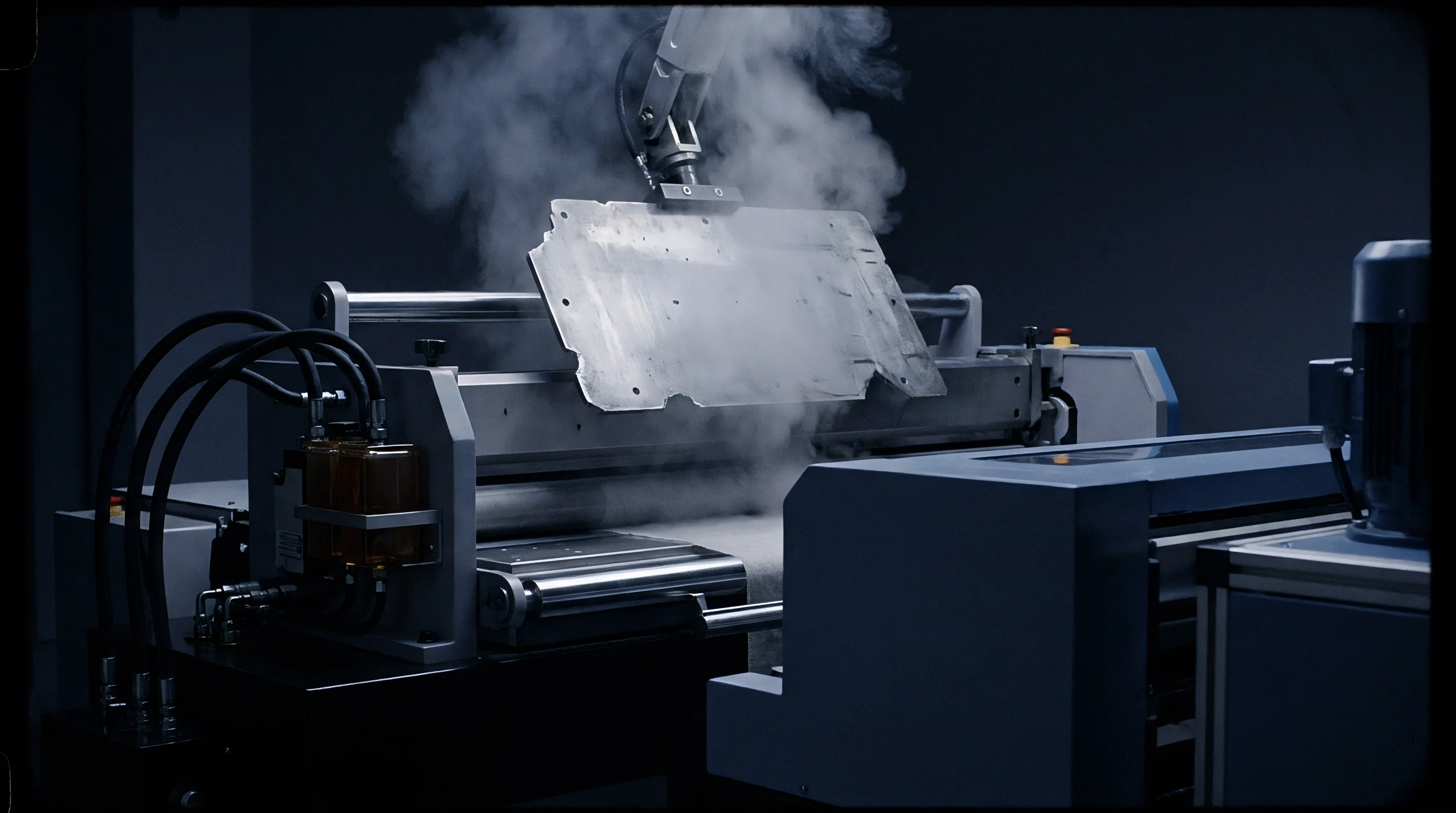
Does Inter-Yarn Friction Limit Settability before Warp Breakage?
Maximum pick density is frequently governed by sliding friction rather than spatial yarn volume limits. As yarn pack density increases, the contact area between warp and weft expands nonlinearly. The static coefficient of friction prevents the inserted pick from sliding completely into the weave structural trough.
When beat-up force overcomes static friction, kinetic sliding begins; however, stick-slip behavior causes the pick to stop prematurely if warp tension drops slightly during sley recoil. This mechanism creates tight picks and loom stops long before yarn diameter geometry physically blocks insertion.
Yarn size formulations heavily alter these friction mechanics. Polyvinyl alcohol and refined starch coatings smooth out surface fuzz, reducing the kinetic coefficient of friction during shed crossing. Size formulas that dry too hard increase yarn bending rigidity, which elevates force requirements at the fell line.
Synthetic lubricants added to size mix recipes lower boundary friction, stabilizing fell movement under high-density weaving conditions.
Warp size pick-up below nine percent yields catastrophic fiber abrasion, whereas size content exceeding fourteen percent hardens the yarn matrix and doubles beat-up resistance.
Failure modes multiply rapidly when inter-yarn friction exceeds operational thresholds during dense weaving cycles.
- Pick Rebound occurs when stored elastic energy in the compressed pick overcomes kinetic friction during sley return, throwing the pick out of alignment.
- Warp Filamentation develops when high normal forces cause adjacent ends to abrade one another inside the reed dent, causing fuzz balls that stop shedding.
- Fell Line Undulation arises from localized variations in yarn lubricant concentration, causing uneven fell displacement across width zones.
- Structural Jamming marks the absolute threshold where yarn compression stiffness prevents any further advance of the pick regardless of beat-up load.
Ignoring yarn friction dynamics when raising pick counts guarantees shed breakdowns, rapid reed wear, and degraded fabric tensile strength.


Computation
Predictive modeling translates dynamic loom physics into computable systems of differential equations. Mathematical modeling treats warp and weft yarns as viscoelastic elements governed by Maxwell and Kelvin-Voigt mechanical models. Dynamic fell displacement is calculated as a continuous function of crank angle, sley kinematics, shed timing, and nonlinear yarn spring constants.
Friction coefficients enter the model as dynamic variables that change with sliding velocity and normal contact force.
Viscoelastic Equation Formulations
The mathematical frame relies on momentum conservation at the fell line. The transient displacement vector depends on total warp mass, cloth take-up compliance, warp sheet elasticity, and time-dependent yarn relaxation moduli. Sley motion delivers an impulsive force profile modeled as a truncated sinusoidal peak over five to fifteen degrees of crank rotation.
Model verification uses parameters gathered from real-time tension sensors and high-speed image analysis. The following table presents typical parameter ranges utilized in high-density fell movement dynamic models.
| Variable Description | Symbol | Numerical Range | Measurement Unit |
|---|---|---|---|
| Warp Sheet Dynamic Modulus | E_warp | 1200 – 3500 | N/tex |
| Cloth Elastic Compliance | C_cloth | 0.015 – 0.085 | mm/N |
| Inter-Yarn Kinetic Friction | mu_k | 0.18 – 0.42 | dimensionless |
| Sley Peak Acceleration | a_sley | 45 – 180 | m/s^2 |
| Fell Damping Coefficient | c_fell | 12 – 48 | N s/m |
Validation of predictive software requires systematic empirical measurement at the loom frame.
Standard mill tolerances allow three percent variance in pick density, but high-density technical weaves fail air-permeability audits if pick count shifts by half a pick per centimeter.
- Mount dual laser displacement gauges above the cloth fell and breast beam.
- Attach piezoresistive tension links to four selected warp ends across the reed width.
- Synchronize sensor data acquisition with absolute encoder signals on the loom main drive shaft.
- Record ten consecutive loom picks at full operating speed under steady-state thermal conditions.
- Extract peak displacement amplitude, recoil rate, and force decay constants for model coefficient fitting.
Suppliers frequently claim that warp yarn tension variations stem entirely from raw material yarn count irregular shape rather than machine shed geometry.

Ledger
Structural limits directly govern weaving shed economics. Operating a loom at ultra-dense pick settings forces lower machine speeds to prevent thermal breakdown of yarn sizing and excessive warp end breakages. Loom hour costs remain fixed regardless of running speed; therefore, reductions in picks per minute elevate the direct landed cost per linear meter of fabric.
Warp stop rates rise exponentially when pick densities push fell displacement past critical stability thresholds.

Loom Capacity and Cost Allocation
Shed efficiency drops as fabric density approaches the jammed state. A loom running at ninety-five percent efficiency on standard twill may drop to seventy-two percent efficiency when weaving high-density ballast filter cloth. Stop repair time increases because operator interventions require manual fell alignment to prevent heavy starting marks after a warp break clear.
The economic impact of high-density settings on production throughput and loom hour allocation appears in the comparative breakdown below.
| Fabric Density Target | Loom Speed (RPM) | Shed Efficiency (%) | Stops per 10^5 Picks | Loom Hours per 100m | Direct Cost Index ($/m) |
|---|---|---|---|---|---|
| Standard Plain Weave | 550 | 94.5 | 1.2 | 3.2 | 1.00 |
| Dense Industrial Twill | 480 | 89.0 | 3.5 | 4.4 | 1.38 |
| Ultra-Dense Filter Cloth | 360 | 78.2 | 8.1 | 7.7 | 2.41 |
| Jammed Technical Structure | 260 | 68.5 | 15.4 | 12.2 | 3.82 |
Weaving high-density cloth requires structured commercial safeguards to protect landed costs against shed downtime and scrapped yardage.
Loom hour charges consume seventy percent of greige fabric cost when pick counts force loom speeds down by more than thirty percent.
- Fell Line Stability Tolerance establishes maximum allowable displacement boundaries in specifications, binding mills to verified tension controls.
- Starting Mark Inspection Terms mandate four-point visual checks for density bands following every scheduled or unscheduled loom stop.
- Size Formula Audits allow buyers to inspect sizing chemical sheets, preventing unauthorized wax reduction that raises inter-yarn friction.
- Loom Speed Minimum Clauses specify baseline machine cycle speeds, ensuring suppliers do not slow equipment down to hide inadequate size preparation.
Contracts specify that deliverable fabric lots must exhibit pick count uniformity within plus or minus zero point five percent across the entire usable width, measured under standard conditions according to ISO 7211 part 2.