Dynamic Warp Tension Mechanics and Relay Nozzle Interference in Dense Linen Shedding
Dynamic tension control and precise advance relay nozzle blowing prevent shed cling and insertion failures in dense linen air-jet weaving.
Pulse
Shed Opening Dynamics and Peak Tension Profiles
Linen yarns stretch far less than continuous filament or staple cotton, often showing under 2.5 percent elastic elongation at break. When the shedding motion forces dense warp ends open to clear an insertion tunnel, tension spikes within milliseconds. In heavy linen constructions over 24 ends per centimetre using coarse wet-spun yarns, this peak strain pushes flax fibers right to their elastic limit.
Because the shed geometry makes the path length asymmetric between upper and lower sheets, warp yarns face heavy cyclic tensile loading at the backrest roller and droppers.
Peak tension varies across the reed width as the shed opens. Backrest roller damping ~ whether mechanical springs or active electronic systems ~ takes up part of the strain pulse during shedding and beat-up. Setting tension too low to protect brittle fibers causes lower-sheet warp yarns to sag into the filling yarn’s path.
Excess tension, on the other hand, limits shed height, tightening the air-jet tunnel profile until relay nozzles knock against high-tension warp ends.
Peak tension in dense 100 percent flax weaving reaches up to 85 centinewtons per warp end during shed opening at 600 picks per minute.
Tracking dynamic warp tension takes piezoelectric load cells mounted across the warp sheet. Tension varies across the beam because of uneven yarn moisture, inconsistent size application, and density gradients built up during warping. The middle of the sheet usually stays tighter than the selvedges from differential crimp during winding, creating local shedding resistance and blocking the shed.
Warp Sett and Geometric Interference
Dense linen fabrics, like heavy plain weave sheetings or tight ducks, crowd warp yarns tightly inside the reed dents. High cover factors leave little open space for relay nozzles entering and leaving the shed tunnel. As heald frames pull the threads apart, surface fuzz on wet-spun linen strands interlocks.
This mechanical entanglement, or shed clinging, stops individual ends from reaching the full height of the upper or lower shed lines.
When warp ends hang in the tunnel boundaries, they block air blasts from the relay nozzles. Mounted on the reed table, the nozzles swing into the open shed with every insertion stroke. If lower-sheet ends hang high from clinging or low tension, nozzle tips run straight into the warp array.
That contact abrades the yarn, snaps single filaments, leaves floating ends, and deflects the air stream pushing the weft across the shed.
| Yarn Count (Tex) | Warp Sett (ends/cm) | Base Tension (cN/end) | Peak Tension (cN/end) | Clear Tunnel Height (mm) |
|---|---|---|---|---|
| 42 Tex | 22 | 28 | 52 | 24.5 |
| 42 Tex | 28 | 38 | 74 | 21.0 |
| 60 Tex | 18 | 32 | 62 | 23.8 |
| 60 Tex | 24 | 45 | 86 | 19.2 |
Adjusting the asymmetric shed angle helps release clinging warps in tight linen weaves. Closing the shed earlier relative to beat-up lets tension equalize before relay nozzles enter the tunnel, though early closure demands more beat-up force. The lower warp sheet needs to stay flat so nozzle tips do not strike threads during high-speed insertion.
A slack lower shed pushes relay nozzle tips right against the warp strands, grinding flax fibers into slub-like clusters as the loom runs.
Plume

Airflow Dynamics of Profile Reeds and Relay Jets
Propelling weft yarn across an air-jet loom depends on the continuous channel formed by profile reed dent wires and timed air bursts from relay nozzles. Air leaving a relay nozzle expands in a cone, forming a high-velocity core wrapped in turbulent boundary layers. In low-density fabrics, this air moves cleanly through the channel with predictable friction along the reed wall.
Dense linen warp sheets disrupt that airflow. Surface fibers sticking out from flax yarns reach into the profile channel, adding surface roughness that robs momentum from the main air stream. When threads cling across the tunnel entrance, they act like aerodynamic baffles.
Expanding air blasts hit these suspended fibers, killing kinetic energy and knocking the jet off the insertion axis.
Relay nozzle air streams lose over 35 percent of propulsion pressure when shedding cling leaves protruding flax fibers inside the profile reed channel.
Distorted airflow makes the inserted filling yarn drop speed before reaching the far selvedge. The leading tip folds back or buckles when air momentum falls below the yarn’s aerodynamic drag threshold. That causes short picks, tip-buckling defects, or loose weft stops that halt high-speed looms entirely.

Relay Nozzle Geometry and Spatial Positioning
Relay nozzles are fixed to the sley bar, entering the shed tunnel on the forward stroke toward beat-up. Pitch angle, distance from the profile reed channel, and height above the race board must hold to fraction-of-a-millimeter tolerances. In heavy linen weaves, the nozzle body itself forms a constant obstacle as tight warp ends return to the closed shed position.
Passing through a crowded warp sheet, a relay nozzle wedges adjacent ends apart. High warp tension sharply increases the lateral force needed to push threads aside, accelerating nozzle wear and fraying the yarn. If tension drops too low, ends snap back behind the nozzle block and catch on its trailing edges during the sley’s backstroke.
Raising relay nozzle supply pressure from 0.35 megapascals to 0.50 megapascals helps overcome shed obstruction in dense linen fabrics, though higher pressure affects yarn structure and accelerates machine wear.
Micro-Turbulence and Yarn Hairiness Effects
Flax fibers are stiffer in bending than cotton, so short fiber ends stick out sideways rather than lying flat along the strand. These rigid fibers set up micro-turbulence around each relay nozzle orifice. High-pressure air blasting from the nozzle tip catches the protruding hairs, untwisting the yarn over repeated insertion cycles.
This fiber breakdown creates loose debris, or linen fly. Lint builds up quickly inside the profile reed channel and around relay nozzle orifices. If compressed air filtration fails, micro-droplets of oil or moisture turn dry lint into a sticky residue that plugs nozzle jet holes, distorts airflow angles, and forces frequent cleaning stops.
Relay nozzle timing must lock onto shed opening progression so high-velocity air does not blast into closed warp ends. Early blowing wastes air and shoves warp fibers sideways into adjacent reed dents, leaving warp streaks and structural defects down the fabric.
Lint accumulating inside the profile reed channel narrows effective insertion width, causing tip-buckling failures shift after shift.

Friction
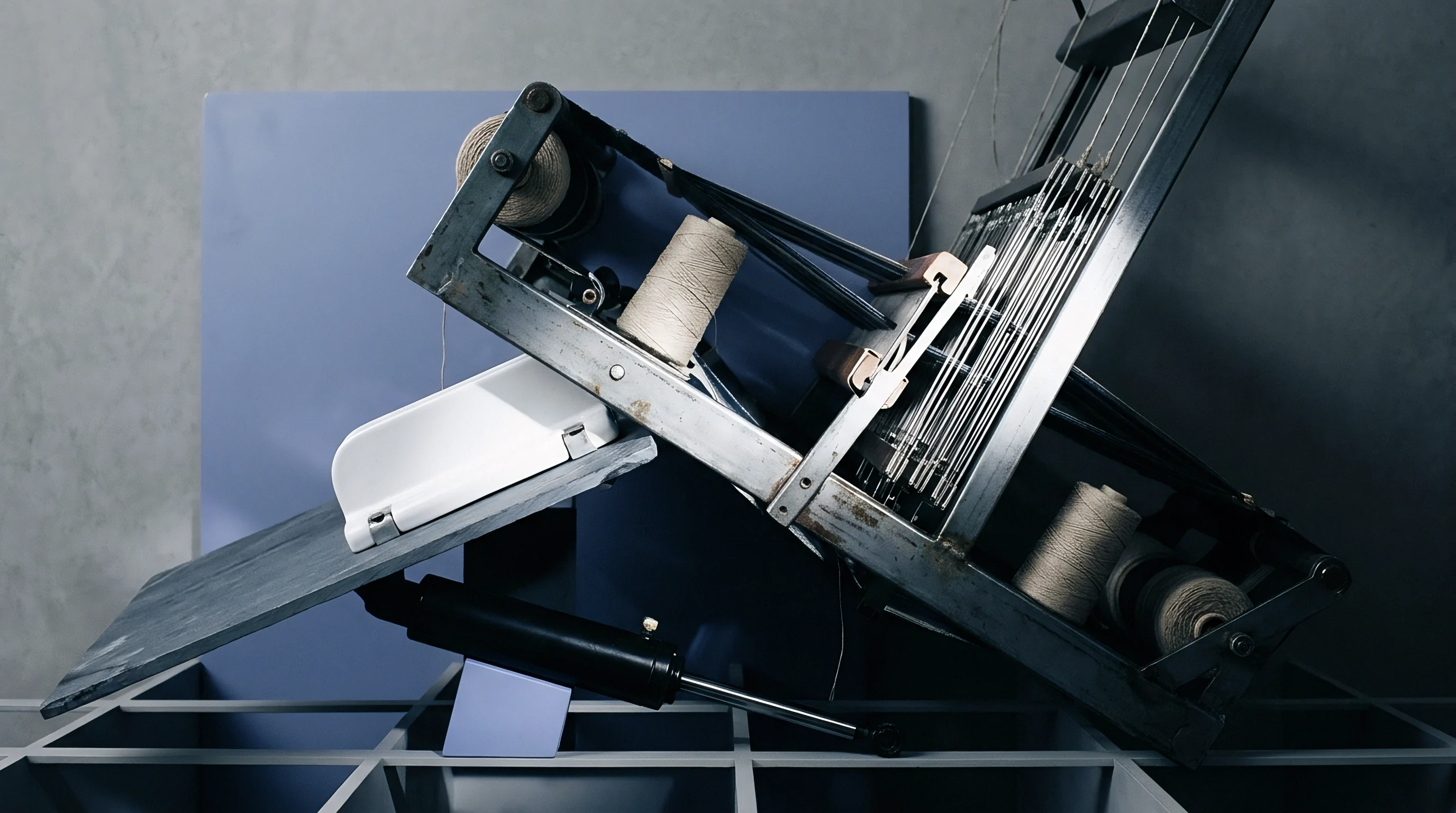
Mechanical Contact and Fiber Fraying Mechanisms
Contact between metal relay nozzles and flax warp ends causes heavy abrasion at high speeds. Hardened stainless steel or ceramic-coated nozzles sweep through the warp sheet hundreds of times a minute. Wet-spun linen carries natural pectin and lignified cell walls that grind against metal guides, wearing down tools while fraying the yarn surface.
Most abrasion occurs along the outer flanks of the nozzle assembly, where warp yarns ride over metal edges during shed transitions. Friction between raw flax and polished steel generates local heat and shreds fibers. Natural slubs and thick places in linen accentuate this contact, breaking down yarn structure.
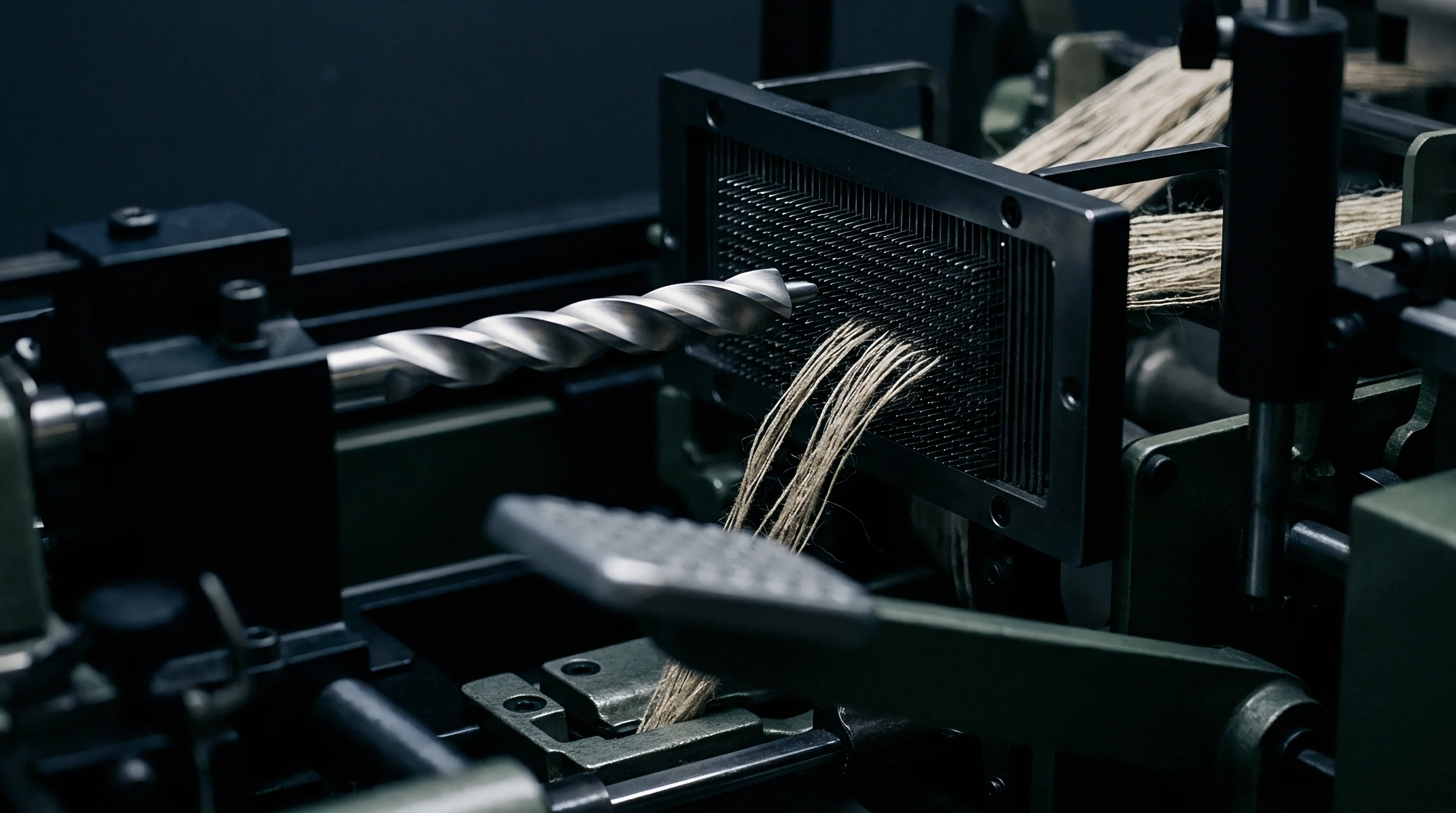
Why Do High Density Linen Sheds Drag Air Flow?
Thousands of stiff, hairy flax fibers spanning the upper and lower sheets make the open shed aerodynamically rough. Dense warps prevent air from venting vertically out of the tunnel. When a relay nozzle fires, static pressure builds inside the enclosed shed rather than escaping through the warp sheet.
This back-pressure wall spreads the air stream laterally, destroying the tight core velocity needed to carry heavy linen filling yarns. Flow speed along the reed axis drops below critical insertion velocity, leaving operators to cut loom speed or crank up compressor pressure.
- Mechanical abrasion on warp ends cuts tensile strength by up to 30 percent, triggering sudden warp breaks behind the drop wires.
- Pectin stripping and fiber shedding coat the relay nozzle body, clogging the fine orifice channels that direct air flow.
- Local yarn twist displacement leaves thin spots in warp ends, exposing fabric to tension band defects.
- Misdirected air streams spill out of the profile reed channel, driving filling yarn into the lower warp sheet and causing heavy weft loops.
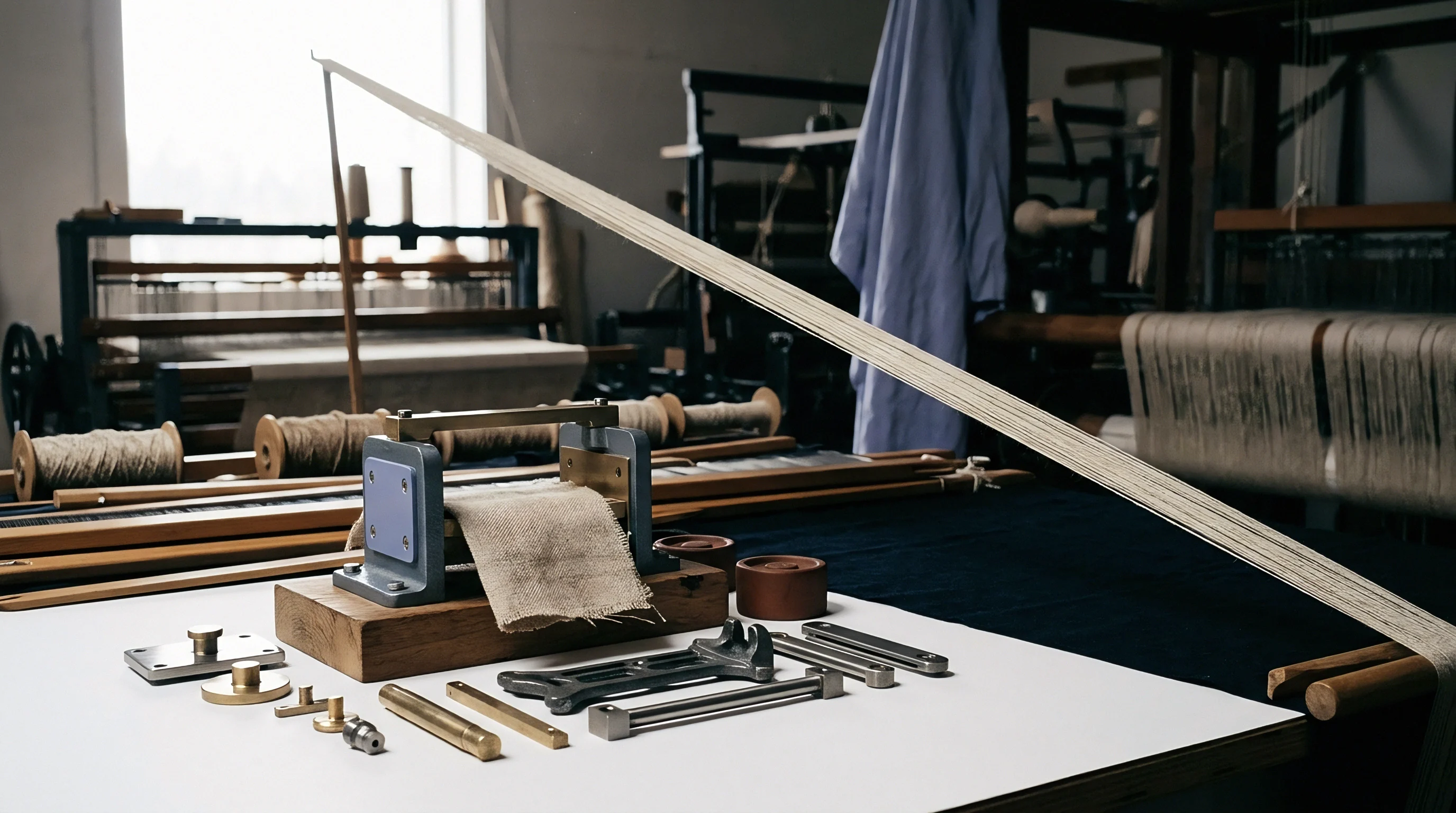
Worked Case on Tension and Air Consumption Balance
Balancing warp tension, relay nozzle air pressure, and shedding performance requires looking at actual operating conditions. Take a 190-centimetre reed width air-jet loom running 100 percent wet-spun linen at 550 picks per minute, with 56 Tex warp yarn at 26 ends per centimetre.
At baseline settings ~ 32 centinewtons base warp tension per end, 0.45 megapascals main nozzle pressure, and 16 relay nozzles running at 0.38 megapascals with an 85-degree blowing angle ~ shed clinging causes 4.2 filling insertion stops per loom hour, while air consumption reaches 1.15 cubic metres per minute standard.
| Case Condition | Warp Tension (cN/end) | Relay Pressure (MPa) | Shed Cling Rate (%) | Stops per Hour | Air Demand (m³/min) |
|---|---|---|---|---|---|
| Baseline Setting | 32 | 0.38 | 14.5 | 4.2 | 1.15 |
| High Tension Shift | 44 | 0.38 | 4.2 | 1.1 | 1.15 |
| High Pressure Shift | 32 | 0.48 | 14.5 | 2.8 | 1.42 |
| Optimized Setting | 40 | 0.42 | 3.1 | 0.6 | 1.26 |
Raising warp tension from 32 to 44 centinewtons per end pulls clinging fibers apart and opens the shed tunnel cleanly. Insertion stops drop from 4.2 to 1.1 per hour with no extra air volume. But running at 44 centinewtons spikes warp breaks by 80 percent because flax fibers embrittle under peak shed extension.
Bumping relay nozzle pressure to 0.48 megapascals at base warp tension cuts filling stops to 2.8 per hour, but drives air consumption to 1.42 cubic metres per minute. The best operating window sets warp tension at 40 centinewtons per end and relay pressure at 0.42 megapascals, balancing shed geometry against yarn strength and power demand.
Operating outside this window causes rapid nozzle wear and forces a full warp re-draw long before the order is finished.
Tolerance
Optimizing Relay Nozzle Timing and Pressure Windows
Managing relay nozzles in dense linen shedding takes fine tuning of air timing and valve angles. Nozzles are grouped across the loom width, usually firing in overlapping pairs or triplets through solenoid valves. Opening duration, measured in degrees of main shaft rotation, dictates air consumption and insertion stability.
In heavy linen weaves, starting the air pulse slightly before the filling yarn tip reaches the nozzle clears a path through protruding fuzz. That advance burst parts clinging threads before the weft arrives. Valve closure must cut air supply instantly as the weft tip passes so trailing fibers are not blown into lower-sheet threads.
Applying an 18-degree advance blowing arc per relay nozzle group eliminates weft tip stalling caused by warp clinging in dense flax constructions.
The main nozzle provides initial acceleration out of the feeder, while relay nozzles maintain steady velocity across the reed. Dense linen yarns need strong main jet force to overcome package pull-off friction, but excessive main pressure damages brittle filling yarns, causing tip separation or stripping.
Machine Adjustments and Setup Protocols
Stable weaving on dense linen warps requires systematic loom setup. Reed alignment, backrest roller height, drop wire tension, and nozzle orientation must all be set within tight tolerances before running a production beam.
- Set backrest roller height 5 millimetres above the center line to increase lower shed tension, holding lower warp threads flat against the race board.
- Adjust asymmetric shed closure timing to 320 degrees of shaft rotation, easing peak warp tension before reed beat-up.
- Verify relay nozzle lateral position with a feeler gauge, maintaining 1.2 millimetres clearance from the back wall of the profile reed channel.
- Calibrate primary and secondary relay valve opening angles to match filling yarn speed across all insertion segments.
- Inspect race board guide covers for burrs or rough spots that could drag on lower warp strands during sley movement.
Setting shed height requires balancing tunnel clearance against yarn strain. Excessive height gives nozzles plenty of room, but fatigues the yarn and causes high warp break rates behind the heald wires.

Quality Inspection Standards and Acceptable Limits
Fabrics woven with heavy nozzle interference show clear defect patterns on the inspection frame. Contact between nozzles and warp yarns leaves abrasion lines parallel to the selvedge, visible as light-reflecting streaks under standard lighting.
ASTM D5430 four-point grading categorizes loom defects by length and severity. Warp abrasion streaks over 230 millimetres add four penalty points to a roll. Misdirected air blasts create filling loops that fold back into the cloth body, drawing heavy penalties in commercial contracts.
Under standard delivery terms governed by ISO 7211 construction guidelines, warp streak defects caused by relay nozzle mechanical interference shall not exceed two minor points per one hundred running metres of finished dense linen cloth.
Outlay
Loom Hour Economics and Capacity Pricing
Weaving dense linen on high-speed air-jet looms alters loom capacity economics. Standard cotton runs on air-jets at efficiencies over 92 percent and speeds of 700 to 900 picks per minute. Heavy linen runs slower ~ often 450 to 600 picks per minute ~ with efficiency dropping to 78 or 84 percent from stops caused by warp clinging, lint buildup, and insertion errors.
Loom capacity is sold in loom hours rather than linear metres. Running at lower speed and efficiency increases the loom hours needed for every metre of cloth. Fixed operating costs ~ weaver labor, electricity, humidity control, and floor space overhead ~ spread across fewer metres, raising baseline production costs per unit length.
Compressed air is the single largest power cost in an air-jet weave room. Running relay nozzles at high pressure to blow through clinging linen warps draws heavy power at the compressor plant. Supplying air at 0.50 megapascals takes roughly 15 percent more electricity than standard 0.35 megapascal lines, directly raising energy costs per metre.
Cost Impact of Yield Drops and Setup Delays
Longer setup times during beam changes further inflate cloth costs. Heavy linen warps require careful drop-wire threading, precise heald wire positioning, and repeated nozzle alignment sweeps before running samples. Setting up a dense linen warp can take up to six hours longer than a cotton style change, adding lost capacity to setup charges.
Yield losses from defect cut-outs directly affect invoice values. Severe nozzle abrasion or recurring filling loops spoil entire fabric sections that must be cut out on the inspection frame. A three percent increase in cut-out waste on expensive flax yarn translates directly into lower operating margins.
| Parameter | Air-Jet (Optimized) | Air-Jet (Over-pressured) | Rapier Loom |
|---|---|---|---|
| Insertion Speed (PPM) | 580 | 520 | 380 |
| Shed Efficiency (%) | 84.5 | 76.0 | 88.0 |
| Air Power Cost (€/m) | 0.14 | 0.22 | 0.00 |
| Warp Break Stops / 10⁵ picks | 1.8 | 4.5 | 0.9 |
| Net Metre Output per Hour | 28.2 | 22.8 | 19.2 |
| Landed Conversion Cost (€/m) | 1.12 | 1.48 | 1.35 |
Running high-density linen on air-jet looms requires aligning technical setup with cost structure. Over-pressuring relay nozzles to gain speed drives up power bills and degrades fabric surfaces through fraying and lint. Slower rapier looms offer a simpler technical route for ultra-dense fabrics, avoiding relay nozzle interference entirely at the expense of lower metre output per hour.
How far can reed modification and active backrest control push maximum warp density on air-jet looms before air propulsion mechanics fail against flax yarn surface drag?