Calculating on Loom Width Draw in for Wet Spun Flax Warps
Calculate wet spun flax reed width by compounding finished width with wet finishing shrinkage, loom pull-in, and weave crimp factors before setting warp ends.

Mechanics
Wet spun flax yarns possess a steep stress-strain gradient that alters warp geometry during shedding. Unlike cotton or synthetic filaments, wet spun linen yarn exhibits low breaking elongation, typically ranging between 2.0 and 2.8 percent. Flax fibers resist elongation.
The bundles of long-line flax fibers are held together by natural intercellular pectins that lock the cellulose microfibrils in place, creating high tensile modulus and near-zero elasticity under weaving tension. When a loom shed opens, the warp ends experience high peak tension spikes rather than elastic yield.
During interweaving, the high stiffness of wet spun flax forces a complex crimp exchange between warp and weft. As the weft pick enters the shed and beat-up occurs, the stiff warp yarn resists bending around the weft, pushing a higher portion of crimp into the weft thread. However, under standard warp tension setpoints on modern rapier or projectile looms, the warp is forced to bend, creating longitudinal warp contraction and lateral draw-in across the cloth fell.
This lateral draw-in pulls the outer selvedges inward, reducing the effective cloth width relative to the reed width on the loom beam.
Pectin swelling alters yarn geometry. When linen yarns absorb atmospheric moisture or wet sizing agents, the lateral yarn diameter increases while yarn length contracts slightly. In dry weaving conditions, dry wet spun yarn relies entirely on mechanical tension balance to dictate draw-in.
The structural rigidity of flax means that weave geometry ~ specifically the float length and crossing frequency ~ directly governs the magnitude of lateral draw-in. Plain weave 1/1 constructions produce maximum interlacing density, generating the highest lateral contraction forces against the loom reed.
The total width reduction from the open reed space to the finished cloth bolt comprises three distinct components: loom draw-in at the fell, off-loom relaxation contraction, and wet finishing process shrinkage. Calculating the initial draw-in width on the loom requires precise isolation of each physical phase. The equation below defines the fundamental relationship between target off-loom greige width and required reed width:
Wreed = fracWgreige1 – Dloom
where Wreed represents the width of the warp in the reed (in centimetres), Wgreige is the target off-loom width before processing, and Dloom is the fractional loom draw-in factor caused by weft beat-up tension and warp crimp conversion.
High-modulus flax warps transfer lateral interlacing stresses directly to the temple teeth rather than absorbing yarn stretch.
| Weave Construction | Warp Crimp (%) | Weft Crimp (%) | Loom Pull-In (%) | Total Width Loss (%) |
|---|---|---|---|---|
| Plain Weave 1/1 | 7.2 | 4.1 | 4.5 | 10.8 |
| Twill 2/1 | 5.8 | 4.8 | 3.6 | 8.9 |
| Twill 2/2 | 5.1 | 5.2 | 3.1 | 8.0 |
| Satin 5-shaft | 3.9 | 6.4 | 2.2 | 6.1 |
| Huckaback 6-thread | 6.5 | 4.5 | 4.0 | 9.7 |
Failing to account for yarn stiffness results in excessive temple tearing, uneven selvedge tension, and unrecoverable width loss during industrial washing.


Reed
Engineers calculate the total width of the warp in the shedding zone using target finished dimensions, crimp values, and shed contraction factors. The loom width determines warp spread. Selecting the correct reed count and denting arrangement ensures that warp threads pass through the reed space without high friction while maintaining uniform end distribution across the cloth fell.
Coarse wet spun yarns (NeL 8 to NeL 18) contain irregular slubs that chafe against reed wires if denting density is too high.

Calculating Total Reed Space
Reed space allocation must account for the active body ends as well as the specialized selvedge ends. Selvedge ends typically utilize double-drawn threads or heavier yarn counts to withstand the lateral pull of the weft pick. The mathematical determination of total reed width follows a structured sequence.
- Establish target finished cloth width in centimetres based on buyer specification.
- Multiply finished width by wet finishing shrinkage allowance to establish greige off-loom width.
- Add calculated loom draw-in width loss derived from weave crimp factors.
- Calculate total body warp ends required by multiplying target greige ends per centimetre by greige body width.
- Add extra warp ends allocated for catch cords and reinforced selvedges.
- Divide total warp ends by chosen ends per dent to calculate minimum occupied reed dents.
Denting Density and End Distribution
Yarn count dictates denting limits. Drawing three or four stiff linen warp ends through a single reed dent increases reed wire friction, leading to warp end breakages and raised surface hairy fuzz. Drawing one end per dent distributes lateral stress evenly but requires a finer, weaker reed wire stock that may deflect under heavy beat-up force when producing high-density linen duck or canvas.
For standard wet spun flax warps of NeL 25 to NeL 30, a denting arrangement of two ends per dent in a 100/10 reed (10 dents per cm) provides optimum clearance. The formula for occupied reed width (Woccuπed) is expressed as:
Woccuπed = fracEbody + EselvedgeDreed × ndent
where Ebody is the number of body ends, Eselvedge is the number of selvedge ends, Dreed is dents per centimetre, and ndent is the number of ends per dent.
Selecting a finer denting count with fewer ends per dent reduces friction on linen warps compared to crowding coarse yarns into wide dents.


Contraction
Dimensional changes in linen fabric occur across two distinct phases between the loom fell and the finished bolt. Greige dimensions fluctuate constantly. The first contraction occurs instantaneously on the loom as the woven cloth releases from machine tension between the fell line and the take-up roller.
The second contraction unfolds during wet finishing, where hot water scouring, bleaching, and tumbling remove sizing agents and relieve residual internal stresses within the flax fibers.
Loom Pull in Dynamics
Loom pull-in represents the lateral narrowing of the fabric while under warp and weft tension during weaving. The weft yarn inserted across the shed is under tension from the feeder brake and rapier clamp. As the reed strikes the weft into the fell, the weft attempts to relax, pulling the outer warp edges inward toward the center line.
High weft insertion speeds accentuate this lateral pull.
Crimp take-up varies by weave pattern. In dense plain weaves, warp end density forces the weft yarn to travel an undulating path. The tension of the weft pulling against this undulating warp generates a net inward force vector.
On a 190 cm nominal loom width, loom pull-in for a wet spun linen plain weave typically consumes 5 to 9 cm of overall width.

Wet Finishing Dimensional Changes
Wet processing exerts a more profound impact on linen fabric width than mechanical loom pull-in. Wet spun flax yarns contain amorphous regions and residual non-cellulosic materials like pectins and hemicellulose. When exposed to hot alkaline scouring baths (80°C to 95°C), these non-cellulosic components soften and swell laterally, causing the yarn diameter to expand while shortening yarn axial length.
Contractual width specifications for wet-spun linen apply strictly to fully conditioned cloth tested under ISO 139 standard atmosphere after three industrial wash cycles.
| Yarn Count (NeL) | Greige Density (Ends x Picks/cm) | Loom Pull-In (%) | Scour & Bleach Shrinkage (%) | Tumble Dryer Relaxation (%) | Cumulative Width Loss (%) |
|---|---|---|---|---|---|
| NeL 14/1 | 14 x 14 | 3.8 | 5.2 | 3.5 | 12.0 |
| NeL 25/1 | 20 x 18 | 4.2 | 4.8 | 3.0 | 11.5 |
| NeL 36/1 | 26 x 24 | 4.9 | 4.1 | 2.5 | 11.0 |
| NeL 50/1 | 32 x 30 | 5.5 | 3.5 | 2.0 | 10.6 |
Mills frequently attribute narrow bolt width to inconsistent yarn batch moisture content rather than improper calculations of loom pull-in factors.

Selvedge
Edge threads experience severe lateral deflection as the fell of the cloth pulls inward relative to the fixed warp alignment. The distance between the reed wire position at beat-up and the cloth position at the temple creates an angular deviation known as the draw-in angle. When this angle grows large, outer warp ends rub intensely against the hard steel reed wires during every shedding motion, causing high yarn abrasion, fuzzing, and eventual warp thread breakage.
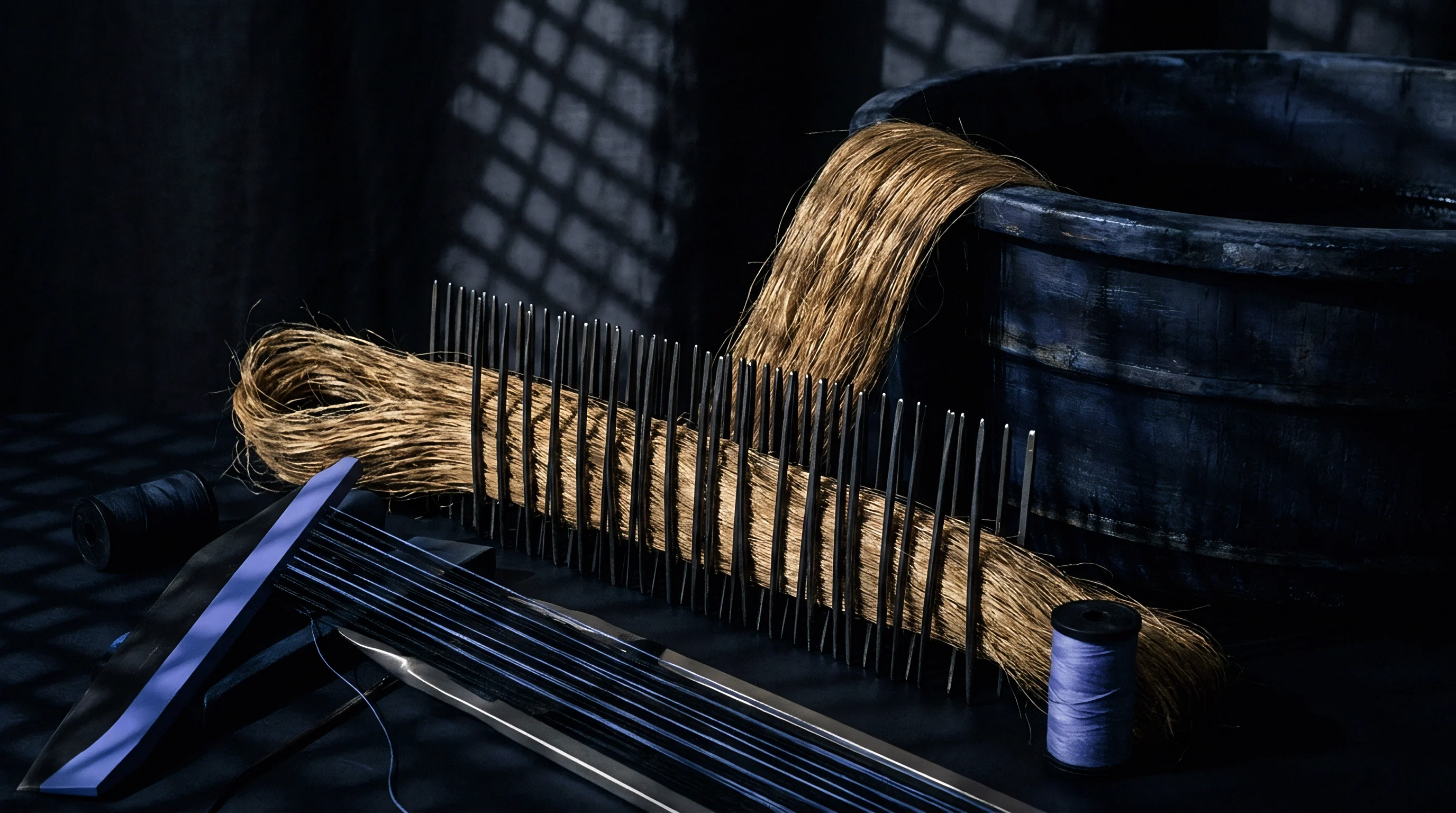
Can Temple Pin Angle Compensate for Excessive Draw in Width?
Temples hold the cloth fell wide. Mechanical ring temples equipped with spiked brass rings grip the fabric edges immediately after the beat-up point to resist lateral cloth contraction. Adjusting the temple ring angles and tooth density holds the fabric to the reed width near the selvedges, reducing the draw-in angle.
However, excessive draw-in width cannot be solved solely by aggressive temple pinning. If the calculated reed space is significantly wider than the natural structural width of the woven construction, temple rings exert extreme tension on the outer edge threads. This results in elongated pin holes, broken edge ends, or torn selvedges during production runs.
Lateral pull damages the reed wires. Selecting the correct temple configuration requires matching pin length, pin angle, and ring count to the specific lea count of the wet spun flax warp.
- Reed Wire Deflection occurs when high lateral warp tension forces outer reed dents to bend inward, causing unequal end spacing and visible warp streaks near the selvedge.
- Selvedge Warp Snap results from peak shedding tension concentrating on the outermost three warp ends due to high draw-in angles exceeding 3.5 degrees.
- Cloth Fell Bowing develops when temple gripping force fails to match central cloth pull-in, creating a curved fell line that causes distortion in cross-weft insertion straightness.
- Temple Ring Abrasion arises when stiff linen fibers scratch brass temple ring segments, transferring metal micro-particles into wet greige fabric edges.
A draw-in angle exceeding three degrees from the reed wire to the temple edge increases selvedge end breakage by 42 percent on rapier looms running above 320 picks per minute.
Whether automated optical sensors can dynamically adjust temple position during weaving to correct selvedge draw-in variations remains an open subject in shedding automation.
Synthesis
A complete calculation sequence demonstrates how construction parameters convert directly into machine setup values. This worked case establishes the total draw-in calculation for a standard commercial wet spun linen plain weave fabric destined for apparel end-use.

Worked Calculation for Wet Spun Plain Linen
Assume a target finished fabric specification requiring 140 cm finished width, a finished weight of 175 g/m², constructed from NeL 26/1 wet spun flax yarn in both warp and weft. Target finished thread density is set at 23.5 ends/cm and 21.0 picks/cm. The parameters governing structural shrinkage are established through laboratory sampling of the target wet finishing route: wet finishing processing width contraction is 5.5 percent, loom pull-in is 3.8 percent, and warp crimp take-up is 5.2 percent.
Tension spikes snap weak slubs. Incorrect reed space yields narrow bolt width. Step-by-step calculation yields the following figures:
Wgreige = fracWfinished1 – Sfinishing = frac1401 – 0.055 = frac1400.945 = 148.15 cm
Wreed = fracWgreige1 – Dloom = frac148.151 – 0.038 = frac148.150.962 = 154.00 cm
Total body warp ends are calculated from target greige width and greige end density. Greige ends per cm (Egreige) equals finished ends per cm multiplied by (1 – Sfinishing), which yields 23.5 × 0.945 = 22.2 ends/cm. Total body ends calculation follows:
Etotalbody = Wgreige × Egreige = 148.15 × 22.2 = 3289 ends
Adding 32 reinforced selvedge ends (16 per side, drawn 4 per dent) gives a total warp count of 3,321 ends. Utilizing a reed with 10 dents/cm (100/10 metric reed count) and a denting plan of 2 ends per dent across the body:
Body Dents = frac32892 = 1645 dents
Selvedge Dents = frac324 = 8 dents
Total Dents Occuπed = 1645 + 8 = 1653 dents
Wactualreed = frac1653 dents10 dents/cm = 165.3 cm
| Assumed Loom Pull-In (%) | Calculated Reed Space (cm) | Actual Greige Off-Loom Width (cm) | Final Delivered Finished Width (cm) | Specification Conformance Status |
|---|---|---|---|---|
| 2.5 | 151.9 | 148.1 | 139.9 | Within Tolerance (-0.1 cm) |
| 3.8 (Baseline) | 154.0 | 148.1 | 140.0 | Target Exact (0.0 cm) |
| 5.0 | 155.9 | 148.1 | 140.1 | Within Tolerance (+0.1 cm) |
| 6.5 | 158.4 | 148.1 | 140.3 | Out of Tolerance (+0.3 cm, High Reed Friction) |
Loom-Shed Technical Verification Checklist
Before launching high-volume production of wet spun flax warps, engineers complete formal technical verification steps.
- Shed Opening Clearance verify that the reed width does not exceed the maximum harness frame width allowance on rapier shedding looms.
- Temple Tooth Engagement confirm that temple ring pins penetrate the selvedge without piercing body ends past the 15 mm edge border.
- Warp Beam Flange Alignment measure warp position on the weaver beam to guarantee straight end flow into the drop wires without lateral splay angles.
- Off-Loom Width Sampling measure greige cloth width at five points across the first ten metres off the loom fell to validate initial loom pull-in estimates.
Excessive reed width allowance causes outer warp ends to chafe against reed dent wires during every shed opening.
Standard procurement contracts mandate that any finished cloth falling more than two centimetres below target specified width triggers a automatic ten percent pricing penalty per linear metre.

Settlement
Financial performance in linen weaving rests on controlling width tolerances to protect pattern yield during garment cutting. Off-spec width destroys cutting yield. Over-width warps consume excess shed space.
When a loom shed miscalculates draw-in on wet spun flax warps, the financial consequences accumulate rapidly across machine hour allocation, yarn consumption, and mill productivity metrics.

Metre Yield Accounting
Weaving mills quote prices based on linear metres produced at a fixed nominal width. If an underestimated draw-in factor results in a finished fabric width of 136 cm instead of a contracted 140 cm, garment manufacturers cannot lay down standard cutting markers. The full roll lot faces commercial rejection or requires heavy price discounting.
Conversely, over-compensating for draw-in by specifying an excessively wide reed space wastes raw flax yarn. Wet spun long-line flax yarn represents over 60 percent of total greige manufacturing cost. Adding unnecessary reed width consumes extra warp ends per metre without increasing sellable fabric yield, directly reducing the mill’s gross operating margin per loom hour.
Loom Shed Efficiency Losses
Incorrect draw-in assumptions degrade loom shed operational metrics. Excessive lateral draw-in angles increase outer warp end breakage rates. Every warp break stops the loom, decreasing shed efficiency percentages and raising labor costs per woven bolt.
A drop in loom efficiency from 88 percent to 78 percent caused by selvedge breaks increases machine hour cost by 12.8 percent on high-speed rapier equipment.
Calculations of draw-in for wet spun flax warps establish the baseline for accurate mill quotation, sizing recipe formulation, and warping machine creel setups. Precision in these upfront geometrical calculations preserves raw material, protects loom productivity, and secures commercial compliance on finished linen orders.