Calibrating Optical Vision Scanners against Chemical Extraction Baseline Weights
Optical vision scanners estimate surface impurity area but require routine calibration against gravimetric chemical extraction weights to verify true clean fibre yield.


Sensor
Line cameras mounted above flax processing conveyors capture reflected radiation to map particle dimensions across moving fibre webs. High-speed charge-coupled device units scan carded sliver and scutched flax at line velocities exceeding sixty metres per minute, recording surface discontinuities against calibrated greyscale backgrounds. The automated apparatus quantifies non-cellulosic matter by converting contrasting pixel clusters into estimated surface areas.
European Flax technical rules require certified scutchers to document cleanliness ratings on delivery manifests. Processing mills in Jiangsu and Zhejiang rely on automated web assessment benches to clear raw fibre shipments for high-count dry and wet spinning routines. The main practical difficulty comes from converting two-dimensional optical areas into physical mass.
Bale tags record gross receipts, while optical cameras capture projected surface area. Because surface reflectivity alters pixel counts, bast fibres present complex topographies that scatter light unevenly. Dew-retted flax harvested across Normandy or Flanders carries varied grey and charcoal tones left by fungal microflora during field retting.
Unretted woody core tissue, known as shive, shows pale yellow or light brown coloration with higher specular reflectance under white light-emitting diodes. Automated scanning units classify any grouping of darkened or discolored pixels above a set contrast threshold as foreign vegetable matter. The detector logs boundary coordinates, computes the enclosed square millimetres, and calculates a contamination index relative to the inspected web area.
Line-scan vision arrays register dark surface perimeters while leaving dense woody fragments inside the sliver core undetected.
Planar image capture records two dimensions while physical mass occupies three. A thin, flat epidermal peel measuring four square millimetres presents the exact optical boundary signature of a dense, thick shive fragment spanning four square millimetres. The internal cell structure of woody core cells contains porous lumens with an apparent density near 0.28 grams per cubic centimetre.
Pure flax bast bundles exhibit compact, crystalline cellulosic walls with a true density approaching 1.52 grams per cubic centimetre. Converting optical area straight into mass fractions using a static geometric multiplier introduces systemic errors into incoming lot acceptance sheets.

Line Scan Array Limitations
Automated imaging benches operating in dry-spinning card rooms encounter three structural blind spots during standard continuous inspection runs.
- Optical Density Blindness prevents the camera from evaluating particle thickness, recording paper-thin cortical skins as identical in substance to solid woody shive fragments.
- Specular Glare Artifacts emerge when high-intensity LED illuminators reflect off crystalline flax wax coatings, bleaching out low-contrast woody fragments against bright blonde straw.
- Velocity Smear Distortion lengthens the calculated profile of transverse shive slivers when conveyor belts accelerate beyond line-rate synchronization frequencies, inflating reported surface metrics by twelve to eighteen percent.

Cross Sectional Shadowing Mechanics
Fibre webs running across high-speed delivery aprons possess significant physical depth. Card slivers delivered to draw frames present a three-dimensional bundle thickness varying from three to eight millimetres depending on sliver metric count. Bast bundles situated along the upper surface shield underlying strata from the focal plane of overhead lens systems.
Shadowed particles escape detection. Dense woody shives trapped inside the interior core pass across the optical inspection zone without reflecting photons to the camera lens. Mill operators auditing incoming tow bales find that optical purity readings consistently overestimate sliver cleanliness whenever web areal density exceeds three hundred grams per square metre.
While optical cameras register surface defects relevant to mechanical spinning performance, they miss non-cellulosic mass fractions that only chemical extraction can measure.


Solvent
Quantitative chemical analysis provides the absolute physical reference benchmark against which factory imaging systems must align. Standardized testing according to ISO 1833 and ASTM D629 relies on selective gravimetric dissolution to separate pure crystalline cellulose from non-cellulosic waxes, pectins, hemicelluloses, and lignin-rich shive fragments. Laboratory technicians extract five-gram specimen tufts drawn from randomized core borings across incoming bale lots.
Thermal ovens drive out water. The testing procedure utilizes Soxhlet glass extractors to strip lipophilic constituents before subjecting remaining fibre bundles to controlled aqueous chemical digestion. Gravimetric balances recording tare masses to four decimal places establish the true dry weight proportions of individual bast components.
Hot organic reagents and boiling solutions strip the binding pectin lamellae that hold individual ultimate fibres into composite commercial bundles. Petroleum ether or ethanol-toluene mixtures extract cuticular waxes, fats, and residual plant resins during initial extraction cycles lasting four hours. Subsequent digestion in a boiling solution of one-percent sodium hydroxide removes intercellular pectin matrices and amorphous hemicelluloses without degrading the crystalline cellulosic backbone.
The insoluble residue collected on sintered glass crucibles represents the physical mass of cleaned bast fibre alongside mechanically detached woody shive.
Specifying ISO 1833 extraction baselines inside the purchase contract shifts lot rejection rights back to the importer when yarn slub counts exceed limits.
The resulting chemical baseline decouples visual web appearance from actual clean fibre yield. Where an inline optical scanner registers an apparent contamination figure of 1.15 percent based on surface pixel contrast, chemical extraction routinely reveals non-cellulosic mass fractions ranging from 4.50 to 7.80 percent of dry initial weight. The difference represents dissolved intracellular waxes, soluble pectins, and concealed cortical tissue invisible to optical imaging sensors.
Yarn spinners who size production lots solely on optical inspection data suffer severe drafting interruptions, spindle stoppages, and yarn count irregularities during downstream wet ring spinning.

Why Discard Raw Pixel Area Unadjusted?
Raw pixel counts fail because bast fibre surfaces possess dynamic optical properties that change under humidity and retting variables. Dew retting darkens bast fibres. Over-retted European flax straw contains dense populations of Cladosporium herbarum fungi, creating melanin pigmentation throughout the cortical tissue.
Optical vision software identifies these dark fungal stains as foreign matter particles, reporting severe contamination levels across completely clean fibre bundles. Conversely, water-retted or chemically under-retted flax displays uniform pale flaxen hues where light-colored woody shives blend into adjacent bast bundles, escaping detection entirely.
| Constituent Fraction | Extraction Reagent | Target Temperature | Duration | Typical Mass Fraction |
|---|---|---|---|---|
| Free Cuticular Waxes | Petroleum Ether | 40 to 60 °C | 4 hours | 1.20 to 1.85 percent |
| Vegetable Fats and Resins | Ethanol (96 percent) | 78 °C | 4 hours | 0.80 to 1.40 percent |
| Intercellular Pectins | Ammonium Oxalate (0.5 percent) | 85 °C | 2 hours | 1.90 to 3.20 percent |
| Hemicellulose Matrix | Sodium Hydroxide (1.0 percent) | 100 °C | 1 hour | 2.50 to 4.10 percent |
| Residual Lignified Shive | Insoluble Crucibles (Physical Separation) | Ambient | Manual wash | 0.40 to 3.50 percent |
| Crystalline Bast Cellulose | Insoluble Residue (Final Tare) | 105 °C Dry | Constant mass | 82.00 to 88.00 percent |
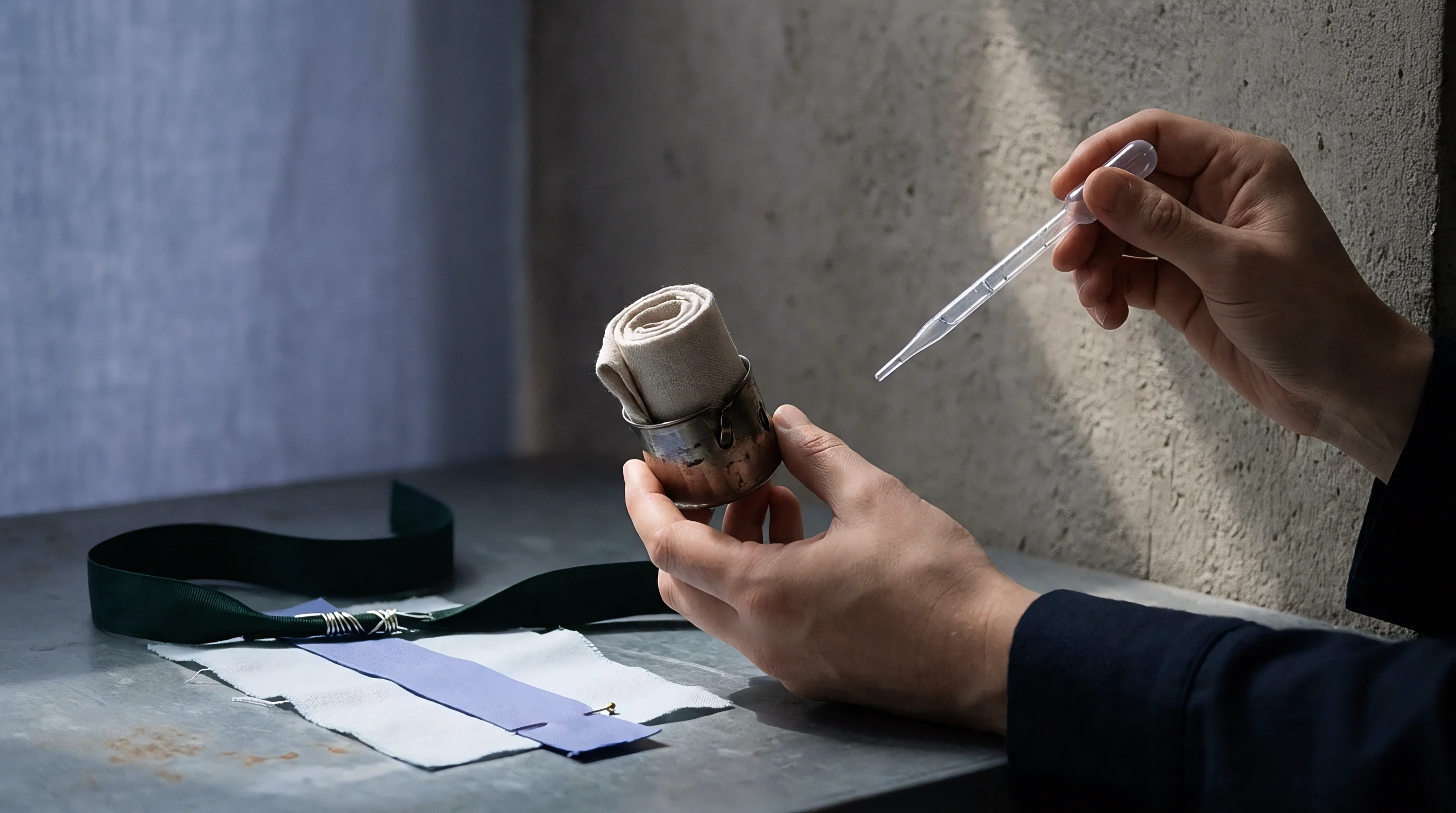
Gravimetric Dissolution Sequences
Accurate calibration mandates an unbroken sequence of chemical processing steps executed on matched split-sample lots.
- Specimen Conditioning stabilizes sample moisture at standard laboratory atmosphere of twenty degrees Celsius and sixty-five percent relative humidity prior to primary tare recording.
- Solvent Dewaxing strips external fats and protective wax barriers in a Soxhlet apparatus to allow subsequent aqueous reagents complete access to intercellular pectin bonds.
- Alkaline Digestion dissolves non-cellulosic polysaccharides in boiling one-percent sodium hydroxide, freeing encrusted shive particles from bast bundles for mechanical mesh filtration.
- Gravimetric Filtration collects cleaned insoluble cellulose and isolated shives onto pre-weighed sintered glass filtering crucibles under moderate vacuum pressure.
- Desiccator Cooling prevents hygroscopic moisture uptake during the balance transfer step, ensuring final dry baseline weights achieve analytical repeatability within 0.02 grams.
Field experience dictates that when solvent extractables exceed three percent of dry sliver weight, optical scanner readings must be adjusted downward by an empirical scaling coefficient to avoid overestimating usable cellulose content.


Tare
Gravimetric truth begins with the balance tare. Industrial weighing vessels, sintered glass crucibles, and drying tins gain and lose atmospheric moisture rapidly when exposed to laboratory environments. Technicians establish the baseline tare weight of every extraction vessel after heating it to 105 degrees Celsius for two hours and cooling it inside an airtight silica-gel desiccator.
Moisture regain alters physical density. Dry mass governs settlement pricing. Pure bast fibres contain a standard legal moisture regain allowance of twelve percent under ISO 6741 regulations, whereas dry woody shive stabilizes near nine percent under identical ambient vapor pressures.
Extracted shive baseline weights exceed uncalibrated optical projection figures by 1.84 percent in dew-retted tow lots carrying heavy cortical adhesion.
The mathematical reconciliation connecting optical scanner surface metrics to chemical extraction weights demands an empirical calibration transfer equation. An automated inspection system registers a total projected contamination area, denoted as optical area index square millimetres per linear metre of sliver. Laboratory bench extractions determine the true gravimetric dry mass of shive recovered from that exact sampled section.
Correlating these variables across successive calibration runs generates a non-linear polynomial curve that corrects for web thickness and fiber pack density.
| Lot Designation | Origin Retting Style | Scanner Area Metric | Extracted Dry Shive | Total Extractable Residue | Gravimetric Variance |
|---|---|---|---|---|---|
| Lot A-410 Scutched Tow | Normandy Dew-Retted | 1.12 percent | 2.45 percent | 6.85 percent | +1.33 percent |
| Lot A-418 Long Bast | Belgian Dew-Retted | 0.45 percent | 1.10 percent | 4.20 percent | +0.65 percent |
| Lot C-102 Carded Sliver | French Dew-Retted | 1.68 percent | 3.52 percent | 7.95 percent | +1.84 percent |
| Lot H-055 Scutched Flax | Heilongjiang Domestic | 2.10 percent | 4.80 percent | 9.15 percent | +2.70 percent |
| Lot Z-882 Combed Top | European Flax Tops | 0.15 percent | 0.42 percent | 2.80 percent | +0.27 percent |
| All figures represent dry mass percentages reconciled after four-hour Soxhlet extraction and one-percent sodium hydroxide digestion. | |||||

Mass Deficits in Retting Residues
Consider a practical calibration reconciliation performed on a commercial production lot. Take a 40-tonne consignment of dew-retted European Flax tow delivered to a spinning facility in Jiangsu at 4.20 dollars per kilogram clean dry basis. The mill vision scanner samples two hundred metres of carded sliver representing twenty kilograms of web, reporting an optical shive index of 1.30 percent by surface area.
The spinning master assumes a mechanical yield of 98.70 percent pure cellulose based on this electronic scanner manifest.
Parallel quantitative chemical extraction executed on six randomized two-hundred-gram composite sub-samples reveals a completely different mass distribution. Chemical digestion dissolves 1.45 percent non-cellulosic waxes and fats, 3.20 percent soluble pectins and hemicelluloses, and isolates 2.65 percent dry woody shive retained on fine wire sieves. The true clean bast cellulose yield equals 92.70 percent.
The uncalibrated optical scanner under-reported solid vegetable impurity mass by 1.35 percentage points while missing 4.65 percentage points of soluble non-cellulosic matrix. On a 40-tonne contract, this unaccounted mass deficit represents 2,400 kilograms of non-spinnable material, translating directly to a financial loss of 10,080 dollars in unrecoverable processing waste during subsequent wet preparation.

Dry Weight Correction Mathematics
Calibrating the scanning system requires programming a multi-variable correction algorithm into the vision processing software. The system calculates true contaminant mass per hundred grams of sliver using four primary variables derived from physical chemical extractions.
- Apparent Optical Fraction represents the raw unadjusted two-dimensional pixel area reported by camera sensors across the scanning zone.
- Volumetric Packing Factor adjusts the baseline calculation for the mechanical bulk density and gram-per-metre weight of the advancing fibre sliver.
- Retting Attenuation Constant compensates for grey fungal pigmentation shifts that darken dew-retted bast bundles relative to unretted golden shive tissue.
- Solvent Extractable Offset incorporates the baseline mass loss attributed to invisible amorphous pectins and waxes known to inhabit that specific seed variety and growth region.
The unresolved question remains whether high-speed line scanners can ever autonomously adapt their correction curves when spinning mills blend European Flax long fibres with domestic Heilongjiang tow across identical carding lines without recalibrating gravimetric balances daily.


Drift
Optical hardware performance decays progressively under real factory conditions. Industrial linen mills operate wet preparation and dry carding rooms characterized by floating airborne fibrillar dust, micro-droplets of processing lubricants, and broad thermal swings. Silicon image sensors suffer dark current rise as ambient operating temperatures inside electrical enclosures climb from twenty to forty-five degrees Celsius during summer production runs.
Lens surfaces collect thin coatings of volatile organic spins finishes and fine bast dust, scattering light and attenuating high-frequency pixel contrast edges. A vision camera calibrated on Monday morning systematically drifts off baseline by Friday afternoon.
Fluctuations in ambient humidity swell the bast sheath while leaving shive geometry unchanged. When relative humidity in the carding shed rises from fifty-five to seventy-five percent, dry flax bast bundles absorb atmospheric moisture rapidly, expanding their cross-sectional diameter by up to twenty percent. Woody shive fragments absorb moisture more slowly and demonstrate significantly less transverse swelling.
This uneven dimensional expansion alters the relative surface area ratio across the moving web, leading uncorrected vision systems to report an artificial drop in foreign matter contamination when absolute contaminant weight remains identical.
Ambient mill humidity swells the bast sheath while leaving shive geometry unaltered.
Maintaining analytical stability requires structured calibration verification routines tied directly to offline gravimetric testing intervals. Spinning mills running certified European Flax yarn lots verify scanner baseline parameters at scheduled shifts. When quality controllers skip periodic gravimetric recalibration, scanner drift leads production managers to alter drawing drafts and comber settings improperly, generating yarn with excessive thick places, high slub counts, and unexpected dye resist rings that surface only after finished fabric piece-dyeing.
| Operational Factor | Physical Mechanism | Scanner Drift Tendency | Baseline Weight Deviation | Correction Frequency |
|---|---|---|---|---|
| Sensor Enclosure Heat | Thermal dark current accumulation | Over-reports dark shive pixels | +0.40 to +0.85 percent | Every 24 operating hours |
| Airborne Lint Accumulation | Lens scatter and contrast reduction | Under-reports low-contrast defects | -0.60 to -1.20 percent | Every 8-hour shift change |
| Sliver Moisture Uptake | Hygroscopic bast bundle swelling | Under-reports relative shive area | -0.35 to -0.75 percent | Continuous hygrometer sync |
| LED Illuminator Decay | Luminous flux output degradation | Distorts greyscale threshold map | +0.50 to +1.10 percent | Monthly lux meter verify |
| Carding Speed Changes | Motion blur across linear pixel path | Artificially widens defect area | +0.30 to +0.90 percent | Automatic encoder locking |

Are Inline Optical Drift Thresholds Defensible?
Inline alarm thresholds hold commercial validity only when backed by an unbroken chain of custody linked to physical extraction logs. When an automated line scanner flags an incoming bale lot as exceeding maximum allowable defect thresholds, Chinese mills often issue immediate chargebacks or demand fiber downgrades. Unless the scanning hardware carries verifiable calibration logs tied back to analytical balances holding valid ISO 17025 certification seals, such commercial rejections fail during formal arbitration.
Importers successfully contest supplier downgrades whenever mill inspection systems rely on factory-default optical algorithms unverified by wet chemical extraction audits.
Failure to maintain strict calibration alignment between inline optical cameras and gravimetric chemical standards exposes yarn buyers to severe downstream financial liabilities, resulting in customer fabric rejections, commercial chargebacks, and unrecoverable air-freight replacement expenses.


Settlement
Commercial contracts governing raw flax and processed sliver purchases require explicit language defining how clean fiber mass is determined at the discharge port. European Flax and Masters of Linen certified fibres command substantial market surcharges ranging from forty to eighty cents per kilogram above uncertified alternatives. Buyers pay these premiums based on certified origin documents and declared cleanliness ratings.
When goods arrive at spinning mills, incoming quality acceptance protocols must harmonize optical scanner logs with gravimetric chemical extraction baselines to prevent contentious invoice disputes.
Mass balance admits no shadows. Spinners pay for delivered yield. Sourcing agreements drafted by experienced trading houses incorporate definitive testing hierarchy clauses into purchase specifications.
Standard contract provisions establish that high-speed optical scanner logs serve solely as preliminary screening tools for rapid incoming lot triage. Whenever scanner readings diverge from origin invoice declarations by more than 0.50 percentage points, the contract binds both buyer and seller to settle invoice balances based exclusively on third-party gravimetric solvent extraction executed under ISO 1833 guidelines.
Proof of origin remains inextricably bound to physical purity verification. Scutched flax straw grown in Western Europe carries distinctive chemical profiles, with wax-to-pectin ratios reflecting oceanic temperate growth conditions. When laboratory extraction baselines reveal abnormal non-cellulosic mass fractions exceeding nine percent combined with atypical lignin signatures, technical auditors immediately investigate whether low-grade domestic tow was blended into the European consignment during carding.
Calibrating the mill optical inspection equipment against rigorous chemical extraction baselines protects the buyer against commercial fraud, regulatory origin penalties, and false sustainability certifications.

Contractual Allocation of Yield Variance
Purchase contracts covering certified linen sliver require precise mathematical provisions governing moisture-adjusted clean yield reconciliations.
Settlement invoices calculate payable mass by multiplying certified bill-of-lading net weight by the ratio of chemically extracted clean cellulose yield divided by the declared contract purity baseline. If a mill delivers fiber showing 88.50 percent clean cellulose against a 92.00 percent contract specification, the buyer applies an immediate pro-rata price reduction across the entire lot invoice. This contractual mechanism eliminates supplier debates regarding camera threshold sensitivities or lighting angles by anchoring final payment directly to the true dry mass of usable spinning material.

Documentary Cross Checks at Mill Discharge
Final acceptance dossiers assembled by cross-border sourcing desks combine four mandatory compliance documents before commercial funds release.
The complete audit packet contains the European Flax Scope Certificate validating producer certification, the matching Transaction Certificate naming the specific shipping lot numbers, the inline optical scanner web inspection log recording gross defect maps across every running sliver metre, and the independent ISO 17025 accredited laboratory test report detailing gravimetric chemical extraction baseline weights. Harmonizing the physical laboratory weights with electronic camera logs provides immutable evidence of compliance during customs origin audits and commercial arbitration challenges.
Purchase contracts incorporate standard arbitration clauses stipulating that laboratory gravimetric extraction baseline weights supersede optical scanner readouts in all matters of invoice adjustment, quality grading, and commercial claim resolution.