Wet Spun Flax Yarn Tensile Strength Testing Baseline Methods
Wet spun flax yarn tensile strength testing requires ISO 2062 CRE methods at 500 mm gauge length with capstan grips under standard 65% RH regain balance.


Moisture
Thermal softening of inter-cellular pectins during wet spinning generates a tightly aligned cellulosic strand structure that reacts aggressively to ambient relative humidity during tensile evaluation. Water molecules enter the amorphous regions of the flax elementary fibers, swelling the cell walls and activating hydrogen bond reorientation under tension. This physical response causes wet spun linen strands to gain breaking force when wet, departing sharply from the behavior observed in cotton, silk, or synthetic continuous filaments.
Wet spun flax strands tested at full moisture saturation exhibit up to thirty percent higher breaking tenacity than identical spools evaluated under standard dry lab conditioning.
Atmospheric Balance Standard
Laboratory testing strictly follows ISO 139 parameters, maintaining an environment of 20 ± 2 °C and 65 ± 4 % relative humidity. Packages stored on wooden crates require a minimum of 24 hours of forced conditioning to establish internal moisture equilibrium before mounting onto tensile test benches. Inadequate equilibrium time leaves thermal gradients across outer and inner yarn layers, introducing artificial variation into single-strand force-displacement curves.
Dry yarn exhibits lower extension.
Hydration Tenacity Mechanics
During wet drafting, flax ultimate fibers slide past each other as soft pectin binders yield inside the liquid trough. Once dried onto bobbins, these technical fibers lock into place under high longitudinal stress. Reintroducing moisture relaxes residual internal shear stresses, enabling micro-fibril realignment along the fiber axis during mechanical loading.
Tensile strength reaches peak values between 12 % and 14 % moisture regain, beyond which liquid film lubrication between outer ultimate fibers begins to cause slip failures.
| Yarn Type | Nominal Count (Nm) | Conditioning State | Moisture Regain (%) | Breaking Tenacity (cN/tex) | Elongation at Break (%) |
|---|---|---|---|---|---|
| Wet Spun Linen | 26 | Standard Lab (20°C / 65% RH) | 12.2 | 31.5 | 2.1 |
| Wet Spun Linen | 26 | Water Saturated (Wet Test) | 28.5 | 38.2 | 2.8 |
| Wet Spun Linen | 40 | Standard Lab (20°C / 65% RH) | 11.8 | 34.0 | 1.9 |
| Dry Spun Flax | 10 | Standard Lab (20°C / 65% RH) | 11.5 | 16.8 | 3.4 |
| Dry Spun Flax | 10 | Water Saturated (Wet Test) | 26.0 | 18.1 | 3.8 |
A testing facility evaluating raw wet spun linen yarn without environmental controls generates tenacity figures that drift across seasons, leading buyers to accept weak warps that fail in high-speed rapier sheds.


Grip
Inelastic bast fiber yarns rupture at lower axial strain than cotton strands, concentrating stress at the clamp interface during tensile testing. Low strain tolerance of wet spun flax (1.8 % to 2.8 % total elongation) means any jaw edge indentation or pinching generates artificial stress risers. Standard flat rubber jaw faces fail when applied to smooth, highly twisted flax strands, resulting in premature jaw breaks or progressive strand slippage under load.
Flax fibers align under tension.

Jaw Face Selection
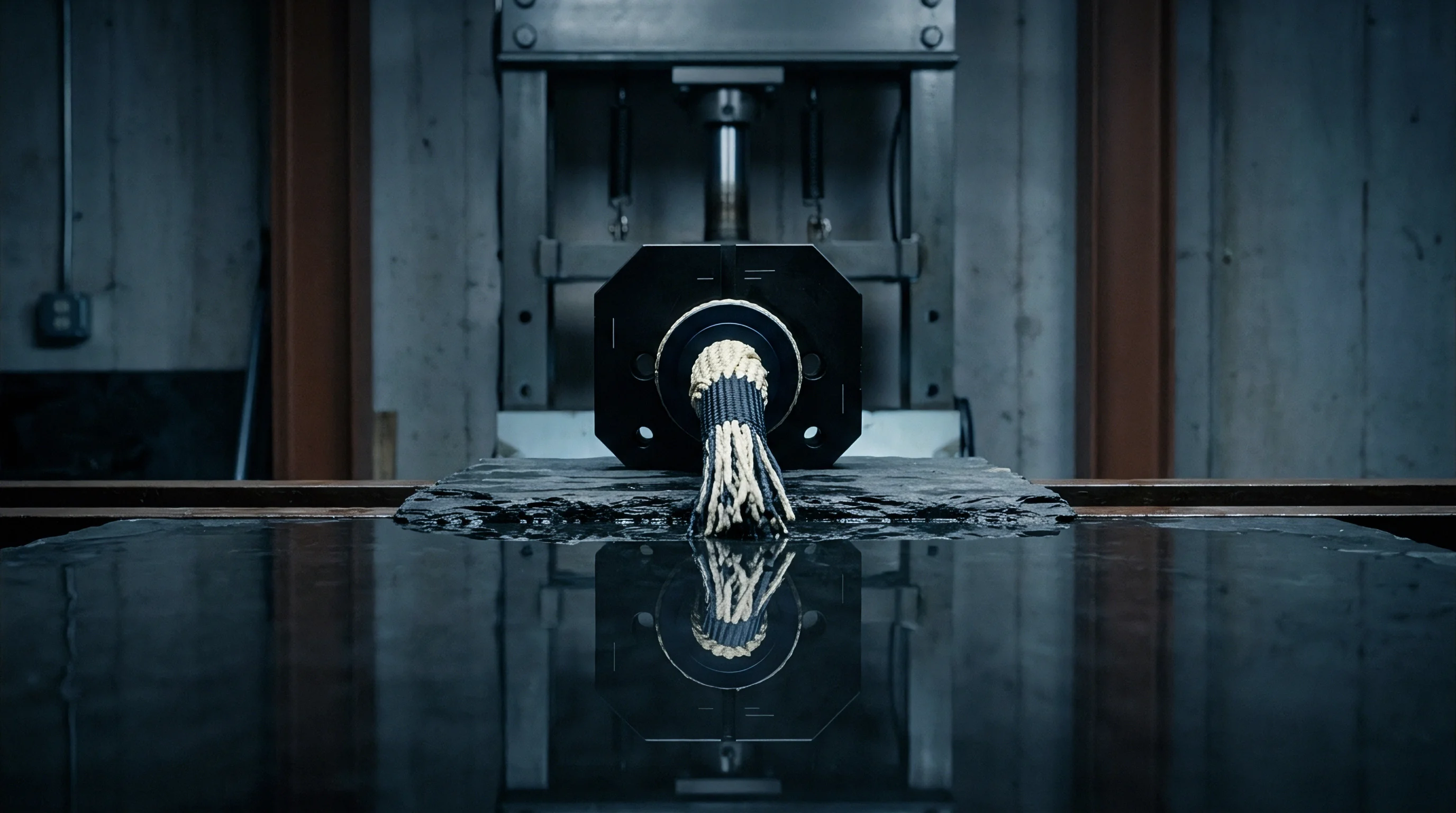
Flat pneumatic clamps equipped with smooth polyurethane or hard rubber face inserts (80 to 90 Shore A durometer) accommodate mild linear density variations across technical flax fibers. High-tenacity strands demand horn-style or capstan pneumatic grips, wrapping the strand around a curved surface before final clamping. Capstan geometries distribute braking friction across the circumference of the metal bollard, reducing stress concentrations at the jaw exit to under ten percent of peak load.
Capstan surfaces prevent throat pinch.
- Jaw pinch severance occurs when excessive clamping air pressure crushes the crystalline flax fiber core, resulting in immediate structural failure precisely along the upper rubber contact line.
- Flat face slippage arises when clamping force falls below the minimum grip threshold, permitting the strand to slide out of the jaws and registering false elongation figures.
- Moisture squeeze migration happens when damp or wet spun yarn bundles release internal water under high clamp compression, changing friction dynamics at the rubber boundary layer.
- Throat line abrasion takes place when high yarn twist forces individual technical fibers to drag against unrounded metallic jaw edges during rapid strain ramp-up.
Capstan pneumatic grips maintaining 0.45 MPa air pressure eliminate jaw break frequencies down to less than three percent of total continuous test runs on 26 Nm linen.
Pneumatic Line Dynamics
Maintaining uniform pneumatic force prevents mechanical slip while suppressing crush damage. Automated constant-rate-of-extension benches use regulating valves set between 0.35 MPa and 0.50 MPa depending on yarn linear density. Higher air pressure collapses the tubular structure of flax ultimate fibers, converting high-grade wet spun yarn into damaged material that snaps prematurely under load.
Inappropriate jaw geometry shifts break locations to the clamp boundary, invalidating testing lots and forcing mill laboratories to re-sample expensive yarn shipments at significant landed cost.


Gauge
Instrument settings defined under ISO 2062 Method A establish single-end tensile protocols for textile yarns using constant-rate-of-extension machinery. Testing wet spun flax requires a fixed gauge length of 500 ± 1 mm, though 250 mm settings are permitted for specialized high-twist samples. Because flax fibers contain structural micro-cracks and nodes along technical bundle lengths, longer test lengths expose more critical flaws, reducing average measured breaking strength in accordance with Weibull weakest-link mechanics.
Weakest link governs line failure.

Constant Rate Extension Protocol
Testing equipment must maintain a constant extension speed of 500 mm/min or an adjustable crosshead velocity that forces single-strand rupture within 20 ± 3 seconds. Pre-tensioning the strand before clamp closure prevents slack-induced strain distortion. Applied pre-tension stands at 0.5 ± 0.1 cN/tex, pulling the strand taut without extending the natural crimp produced during spinning package winding.
- Set pneumatic jaw separation to exactly 500 mm using an external optical calibration bar.
- Condition packages for 24 hours at 20 °C and 65 % relative humidity inside the testing enclosure.
- Load single strands into capstan clamps under a pre-tension of 0.5 cN per tex.
- Engage extension drive at a constant speed of 500 mm per minute until rupture occurs.
- Record peak breaking load and elongation percentage while discarding breaks within 5 mm of clamp line.
- Repeat across twenty package samples to extract mean breaking tenacity and coefficient of variation.
ISO 2062 mandates that any specimen snapping within 5 mm of the jaw edge must be discarded if the break load falls below ninety percent of the sample mean strength.
| Gauge Length (mm) | Crosshead Speed (mm/min) | Mean Breaking Force (cN) | Breaking Tenacity (cN/tex) | Tenacity Coefficient of Variation (%) | Weibull Shape Parameter (m) |
|---|---|---|---|---|---|
| 100 | 100 | 1320 | 34.3 | 11.2 | 6.8 |
| 250 | 250 | 1260 | 32.8 | 13.5 | 5.9 |
| 500 | 500 | 1210 | 31.5 | 15.8 | 5.1 |
| 1000 | 1000 | 1140 | 29.6 | 18.2 | 4.4 |
According to standard commercial delivery specifications, contracts specifying single-end yarn breaking strength without fixing gauge length and clamp traverse rate permit suppliers to quote figures derived from artificially short test spans.

Variance
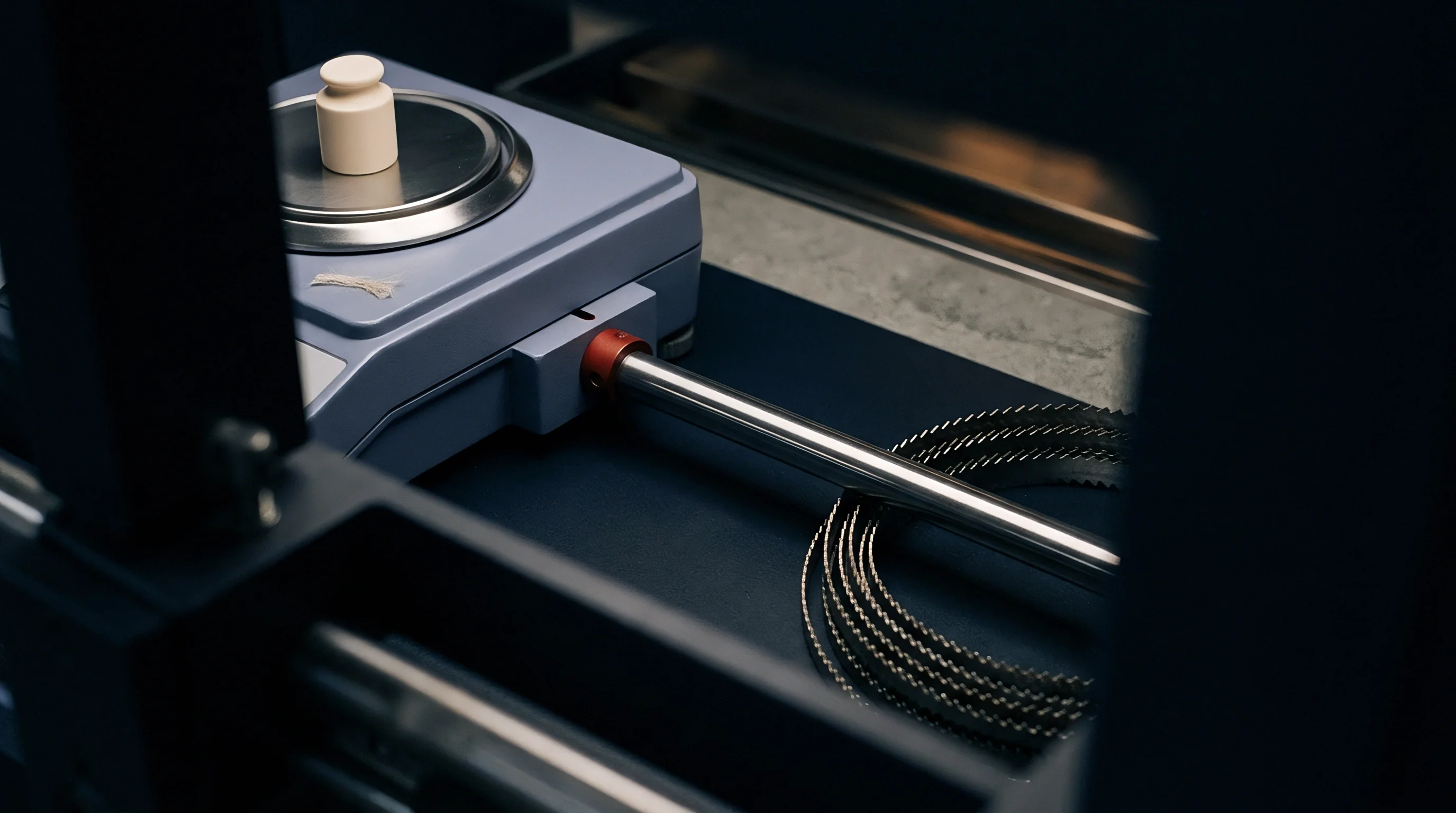
Natural variation in bast fiber structural dimensions produces wide scatter across tensile test datasets. Single-end testing yields breaking force values in centinewtons (cN), which are converted into breaking tenacity expressed as centinewtons per tex (cN/tex) by dividing breaking force by yarn linear density in tex. Metric yarn count (Nm) relates directly to tex where tex equals 1000 divided by Nm. Evaluating single-end breaking tenacity alongside English Lea Count-Strength Product (CSP) reveals the internal structural integrity of the yarn package.
Calculated tenacity reflects linear density.
Statistical Tenacity Assessment
High-speed weaving operations require wet spun flax warps with low strength variance. A mean breaking tenacity of 30 cN/tex with a coefficient of variation (CV%) of 12 % performs far better on a rapier loom than a 35 cN/tex yarn with a CV% of 22 %. Single weak points below 14 cN/tex trigger warp breaks during shedding, stopping the loom and creating start marks across high-density linen fabrics.
High twist suppresses strand slippage.
Skein tests average local defects.
Skein strength testing via ISO 6939 wraps a 109.7-meter lea (80 turns on a 1.5-yard reel) pulled to rupture on a pendulum CRT or CRE tester. The resulting lea breaking force in pounds multiplied by metric count yields Lea CSP. Because skein tests average load across 160 parallel strands, they suppress individual weak link signals that single-strand CRE testing picks up.
| Metric Count (Nm) | Target Tenacity (cN/tex) | Max Single-End CV (%) | Min Lea CSP (lb x Nm) | Loom Type Suitability | Expected Efficiency (%) |
|---|---|---|---|---|---|
| 14 | 28.0 | 13.0 | 2400 | Air-Jet (600 ppm) | 91.5 |
| 26 | 31.5 | 14.5 | 2700 | Rapier (450 ppm) | 93.2 |
| 40 | 34.0 | 16.0 | 2950 | Rapier (380 ppm) | 89.8 |
| 60 | 36.5 | 18.0 | 3100 | Dornier Rapier (320 ppm) | 86.4 |
Worked Calculation Analysis
Consider a 50-bobbin sample lot of 26 Nm wet spun flax yarn. Metric count conversion yields a nominal linear density of 38.46 tex. Single-end CRE testing on a 500 mm gauge length across 100 breaks yields a mean breaking load of 1210 cN with a standard deviation of 181.5 cN.
Mean tenacity calculation: 1210 cN / 38.46 tex = 31.46 cN/tex.
Coefficient of variation calculation: (181.5 cN / 1210 cN) x 100 = 15.0 %.
Weibull distribution modeling on this dataset yields a characteristic load parameter of 1285 cN and a shape parameter (m) of 5.1. The lower three-sigma limit for breaking force lands at 665.5 cN, corresponding to a local minimum tenacity of 17.3 cN/tex. Assume a warp layout with 4800 ends operating on a rapier loom at 420 picks per minute; this distribution predicts approximately 1.8 warp stops per 100,000 picks.
If the single-end CV% rises to 20 % while keeping mean tenacity constant at 31.46 cN/tex, the lower three-sigma limit drops to 12.5 cN/tex, causing warp breaks to escalate to 6.4 stops per 100,000 picks and reducing shed efficiency by four percentage points.
Weibull shape parameters below 5.0 in wet spun flax yarns indicate structural un-cleared thick and thin places that degrade warp reliability on automatic looms.
A decision matrix for bench audit compliance requires systematic verification before releasing yarn lots to warping beams.
- Pneumatic clamp pressure calibration ensures clamping air meters read within 0.01 MPa of specified bench targets before running baseline single-strand tests.
- Package conditioning verification measures moisture content using capacitive probe meters to confirm regain meets the 12 % threshold.
- Grip face rubber inspection checks elastomeric jaw inserts for physical wear grooves that alter friction coefficients during tensile extension.
- Traverse velocity validation confirms crosshead movement matches 500 mm/min limits within one percent error margins.
Why do wet spun flax strands display bimodal strength distributions when spun from un-hackled tow fibers compared to line flax?
The core structural mechanism behind this bimodal distribution remains contested between fiber bundle length variance and localized pectin gelation differences during wet spinning drafting.

Allowance
Integrating tensile strength baseline testing into commercial yarn procurement protocols protects weavers against weak yarn lots. Technical specifications establish minimum breaking tenacity thresholds alongside strict CV% maximums. Purchase agreements state that shipments exhibiting mean tenacity values below contracted minimums or CV% exceeding agreed ceilings permit the buyer to issue debit notes or reject raw yarn bobbins prior to beam warping.
High tenacity prevents warp breaks.
Commercial contracts define yarn quality allowances based on batch acceptance sampling under ISO 2859-1 rules. For a 5,000 kg shipment of 26 Nm wet spun flax yarn, a sample size of 80 bobbins undergoing single-end CRE testing must yield zero non-conforming packages falling below the critical breaking threshold of 18 cN/tex. When test results show non-conformance exceeding two percent of total tested ends, the buyer enforces a landed cost penalty calculated against lost loom shed capacity.
Loom hours lost to yarn-induced warp breakage are billed against yarn supplier invoices at standard shed rates ranging from 28 to 45 EUR per loom hour depending on reed width and shedding motion complexity. Establishing rigorous baseline tensile parameters prior to warping eliminates friction between spinning mills and weaving sheds, securing predictable fabric construction costs.