Metric Fibre Number Claims and the Test Method behind Them
Metric fibre number claims require ISO 2370 gravimetric verification because airflow instruments skew up to fifteen percent across retting types and moisture regains.
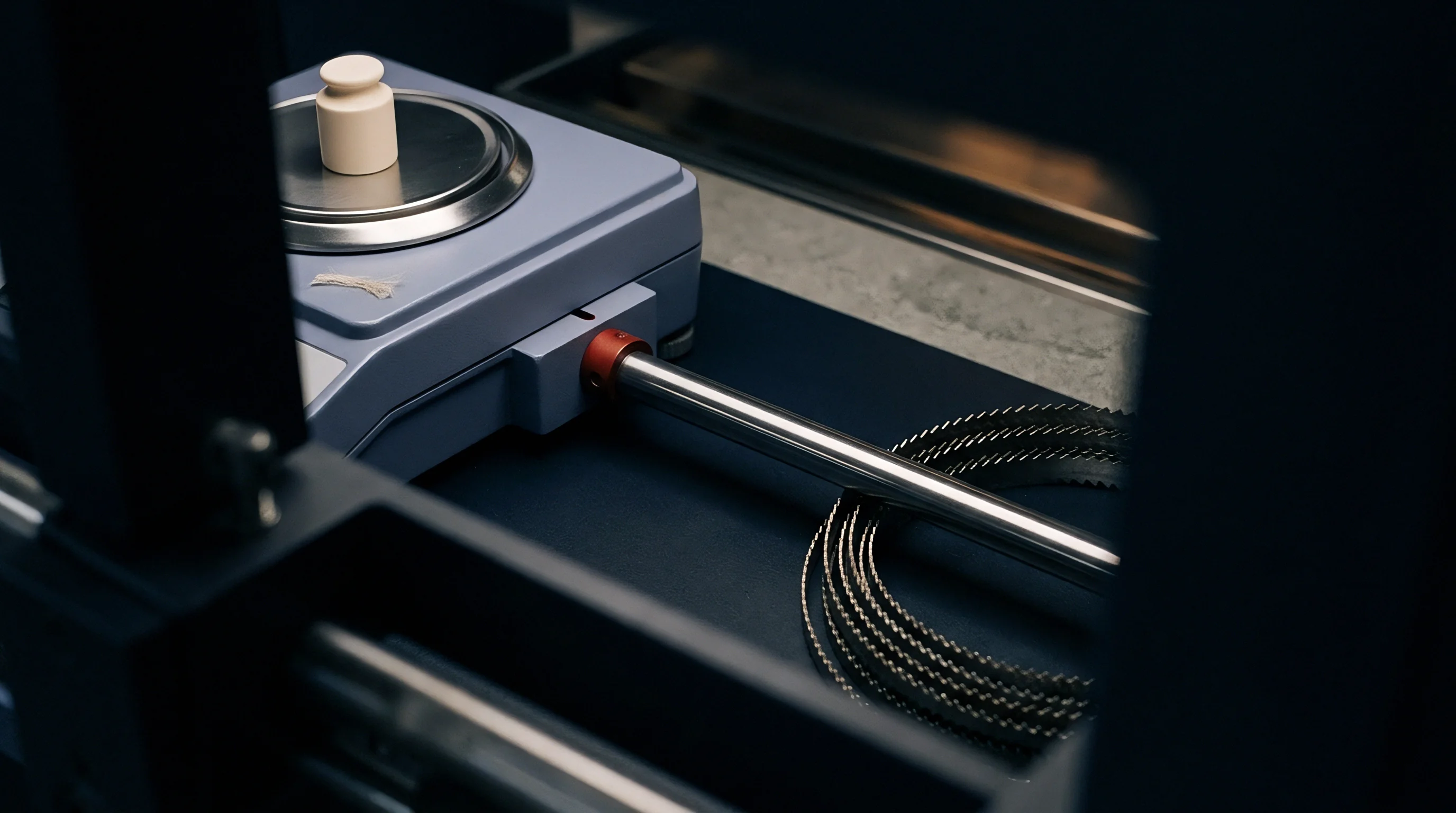
Clamp
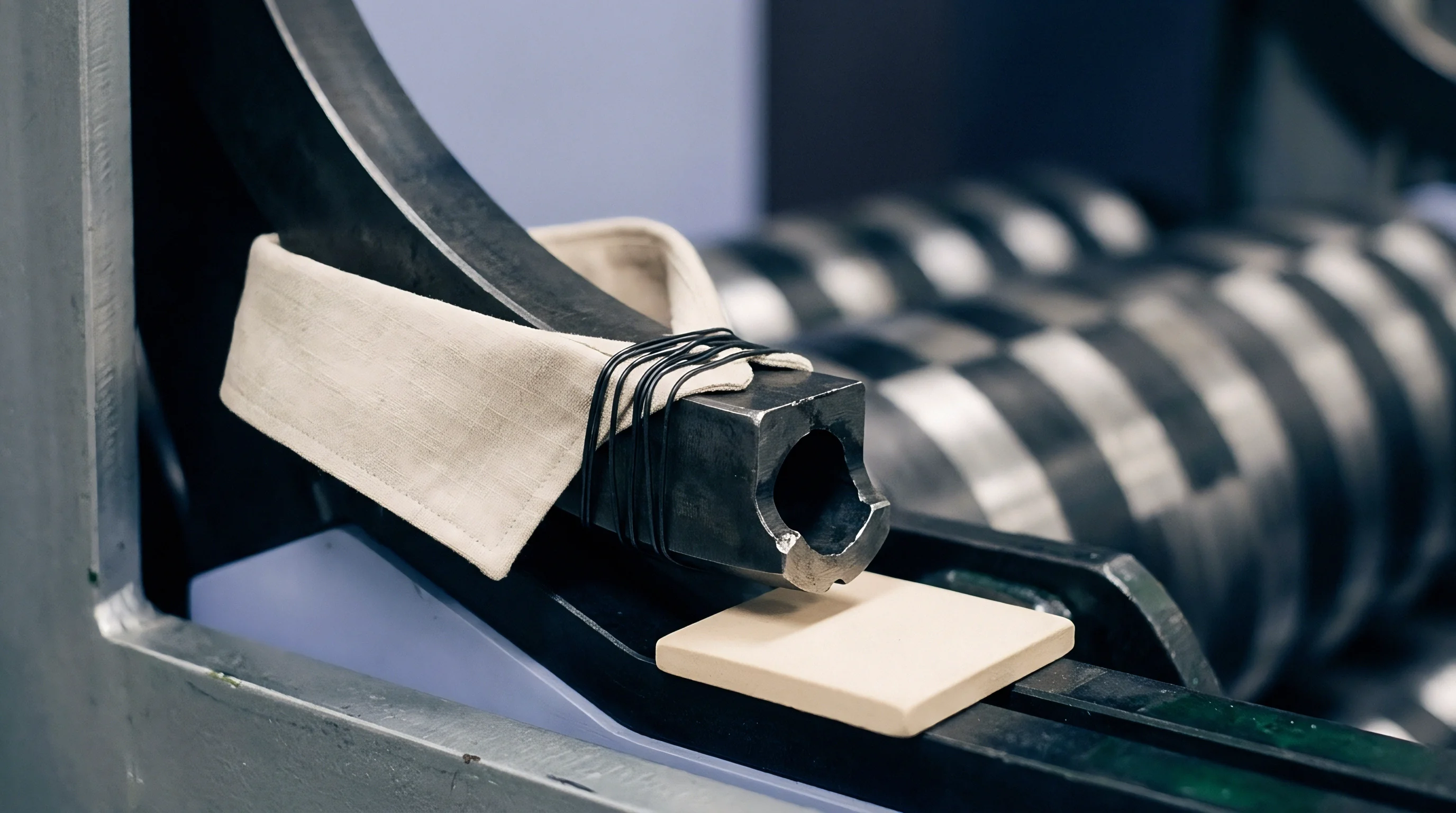
Clamping Physics and Precision Cut Lengths
Determining the gravimetric linear density of bast fibres depends on isolating bundle segments under fixed mechanical tension. Metric fibre number, expressed as Nmf, measures how many metres of fibre weigh one gram. This value reflects the average thickness of technical fibre bundles rather than individual ultimate cells.
In raw flax, these technical bundles consist of ultimate fibres bound together by interlamellar pectin matrices. Obtaining an accurate Nmf requires pulling bundles through double-comb clamp assemblies to clear loose, unaligned strands and residual shive particles. Standard procedures specify a clamp tension of exactly 10 cN/tex to prevent slipping or necking during preparation.
Precise mass measurements remain fundamental to all gravimetric calculations.
Preparing a gravimetric specimen involves cutting out the central portion of aligned long-staple line flax. ISO 2370 requires cutting these central sections to exact lengths of 10 mm, 20 mm, or 50 mm with dual-blade guillotine cutters fitted with micro-ground tungsten carbide edges. Dull or worn edges fray bundle ends, introducing length errors that push mass measurements toward artificially low metric numbers.
A deviation of just 0.2 mm on a 10 mm specimen creates a two percent error in calculated linear density before the sample reaches the microbalance. Operators align scutched or hackled sliver through parallel comb fields, hold the central bundle under constant clamp load, and make a simultaneous dual-shear cut across five hundred to one thousand parallel bundles.
Conditioning directly governs every gravimetric measurement. Flax fibres pull moisture from the air quickly due to open hydroxyl groups in the secondary cell wall. Before weighing, cut bundle specimens must equalize in a climate-controlled room set to 20°C and 65% relative humidity for at least 24 hours.
ISO 139 mandates this step to bring moisture content to standard commercial regain levels. Weighing unconditioned bundles fresh from a freight container understates the true metric fibre number by up to eight percent, as absorbed water adds mass without adding length.
ISO 2370 test protocol establishes metric fibre number from thirty clamped cut bundles conditioned at twenty degrees Celsius and sixty-five percent relative humidity.
Double-comb extraction clamps isolate individual technical bundles without disturbing the parallel fiber lay. Counting individual bundle ends under low-power stereomicroscopes converts raw specimen mass into average single-bundle linear density. A single technical fibre bundle pulled from hackled line flax typically displays an Nmf between 300 and 1,200, which corresponds to 3.33 tex down to 0.83 tex.
Primary ultimate cells within these bundles carry individual metric numbers between 3,000 and 6,000 (0.33 tex down to 0.16 tex). Commercial trade specifications quote aggregate technical bundle fineness, as this is what controls drafting behavior on spinning frames.

Gravimetric Metric Fibre Number Calculation
Calculating Nmf converts bundle count, cut length, and dry bundle mass into a length-per-unit-mass ratio. Total length starts at Ltotal = N × Lcut, where N is the number of technical bundles counted in the clamp specimen and Lcut is the cut length in millimetres. With total specimen mass m recorded in milligrams, the metric fibre number formula is:
Nmf = fracN × Lcutm
In tex, the conversion is inverse: Tex = frac1000Nmf. A lot with an average technical bundle metric number of 500 converts to exactly 2.0 tex, or 20 dtex. High-grade long-line flax intended for wet spinning into fine yarns requires an Nmf over 700 (1.43 tex), while coarse tow stock for dry spinning usually tests between Nmf 180 and 350 (5.55 tex down to 2.85 tex).
Standard lab protocol requires testing multiple bundle specimens per lot to cover natural biological variation. Field-retted flax varies in fineness because stem diameter, planting density, and soil nitrogen differ across the field. A full lot evaluation takes thirty distinct bundle extractions across five separate sample bales.
Calculating the mean metric fibre number together with the coefficient of variation shows how uniform the fibre preparation really is. Lots with a CV above 22 percent disrupt drafting zones in wet spinning, producing frequent thin and thick spots in the yarn.
Running a gravimetric bundle analysis follows a practical sequence of preparation, cutting, counting, and weighing.
- Sampling and parallelization ~ pull fifty sliver sections from five random points in the bale, then draw them manually through hand combs to align technical fibres without stripping out fine elements.
- Clamp loading and tensioning ~ mount the combed sliver in a holding fixture, apply a static load of 10 cN/tex across the bundle spread to remove curvature, and tighten the jaw locks.
- Guillotine shear extraction ~ drop twin tungsten carbide blades simultaneously through the locked bundle to cut a precise 20 mm central specimen, then clear away the trimmed tails.
- Optical bundle counting ~ use a stereo microscope at 20x magnification to tally every technical fibre end across the cut cross-section, recording total count N.
- Microbalance mass determination ~ transfer the counted cut bundle immediately onto an analytical balance accurate to 0.001 mg inside the conditioning chamber to record mass m.
Sending gravimetric test results back to suppliers often starts arguments over sample preparation. Exporters frequently claim that lab combing was too aggressive, arguing that comb teeth split coarse technical bundles into artificially fine elements during preparation.

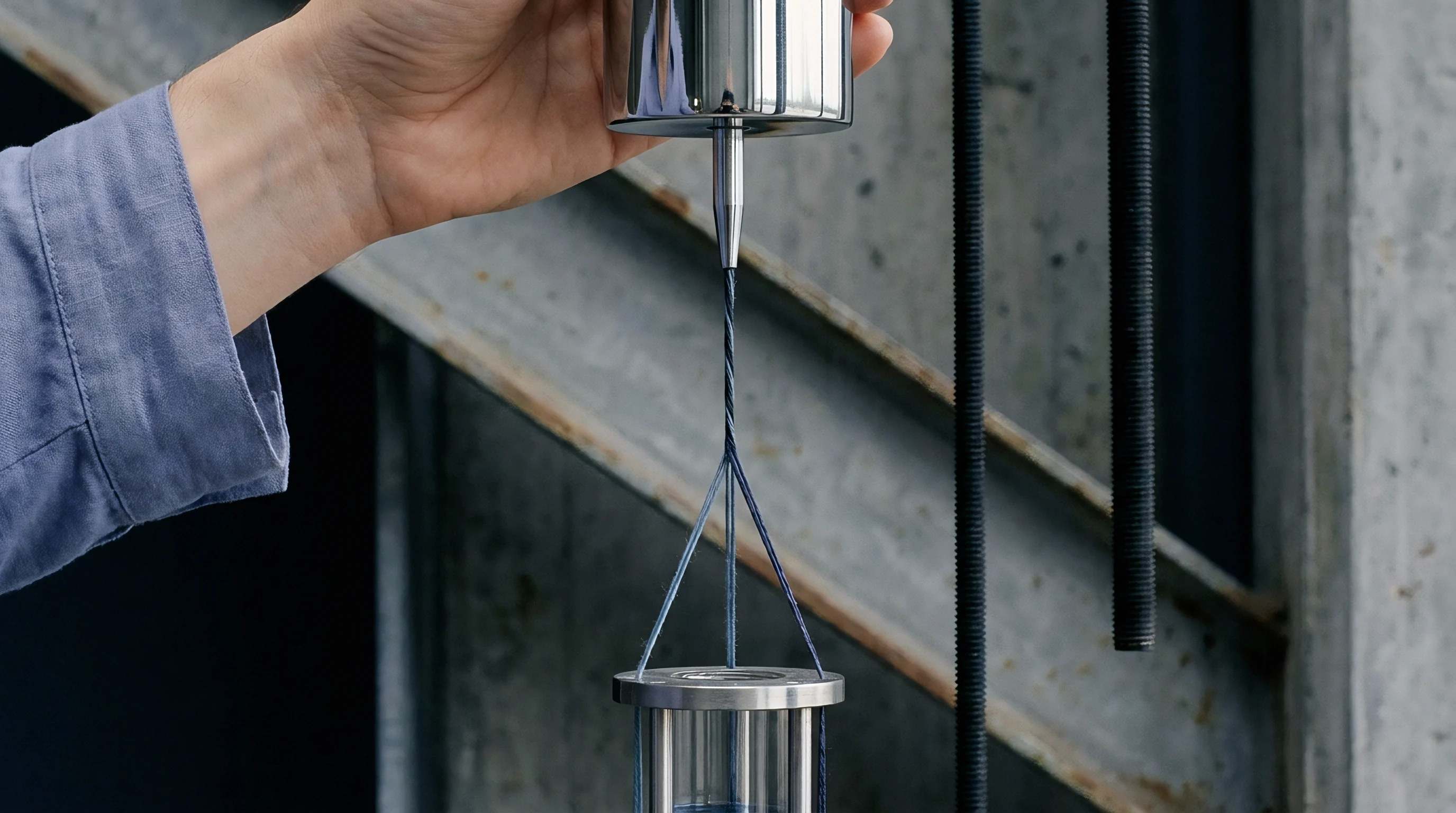
Bench
Air Permeability Instruments and Calibration Shifts
Airflow testing provides a fast, indirect estimate of flax fineness by measuring resistance to air passing through a compressed fibre plug. Systems based on Sheffield air-permeability principles or the Wira fineness meter force a regulated stream of dry air through a cylinder packed with a set mass of fibre. Specific surface area dictates drag through porous media.
Finer fibres present more surface area per unit mass, restricting airflow and creating a higher pressure drop across the plug. Coarser fibres leave larger channels between bundles, allowing more airflow at the same drive pressure.
Interlamellar pectin retains structural cohesion between single ultimate fibres.
Using cotton airflow meters on bast fibres requires custom chamber inserts and revised calibration curves. Cotton fibres have closed, kidney-bean cross sections and fairly uniform cell walls, while technical flax bundles have irregular, polygonal cross sections with variable lumens. Residual shive, un-retted cortical tissue, and uneven pectin alter plug porosity regardless of actual fibre linear density.
Converting standard Micronaire readings directly into flax Nmf causes severe errors unless the scale is calibrated against gravimetrically verified flax standards.
Gravimetric checks on incoming line flax bales are performed before releasing material to the hackling combs. Testing shows that dew-retted European flax and water-retted Asian flax need separate calibration channels on the same bench. Water-retted stock has cleaner bundle surfaces and less residual pectin, opening airflow paths and giving artificially high metric numbers.
Dew-retted stock contains fungal hyphae and broken cortical fragments that restrict air, understating actual bundle Nmf if measured against a water-retted baseline.

Optical Cross-Section Analysis against Gravimetric Mass
Automated optical image analysis measures fineness by scanning thousands of bundle cross sections or projected widths with high-resolution sensors. For cross-sectional analysis, aligned flax sliver is embedded in polyurethane resin blocks, cured, and sliced into 10 micrometre sections on a microtome. Transmitted light microscopy captures cross-sectional area, major and minor axes, and perimeter dimensions.
Software then calculates equivalent circular diameter and linear density by multiplying measured area by the volumetric density of flax cellulose (1.50 g/cm3).
Projected width systems move dry fibre sliver through an optical channel, using high-speed line-scan cameras to capture bundle perimeters on the fly. Software filters out shive dust and overlapping nodes. While optical projected width correlates well with gravimetric methods on clean, highly hackled line flax, it diverges when testing raw scutched tow.
Irregular ribbon-shaped bundles skew width measurements depending on how the bundle faces the light path. Rotating bundles as they pass the camera reduces shape distortion, yielding reliable metric fibre number distributions.
| Test Method | Standard Reference | Sample Preparation Time | Measured Metric Range (Nmf) | Coefficient of Variation Range |
|---|---|---|---|---|
| Gravimetric Cut and Weigh | ISO 2370 | 45 minutes per sample | 200 to 1,200 | 8% to 14% |
| Air Permeability (Sheffield) | ISO 1973 (Adapted) | 5 minutes per sample | 250 to 950 | 12% to 18% |
| Microtome Optical Sectioning | ASTM D1444 (Modified) | 120 minutes per sample | 150 to 1,500 | 15% to 25% |
| Dry Optical Projected Width | ISO 137 (Modified) | 15 minutes per sample | 300 to 1,100 | 10% to 20% |
Gaps between optical cross-sectional calculations and gravimetric weighing stem from internal air voids in technical bundles. Flax bundles have micro-lumens inside individual ultimate cells and gaps between unbonded cell walls. Microtome area measurements include these internal voids inside the outer perimeter, overestimating actual cellulose volume.
Gravimetric weighing reflects net solid mass alone. Multiplying optical volume by standard cellulose density gives a calculated mass above the true weighed mass, which understates optical metric fibre numbers relative to gravimetric bench results.
Testing protocols must set calibration factors for each retting origin and processing stage. Scutched long line, hackled sliver, drawing sliver, and roving each show different degrees of bundle division and pectin removal. Applying a single airflow calibration curve across every stage misreads roving fineness by up to fifteen percent because preceding mechanical and chemical steps split technical bundles apart.
Airflow instrument calibrations shift whenever atmospheric humidity inside the testing laboratory drifts beyond standard control limits.
Frame
Fibres per Cross Section and Spinning Limits
Drafting mechanics on the wet-spinning frame determine the minimum number of technical fibres needed in a yarn cross section to insert twist without constant end breaks. Stable wet spinning of line flax requires an average of 25 to 35 technical fibre bundles across the section. Dry-spun tow systems need 60 to 80 bundles to compensate for lower inter-fibre friction and higher density variance.
The metric fibre number (Nmf) of the input bundles sets the absolute limit on achievable yarn metric count (Nmy).
Calculating maximum theoretical yarn count relies on a simple structural relation. Target yarn linear density in tex equals 1,000 divided by target yarn Nmy. Dividing target yarn tex by the minimum required fibre count in the cross section yields maximum allowable bundle linear density in tex.
Converting bundle tex back into metric fibre number gives the core relationship:
Nmy = fracNmfNmin
Where Nmin is the minimum number of technical fibres needed across the yarn section to hold drafting tension. Spinning a fine Nmy 60 (16.67 tex) yarn wet at Nmin = 30 requires input fibre fineness of Nmf = 60 × 30 = 1,800 (0.55 tex). Feeding a lot with an actual Nmf of just 600 (1.67 tex) into a frame set up for Nmy 60 leaves only 10 technical fibres in the cross section.
The yarn breaks continuously at the spinning triangle as drafting rollers pull the sparse bundle matrix apart under flyer tension.
How Does Fibre Fineness Limit Target Yarn Count?
Fibre bundle linear density dictates how mass is distributed along the yarn during drafting attenuation. In wet spinning, roving passes through a hot water bath before entering the drafting rollers. Water held between 60°C and 70°C softens residual inter-fibre pectin, letting technical bundles slide past each other and split into finer sub-units under draft forces.
If raw fibres are too coarse, pectin softening cannot reduce bundle thickness fast enough during the two-second immersion window. Coarse bundles pass intact through the drafting zone, leaving heavy thick spots followed by empty drafting gaps.
Excessively coarse fibers place structural strain on drafting components during processing.
Drafting force increases non-linearly as input fibre metric number drops. Coarse bundles resist roller clamping pressures, causing stick-slip movement between top rubber rollers and bottom fluted steel rollers. This stick-slip action introduces periodic mass variations matched to the draft zone nip distance, which show up as spectrograph chimneys on capacitive yarn evenness testers.
Fine bundles with high metric numbers reduce drafting resistance, allowing smooth sliver attenuation at draft ratios over 20 on modern wet-spinning frames.
Contractual limits on yarn unevenness default to ISO 2060 sampling terms unless specific wet-spinning linear density deviations are explicitly appended.
End breakage rates on wet-spinning frames serve as a direct physical audit of fibre metric number accuracy. Frame trials running at standard speeds (typically 5,000 to 7,000 RPM) track end breaks per 1,000 spindle-hours. Running a fibre lot whose delivered Nmf is fifteen percent below spec pushes breakage rates from an acceptable 30 breaks per 1,000 spindle-hours to over 120.
Operators have to slow frame speeds, raising production costs per kilogram and creating excessive yarn splices that degrade downstream weaving efficiency.
In wet-spinning trials where fibre fineness dropped below 500 Nmf, spinners tried to compensate by increasing roving twist multipliers to maintain sliver cohesion in the water trough. The extra twist restricted drafting attenuation, forcing the mill to drop yarn count targets from Nmy 39 down to Nmy 26. While this kept the frames running, product market value per kilogram dropped by twenty-two percent.
Spinning mill purchase specifications require that metric fibre number claims derive from hackled sliver sampled just before roving preparation rather than raw scutched bales, ensuring reported fineness reflects material entering the drafting system.


Yield

Hackling Waste Rates across Fineness Bands
Scutched line flax goes through comb hackling to align long fibres, remove residual shive, and split coarse technical bundles into finer spinnable units. Combing strips short, tangled, or weak fibres out of the main strand, transferring them into the hackling tow. Coarser raw flax with low initial metric numbers requires tighter pin density sequences across the hackling bed to hit target fineness.
While aggressive hackling splits coarse bundles, it drives up short fibre waste, turning high-value long line stock into lower-value tow.
| Fibre Grade Parameter | High Fineness Line | Standard Line | Coarse Tow Blend | Units |
|---|---|---|---|---|
| Input Raw Fibre Metric Number (Nmf) | 750 | 550 | 350 | Metres / Gram |
| Raw Fibre Linear Density | 1.33 | 1.82 | 2.86 | Tex |
| Raw Fibre Purchase Price | 5.20 | 4.10 | 2.60 | USD / Kilogram |
| Hackling Yield (Long Line) | 68.5 | 58.0 | 42.0 | Percent Mass |
| Hackling Tow Generation Rate | 26.5 | 36.0 | 50.0 | Percent Mass |
| Unusable Shive and Dust Loss | 5.0 | 6.0 | 8.0 | Percent Mass |
| Tow Value Realization | 1.80 | 1.60 | 1.40 | USD / Kilogram |
| Effective Hackled Line Sliver Cost | 6.89 | 6.07 | 5.29 | USD / Kilogram |
| Maximum Stable Wet-Spun Count (Nmy) | 50 | 36 | 22 | Yarn Metric Number |
| Finished Woven Fabric Weight | 180 | 180 | 180 | Grams / Sq Metre |
| Fibre Cost per Finished Woven Metre | 1.24 | 1.09 | 0.95 | USD / Metre |
Hackling yield measures net long-line output against gross scutched fibre input. A fine raw lot testing at Nmf 750 passes through high-density comb pins with minimal breakage, yielding up to 68.5 percent long-line sliver. A coarse lot at Nmf 350 subjects stiff bundles to heavy impact forces, snapping fibres along internal growth microcracks.
Long-line yield drops to 42.0 percent on coarse stock, while tow generation climbs to 50.0 percent. Because hackled long-line sliver trades at more than triple the price of tow, poor hackling yield drives up net sliver costs significantly.
The hackling process isolates long line fibers from short, lower-value tow.
Comb pin wear accelerates when processing coarse flax. Pin points dull rapidly from high impacts against un-split technical bundles, reducing comb penetration through the trailing tails. Dulled pins cannot divide bundles cleanly, causing sliver metric numbers to drop during long production runs.
Hackling managers monitor sliver fineness every four hours, swapping comb bars whenever hackled sliver Nmf drops more than ten percent below baseline targets.

Worked Costing Model for Line Yarn Yields
Determining net landed yarn cost requires balancing raw fibre acquisition prices, hackling mass yields, tow credits, wet-spinning conversion fees, and weaving efficiency. Raw line flax bought at USD 4.10 per kilogram with an Nmf claim of 550 yields 58.0 percent long-line sliver and 36.0 percent tow, leaving 6.0 percent dust and shive waste. Selling tow at USD 1.60 per kilogram offsets initial fibre expenditure:
Net Sliver Cost = fracRaw Price – (Tow Yield × Tow Price)Line Yield
Net Sliver Cost = frac4.10 – (0.360 × 1.60)0.580 = frac4.10 – 0.5760.580 = 6.075 USD/kg
If a supplier delivers a lot claiming Nmf 550 that actually tests at Nmf 420 on the bench, the mill cannot run the intended comb sequence without destroying yield. To hit target sliver fineness, pin density must be increased across the final hackling stages, dropping long-line yield from 58.0 percent to 49.0 percent while tow output climbs to 44.0 percent. Recalculating net sliver cost reveals the financial impact:
Net Sliver Cost = frac4.10 – (0.440 × 1.60)0.490 = frac4.10 – 0.7040.490 = 6.931 USD/kg
That fineness deficit forces an immediate 14.1 percent increase in raw sliver cost per kilogram before spinning even begins. Carrying this cost forward through wet spinning (Nmy 36) into a plain-weave fabric at 180 g/m2 increases fibre input cost from USD 1.09 per finished metre to USD 1.25 per metre. On a 50,000-metre contract, an uncorrected 130-point deficit in raw metric number burns USD 8,000 in direct margin.
Fibre bundle coarseness accelerates comb pin wear while shifting hackling output toward low-value short tow.
Hackling yield drops by four percent when bundle linear density rises above two tex. On a 100-tonne delivery from a wet summer crop where harvesting was delayed, under-retting left thick pectin bonds intact along lower stem sections, producing coarse butt ends that snapped inside the first three hackling fields. The mill absorbed a net loss of USD 18,400 across the run after reallocating excess tow to coarse dry-spun cordage.


Ledger
Moisture Regain Adjustments and Invoice Mass
Commercial flax transactions settle on a conditioned mass basis under ISO 6741. Standard commercial regain rates set moisture allowances at 12.0 percent for hackled flax line and 13.0 percent for tow. Scutched flax bales shipped by sea absorb or lose moisture depending on hold conditions.
Buying fibre without adjusting gross weight for moisture deviations leads to financial losses or false weight claims against suppliers.
Variations in moisture content directly alter the billed weight of raw fiber.
Adjusting invoice mass requires establishing oven-dry mass from core samples pulled from sealed test bales. Lab ovens dry specimens at 105°C until weighings taken fifteen minutes apart change by less than 0.05 percent. Commercial invoice mass Mc converts from dry mass Md using standard regain allowances Rc:
Mc = Md × left(1 + fracRc100right)
A delivered container weighing 20,000 kg gross at 15.5 percent moisture has an oven-dry mass Md = frac200001 + 0.155 = 17,316.02 kg. Applying the standard line regain allowance of 12.0 percent yields a commercial mass of 17316.02 × 1.12 = 19,393.94 kg. The buyer pays for 19,394 kg instead of the full 20,000 kg container weight, saving payment on 606 kg of water.
Linear density calculations must tie back to oven-dry mass to eliminate moisture distortions. Reporting metric fibre numbers on wet samples understates actual cellulose linear density. Test certificates should explicitly state whether Nmf values reflect oven-dry mass, standard conditioned regain, or as-received ambient weight.
Confusing these reference states can skew linear density figures by up to thirteen percent on standard commercial lots.

Sampling Plans for Incoming Freight Audit
Statistical acceptance sampling protects spinning mills against off-spec linear density lots. ISO 2859-1 governs sampling plans based on total bale count. For a standard 100-bale ocean container, an inspection level II normal single sampling plan calls for pulling core samples from 8 random bales for gravimetric testing.
Moisture fluctuations during maritime transit shift certified lot mass without altering total dry cellulose content.
Dry-spinning processes operate effectively on coarser technical bundles than wet spinning.
Audit testing evaluates both mean metric fibre number and intra-lot variance. Bales coming from different fields or retting ponds within one shipment often show distinct fineness distributions. If the sample mean Nmf meets contract specs but standard deviation exceeds fifteen percent of that mean, the lot will cause severe count variations during draw-frame blending.
Commercial claim failures usually trace back to errors in testing, sampling, or documentation.
- Unconditioned gravimetric weighing ~ bypassing the 24-hour chamber equalization generates artificially low metric fibre numbers on high-moisture stock.
- Calibration scale mismatch ~ running airflow instruments against cotton Micronaire standards instead of validated bast fibre reference sets skews readings.
- Inadequate comb sample preparation ~ failing to strip out un-retted cortical shive during manual preparation corrupts optical bundle width measurements.
- Omission of moisture correction equations ~ results in paying full price for water weight absorbed during high-humidity transit legs.
- Inconsistent sample depth extraction ~ drawing samples only from bale surfaces misses compacted, high-moisture core zones.
How does a buyer arbitrate a lot that meets aggregate metric number targets yet contains twenty percent of bales below the absolute spinning threshold?


Paperwork
Technical Specification Clauses for Fiber Purchase
Flax supply contracts require explicit numerical specifications rather than loose grade descriptions like Superior Dew Retted or Fine Water Retted. Descriptive grade terms carry no legal standing in international trade courts. Raw material contracts should explicitly state ISO test methods, metric fibre number tolerances, moisture regain terms, and sampling schedules directly on the purchase order.
Finer technical bundles enable the production of high-count, fine-quality yarns.
Customs classification under the Harmonized System depends on processing state and linear density boundaries. HS Code 5301.10 covers raw or retted flax; 5301.21 covers broken or scutched line; 5301.29 encompasses hackled or processed line flax. Misclassifying fine hackled sliver as raw scutched flax under HS 5301.21 to lower tariffs risks severe customs fines and vessel holds at destination ports.
Elevated water temperature breaks down residual pectin binding the fiber matrix.
Certificates of Analysis from accredited independent labs must accompany export shipments. A valid certificate details sampling protocol, conditioning parameters, the specific test method used (ISO 2370 for gravimetric, modified ISO 1973 for airflow), sample size N, mean metric fibre number Nmf, coefficient of variation, and oven-dry moisture percentage. Certificates lacking sample size or lab atmospheric data carry no weight in trade arbitrations.

Dispute Resolution Protocols for Discrepant Linear Density
Receiving off-spec material requires starting a formal verification protocol within five business days of breaking container seals. Bringing in independent certified surveyors protects evidence integrity before material enters production.
- Container inspection team verifies outer seal integrity, records seal numbers, checks interior surfaces for condensation, and takes photos.
- Surveyor draws core samples from 15 percent of delivered bales following ISO 2859-1 inspection level II guidelines, sealing them immediately in vapor-proof aluminum foil bags.
- Testing team splits each core sample into three equal parts: sample one for mill verification, sample two for the supplier, and sample three kept in sealed storage for neutral laboratory arbitration.
- Conditioning room operator equalizes sample one for 24 hours at 20°C and 65% relative humidity before running ISO 2370 gravimetric bundle analysis on thirty cut specimens.
- Purchasing manager compiles lab results, compares mean Nmf against contract tolerance bands, calculates yield adjustments, and files a formal claim with the supplier alongside surveyor reports.
- Arbitration panel sends sample three to an agreed neutral textile testing institute if mill and supplier lab results differ by more than five percent, binding both parties to the neutral verdict.
Standard contract clauses keep metric number acceptance bands within plus or minus five percent of target values. Drops exceeding five percent trigger price re-indexing based on hackling yield loss formulas. Fineness drops over twelve percent give buyers the right to reject entire shipments at supplier expense, returning containers or redirecting freight to secondary dry-spinning buyers.
Certified laboratory results establish the final commercial valuation of the lot.
Line flax contracts specify that re-testing costs fall on whichever party’s reported metric number diverges furthest from the neutral laboratory arbitration result, preventing frivolous claims while keeping exporters accountable to declared fineness numbers.