Yarn Moisture Regain Calibration in Slasher Sizing Operations
Calibrating slasher moisture regain requires gravimetric oven drying adjusted for size add-on to prevent loom end breaks and excessive energy consumption.


Equilibrium
Water content inside a yarn bundle controls the viscoelastic performance of sizing polymers during warp preparation. As raw yarn passes through the size box, hydrophilic fibers absorb liquor while surface fibers take up film-forming polymers like poly-vinyl alcohol, modified starches, and carboxymethyl cellulose. Moisture regain measures the mass of absorbed water relative to the bone-dry mass of the yarn sheet, whereas moisture content measures water mass relative to total wet yarn mass.
Confounding these two metrics skews drying cylinder heat balance calculations and corrupts warp beam density.
Target regain depends on fiber chemistry. Standard combed cotton yarn requires an equilibrium regain target between 7.0 percent and 8.5 percent, while carded cotton runs between 6.5 percent and 7.5 percent. Polyester blends reduce the required moisture load because hydrophobic synthetic filaments absorb less than 0.4 percent water, leaving a 65/35 polyester and cotton blend to reach equilibrium at 3.8 percent to 4.5 percent regain.
Pure flax linen requires 10.5 percent to 12.0 percent moisture to prevent brittle end breaks under tension, as water content directly governs film strength and over-drying damages warp elasticity.

Hydration Dynamics in Sized Warp Sheet
Cellulosic fibers bind moisture through hydroxyl sites within amorphous regions of the cell wall. When starch or poly-vinyl alcohol coats the exterior surface, the size polymer forms a secondary barrier against water vapor release. Slasher dry cans must therefore drive moisture out from the core of the yarn while simultaneously curing the external size film into a continuous, flexible shell.
| Fiber Composition | Yarn Count (Ne) | Size Formulation | Size Add-On (%) | Target Moisture Regain (%) | Critical Over-Dry Threshold (%) |
|---|---|---|---|---|---|
| 100% Ring Spun Combed Cotton | 30/1 | PVA / Modified Starch 50/50 | 11.5 | 7.5 – 8.2 | 5.0 |
| 100% Carded Cotton | 20/1 | Native Corn Starch / Wax | 14.0 | 7.0 – 7.8 | 4.5 |
| 65/35 Polyester / Cotton | 45/1 | PVA / Acrylic Binder | 9.0 | 4.0 – 4.6 | 2.5 |
| 100% Wet Spun Flax Linen | 14/1 Lea | Soluble Starch / Softener | 8.0 | 11.0 – 12.5 | 7.5 |
| 100% Viscose Rayon | 30/1 | CMC / PVA Blend | 10.0 | 11.5 – 13.0 | 8.0 |
Evaporating water from a dense warp sheet of up to 10,000 individual ends requires stepped heat application across multiple dry can sections. The initial cylinder zone operates at lower temperatures ~ between 65 and 80 degrees Celsius ~ to prevent size skinning and cylinder sticking. Middle cylinder zones run between 110 and 130 degrees Celsius to drive bulk moisture out of the inner fiber core, followed by final cooling cylinders that stabilize sheet temperature before split rods separate adjacent ends.

Thermal Evaporation Dynamics
Slasher dry cans rely on continuous steam pressure control to match heat transfer rates with running speed. When speed drops during beam changes or crease clearing, cylinder surface temperatures must decrease immediately. Thermal inertia in heavy cast-iron cans otherwise causes temporary over-drying of the stationary warp section, making sizing films glass-brittle and stripping the elongation capacity needed during loom shed opening cycles.
Pure combed 30s Ne yarn sized with 11.5 percent PVA and starch film retains 8.0 percent target moisture regain under standard conditions of 21 degrees Celsius and 65 percent relative humidity.
Excessive thermal energy breaks hydrogen bonds within native cellulose, inducing permanent embrittlement. Yarn exiting dry cans below 4.0 percent moisture regain suffers severe strength degradation and loses stretch recovery. Re-absorbing moisture from ambient air behind the headstock takes hours, but weaving machinery processes the beam immediately after sizing, leaving a desiccated warp vulnerable to rapid end breakage under high pick-insertion speeds.
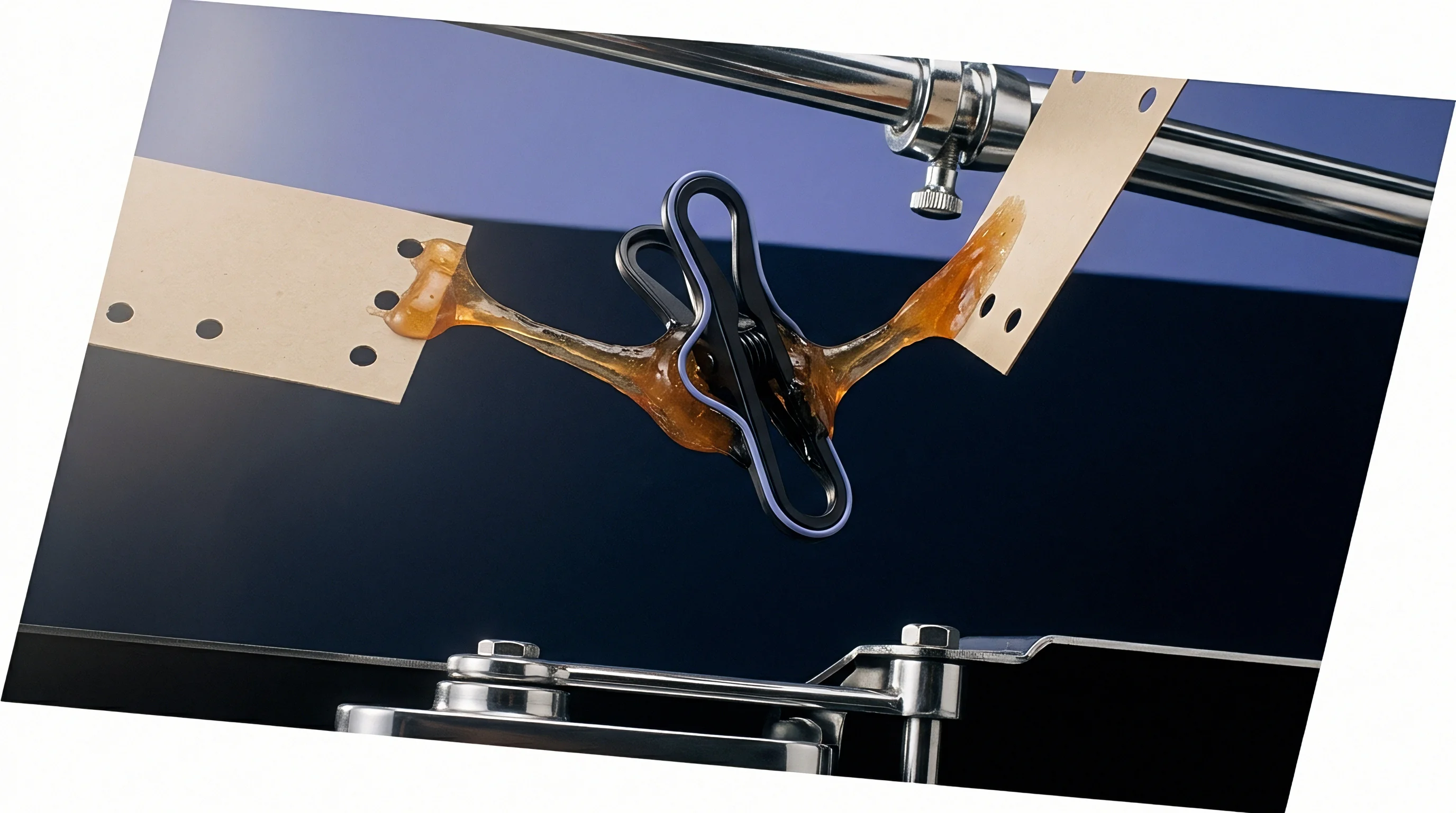

Sensors
Online monitoring instruments mounted on the headstock track moisture levels across the moving warp sheet continuously, relying on dielectric capacitance, near-infrared reflectance, or microwave attenuation. Capacitance instruments track shifts in the dielectric constant of the yarn sheet as it passes between sensor plates. Because water has a dielectric constant of approximately 80 while dry cellulose sits near 3.5, minor shifts in moisture produce distinct changes in electric capacitance.
Dielectric capacitance plates require direct contact or precise proximity to the running yarn array. Variations in warp sheet density, total end count, yarn count changes, and web flutter can trigger false readings, and cold yarn sheets skew dielectric heads. These sensors also react to conductive additives in the sizing bath, such as residual salt ions or anti-static compounds, requiring calibration curves that map specific size mix recipes to voltage outputs.

Dielectric Capacitance Measurement Principles
High-frequency electrical fields penetrate the yarn sheet to measure bulk moisture through the entire cross-section. Sensor zero points require recalibration whenever raw material supplier lots change, as variations in natural cotton wax alter surface conductivity and shift baseline voltage. Operational teams verify online dielectric sensor readings against daily gravimetric lab samples to catch calibration drift early.
- Thermal Drift Distortion occurs when yarn sheet surface temperatures fluctuate rapidly after slasher speed changes, causing capacitive circuit impedance to shift independently of actual moisture content.
- Static Charge Interference develops as high-speed synthetic or blended warps rub against dry-can guide rolls, generating electrostatic voltages that corrupt sensor micro-ampere readings.
- Conductivity Shifts stem from variations in municipal water mineral content or sizing additive batches, altering the ionic field response across fixed capacitive plates.
- Optical Surface Occlusion affects near-infrared systems when sizing dust, lint fly, or vaporized wax coats the lens surface, attenuating reflectance signals and causing false wet readings.

Near-Infrared Reflectance Signal Drift
Optical monitoring beams evaluate specific absorption wavelengths corresponding to water molecule hydroxyl bands. Near-infrared systems provide non-contact measurement, eliminating mechanical web deflection errors, but they evaluate only the outer skin of the yarn sheet. If the sizing film forms a skin that seals in inner moisture, optical systems underreport bulk moisture retention and misread the state of the sheet unless the optics remain completely clean.
A cold moisture head reads dry warp as wet when surface condensation masks the optical receiver.
Microwave attenuation units pass ultra-high frequency signals through the yarn sheet to measure power absorption by free water molecules. Microwave systems penetrate dense, high-end-count warps more effectively than capacitance plates, offering reliable total-water measurements regardless of surface skinning. High initial capital costs, however, confine microwave hardware mostly to high-speed industrial slashers running heavy denim or canvas warps.
Online dielectric heads maintain factory calibration provided sizing bath conductivity remains constant across chemical mix batches.

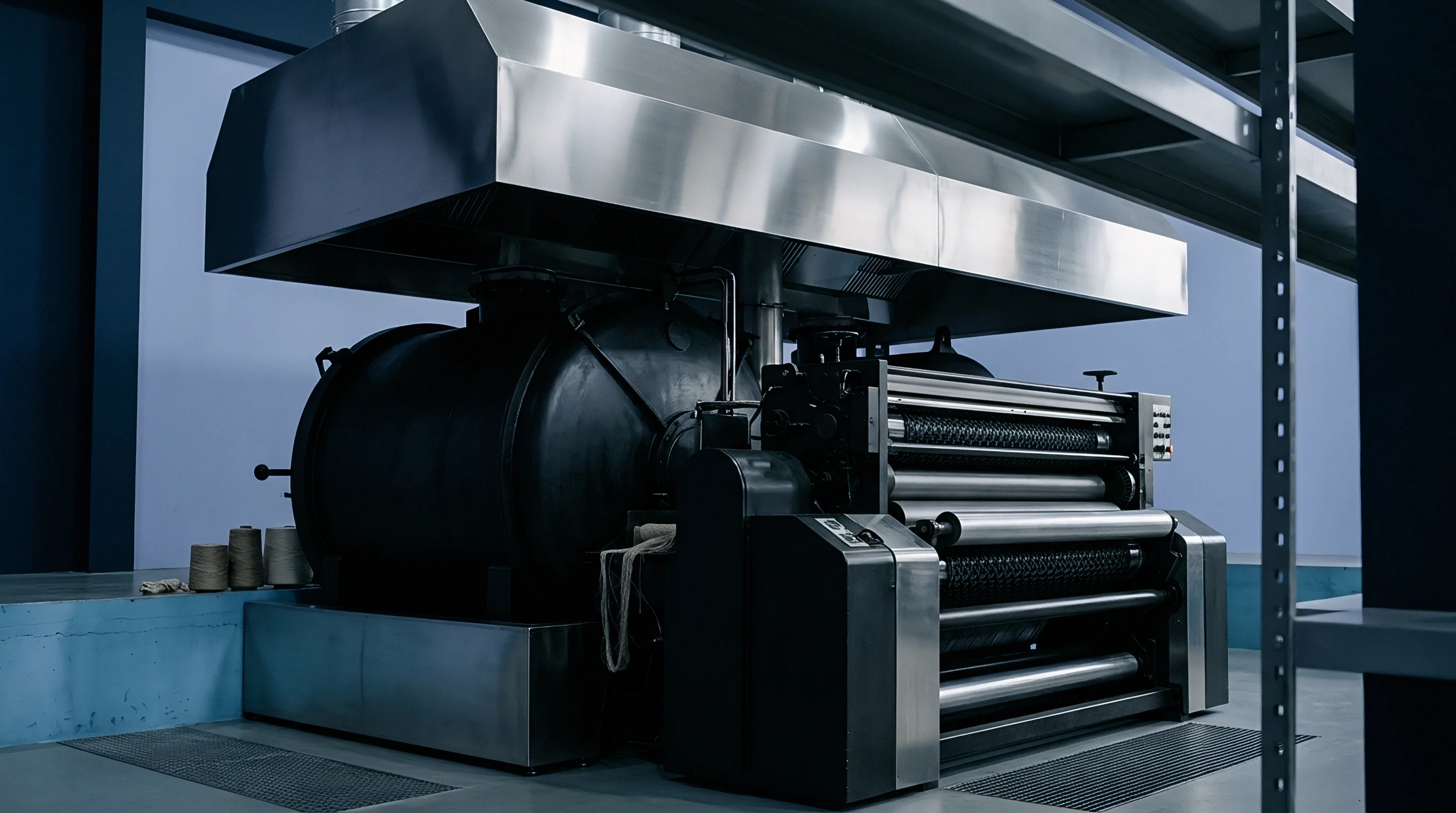
Oven
Gravimetric laboratory analysis remains the reference standard for calibrating online moisture instruments. Dry weight testing requires pulling raw warp samples immediately behind the split rods, sealing them in vapor-tight containers, and weighing them before and after thermal drying. Standard laboratory protocols specify drying samples at 105 degrees Celsius until mass stabilizes, establishing the true gravimetric dry weight baseline.
Moisture regain calculations must be kept distinct from moisture content formulas: regain percentage divides water mass by dry yarn mass, whereas content percentage divides water mass by wet yarn mass. Slasher calibration protocols rely on regain exclusively, and converting carefully between the two prevents inventory errors when calculating sized yarn delivery weights.

Gravimetric Reference Protocol under Standard Atmosphere
Analytical testing chambers maintain strict ambient temperature and humidity to ensure reproducible dry weight measurements. Standard atmosphere calls for 20 degrees Celsius plus or minus 2 degrees, and 65 percent relative humidity plus or minus 4 percent. Samples removed from drying ovens reabsorb atmospheric moisture rapidly unless cooled inside sealed desiccators over activated silica gel.
- Extract four warp sheet samples spanning full reed width immediately behind the split rods.
- Seal samples instantly in airtight aluminum canisters to eliminate ambient humidity pickup.
- Weigh wet samples on an analytical balance reading to 0.001 gram precision.
- Dry samples at 105 degrees Celsius until three consecutive mass readings at 15-minute intervals yield zero mass change.
- Desize the dried samples using enzymatic bath washing to separate pure fiber mass from dried size solids.
- Compute fiber moisture regain using desized bone-dry reference weight.

Barycentric Size Add-On Math Adjustment
Determining true moisture regain requires isolating pure fiber mass from dried size solids. When sized yarn contains 10 percent dry size add-on, the differing hygroscopic behavior of the size polymer alters dry weight ratios and shifts the dry baseline.
Let initial wet sample weight be recorded as W_w. Let oven-dried sized sample weight be recorded as W_d. Let size add-on percentage based on dry fiber weight be recorded as S. Pure dry fiber weight W_f is extracted using the relationship:
W_f = W_d / (1 + (S / 100))
Uncorrected moisture regain R_u calculates as:
R_u = ((W_w – W_d) / W_d) 100
Corrected fiber moisture regain R_c, accounting for size solids mass, calculates as:
R_c = ((W_w – W_d) / W_f) 100
| Recipe Code | Base Fiber Type | Polymer Composition | Size Add-On S (%) | Uncorrected Regain R_u (%) | Corrected Fiber Regain R_c (%) |
|---|---|---|---|---|---|
| REC-101 | Cotton Combed 30s | 100% Modified Corn Starch | 12.0 | 7.10 | 7.95 |
| REC-102 | Cotton Combed 30s | 80% PVA / 20% Starch | 10.5 | 6.80 | 7.51 |
| REC-204 | Cotton/Poly 65/35 | 60% PVA / 40% Acrylic | 8.5 | 3.90 | 4.23 |
| REC-305 | 100% Linen 14 Lea | 100% Soluble Potato Starch | 7.5 | 10.20 | 10.97 |
For a wet sample weight W_w of 250.000 grams and an oven-dried weight W_d of 230.000 grams with a verified size add-on S of 10.0 percent, dry fiber mass W_f equals 209.091 grams. Uncorrected regain works out to 8.69 percent, while corrected fiber regain yields 9.56 percent. Skipping size add-on arithmetic leads to over-drying the warp sheet by nearly one full percentage point of moisture.
ISO 2060 mandates bone-dry mass determination at 105 degrees Celsius, nullifying commercial invoices that calculate yarn weight without adjusting for non-fibrous size add-on.
Calibrating slasher speed against unadjusted gravimetric samples under-dries the yarn beam, forming micro-gels that disrupt loom shed performance and drive up warper stop costs.

Distortion
Incorrect moisture retention leaving the slasher degrades downstream weaving performance. Over-drying turns size films brittle and crystalline. As the warp sheet unwinds on the loom, this stiff film fractures under harness frame shedding action, shedding starch as fine powder that chokes heald eyes, drop wires, and reed dents.
Under-drying leaves warp yarns tacky and structurally weak. Excess moisture acts as a plasticizer, reducing size film tensile strength and causing excessive yarn elongation under weaving tension. Tacky yarns stick at lease rods, while soft size rubs off on drop wires to build up sticky gel accumulations that trigger false stops.
In humid weave sheds, over-moist beams can develop bacterial mildew within forty-eight hours, permanently staining grey fabric.

Physical Mechanical Degradation of Dry Size Film
When warp yarns enter the weaving shed below four percent moisture content, individual cotton fibers lose their flexibility. Friction from harness wires and reed blades strips the size skin off the yarn core, exposing raw fibers that increase warp hairiness and tangle adjacent ends during shed opening on high-tension air-jet looms.
- Shedding Powder Accumulation indicates severely over-dried starch films fracturing under harness mechanical abrasion, leaving white polymer dust beneath the weaving motion.
- Warp End Clinging signals under-dried yarn beams where tacky surface size causes adjacent ends to stick together during shed split cycles.
- Micro-Crack Fracture occurs when brittle size coats fail under cyclic tension, exposing raw filament bundles to harness friction.
- Heald Eye Chafing results from uneven moisture profiles across the beam width, driving localized abrasive wear against high-friction metallic surfaces.

Weave Shed Efficiency Impact
Loom performance drops sharply when warp moisture strays outside target tolerances. High-speed air-jet looms running at 900 picks per minute require a clean shed opening for main-nozzle air-pick insertion. Stuck ends or loose fiber fly obstruct the air channel, bringing on mispicks and automatic stops.
| Regain Condition | Physical State of Size Film | Primary Failure Mode | Loom Stop Type | Efficiency Loss (%) |
|---|---|---|---|---|
| Extreme Over-Dry (< 4.0%) | Brittle, Crystalline | Film Shearing / Powdering | Warp End Breakage | 6.5 – 12.0 |
| Moderate Over-Dry (4.0 – 6.0%) | Rigid, Low Elongation | Micro-Cracking under Tension | Abrasion Breakage | 2.5 – 5.0 |
| Target Zone (7.0 – 8.5%) | Flexible, Elastic, Tough | Optimal Weaving Performance | Baseline Stoppage | 0.0 (Nominal) |
| Moderate Over-Moist (9.0 – 10.5%) | Soft, Tacky, Ductile | End Clinging / Lease Sticking | Mispick / Air Channel Obstruction | 4.0 – 8.0 |
| Extreme Over-Moist (> 11.0%) | Gelatinous, Uncured | Size Transfer to Machine Parts | Drop Wire False Stop / Mildew | 10.0 – 22.0 |
A single stop on an air-jet machine requires automated or manual intervention, losing upwards of two minutes of production time. Warp stop rates exceeding 1.5 stops per 100,000 picks push weave shed efficiency below profitable levels. Precise moisture regain calibration keeps warp end breakdown rates under control.
Excessive moisture in stored loom beams degrades starch films into tacky gels within forty-eight hours.
Brittle size flakes off under heald wire friction long before the yarn sheet meets the reed blade.
Tolerance
Commercial sizing contracts set strict target regain ranges backed by financial penalties for out-of-spec deliveries. Water weight is direct revenue: selling warp beams containing excess moisture effectively bills water at yarn prices, while delivering over-dried beams forfeits billable weight and wastes slasher steam energy.
Over-drying escalates slasher energy consumption significantly. Running dry cans at high steam pressures to push regain down from 8.0 percent to 4.0 percent increases thermal energy consumption by 18 percent per kilogram of processed warp. Slasher speed must also drop from 80 meters per minute to 62 meters per minute, cutting room throughput by 22 percent.

Commercial Beam Yield Arithmetic
Slowing down the slasher to over-dry yarn compounds operational losses. For instance, a slasher processing a 4,000-meter warp beam of 100% cotton yarn weighing 850 kilograms at nominal 8.0 percent regain consumes 1.4 kilograms of steam per kilogram of evaporated water at optimal speed. Forcing moisture down to 5.0 percent evaporates an extra 25.5 kilograms of water per beam, burning additional boiler energy while reducing final invoice weight by 25.5 kilograms.
| Regain Target (%) | Slasher Speed (m/min) | Steam Use (kg/kg Yarn) | Beam Production (Beams/Shift) | Direct Energy Cost ($/Metre) | Weave Shed Efficiency (%) |
|---|---|---|---|---|---|
| 5.0 (Over-Dried) | 62 | 1.72 | 14.0 | 0.042 | 88.2 |
| 6.5 (Sub-Optimal) | 72 | 1.50 | 16.2 | 0.036 | 92.1 |
| 8.0 (Target Baseline) | 82 | 1.35 | 18.5 | 0.031 | 95.6 |
| 9.5 (Over-Moist) | 90 | 1.20 | 20.2 | 0.027 | 89.4 |
Determining the landed cost of sized warp means factoring loom hour expenses back into slasher parameters. A shed running 200 air-jet looms books capacity at an average cost of $18.50 per loom hour. If poor moisture calibration reduces overall shed efficiency by 3.5 percent, the mill loses 7.0 loom hours per day per loom array, accumulating over $3,800 in unrecoverable daily overhead.

Loom Hour Loss Metrics
Unplanned stoppages directly inflate the cost per woven meter, leading technical managers to enforce strict monitoring routines and shift-by-shift gravimetric verification against online sensor displays.
- Continuous Temperature Profiles must record dry can surface heat across all processing zones to verify automatic speed-compensation controls during slasher stops.
- Gravimetric Verification Logs document daily oven-dry test results against headstock sensor readings to validate inline calibration stability.
- Dielectric Head Zero Point tracking requires resetting baseline voltage readings after every sizing bath chemical cleanout or recipe change.
- Size Box Concentration Records measure refractometer Brix values alongside yarn moisture outputs to decouple size add-on shifts from moisture signals.
Commercial sizing agreements generally enforce a hard tolerance of plus or minus 0.5 percent moisture regain across the warp beam length, penalizing slashers ten dollars per beam for every half-percent deviation that forces loom speed reductions.