Quantifying Micro-Structural Flax Pectin Degradation Limits under High-Frequency Relay Nozzle Pressure Impulse Cycles
Air-jet relay nozzle impulses over 4.0 bar shear flax middle lamella pectin, requiring PVA-bound sizing and 3.8 bar max pressure to prevent lint shedding.


Matrix
Flax technical fibers consist of elementary cellulosic filaments bound together by an intercellular matrix dominated by calcium pectate and hemicellulosic polysaccharides. In high-speed air-jet insertion, relay nozzles direct focused supersonic air blasts across the profile reed tunnel at frequencies between 40 Hz and 120 Hz to propel the weft yarn. These high-frequency pressure impulse cycles subject the moving yarn surface to localized dynamic pressure peaks exceeding 4.5 bar, coupled with micro-scale thermal drops caused by rapid adiabatic expansion at the nozzle orifice.
The mechanical integrity of the yarn relies directly on the shear resistance of the pectin layer within the middle lamella. When the frequency and peak amplitude of the pressure impulses exceed the viscoelastic strain limit of this pectin matrix, micro-cracking initiates along the primary fiber bundle interface.
The middle lamella pectin functions as a dampening viscoelastic hydrogel. Under continuous pressure impulses from relay valves, high velocity drag forces strip the soft non-cellulosic outer domain of the flax bundle. This erosion degrades yarn surface smoothness and exposes bare elementary fibers, creating loose fibrillar tails that snag against reed dent wires.
Standard ring-spun flax yarns carrying wet-spun or dry-spun configurations retain between 4 percent and 7 percent residual pectin by weight. Wet-spun yarns exhibit a crystalline, consolidated pectin structure due to hot-water drafting, offering a higher threshold against pneumatic impulse fatigue than dry-spun yarns, where porous, amorphous pectin matrices fracture under lower impulse energies.
| Yarn Production Method | Yarn Count (Nm) | Pectin Content (% wt) | Relay Peak Pressure (bar) | Impulse Frequency (Hz) | Fibrillation Rate (fluffs/m) |
|---|---|---|---|---|---|
| Wet-Spun High-Hackled Flax | 26.0 | 5.8 | 3.5 | 60 | 0.12 |
| Wet-Spun High-Hackled Flax | 26.0 | 5.8 | 5.0 | 100 | 1.84 |
| Dry-Spun Tow Flax | 18.0 | 4.2 | 3.5 | 60 | 0.85 |
| Dry-Spun Tow Flax | 18.0 | 4.2 | 5.0 | 100 | 6.40 |
| Sized Wet-Spun Flax | 36.0 | 5.5 | 4.5 | 85 | 0.38 |
Air-jet looms operating on pure linen or flax-rich blend warps encounter severe mechanical limits when relay nozzle impulse frequencies approach the natural resonance of the outer fiber bundle. Mechanical agitation from the air pulse shears the galacturonic acid polymer chains forming the pectin backbone. Over time, repeated impulse cycles strip the protective sheath, converting structural pectin into airborne micro-dust.
This dusting accumulates inside the reed channel, blocking optical weave sensors and forcing automatic loom stops. Maintaining nozzle pressure within a window below the structural yield stress of the specific pectin grade prevents bundle disintegration while preserving yarn flight stability.
A wet-spun flax yarn retaining 5.8 percent middle lamella pectin maintains structural bundle cohesion up to a relay nozzle peak pressure of 3.8 bar at 80 Hz.
Yarn twist plays a secondary role in resisting pneumatic degradation. Higher twist multipliers increase the normal force between elementary fibers, mechanically trapping the internal pectin matrix against localized pneumatic drag forces. However, excessive twist reduces cloth cover factor, increases yarn stiffness, and drives up raw material cost per square metre.
Balancing twist insertion with regulated nozzle pressure profile curves provides a structural defense against fiber splitting in high-speed weaving sheds.
Yarns produced from unretted or under-retted flax hold rigid, highly branched pectin structures that resist initial pneumatic displacement. They suffer abrupt brittle fracture when exposed to pressure spikes above 4.0 bar. Well-retted flax fibers present soft, homogeneous pectin layers that deform plastically before shedding lint into the relay channel.


Blast
Relay nozzle geometry and valve opening timings determine the kinetic energy delivered to the yarn surface during every pick insertion cycle. Modern profile reeds utilize multi-hole relay nozzles spaced at fixed intervals across the reed width. Each nozzle fires for a duration between 8 milliseconds and 18 milliseconds, depending on loom speed and pick length.
As the leading end of the weft yarn passes each relay position, the air jet generates a sharp pressure wave front. The high pressure gradient across the yarn cross-section generates radial expansion forces, driving localized fiber detachment.

Pneumatic Pulse Mechanics
The dynamic impact of compressed air on the yarn surface acts through tangential shear stress and normal impact pressure. Tangential drag accelerates the weft thread across the shed, while normal pressure waves penetrate the porous fiber bundle. Compressed air supplied at 0.5 MPa expands through relay nozzle orifices, reaching velocities near Mach 1 at the nozzle outlet.
The kinetic energy density within the core jet stream exerts micro-impacts on the moving yarn surface. These impacts repeatedly compress and release the flax bundle at frequencies set by the relay valve operating schedule.
Thermal action accelerates pectin embrittlement inside the nozzle blast zone. Free expansion of compressed air drops local air temperatures near the nozzle exit by up to 15 degrees Celsius below ambient shed air. This rapid local chilling reduces the viscoelastic ductility of the pectin hydrogel, shifting the inter-fiber bonding layer from a flexible plastic state into a brittle glassy state.
Under chilled conditions, high-frequency pressure impulses fracture the polygalacturonic acid matrix rather than allowing plastic deformation. Moisture equilibrium within the weaving shed buffers this thermal drop; relative humidity levels kept between 68 percent and 75 percent supply moisture that acts as an internal plasticizer within the flax pectin structure.
- Set compressor output regulator to establish a steady main supply pressure of 0.60 MPa at the loom air tank manifold.
- Calibrate electronic valve timing to restrict individual relay nozzle injection durations to a maximum of 10 milliseconds per pick cycle.
- Adjust nozzle stance distance to maintain exactly 4.5 millimetres spacing between the nozzle tip and the profile reed channel wall.
- Verify shed humidity controls to hold ambient moisture at 72 percent relative humidity, counteracting adiabatic cooling at the nozzle orifice.
- Measure lint accumulation rates along the profile reed every four loom hours using optical density tracking to detect early pectin degradation.
When pressure impulse timing overlaps between consecutive relay nozzle valves, localized pressure spikes reach 1.4 times nominal system pressure. These wave superposition zones cause localized pectin degradation along the yarn length. Matching relay valve firing schedules precisely to the position of the yarn tip prevents excessive air turbulence and minimizes peak impact stress on the unshielded flax bundle.
Elevated relay pressures overcome pick-stop errors on heavy flax counts, but mask poor warp shed opening geometry at the expense of structural yarn damage, increasing greige defect rates downstream.


Decay
Micro-structural degradation of flax pectin under cyclic pneumatic loading follows a progressive three-stage mechanical breakdown model. Stage one involves micro-void formation within the amorphous regions of the middle lamella, caused by repeating shear stresses below the static yield strength. Stage two manifests as micro-crack propagation along the boundary between the pectin-rich middle lamella and the primary cellulosic cell wall (S1 layer).
Stage three results in complete structural cleavage, where fragments of the pectin matrix detach entirely from the bundle, releasing free elementary cellulosic fibers into the air stream.

Does Pectin Structural Shear Exceed Cellulosic Yield?
Elementary flax fibers possess tensile moduli exceeding 60 GPa, whereas the dry middle lamella pectin matrix exhibits a tensile modulus under 2.5 GPa. Under high-frequency pressure impulses, the severe modulus mismatch between cellulose microfibrils and the inter-fiber pectin matrix forces the lower-modulus pectin to absorb the majority of cyclic deformation strain. The rate of pectin matrix decay scales exponentially with nozzle impulse frequency once the operating frequency exceeds 75 Hz. The mechanical shear stress induced by air drag drives inter-fiber slip long before the tensile stress approaches the yield strength of the crystalline cellulose microfibrils.
| Impulse Cycle Count | Pectin Loss (%) | Yarn Tensile Loss (%) | Mass Loss (g/1000m) | Fibril Detachment Count |
|---|---|---|---|---|
| 10,000 | 0.8 | 1.2 | 0.04 | 12 |
| 50,000 | 3.1 | 4.8 | 0.19 | 68 |
| 100,000 | 8.7 | 11.5 | 0.52 | 210 |
| 250,000 | 19.4 | 24.1 | 1.45 | 620 |
| 500,000 | 38.2 | 46.8 | 3.10 | 1450 |
Scanning electron microscopy of flax yarns retrieved from air-jet sheds reveals distinct structural signatures of pneumatic pectin decay. Unlike chemical degradation from over-bleaching, which weakens cellulose chains uniformly across the fiber cross-section, high-frequency nozzle impulse damage is concentrated on the outer boundary of the yarn. The outer 20 percent of the yarn cross-section loses up to 45 percent of its pectin binder, while the yarn core retains its original matrix density.
This radical structural gradient produces a loose, fuzzy surface architecture over a rigid structural core.
Cyclic pneumatic pressure impulses at 90 Hz reduce outer fiber pectin retention by 38.2 percent after 500,000 insertion cycles, dropping single-end yarn strength by nearly half.
Chemical composition changes accompany this physical erosion. The mechanical stripping selectively removes soft water-soluble pectins and low-degree-of-esterification polygalacturonic acids first. Highly cross-linked calcium pectate complexes resist displacement longer, forming sharp, microscopic crystalline ridges along the fiber surface.
These microscopic ridges increase inter-yarn friction, causing static charge buildup, warp cling in the harness frames, and clean-shed failure during shedding motion cycles.
Unresolved questions persist regarding how low-frequency pneumatic pulsing affects the re-absorption of ambient moisture into micro-cracked pectin matrices during idle loom periods.

Fray
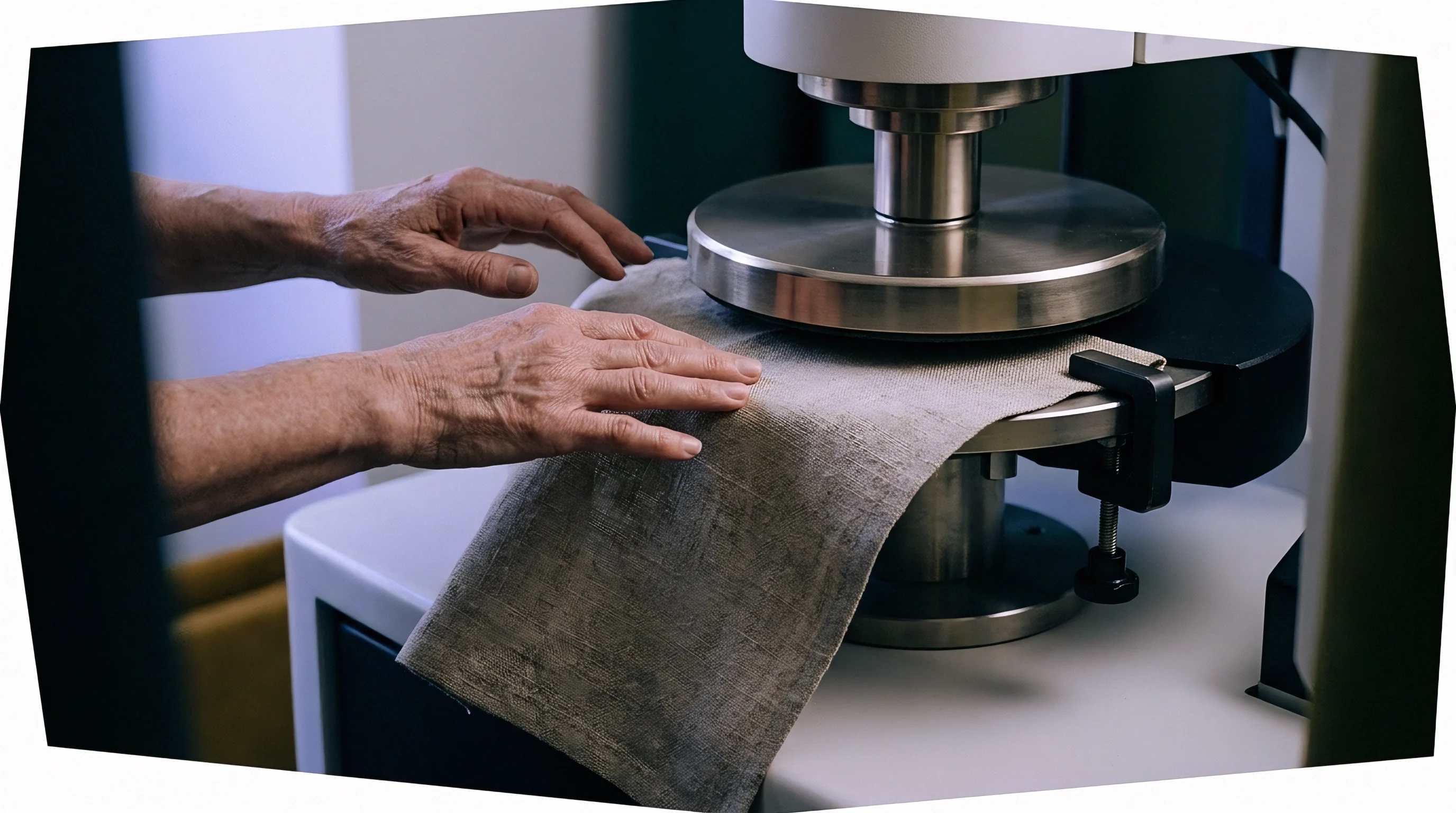
Quantifying micro-structural pectin degradation requires specialized analytical testing protocols adapted specifically for high-speed weaving conditions. Standard single-end tensile testing performed per ISO 2062 reveals overall loss of breaking force, but fails to isolate surface pectin decay from core cellulosic failure. Measuring the mass loss of non-cellulosic matter after controlled air-blast exposure yields precise figures on pectin shedding rates.
Laboratory air-jet simulator benches subject yarn loops to calibrated nozzle pressure pulses while capturing liberated lint on absolute membrane filters for micro-chemical assay.

Analytical Detection Protocols
Fourier-transform infrared spectroscopy (FTIR) operating in attenuated total reflectance (ATR) mode allows direct measurement of pectin degradation on the yarn surface. The absorption peak ratio between the esterified carboxyl group band at 1740 cm⁻¹ and the structural cellulose C-O stretching band at 1030 cm⁻¹ provides a quantitative index of surface pectin density. A declining peak ratio indicates localized removal of pectin sheath materials under high-frequency impulse testing.
Combining ATR-FTIR analysis with ruthenium red dye staining allows visual mapping of pectin depletion zones along the yarn profile.
- Surface ATR-FTIR spectroscopy measures the 1740 cm⁻¹ to 1030 cm⁻¹ band ratio to verify pectin chemical retention following pressure exposure.
- Ruthenium red colorimetry provides quantitative spectrophotometric assessment of residual calcium pectate complexes remaining on the fiber bundle surface.
- Optical fuzz-button tracking quantifies liberated elementary fiber ends per metre of yarn using high-speed digital line-scan cameras.
- Residual calcium assay uses atomic absorption spectroscopy to detect the stripping of calcium ions linked to inter-molecular pectin cross-linking networks.
Automated optical trash monitoring installed on the profile reed offers real-time detection of lint release during live mill production runs. Lint accumulation metrics are converted into micro-structural loss figures using empirical calibration curves. When dust deposition exceeds 0.35 grams per loom operating hour on a 190 cm reed width, pectin degradation has breached the acceptable structural limit of the yarn, signaling imminent pick-stop spikes.
Standard contract specifications for technical flax yarns mandate a maximum surface pectin loss of 5.0 percent after exposure to 100,000 cycles of 4.0 bar nozzle impulses.
Testing flax yarns before committing large warps to the sizing room protects the buyer against latent batch variation. Flax lots harvested during wet retting seasons exhibit variable pectin esterification levels, resulting in inconsistent pneumatic durability on air-jet machinery. Standardized pressure-impulse stress testing eliminates weak yarn batches before beam winding.
Quality guarantees attached to commercial yarn deliveries frequently specify compliance with ASTM D2256 tensile retention limits, yet neglect the critical surface friction parameters altered by micro-pectin loss. Incorporating mandatory ATR-FTIR surface spectrum ratios into purchasing agreements provides a legally defensible standard for structural yarn integrity.

Bond
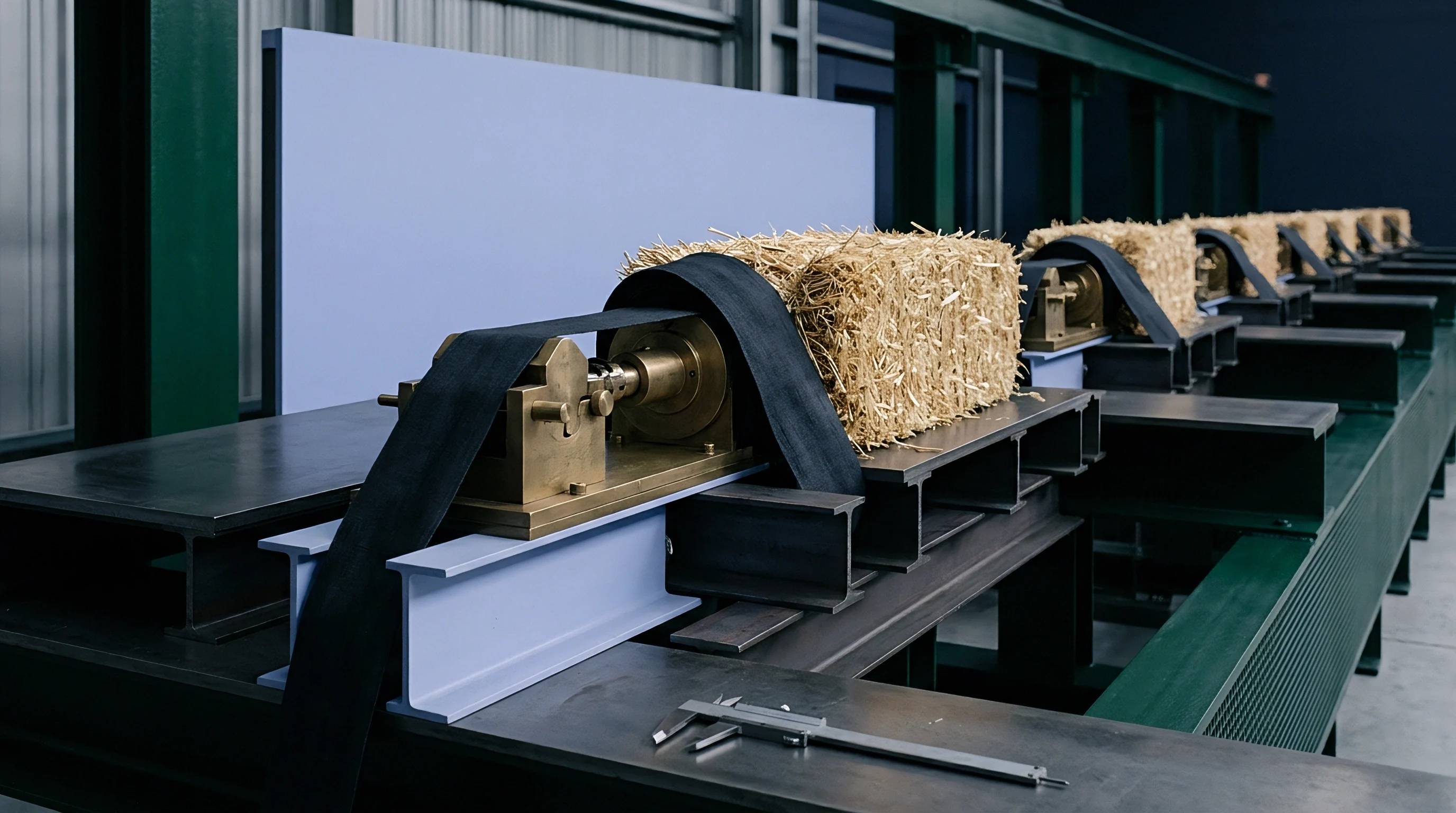
Protecting the flax middle lamella pectin from impulse-induced pneumatic degradation requires application of engineered sizing formulations that penetrate the yarn bundle and form a flexible matrix shield. Conventional starch sizing coats the yarn surface but lacks the elasticity to absorb high-frequency energy spikes from air-jet nozzles. Polyvinyl alcohol (PVA) and modified acrylic polymers supply higher film elongation, wrapping the delicate outer fibers in an elastomeric skin that dampens shockwaves before energy reaches the internal pectin layers.

Chemical and Mechanical Stabilization
Adding cross-linking agents and lubricity additives directly into the size bath enhances resistance to high-speed air stripping. Low-viscosity oxidized starches combined with soft acrylic esters penetrate deep into the inter-fiber voids, physically locking elementary fibers into place. Synthetic lubricants incorporated into the formula reduce the coefficient of friction between air-stream micro-droplets and the yarn surface, lowering tangential air drag forces by up to 22 percent.
| Sizing Agent Composition | Size Add-On (% dry) | Film Elongation (%) | Pectin Loss Reduction (%) | Loom Efficiency Gain (%) |
|---|---|---|---|---|
| Native Potato Starch | 10.5 | 2.8 | 14.2 | 3.1 |
| Thin-Boiling Modified Starch | 11.0 | 4.2 | 28.6 | 6.4 |
| PVA / Modified Starch (50/50) | 9.5 | 8.5 | 64.0 | 12.8 |
| Acrylic Ester / PVA Hybrid | 8.0 | 12.0 | 82.5 | 16.5 |
| Cross-Linked Bio-Polymer | 10.0 | 9.2 | 71.0 | 14.1 |
Sizing bath temperature control plays a decisive role in achieving optimal chemical protection. Maintaining size box temperatures at exactly 85 degrees Celsius ensures low liquid viscosity, allowing the protective liquor to flow thoroughly into the porous flax structure before film formation occurs on the squeeze rolls. Squeeze roll pressures must be set to deliver a wet pick-up of 80 percent, yielding a final dry size add-on between 9.0 percent and 11.0 percent by weight.
Over-sizing creates a brittle, glass-like shell on the flax yarn surface. When this brittle layer encounters high-frequency air pulses from relay nozzles, it shatters in large fragments, stripping both the size film and the underlying pectin sheath simultaneously. Under-sizing leaves elementary fibers unprotected, allowing immediate pneumatic stripping of middle lamella pectin within the first hundred metres of insertion flight.
Applying an inadequate sizing chemistry causes widespread pectin shedding along the profile reed, leading to sensor blinding, uncontrolled pick stops, and severe loom efficiency losses across the entire shed floor.


Outlay
Managing the economic impact of micro-structural pectin degradation requires balancing air-jet loom operating speeds against compressed air energy costs and greige fabric rejection rates. Air-jet looms consume between 35 and 65 cubic metres of compressed air per hour per machine when weaving pure linen. Operating relay nozzles at elevated pressures to force poor-grade flax through the shed exponentially increases energy consumption while accelerating yarn damage.

Commercial Operating Economics
To quantify the landed cost impact of pressure impulse choices, take a 10,000-metre production run of 100 percent linen fabric (160 gsm, 150 cm finished width, 24 picks/cm) running on air-jet looms at 650 picks per minute. Operating at an aggressive 5.0 bar relay pressure reduces pick stops caused by tight sheds, but accelerates pectin stripping, causing a 3.5 percent fabric rejection rate due to embedded fluff balls and surface reed marks. Reducing relay pressure to 3.8 bar protects yarn pectin integrity, lowering rejections to 0.5 percent, but requires dropping machine speed to 580 picks per minute to avoid tip-buckling insertion errors.
- Compressor power load scales with the cube of supply pressure, adding 0.08 kWh per woven metre when elevating relay pressure from 3.8 bar to 5.0 bar.
- Greige repair labor costs escalate rapidly when shed lint shedding creates secondary defects like double picks and broken end floats.
- Reed maintenance frequency triples under high dusting conditions due to sticky pectin residue building up inside micro-profile channels.
- Loom hour valuation books fixed overhead costs against actual net efficiency, making unprogrammed pick stops the primary margin driver.
Calculations show that running air-jet looms at lower peak pressures with optimized sizing protection yields superior landed margins per metre despite modest speed reductions. The reduction in compressed air electrical load, combined with higher first-quality cloth output, offsets the incremental loss in loom output rate.
Booking air-jet capacity for pure flax or high-flax fabrics requires specifying exact relay pressure ceilings inside contract manufacturing agreements. Mill schedules that rely on maxed-out compressor lines to achieve target meterage inevitably compromise the structural fiber matrix of the finished linen cloth, transferring unquantified defect risks directly onto the buyer’s cutting table.