Quantifying Loom Speed Penalties and Crimp Amplification in Extreme Density Fabric Constructions
Extreme fabric density forces loom speed derating and amplifies yarn crimp, shifting loom-hour requirements and landed metre costs upward.


Thrust

Beat-Up Mechanics under Extreme Cover Factors
High pick-density woven construction changes the physics of the shed at the moment of cloth fell displacement. As the warp thread count per centimetre approaches the theoretical packing limit of the yarn diameter, the resistance of the intersecting yarns to sliding past one another increases non-linearly. Beat-up force, exerted by the reed against the fell of the cloth, must overcome both the frictional resistance between overlapping warp ends and the structural bending stiffness of the yarn material.
In conventional density ranges, this mechanical energy is absorbed by yarn deformation and minor beat-up movement. When cover factors exceed ninety percent, every increment of added picks per centimetre demands exponentially higher beat-up momentum from the main motor and sley drive assembly.
The position of the cloth fell shifts toward the reed during beat-up on extreme density warps. This displacement reduces the effective length of the shed, forcing higher peak tension on individual warp yarns during beat-up acceleration. Excess tension during beat-up damages spun flax fibers and fine filament yarns alike, creating micro-filamentation and localized yarn fatigue before the cloth leaves the temple roll.
Peak beat-up force on linen warps exceeding eighty-eight percent combined cover factor increases by up to three hundred percent compared to standard broadcloth setts.
Shed height geometry must expand to clear the shed for clean weft insertion. Expanding the shed opening increases the mechanical stroke of the heald frames, which elevates dynamic warp stress during frame reversal. The friction between crowded warp threads during harness crossover creates warp resistance, where adjacent ends cling and fail to separate cleanly.
This phenomenon induces mispicks, yarn abrasion, and broken ends that stop the machine.
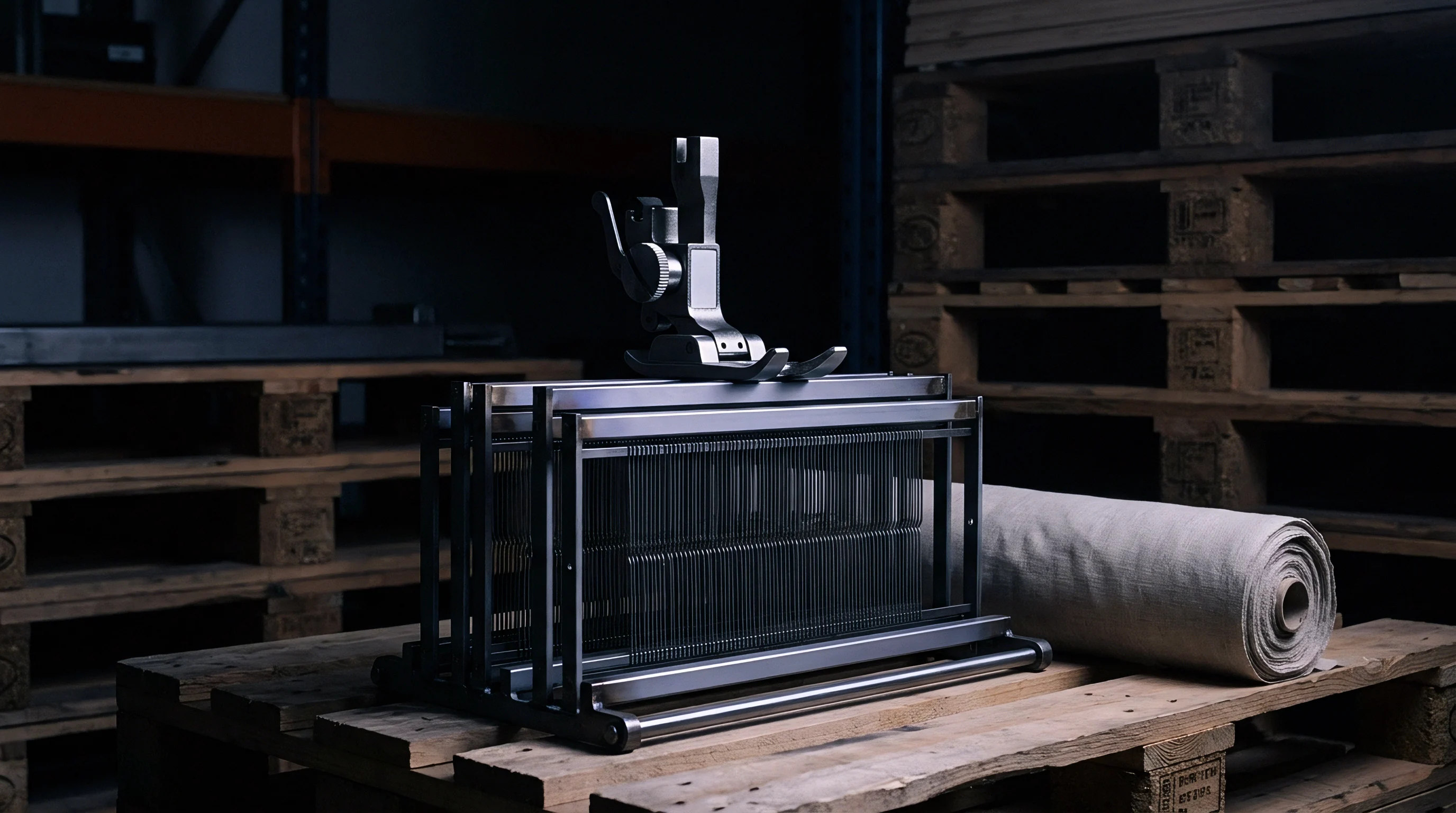
Failure Modes Driven by Excessive Fell Displacement
Overloading the beat-up stroke under extreme sett conditions initiates predictable physical degradation in the greige fabric and machine components. The structural limits of the loom and thread become apparent through specific operational failures.
- Fell Bounce occurs when the elastic recoil of the tight warp geometry pushes the newly inserted weft pick back toward the harness before the shed fully closes.
- Reed Deflection develops when high density resistance forces the reed blades to flex laterally, producing uneven density bands across the cloth width.
- Heald Wire Grooving results from continuous high tension friction as tight warp ends slice into the wire eyes during shed changes.
- Temple Roll Scuffing appears when extreme radial contraction pulls the cloth edge inward against the pin rings, tearing outer warp ends.
Continuous operation under high beat-up force accelerates wear on the main drive crankshaft, eccentric cams, and sword arm bushings. Mill maintenance schedules require shortened grease intervals and frequent drive belt inspection when running extreme density warps. Ignoring these elevated friction loads leads to premature clutch slip, drive motor thermal trips, and irregular beat-up timing that leaves structural bars across the finished bolt.
Selecting an unsuitable loom frame for dense constructions converts machine life into immediate scrap costs.
Interlace

Crimp Amplification Dynamics in Heavy Setts
Crimp defines the structural wave imparted to a yarn as it weaves over and under opposing yarn systems. In extreme density constructions, thread packing limits force one yarn system to absorb the majority of structural displacement. When warp ends are packed tightly together, the weft pick cannot remain straight; instead, the weft must bend around the dense array of warp threads.
Conversely, if warp tension is maintained at extreme levels, the warp yarn remains rigid, forcing the weft yarn into deep, tortuous crimp angles. This imbalance creates crimp amplification, where small additions in pick count yield disproportionate structural contraction in the non-tensioned yarn system.
Yarn cross-sections flatten under extreme interlace pressure. Round spun yarns deform into lenticular or racetrack shapes within the cloth matrix, altering the effective yarn axis spacing. This cross-sectional deformation increases the contact area between warp and weft, raising the static coefficient of friction.
The fabric stiffens dramatically in hand feel, while its tear strength drops due to the inability of individual yarns to bundle together and share local tearing loads.
Crimp redistribution between warp and weft systems stabilizes only after full tension relaxation during wet finishing protocols.
Crimp geometry directly controls cloth thickness, mass per square metre, and volumetric density. As warp crimp increases under heavy weft packing, the fabric thickness expands beyond the sum of two uncompressed yarn diameters. The structural volume fills with inter-yarn contact zones, eliminating voids and creating wind-resistant, highly impermeable textile structures.

Jamming Limits and Math of Thread Path Distortion
Peirce geometry models the theoretical limits of yarn packing within a woven matrix. Jamming occurs when adjacent warp or weft threads touch continuously along their length, leaving no physical space for further density expansion. Beyond the jamming limit, additional thread insertion forces severe crimp amplification or structural bucking of the fabric surface.
Calculating the maximum achievable picks per centimetre requires evaluating the diameter of both warp and weft yarns alongside their specific crimp percentages. The formula for yarn diameter in millimetres, assuming a fiber packing density factor within the yarn core, provides the baseline geometric threshold. When the warp cover factor and weft cover factor combine to exceed the absolute jammed limit, the loom cannot insert further picks without sacrificing dimensional stability or damaging the yarn.
Do extreme sett ratios force an unrecoverable imbalance in yarn crimp distribution between warp and weft systems across varied weave structures?


Derating

Quantifying Machine Speed Losses at High Cover Factors
Loom speed, measured in picks per minute, drops when broadcloth density surpasses standard manufacturing thresholds. High cover factors demand longer shed dwell times to allow clean weft insertion and prevent harness interference. Modern high-speed looms must be derated by loom tuning technicians to preserve yarn integrity and maintain acceptable shed efficiency percentages.
Air-jet insertion systems suffer severe efficiency losses in high density weaving due to reduced shed clearance. The high velocity air stream disperses when striking dense warp sheets, leading to tip instability on the inserted weft yarn and frequent weft stops. Rapier looms handle dense warps more effectively through direct mechanical control of the weft tip, yet they demand speed reductions to prevent ribbon wear and gripper detachment under high warp tension loads.
| Combined Cover Factor | Insertion System | Nominal Shed Speed (PPM) | Derated Speed (PPM) | Achievable Efficiency (%) |
|---|---|---|---|---|
| 75% – 82% | Air-Jet | 850 | 820 | 94.5 |
| 83% – 88% | Air-Jet | 850 | 680 | 88.0 |
| 89% – 93% | Flexible Rapier | 600 | 460 | 82.5 |
| 94% – 97% | Rigid Rapier / Projectile | 450 | 310 | 74.0 |
Operating a loom shed at reduced speed directly shifts fixed overhead costs onto the running metre price of the greige cloth. Machine allocation accounting relies on constant pick generation per hour; a twenty-five percent reduction in machine speed increases the required loom-hours per thousand metres by thirty-three percent.
Which Loom Shed Parameters Force Speed Reduction during High Cover Weaving?
The operational sequence for establishing maximum safe operating speed on extreme density warps involves systematic testing of machine dynamics and stop rates.
- Calculate combined fabric cover factor using measured yarn diameters and reed count.
- Reduce nominal loom drive speed by fifteen percent prior to warp mounting if combined cover factor exceeds eighty-eight percent.
- Adjust warp tension let-off system to maintain fell position within a two-millimetre tolerance window during shed transition.
- Extend heald frame dwell angle by ten to fifteen degrees to optimize weft insertion clearance.
- Monitor warp end break rate over a continuous four-hour trial run, reducing speed in twenty-five pick increments until break rates fall below 0.5 breaks per loom hour.
Mill managers often explain speed derating on high density runs by claiming that high yarn strength specifications justify raw machine speed reductions to protect expensive warp materials.
Uncontrolled speed drops undermine loom shed profitability, exposing the buyer to lead-time extensions and unquoted pricing surcharges at the final billing stage.
Contraction

Calculating Crimp Amplification and Mass Alteration
Warp take-up percentage measures the difference between the length of warp yarn pulled from the beam and the resulting length of finished woven cloth. Extreme pick densities force severe warp take-up because the warp threads must trace a elongated path over and under tightly packed weft picks. High take-up rates increase warp yarn consumption per finished metre, shifting the cost profile of the raw materials.
Fabric weight, expressed in grams per square metre, increases as crimp contraction pulls more yarn mass into a smaller planar surface area. A specification targeting a greige weight of two hundred grams per square metre can easily yield two hundred and thirty grams per square metre if crimp amplification is under-calculated during yarn allocation. This weight escalation impacts landed freight costs and alters downstream garment yield projections.
Standard ISO 7211 testing protocols define crimp percentage as the ratio of un crimped thread length to woven fabric length, providing the foundation for accurate yarn consumption accounting.
Width contraction during weaving presents a parallel operational challenge. Tight weft insertion pulled into dense warp sheets contracts the cloth width past nominal reed width settings. Loom reed width calculations must incorporate elevated crimp take-up values to ensure the off-loom greige width matches downstream finishing frame entries.
| Weave Structure | Warp Density (ends/cm) | Weft Density (picks/cm) | Warp Crimp (%) | Weft Crimp (%) | Finished Mass Shift (%) |
|---|---|---|---|---|---|
| 1/1 Plain Weave | 42.0 | 36.0 | 12.5 | 4.2 | +14.2 |
| 2/2 Twill | 48.0 | 40.0 | 8.8 | 6.5 | +9.5 |
| 5-End Satin | 56.0 | 44.0 | 5.2 | 9.1 | +7.1 |
| 3/1 Broken Twill | 50.0 | 42.0 | 7.4 | 7.8 | +8.8 |
As a rule of thumb, every single percent increase in warp crimp above ten percent increases total yarn purchasing requirements by one point two percent due to waste margins and tension loss.

Inspection

Greige Fault Profiles under High Warp and Weft Densities
Extreme density fabric constructions alter the appearance and severity of standard greige defects on the inspection frame. High warp cover amplifies the visual impact of reed marks, where uneven dent spacing leaves permanent longitudinal streaks down the roll. A single broken filament or slub in a dense warp sheet creates immediate yarn friction, resulting in clinging ends that pull neighbouring threads out of alignment.
Starting marks, caused by loom stops and mechanical relaxation during shed pause, become severe in dense fabrics. The intense tension applied to the fell during loom restart leaves high or low density bands across the width that cannot be scoured or tentered out in finishing. Minimizing loom stops through precise warp preparation is the single primary defense against off-grade high density greige production.
Greige inspection visual standard ASTM D5430 governs four-point penalty scoring, setting strict point limits per hundred square metres for high-density contract goods.
Structural skew and bow occur when uneven beat-up force or temple roll drag skews the high density weft line away from a right angle. In dense weaves, internal friction locks the skewed picks into position, making physical straightening during finishing difficult. Inspection frames must utilize automated optical sensors to verify pick straightness continuously across every running metre.

Qualification Protocol for Extreme Density Greige Batches
Verifying cloth quality before releasing greige rolls to the dye house demands a systematic physical audit. The following evaluation points protect the buyer from accepting defective high-density material.
- Density Audit requires pick and end counts taken at five distinct locations across the width, verifying uniformity against the specification tolerance.
- Mass Verification measures weight per square metre on cut samples after four hours of standard conditioning, catching uncalculated crimp shifts early.
- Bow Assessment quantifies maximum pick deflection from a straight horizontal datum across the full usable width of the roll.
- Fell Mark Grading categorizes stop marks under direct backlighting, penalizing any visual line that exceeds one pick space in width.
Standard commercial supply agreements specify that greige rolls displaying more than twenty-eight penalty points per hundred square metres under ASTM D5430 four-point evaluation are subject to immediate price debits or full lot rejection.

Tariff

Financial Modeling of Derated Loom Time and Material Yield
Loom time represents the core unit of capacity in a weaving mill. When an extreme density specification forces a loom to derate speed from six hundred to four hundred picks per minute, the production output per loom hour drops by thirty-three percent. Fixed loom shed overheads, including electricity, floor space, climate control, and labor, remain constant per hour.
Consequently, the weaving cost per metre escalates directly with the loss of machine speed.
Cost calculations for dense fabrics must combine the speed penalty with yarn mass amplification metrics. High crimp take-up requires purchasing additional yarn mass to achieve a given finished metre length. When yarn consumption increases by ten percent due to crimp amplification and loom output falls by twenty-five percent due to speed derating, the cumulative landed cost per metre rises significantly above nominal base quotes.
| Target Picks/cm | Loom Speed (PPM) | Loom Hours per 1000m | Base Weave Cost ($/m) | Yarn Cost Adjustment ($/m) | Final Landed Cost ($/m) |
|---|---|---|---|---|---|
| 30.0 | 650 | 25.6 | 1.85 | 3.20 | 5.05 |
| 36.0 | 580 | 34.5 | 2.48 | 3.58 | 6.06 |
| 42.0 | 440 | 53.0 | 3.81 | 4.12 | 7.93 |
| 48.0 | 320 | 83.3 | 5.99 | 4.85 | 10.84 |
A worked example demonstrates the financial exposure built into unexamined high density specifications. Consider a contract for ten thousand metres of heavy 1/1 plain weave linen fabric specified at forty-four picks per centimetre on a two-metre nominal reed width. Standard shed capacity for broadcloth targets five hundred and fifty picks per minute at eighty-eight percent efficiency, yielding thirty-seven running metres per loom hour at a base shed rate of twenty-four dollars per loom hour, establishing a base weaving cost of sixty-five cents per metre.
Mounting the actual extreme density warp forces the shed manager to derate the rapier loom to three hundred and sixty picks per minute to prevent warp end breaks and beat-up stalling. Shed efficiency drops to seventy-eight percent due to frequent stop mark clearing and heald wire adjustments. Actual production drops to nineteen point five metres per loom hour, elevating the weaving cost to one dollar and twenty-three cents per metre.
Simultaneously, measured warp crimp amplifies from seven percent to thirteen point five percent, requiring six hundred and fifty kilograms of additional warp yarn across the ten thousand metre order. The combined effect of speed derating and yarn mass amplification adds fifteen thousand eight hundred dollars to the landed order invoice. Structuring purchase orders with explicit speed-efficiency clauses locks the loom-hour rate against unannounced mill surcharges.