Verifying Scutched Flax Moisture Regain during Mill Receiving
Scutched flax moisture regain verification requires core sampling and ISO 6741-1 oven drying to adjust gross weight to a 12.0 percent commercial mass basis.


Probe
Flax fibres absorb and release atmospheric water vapor until reaching hygroscopic equilibrium with the surrounding air. Scutched flax arrives at the spinning mill in high-density compressed bales, holding moisture levels that directly affect the commercial weight, carding performance, and storage stability of the lot. Accurate determination of moisture regain upon arrival establishes whether the buyer pays for dry plant fibre or excess trapped water.
Standard moisture regain for scutched flax is established internationally at 12.0 percent under rules published by the International Bureau for the Standardisation of Man-Made Fibres and adopted for bast fibres by European trade bodies. This figure represents the mass of water absorbed by one hundred parts of dry fibre weight. It differs from moisture content, which measures water mass as a percentage of total damp fibre weight.
A lot with a moisture regain of 12.0 percent carries a moisture content of 10.71 percent. Confusing these two figures alters the commercial invoice weight by more than one percent, creating substantial financial discrepancy on bulk fibre shipments.

Why Do Handheld Resistive Meters Drift in High Humidity Receiving Bays?
Direct electrical measurement of bale moisture relies on inserting insulated pin electrodes into the compressed fibre bundle. Handheld resistive meters calculate moisture content by driving a direct current between two electrode tips and measuring electrical resistance through the flax matrix. Cellulosic fibres exhibit lower resistance as water content increases.
Atmospheric relative humidity exceeding 75 percent in a receiving dock creates a surface film of moisture on exposed bale exteriors and probe insulation shafts. This surface film offers a low-resistance path, bypassing the internal fibre matrix and artificially inflating the regain reading on meter displays.
Capacitive meters measure the dielectric constant of the bale surrounding an antenna probe. Water possesses a relative permittivity of approximately 80 at room temperature, while dry flax cellulose registers between 3 and 7. Changes in ambient temperature alter these electrical properties independently of actual water content.
Uncalibrated field meters used without temperature correction introduce errors of up to 1.5 percentage points in regain values when receiving bales during winter or summer climate extremes.
A temperature shift of ten degrees Celsius alters resistive moisture meter readings by roughly 0.5 percentage points on unconditioned scutched line flax.
Verification at mill receiving relies on continuous cross-calibration of electronic field tools against gravimetric laboratory standards. ISO 6741-1 specifies the referee test procedure, where representative flax samples are weighed, dried to constant mass in a ventilated oven at 105 degrees Celsius, and weighed again to compute absolute dry mass. Handheld units serve for rapid screening on the dock, but oven drying remains the single authoritative baseline for settling commercial weight adjustments.
| Fibre Classification | Standard Regain (%) | Equivalent Moisture Content (%) | Reference Test Method |
|---|---|---|---|
| Scutched Flax Line Fibre | 12.00 | 10.71 | ISO 6741-1 / BISFA |
| Flax Tow (Combed or Carded) | 12.00 | 10.71 | ISO 6741-1 |
| Cotton (Commercial Basis) | 8.50 | 7.83 | ISO 6741-2 |
| Raw Hemp Line Fibre | 12.00 | 10.71 | ISO 6741-1 |
Calibration stability requires strict routine controls when operating portable moisture meters across varying shipment lots:
- Pin Shaft Insulation Inspection verifies that non-conductive coatings remain intact to prevent stray currents near the bale surface.
- Temperature Compensation Adjustments match the meter internal processor settings to the physical temperature of the bale interior rather than dock air.
- Species Setting Verification ensures the meter firmware applies cellulosic bast fibre resistance curves rather than timber or cotton calibrations.
- Zero Point Verification checks instrument electronic baseline drift using fixed resistor reference plugs before each receiving shift.
Electronic field probes supply quick initial sorting data, but laboratory oven drying dictates final financial settlement.

Core
Bale geometry and pressing parameters create uneven moisture distribution throughout imported flax packages. Hydraulic baling presses exert pressures up to 200 bar, forming dense exterior shells that seal internal fibre layers. Rain exposure during transport or condensation inside sea containers creates damp outer zones, while dry storage creates surface desiccation while retaining high internal moisture core levels.
Point testing near the strapping bands fails to reflect the true average regain of the bale.
Core sampling procedures require penetration to the geometric centre of the compressed unit. Stainless steel tubular drills fitted with serrated cutting edges extract cylindrical fibre cores without generating frictional heat that evaporates moisture during extraction. The drill tube enters perpendicular to the lay of the scutched stricks, drawing material from exterior, intermediate, and deep core zones in a single stroke.
Bale core sampling must capture all density strata to prevent outer layer moisture bias.
Receiving inspection relies on a systematic sampling sequence executed immediately upon unloading to prevent ambient moisture exchange with warehouse air.
- Position the barded flax bale on the receiving scale and record gross scale weight.
- Select sampling bales according to square-root sampling rules, taking a minimum of ten bales per twenty-tonne lot.
- Drive the hollow core drill horizontally into the side face of the bale to a depth of at least 400 millimetres.
- Eject the extracted fibre core directly into a hermetically sealed aluminum container or vapor-barrier foil bag.
- Record container gross mass immediately on a calibrated laboratory balance accurate to 0.01 grams.
- Transfer sealed specimens to the testing laboratory within two hours of sampling on the receiving dock.
Sampling depth omissions lead directly to incorrect lot mass declarations that compromise spinning mill performance. Excessively moist bales admitted to storage develop localized mold growth within three weeks, weakening cellulose chain length and destroying fibre tenacity during subsequent hackling operations.
Tonnage
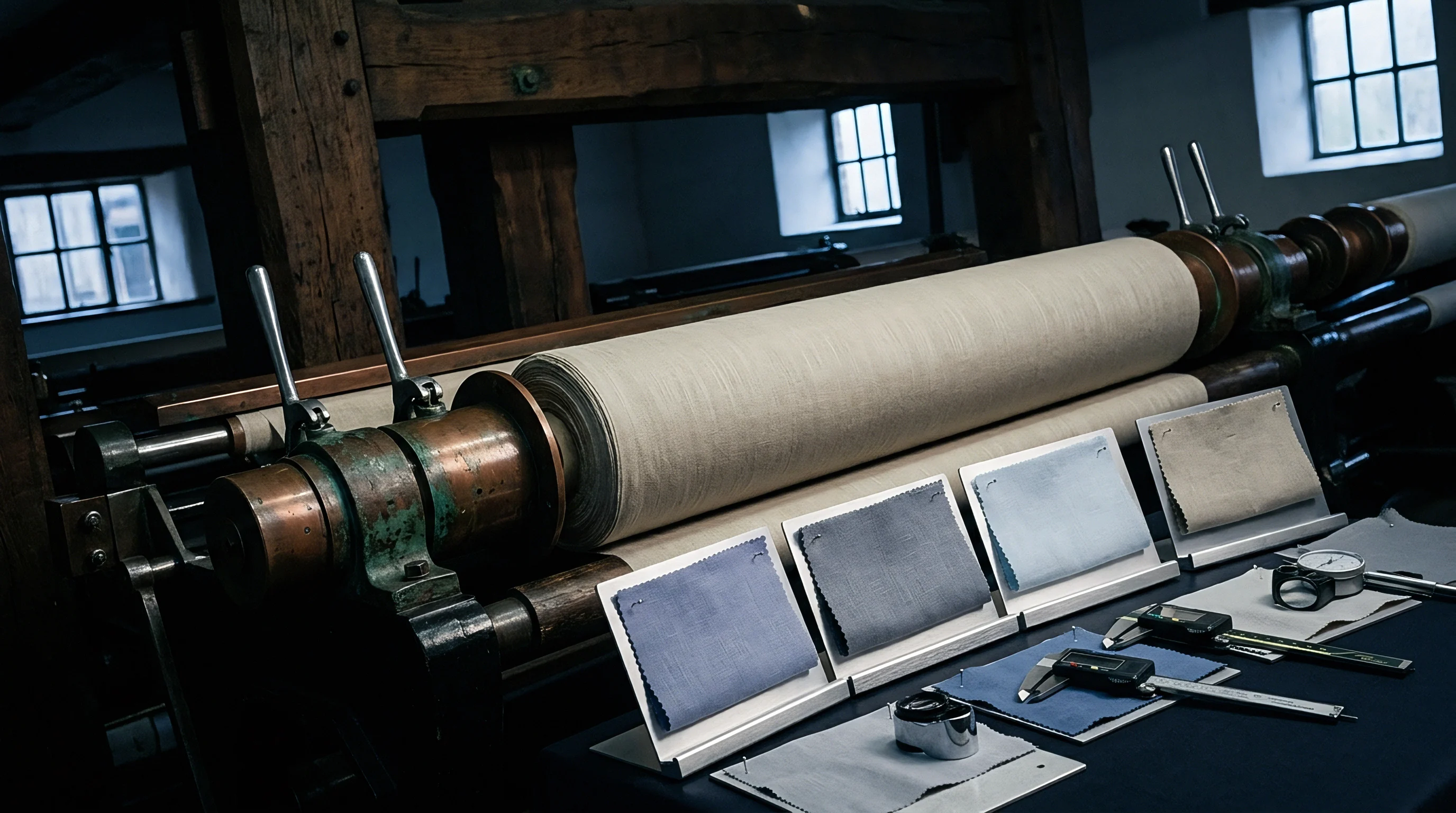
Commercial transactions for scutched flax settle on commercial mass rather than gross delivered scale weight. Commercial mass represents the clean oven-dry mass of the fibre consignment plus the standard commercial regain allowance of 12.0 percent. When incoming shipments arrive with moisture levels above or below this baseline, the mill receiving desk calculates invoice weight adjustments to ensure the buyer pays strictly for contractually agreed fibre mass.
The mathematical conversion from gross scale weight to commercial mass uses the measured percentage moisture regain obtained through laboratory oven drying. The clean dry mass is calculated first by dividing gross fibre mass by one plus the actual regain expressed as a decimal. Applying the standard 12.0 percent factor to this dry baseline yields the correct invoice weight.
Consider a received shipment arriving with an invoice scale weight of 20,000 kilograms. Laboratory core testing via ISO 6741-1 determines an actual moisture regain of 14.50 percent across the lot. The commercial mass calculation proceeds in two steps:
Clean Dry Mass = Received Scale Mass / (1 + Actual Regain / 100)
Clean Dry Mass = 20,000 kg / (1 + 0.1450) = 17,467.25 kg
Commercial Mass = Clean Dry Mass (1 + Standard Regain / 100)
Commercial Mass = 17,467.25 kg 1.1200 = 19,563.32 kg
The lot contains only 19,563.32 kilograms of commercial mass. The buyer deducts 436.68 kilograms from the billable invoice weight. At a scutched flax market price of 4.80 Euros per kilogram, this single moisture verification calculation prevents an overpayment of 2,096.06 Euros on one truckload.
| Actual Regain (%) | Delivered Mass (kg) | Calculated Dry Mass (kg) | Commercial Mass (kg) | Billable Weight Adjustment (kg) | Financial Settlement Impact (€4.80/kg) |
|---|---|---|---|---|---|
| 10.00 | 20,000.00 | 18,181.82 | 20,363.64 | +363.64 | +€1,745.47 |
| 11.00 | 20,000.00 | 18,018.02 | 20,180.18 | +180.18 | +€864.86 |
| 12.00 (Standard) | 20,000.00 | 17,857.14 | 20,000.00 | 0.00 | €0.00 |
| 13.00 | 20,000.00 | 17,699.12 | 19,823.01 | -176.99 | -€849.55 |
| 14.00 | 20,000.00 | 17,543.86 | 19,649.12 | -350.88 | -€1,684.22 |
| 15.00 | 20,000.00 | 17,391.30 | 19,478.26 | -521.74 | -€2,504.35 |
Commercial weight calculations based on certified oven drying protect the mill against paying full fibre price for excess water weight.
Dry shipments below 10.0 percent regain create different operational challenges. Fibres lose elasticity, becoming brittle during hackling and carding. Fibre breakage increases short fibre percentages, reducing yield in combed sliver production.
Mills often apply a commercial credit to suppliers sending excessively dry fibre, provided the material has not suffered thermal damage during artificial drying at the scutching mill.
Commercial mass adjustments depend on three core parameters established during receiving verification:
- Gross Weighbridge Mass measures raw incoming weight including bale packaging, straps, and protective wrapping materials.
- Tare Weight Deductions subtract known mass values of steel bands, wooden pallets, and plastic covers from gross incoming weight.
- Oven Dry Regain Percentage provides the absolute ratio of water to dry cellulose determined by laboratory thermal drying.
Suppliers sometimes claim that moisture loss occurred during transit through hot climates, yet contracts governed by standard trade rules fix the commercial weight strictly at the moment of mill dock receiving.

Clause
Clear contractual wording governs moisture dispute resolution between flax scutchers and spinning mills. Standard supply contracts incorporate trade terms formulated by the International Linen and Hemp Confederation (CELC). These rules specify permissible moisture thresholds, mandatory sampling protocols, and financial adjustment formulas applied during mill receiving.
Contracts specify an absolute maximum moisture regain ceiling, typically capped at 14.0 percent. Shipments arriving above this limit grant the buyer the right to reject the lot entirely or accept the goods under severe penalty discounts covering extra drying and handling costs. Scutched flax stored above 14 percent regain degrades rapidly due to bacterial heating inside dense bales.
Official joint sampling rules under European trade standards require sealed referee samples to be retained for independent laboratory arbitration.
Dispute procedures require notification within three business days of delivery. When the buyer field measurements differ from the supplier invoice specification by more than 0.5 percentage points, official joint re-sampling takes place. An accredited independent testing facility executes the referee method under ISO 6741-1.
The findings of the referee laboratory bind both parties, with the losing party absorbing all testing and sampling fees.
Standard purchase orders incorporate explicit moisture settlement provisions: “Commercial weight shall be determined upon receiving at buyer’s facility in accordance with ISO 6741-1 testing procedures; delivered moisture regain exceeding 12.0% shall result in a proportional reduction of billable invoice mass, while moisture regain exceeding 14.0% gives the buyer sole option to reject the lot at seller’s expense.”