Determining Flax Commercial Mass from Desorption Testing
Commercial mass determination from desorption testing requires converting anhydrous dry mass to invoice weight using standard regain percentage allowances.

Cell
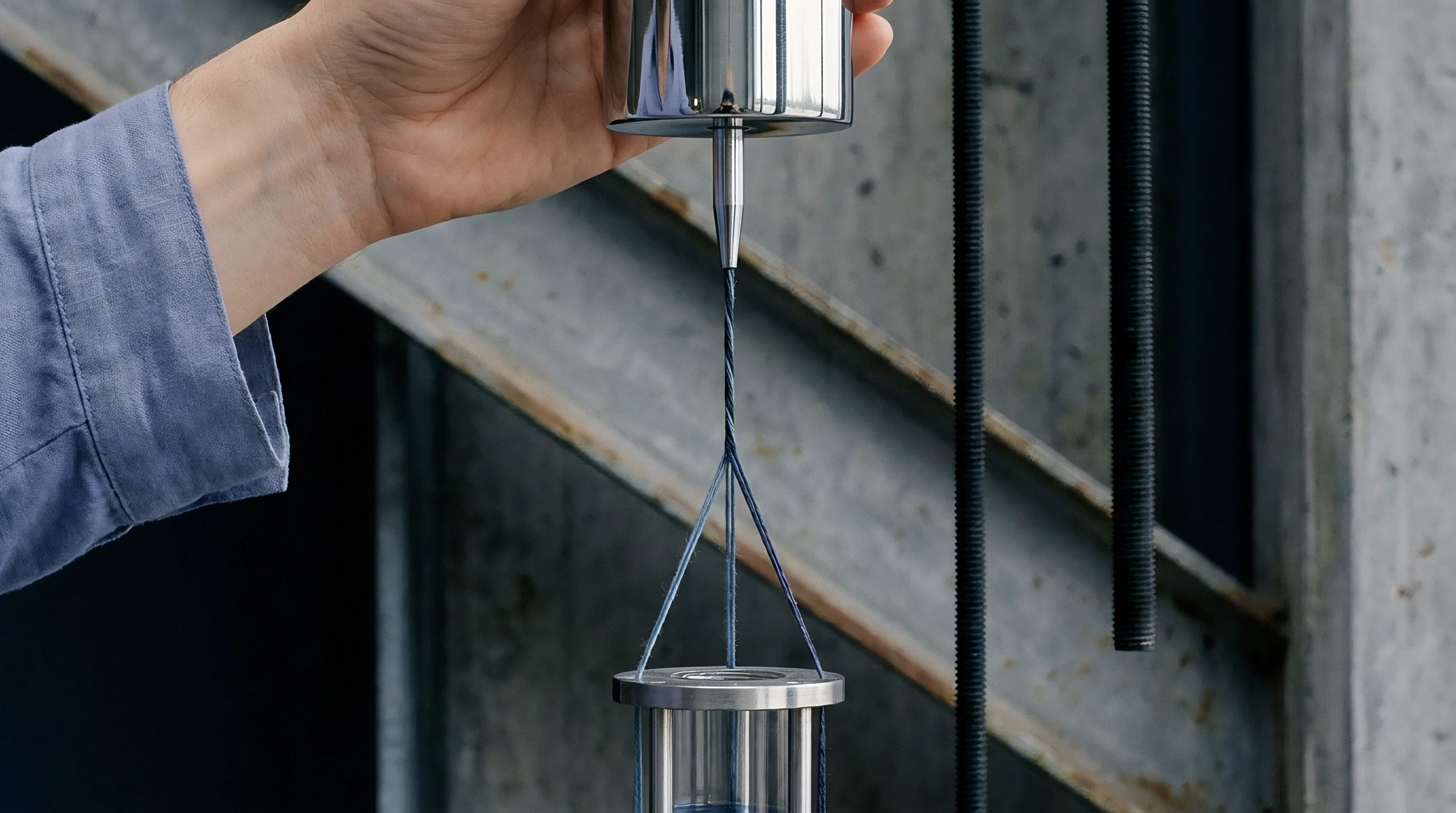
When specimen containers are placed in forced-air drying equipment, they experience steady convective heat flow. In commercial moisture testing of flax fiber, gravimetric determination relies on evaporating unbound moisture until the specimen reaches a stable mass. Scutched long fiber bundles retain interstitial water within cellular lumens and between individual bast strands.
Standard protocols specify drying these specimens in a ventilated enclosure at 105°C ± 2°C, which requires stable air movement. Air currents inside the heating chamber pass across sample baskets to carry evaporated water vapor away from the fiber bed.
Air movement inside heated enclosures prevents localized moisture saturation around dense fiber bundles. If circulation drops, humidity accumulates in the lower zones of the chamber, slowing desiccation and producing artificially high dry weight measurements. Gravimetric balances linked to drying chambers record mass at periodic intervals, tracking reduction until consecutive weighings at 15-minute intervals show a change smaller than 0.05 percent of the initial mass.
Forced-air drying at 105°C until consecutive weighings at 15-minute intervals show under 0.05% mass change defines total desiccation under ISO 6741-1.
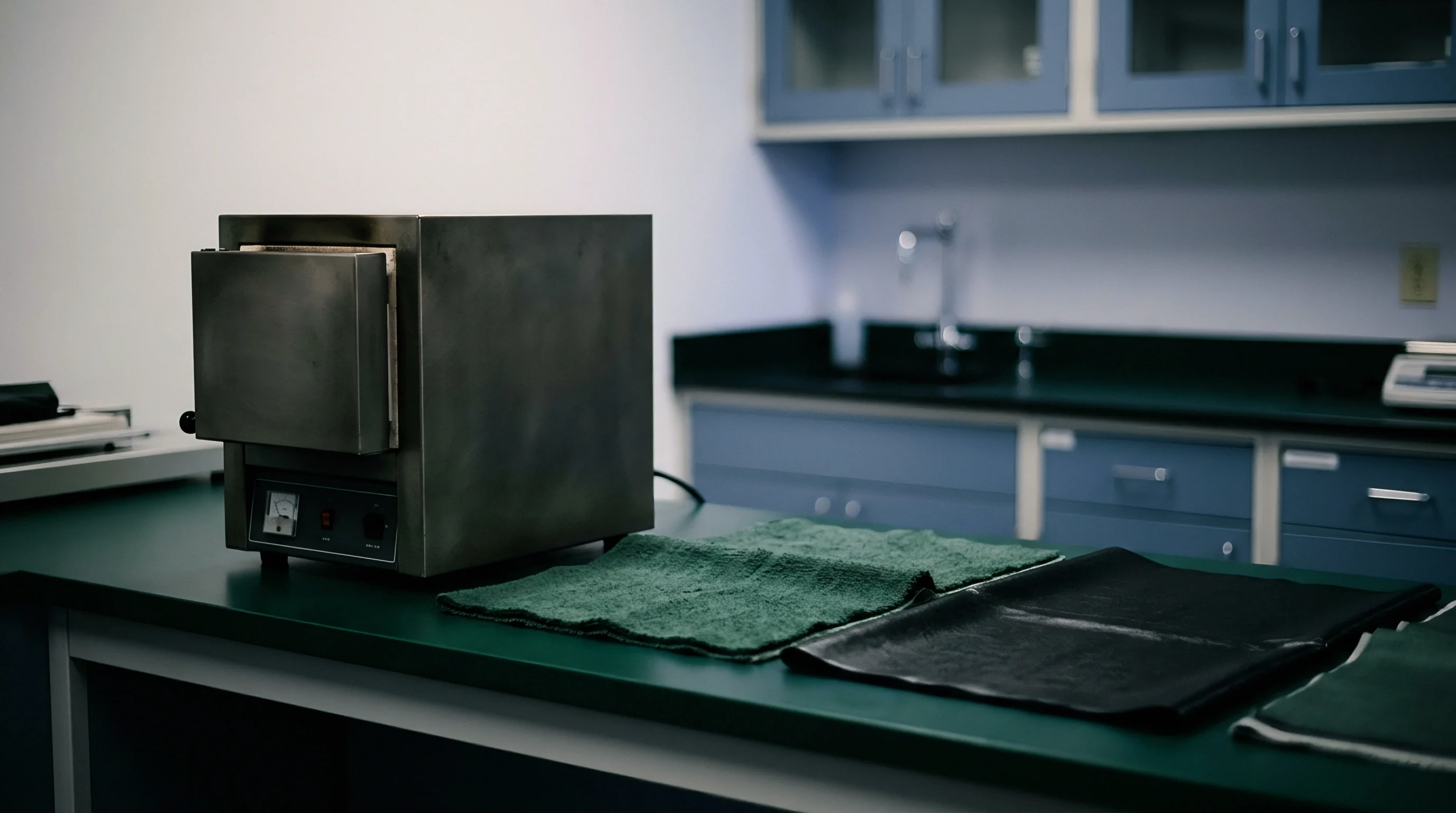
Convective currents driven by high chamber temperatures lift weighing baskets slightly, exerting a measurable upward force on analytical balance pans. Hot-weighing inside an oven without switching off convective fans introduces systematic negative mass errors. Weighing specimens in sealed bottles after cooling them in a desiccator eliminates these air buoyancy artifacts, though the extra handling adds processing time to high-volume commercial testing routines.
- Inadequate Specimen Aeration Convective air streams failing to penetrate dense flax cores leave hidden water pockets during oven drying.
- Tare Drift in Heated Weighing Units Thermal expansion of metal sample pans alters initial weight baselines during high-temperature gravimetric cycles.
- Variable Ambient Humidity During Sample Transport Unsealed specimen containers exchange moisture with surrounding air prior to laboratory testing.
- Improper Temperature Gradient Calibration Non-uniform heat distribution inside forced-air chambers creates uneven desiccation rates across multiple sample trays.
Oven balance errors compound rapidly. A balance calibration shift of half a gram during hot weighing alters the invoiced consignment weight by dozens of kilograms, forcing immediate financial adjustment during port clearance.

Isotherm
Equilibrium curves plot the moisture content of bast fibers against ambient relative humidity at constant temperatures. Natural flax cellulose shows pronounced sorption hysteresis, where desorption yields a higher mass than adsorption. When flax loses water from a fully saturated state down to ambient equilibrium, it retains a higher moisture percentage than fiber gaining moisture from an anhydrous state to that same ambient equilibrium point.
Natural flax absorbs or releases moisture depending on its processing history. During field retting and mechanical scutching, flax fibers experience fluctuating environmental humidity, so scutched long flax delivered to spinning mills contains moisture held along its desorption boundary curve. Testing laboratories that condition samples by drying them down to standard testing atmosphere (20°C and 65 percent relative humidity) land on the desorption equilibrium branch ~ which sits roughly 1.5 to 2.2 percentage points higher than the adsorption curve at identical relative humidity levels.
| Transformation Stage | Standard Commercial Regain (%) | Hysteresis Equilibrium Spread (%) | Commercial Mass Exposure Risk |
|---|---|---|---|
| Scutched Long Flax | 12.0 | 1.8 to 2.2 | High dry-mass underestimation from elevated desorption equilibrium |
| Hackled Tow Fiber | 12.0 | 1.5 to 1.9 | Moderate mass variance caused by residual shive content |
| Wet-Spun Flax Yarn | 12.0 | 1.2 to 1.6 | Inconsistent boil-off loss affecting dry mass calculations |
| Dry-Spun Flax Yarn | 13.0 | 1.0 to 1.4 | Spinning lubricant volatilization altering thermal mass readings |
Moisture content measurements taken during drying consistently exceed measurements taken during wetting at identical ambient relative humidity levels, creating a systematic mass gap. Structural hydroxyl groups on cellulose microfibrils form stable hydrogen bonds with water molecules during desorption, resisting moisture release. At the same time, pectin compounds and residual outer-bark waxes in unrefined bast fibers restrict water vapor diffusion out of inner fiber bundles, extending the time necessary to attain true thermodynamic equilibrium.
ISO 6741-2 rules that moisture calculations based on equilibrium state specify whether equilibrium was reached via adsorption or desorption.
Elevated equilibrium moisture levels reflect internal fiber cell wall structure rather than residual surface humidity from processing.


Regain
Commercial mass agreements substitute nominal moisture percentages for actual moisture content measured at the port of entry. In international linen trading, raw flax fiber and spun yarn trade on commercial mass rather than raw net mass. Commercial mass reflects the mass of fiber after complete desiccation, combined with an officially agreed moisture regain allowance.
Under European Flax rules and ISO 6741 standards, the standard commercial regain allowance for scutched flax fiber stands at 12.0 percent.
Can Desorption Testing Override Standard Commercial Regain?
Laboratory desorption procedures isolate total moisture mass to establish the dry base of a fiber shipment for final billing. Desorption testing strips all moisture to calculate the anhydrous mass (Md). The formula for commercial mass (Mc) applies the official regain factor directly to this desiccated base:
Mc = Md × left(1 + fracRc100right)
In this equation, Rc represents the contractual commercial regain percentage. When physical fiber arrives with a moisture content of 14 percent due to desorption equilibrium retention, the buyer does not pay for that 14 percent water content. The invoice adjusts total mass down to the 12.0 percent commercial regain base.
Desorption testing serves exclusively to discover the true anhydrous dry mass (Md), removing environmental water variance from the billing baseline.
- Extract representative specimen cores across ten percent of total consignment bales using an end-drilling sampling tube.
- Seal specimens in vapor-impermeable containers immediately to prevent moisture exchange during transport to the testing laboratory.
- Measure initial wet mass on a calibrated analytical balance before introducing specimens into the gravimetric drying enclosure.
- Heat specimens at 105°C until continuous mass loss stops, yielding the exact dry specimen mass for formula application.
Standard trading agreements rely on mathematically fixed moisture addition percentages. Contractual formulas prevent disputes regarding variable weather conditions during transit across ocean freight routes. Whether a shipment absorbs damp sea air or dries out during desert trucking, the calculated commercial mass remains constant because the underlying dry fiber mass (Md) does not change.
Standard commercial regain applies exclusively to anhydrous dry fiber mass regardless of the moisture content present at physical delivery.
Section 4 of standard European flax purchase contracts dictates that physical weighing records combined with laboratory dry mass ratios form the sole basis for invoice settlement.

Correction
Thermal desiccation drives off non-aqueous compounds alongside free moisture, as the natural pectins and fats in flax fibers decompose under prolonged heat. When forced-air oven testing runs at 105°C for extended durations, volatile organic matter escapes from the bast tissue and registers as lost moisture on gravimetric scales, distorting the dry weight calculation.
Enclosure sensors balance heat distribution to prevent scorched spots on the fiber. However, oven desiccation beyond two hours at elevated temperatures degrades non-cellulosic fiber constituents: extractives including low-molecular-weight waxes, residual retting oils, and volatile hemicellulose fractions evaporate during oven exposure. Overestimating moisture mass via volatile loss understates true dry fiber weight, creating an artificial reduction in final invoiced commercial mass.
| Drying Condition | Temperature (°C) | Volatile Non-Water Mass Loss (%) | Dry Mass Adjustment Factor | Invoice Mass Shift per 10 Tonnes (kg) |
|---|---|---|---|---|
| Standard Forced Air Oven | 105 ± 2 | 0.35 to 0.50 | 0.9960 | -40 to -50 |
| Reduced Temperature Vacuum Drying | 60 ± 2 | 0.05 to 0.10 | 0.9992 | -5 to -10 |
| Desiccant Chamber Exposure | 20 ± 1 | 0.00 to 0.02 | 1.0000 | 0 |
| Methods note: Volatile mass loss measured across scutched long flax with 1.2% extractable wax content. | ||||
Quantifying organic loss requires solvent extraction checks on sister samples prior to thermal testing. Vacuum drying at 60°C removes free and bound water without triggering heat degradation of pectin materials. Mass corrections based on vacuum desiccation produce higher dry weight figures, shifting final commercial mass upward by up to 0.4 percent compared to standard 105°C oven results.
- Volatile Mass Deduction Verification Quantify non-water mass loss through low-temperature vacuum drying comparison before finalizing dry mass calculations.
- Buoyancy Compensation Audit Adjust balance mass readings to account for air density shifts caused by thermal convection within heated drying compartments.
- Exhaust Flow Rate Standardization Regulate forced-air airflow velocities to maintain uniform moisture transport without displacing loose fiber particles.
- Cooling Desiccator Moisture Control Maintain active silica gel desiccant within cooling vessels to eliminate reabsorption while samples return to ambient temperatures.
Thermal mass loss above 105°C includes non-aqueous plant fats along with moisture.
Lower drying temperatures with extended vacuum exposure yield dry weights that preserve natural fiber waxes while removing bound water completely.
Margin
Financial variance between calculated commercial mass and actual delivered mass impacts contract settlement values directly. On a 20-tonne shipment of scutched European flax priced at €4.80 per kilogram, a 1.5 percent deviation in dry mass determination alters the line-item valuation by €1,440. High-volume textile enterprises processing thousands of tonnes annually absorb massive financial leakage when mill laboratories apply uncalibrated desorption procedures.
Disputes over delivered weights emerge when incoming test reports from buyers contradict seller mill clearance certificates. Sellers conditioning samples along the desorption curve report lower dry fiber percentages when volatile losses occur, while buyers testing wet-received bales encounter inflated wet weights from moisture picked up in humid transit holds. Independent arbitration testing relies on standardized ISO 6741-1 procedures executed by certified third-party testing laboratories.
Contracting parties continue to debate whether commercial regain factors designed for open-air mechanical scutching remain technically accurate for chemically bleached or enzymatic-treated flax fibers.