Determining Standard Moisture Regain Values in Commercial Yarn Testing
Commercial yarn weight settlement adjusts damp scale readings to oven dry mass plus official regain allowances to prevent paying liquid water surcharges.

Allowance
Commercial yarn pricing depends on standard weight determination protocols set by international trade bodies. In cross-border trade, damp scale weight fluctuates with ambient humidity during transit and storage, meaning direct scale weight invoicing forces buyers to pay for absorbed water vapor. International trade agreements use moisture regain values to create a uniform financial baseline for invoicing.
These standard values define the recognized percentage of water weight added back to completely dry fiber mass when calculating invoice weight.
Confusing moisture content with moisture regain causes frequent billing disputes. Moisture content measures water mass as a percentage of total damp yarn weight, whereas Moisture regain measures water mass as a percentage of the bone-dry oven-dried fiber mass. For example, a yarn sample weighing 100.0 grams dry that absorbs 12.0 grams of water carries a moisture regain of 12.00 percent.
That same sample has a moisture content of 10.71 percent, since the 12.0 grams of water is divided by the 112.0 grams of combined yarn and liquid mass.
| Fiber Type | Standard Regain Allowance (%) | Governing Standard Code | Conditioning Specification |
|---|---|---|---|
| Flax (Wet Spun Linen) | 12.00 | ISO 2060 / BISFA | 20°C, 65% RH equilibrium |
| Flax (Dry Spun Linen) | 12.00 | BISFA Trade Rules | 20°C, 65% RH equilibrium |
| Cotton (Carded) | 8.50 | ISO 2060 / ASTM D1909 | 20°C, 65% RH equilibrium |
| Cotton (Combed) | 8.50 | BISFA Trade Rules | 20°C, 65% RH equilibrium |
| Viscose (Rayon) | 13.00 | BISFA Trade Rules | 20°C, 65% RH equilibrium |
| Polyester (Staple/Filament) | 1.50 | ISO 2060 / ASTM D1909 | 20°C, 65% RH equilibrium |
| Polyamide (Nylon 6,6) | 5.75 | BISFA Trade Rules | 20°C, 65% RH equilibrium |
| Wool (Scoured Yarn) | 17.00 | IWTO-33 / ISO 2060 | 20°C, 65% RH equilibrium |
Linen yarn spun from flax bast fibers has a porous cell structure with open lumen cavities, making it highly hygroscopic. Standard commercial regain values reflect the equilibrium reached when dry yarn rests in an atmosphere maintained at 20.0°C and 65.0 percent relative humidity. These allowances vary widely between synthetic and natural fibers: polyester carries an official regain allowance of 1.50 percent under ISO 2060 rules, while wet-spun linen yarn carries a 12.00 percent allowance under International Bureau for the Standardisation of Man-Made Fibres regulations.
International trade contracts applying BISFA rules adjust total billed yarn mass to the official commercial allowance regardless of ambient humidity at the loading dock.
Standard allowances prevent buying mills from paying fiber prices for unconditioned ambient water absorbed during ocean freight. Under commercial agreements, yarn mass is calculated by taking the oven-dry weight of the tested lot, stripping extractable lubricants where agreed, and adding the official percentage allowance. Net weight determines final price.
If a container arrives with yarn holding 15.00 percent moisture regain from damp ocean transport, the commercial invoice adjusts billable mass back to the 12.00 percent standard regain allowance, saving the importer from paying for 3.00 percent excess water weight.
Under ISO 2060 Clause 8.2, buyer claims regarding short shipment weight automatically lapse unless damp sample mass is locked in hermetic containers within two hours of container seal breaking.


Chamber
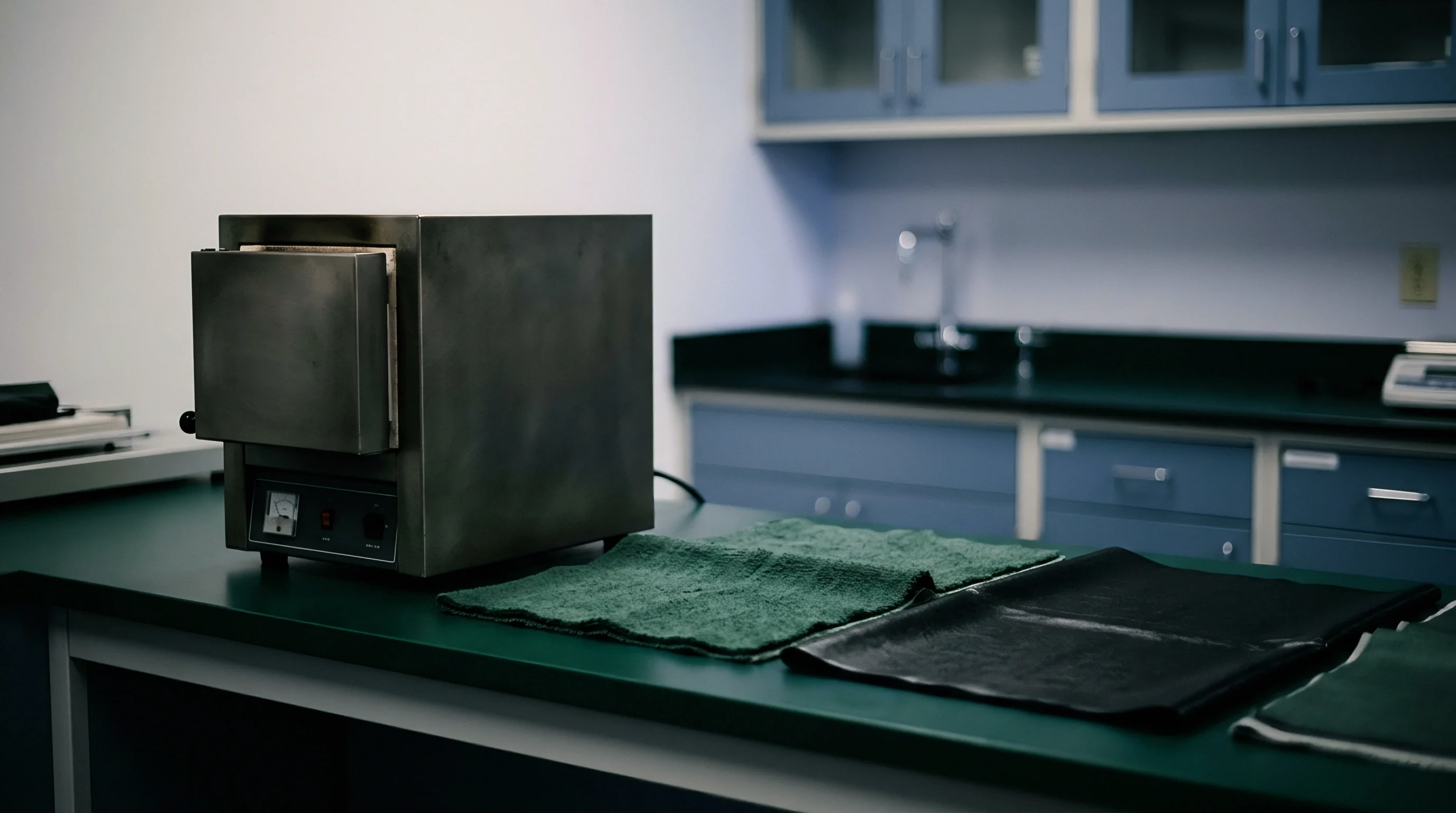
Determining pure fiber weight in the laboratory relies on controlled oven desiccation under standardized thermal cycles. Methods prescribed by ISO 6741-1 and ASTM D2495 require forced-draft ventilated ovens that pass hot air through yarn specimens to remove free moisture. Samples are heated at 105.0°C to 110.0°C until sequential weighings show no further loss of mass, establishing the final constant weight as the oven-dry mass of the batch.
Oven Dry Mass Determination Workflow
- Sample Extraction pulls representative yarn hanks from unopened packages immediately upon container destuffing, transferring 50.0-gram specimens directly into hermetically sealed specimen bottles.
- Initial Weighing records the gross damp scale weight on an analytical balance calibrated to 0.001-gram precision prior to thermal processing.
- Thermal Desiccation exposes unstoppered specimens to forced hot air at 105°C within the oven enclosure for a minimum duration of 60 minutes.
- Constant Mass Verification weighs specimens at 15-minute intervals until two successive weighings show less than 0.05 percent mass variance.
Air currents inside a ventilated drying enclosure exert vertical forces on balance pans mounted inside or above the heating zone, introducing systematic thermal buoyancy errors during hot weighing. Because air at 105°C is less dense than room air at 20°C, it creates upward lift on the sample holder. Weighing specimens in a heated enclosure without buoyant air correction produces an artificially light dry mass, inflating the calculated regain percentage.
To prevent this, laboratories either apply automated buoyant force compensation formulas or transfer samples into desiccators with activated silica gel to cool to ambient density before weighing.
| Testing Regime | Drying Temperature Range | Weighing Environment | Air Buoyancy Correction Factor |
|---|---|---|---|
| ISO 6741-1 Standard | 105°C to 110°C | Internal oven balance (Hot) | +0.00115 g per cm³ sample volume |
| ASTM D2495 Standard | 105°C to 110°C | Sealed desiccator (20°C) | None required when cooled |
| IWTO-33 (Wool Rules) | 105°C to 110°C | Continuous flow drying oven | Empirical buoyancy factor applied |
| BISFA Test Method | 105°C to 109°C | Hermetic container enclosure | Fixed container tare deduction |
Room temperature conditioning under ISO 139 mandates maintaining an atmosphere of 20.0°C ± 2.0°C and 65.0 percent ± 4.0 percent relative humidity. Hygroscopic fibers like flax display hysteresis during moisture sorption: yarn reaching equilibrium from a wet state retains more moisture than yarn approaching equilibrium from a bone-dry state at the same room humidity. For instance, flax fibers approaching 65.0 percent relative humidity from saturation hold roughly 13.20 percent moisture regain, whereas bone-dry flax approaching that same environment levels off at around 11.40 percent regain.
Laboratory ambient conditioning logs must record continuous temperature and relative humidity traces throughout the 24-hour pre-weighing window.
A yarn sample weighed inside a hot oven without correcting for thermal air buoyancy yields an artificially light dry weight that inflates the calculated commercial mass.

Blend
Multi-fiber yarn construction requires weighted mathematical adjustments to reconcile differing hygrostatic properties. Intimate blend yarns combining flax with cotton, viscose, or synthetic fibers do not conform to single-fiber standard regain values. Calculating commercial regain for a blend involves multiplying the dry mass proportion of each component fiber by its official regain allowance and summing the results.

Which Test Standards Arbitrate Fiber Blend Disputes?
Disputes over fiber content percentages directly affect commercial regain calculations. ISO 1833 defines quantitative chemical analysis procedures to dissolve one fiber component while leaving the other intact. For a yarn specified as 50.0 percent wet-spun flax and 50.0 percent combed cotton, chemical analysis under ISO 1833-11 might reveal an actual bone-dry composition of 52.5 percent flax and 47.5 percent cotton due to variations in spinning waste.
Applying standard regain values of 12.00 percent for flax and 8.50 percent for combed cotton to this verified dry composition yields an official blended regain allowance of 10.34 percent rather than the nominal 10.25 percent commercial estimate.
When calculating commercial invoice weights for 10,000 kilograms of received damp blended yarn, this 0.09 percent shift in regain allowance alters billed fiber weight by 9 kilograms. At premium flax prices, small blend variations compound into noticeable invoice line adjustments.
- Chemical Extraction Audit verifies actual dry fiber proportions prior to applying commercial regain formulas, preventing errors caused by nominal blend claims.
- Regain Formula Application computes blended regain allowances using verified dry fiber fractions multiplied by single-fiber standard coefficients.
- Hysteresis History Check identifies whether yarn arrived via dry or humid transport channels to anticipate sorption equilibrium offsets.
Consider a commercial consignment of 10,000.0 kilograms of damp yarn sold as a 60/40 flax/polyester blend. The contract specifies a dry-spun flax regain allowance of 12.00 percent and a polyester regain allowance of 1.50 percent. Laboratory extraction proves the bone-dry mass contains exactly 6,000.0 kilograms of flax fiber and 4,000.0 kilograms of polyester fiber.
The combined commercial regain allowance equals 60.0 percent times 12.00 percent plus 40.0 percent times 1.50 percent, resulting in a blended commercial regain of 7.80 percent. If the oven-dry mass of the total lot equals 9,200.0 kilograms, the commercial invoice weight equals 9,200.0 kilograms multiplied by 1.078, landing at exactly 9,917.6 kilograms billed mass.
Calculating multi-fiber yarn commercial regain based on initial blend target ratios rather than chemically analyzed oven-dry fiber percentages transfers blend composition errors into financial invoice errors.
Whether international standards bodies will harmonize wet-spun flax commercial allowances between European wet-spinning protocols and Asian dry-spinning export benchmarks remains unresolved as cross-border yarn trade expands.

Docket
Chain of custody documentation confirms that laboratory test specimens accurately represent the physical cargo in a shipping container. Commercial yarn shipments often leave spinning mills in Jiangsu or Zhejiang backed only by internal mill certificates, leading importers auditing weight and provenance to demand independent ISO 17025 accredited laboratory reports. Transaction certificates under European Flax schemes trace fiber origin, but they rely on accurate bill-of-lading yarn weights to preserve mass balance integrity across the supply chain.
While quality certificates expire annually, weighbridge scale tickets recorded at port entry terminals report total gross weight, including pallets, cartons, plastic strapping, and internal paper bobbin cones. Tare weights must be deducted with precision because bobbin cones absorb moisture during transport. A standard paper yarn cone weighing 45.0 grams at 65.0 percent relative humidity can pick up extra moisture in humid cargo holds, reaching 49.0 grams per cone.
Across a container with 20,000 cones, unadjusted bobbin absorption adds 80.0 kilograms of non-yarn water weight to scale records.
- Accredited Testing Scope confirms the testing laboratory holds ISO 17025 accreditation specifically for ISO 6741 oven-dry mass determination protocols.
- Container Sampling Timestamp details the exact time elapsed between container unsealing and sample insertion into hermetic vapor-lock bottles.
- Tare Specification Breakdown itemizes measured weights for pallets, cartons, outer plastic wraps, and individual internal cone carriers.
- Mass Balance Reconciliation matches certified dry yarn mass against gross weighbridge receipts to confirm raw material provenance ratios.
Qualified auditors check that mill weight dockets distinguish between gross container mass, net scale mass, oven-dry fiber mass, and commercial invoiced mass. Discrepancies between certified mill export weight and destination receipt weight frequently stem from relative humidity shifts during ocean transit. Spinning mills in Asia often ship yarn at 8.00 percent moisture regain, but transit across tropical ocean routes can elevate internal container humidity, pushing yarn regain to 13.50 percent upon arrival in Europe.
In cross-border containerized yarn shipping, a 1.5 percent unadjusted excess moisture content across a 20-tonne linen consignment represents 300 kilograms of billed liquid water.
Yarn leaves the spinning frame near standard equilibrium, leaving weight discrepancies upon destination arrival to stem from atmospheric fluctuations during ocean transit.

Margin
Financial settlement for containerized yarn purchases rests on adjusting damp scale weights to reflect oven-dry fiber mass. Because scale weights fluctuate with weather, standard commercial regain formulas convert scale weight into billed commercial mass, shielding buyers from ambient water surcharges while ensuring spinners receive fair compensation for delivered pure fiber.
The standard commercial mass settlement formula applies directly to commercial yarn trade invoices:
Commercial Mass = Damp Scale Weight × (100 + Standard Regain Allowance) ÷ (100 + Measured Moisture Regain)
Applying this formula to a verified commercial consignment illustrates the financial effect. A weaving mill orders 20,000.0 kilograms scale-weight of 100 percent wet-spun linen yarn. The contract establishes a standard commercial regain allowance of 12.00 percent and a contract price of 14.50 EUR per kilogram.
Port inspection samples processed under ISO 6741 drying procedures reveal an actual delivered moisture regain of 14.80 percent due to marine transit absorption.
Substituting actual values into the commercial mass formula yields:
Commercial Mass = 20,000.0 kg × (100 + 12.00) ÷ (100 + 14.80)
Commercial Mass = 20,000.0 kg × 112.00 ÷ 114.80 = 19,512.20 kg
Invoicing on unadjusted scale weight would require the buyer to pay for 20,000.0 kilograms, totaling 290,000.00 EUR. Applying the official moisture regain adjustment reduces billable mass to 19,512.20 kilograms, bringing the corrected financial settlement to 282,926.90 EUR. Adjusting for the 2.80 percent excess moisture regain saves the buying mill 7,073.10 EUR on a single container.
Containerized yarn shipments exposed to high ocean humidity gain damp mass that directly inflates scale weight without adding usable fiber.
Contractual protection requires embedding explicit weight adjustment terms inside master yarn purchasing agreements. Professional contracts state that delivered scale mass remains subject to post-arrival oven-dry verification by an independent laboratory within 14 business days. Warranties specify that if measured moisture regain exceeds contractual allowances by more than 0.50 percent, the seller absorbs all re-testing fees alongside the commercial mass invoice reduction.
Failing to write mandatory oven-dry weight reconciliation into yarn purchase contracts leaves the buyer absorbing water weight surcharges on every container shipped across humid maritime trade routes.