X-Ray Diffraction Basics for Bast Fibre Alignment Analysis
X-ray diffraction maps the azimuthal spread of the cellulose (200) reflection, quantifying bast microfibrillar alignment to predict yarn tenacity and spinning limits.


Lattice
Monoclinic unit cells of native cellulose Iβ form the crystalline core of flax, hemp, and ramie cell walls. Incident monochromatic X-rays strike these organized polymeric domains, producing distinct scattered wave patterns that disclose microfibrillar orientation relative to the primary fibre axis. Industrial grading relies on bundle fineness and hand assessment, yet the internal alignment of cellulose chains dictates the true breaking tenacity of the material.
A classer evaluating long-line scutched flax encounters bundles containing hundreds of elementary cells glued together by pectinaceous middle lamellae. Wide-angle X-ray scattering isolates the crystalline core from this amorphous binder, mapping the angular distribution of crystalline planes directly into intensity arcs on an area detector.
Diffraction experiments align parallel bundles across a sample holder perpendicular to a collimated copper K-alpha radiation beam with a wavelength of 0.15418 nanometres. Transmission geometry yields complete equatorial and meridional profiles without surface absorption artifacts common to reflection arrangements. When cellulose chains align parallel to the fibre bundle axis, equatorial reflections concentrate into sharp, intense arcs.
Misalignment spreads these reflections along the Debye-Scherrer rings, creating broader azimuthal intensity profiles. Laboratory measurements quantify this spread to grade raw bast slivers before commit decisions occur at the mill.
Diffraction Geometry for Bast Bundles
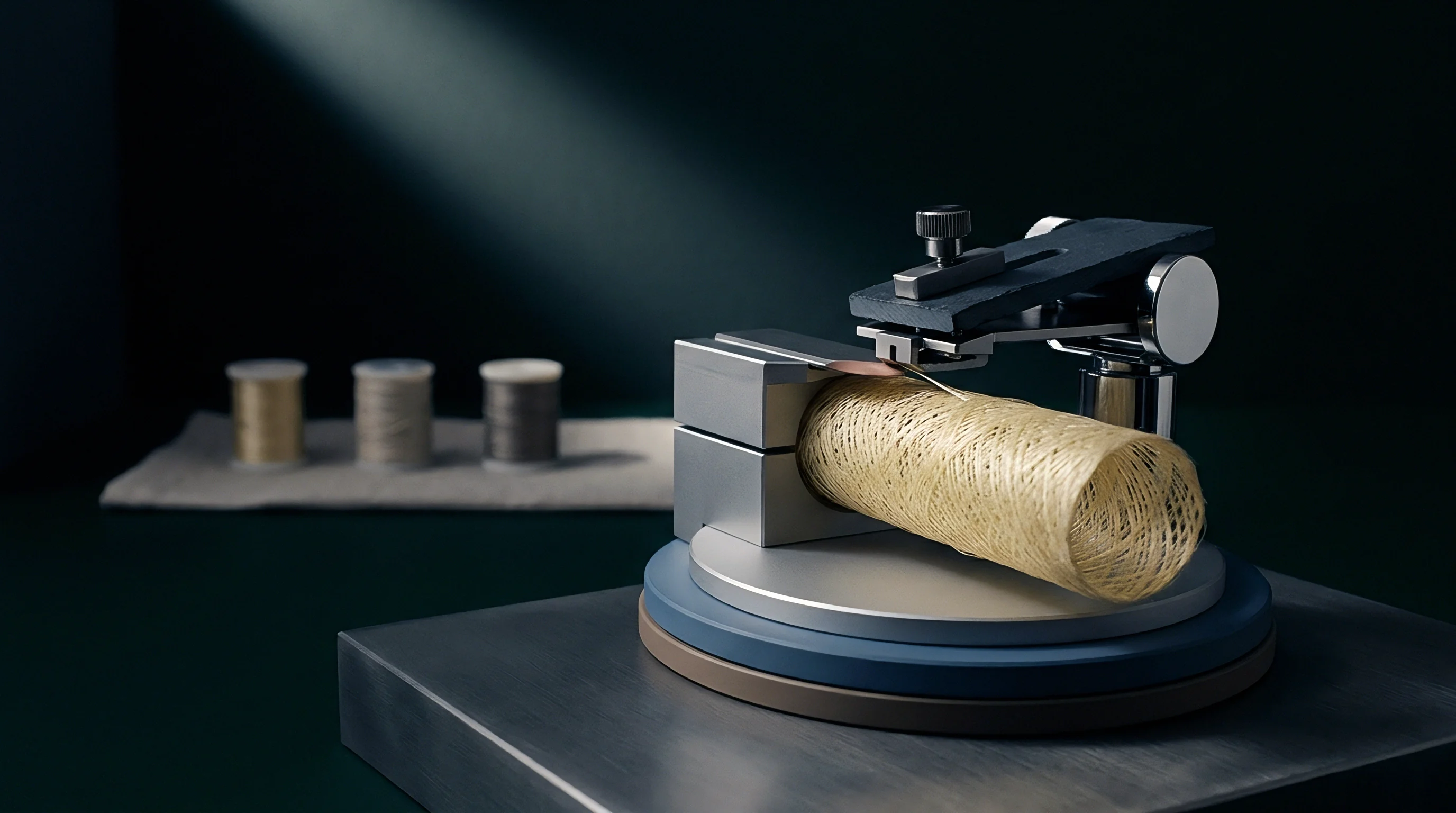
Collimation optics focus the primary beam through an aperture between 0.3 and 0.8 millimetres, matching the width of a combed bast fibre ribbon. The detector sits at a calibrated distance between 50 and 150 millimetres behind the specimen stage, optimized to separate the primary equatorial reflections of cellulose Iβ. Bundle thickness demands careful normalization.
Excessively thick fibre bundles cause secondary scattering and beam attenuation, flattening the apparent intensity peaks. Bundles below fifty micrometres fail to generate sufficient scattered photon counts within practical exposure windows. Standardized tension frames hold the sliver under a constant load of five centinewtons per tex, preventing slack during exposure.
- X-Ray Generator Tube Voltage maintains forty kilovolts and forty milliamperes to deliver stable flux across twelve-hour qualification runs.
- Beam Collimation Assembly uses double pinhole apertures to restrict parasitic air scatter and isolate individual elementary fibre groups.
- Tension Sample Clamp grips bundle ends at twenty-millimetre gauge lengths under calibrated mechanical spring loads.
- Flat Panel Area Detector records two-dimensional scattering patterns with pixel dimensions of seventy-five micrometres for spatial resolution.
X-ray beams penetrate whole bast stems. The resulting transmission diffractograms represent volume-averaged measurements across the full bundle cross-section. This volume average removes the sampling bias inherent to polarized optical microscopy, which interrogates only the outer cell wall layers.
Dew retting preserves internal alignment. Over-retted straw shows diffuse amorphous halos caused by fungal degradation of adjacent non-cellulosic polysaccharides, lowering signal-to-noise ratios across the equatorial baseline.
Parallel fibre bundles scatter radiation symmetrically along the equatorial axis.

Bragg Reflections in Native Cellulose
Scattering planes within cellulose Iβ crystallites produce three primary equatorial peaks designated by their Miller indices: (1-10), (110), and (200). In classical Meyer and Misch unit cell notation, these correspond to the (101), (10-1), and (002) planes. The dominant reflection occurs at a scattering angle two-theta near 22.7 degrees, generated by the (200) crystallographic plane representing the lateral spacing between hydrogen-bonded cellulose sheets.
Two secondary equatorial reflections emerge between fifteen and 16.5 degrees two-theta, corresponding to the (1-10) and (110) planes. Bast fibres with exceptional mechanical properties exhibit tightly confined intensity arcs along the equatorial axis for all three reflections.
Meridional reflections remain faint in unoriented samples but sharpen significantly along the fibre axis at thirty-four degrees two-theta, corresponding to the (004) plane along the cellulose chain backbone. Flax cellulose presents monoclinic symmetry. The intensity distribution along the (200) reflection arc contains the quantitative information needed to calculate microfibrillar angles and crystalline orientation factors.
Bundles showing azimuthal spreading on the (200) arc inevitably yield weaker roving during drawing operations. A tightly focused arc signals high tensile potential in the raw fibre.


Azimuth
Radial integration across a narrow two-theta band isolating the (200) reflection transforms two-dimensional diffraction rings into one-dimensional azimuthal intensity scans. The resulting intensity curve, plotted against the azimuthal angle phi from zero to 360 degrees, exhibits pairs of peaks diametrically opposed across the beam centre. High orientation concentrates these peaks into tall, narrow Gaussian or Lorentzian distributions centered on the equator.
Broad, shallow curves indicate random or helical microfibrillar arrangements relative to the fibre axis. Quantifying this profile permits mathematical extraction of orientation parameters without destructive single-fibre tensile testing.
The azimuthal intensity distribution I(phi) directly yields the mean microfibrillar angle through established geometric relationships. The parameter phi-fifty represents the full width at half maximum of the azimuthal peak, corrected for instrumental broadening and amorphous background scattering. In high-grade scutched flax line, phi-fifty values range between eight and twelve degrees.
Lower grades of tow or mechanically damaged fibres expand beyond eighteen degrees. The speed of data collection allows spinning mills to qualify inbound container loads of scutched flax within hours of customs release.
Hermans Factor and Microfibrillar Angle
Hermans orientation factor, designated as f, defines the degree of crystalline alignment on a normalized numerical scale from zero to one. A factor of zero denotes completely random crystallite orientation throughout the sample volume. A factor of one defines perfect parallel alignment where every cellulose chain runs collinear with the fibre axis.
Mathematical derivation uses the average cosine squared of the angle phi between the crystallite c-axis and the fibre axis. The equation f equals three times the mean cosine squared of phi minus one, divided by two. High-tenacity flax fibres routinely achieve Hermans factors between 0.88 and 0.94.
Flax technical fibres exhibiting a microfibrillar angle below eleven degrees maintain dry tensile tenacities exceeding fifty-eight centinewtons per tex.
The microfibrillar angle, abbreviated as MFA, describes the helical tilt of cellulose fibrils in the dominant S2 cell wall layer. Cave-type formulas and deconvolution procedures translate the azimuthal full width at half maximum into direct microfibrillar angle values in degrees. Flax exhibits some of the lowest microfibrillar angles among commercial bast fibres, typically measuring between six and eleven degrees.
Ramie displays even tighter alignment, often descending to five degrees. Jute and coir feature higher angles, with jute averaging twelve to eighteen degrees and coir exceeding thirty-five degrees. High angles correlate with low modulus.
| Fibre Species | Azimuthal Width Degrees | Hermans Factor | Calculated MFA Degrees | Tenacity cN/tex | Elastic Modulus GPa |
|---|---|---|---|---|---|
| Scutched Flax Line | 10.4 | 0.92 | 8.5 | 62.4 | 58.2 |
| Hackled Flax Tow | 15.8 | 0.84 | 12.8 | 44.1 | 41.5 |
| Water-Retted Hemp | 13.6 | 0.87 | 10.9 | 51.3 | 46.8 |
| Decorticated Ramie | 7.2 | 0.96 | 5.8 | 74.2 | 68.0 |
| Raw Tossa Jute | 19.5 | 0.78 | 15.4 | 36.8 | 32.4 |
Peak Deconvolution across Equatorial Reflections
Extracting the true azimuthal distribution requires subtracting background scattering produced by air, sample holders, and non-crystalline amorphous polysaccharides. The amorphous fraction consists of lignin, hemicellulose, and disordered cellulose chains concentrated in the middle lamella and primary wall. This material produces a broad scattering halo peaking around eighteen degrees two-theta, directly overlapping the valleys between the (1-10), (110), and (200) crystalline peaks.
Curve fitting utilizes Gaussian, Lorentzian, or Pearson VII functions to isolate individual peak contributions before integrating the azimuthal profile.
Baseline subtraction procedures significantly alter the calculated orientation parameters when inconsistent algorithms process successive lots. A linear baseline drawn between fifteen and twenty-six degrees two-theta underestimates the amorphous contribution beneath the (200) reflection, artificially narrowing the calculated azimuthal width by two to three degrees. The Ruland-Vonk method provides a rigorous analytical correction by evaluating radial scattering profiles across a wider angular range.
Commercial laboratories adopting automated integration routines record systematically higher Hermans factors than operators running manual peak deconvolution.
Commercial buyers verify lot crystallinity. Crystalline index values calculated via the Segal empirical formula compare the maximum intensity of the (200) peak with the minimum intensity of the amorphous valley near eighteen degrees two-theta. While the Segal method provides rapid numerical ranking, the resulting values exceed absolute crystallinity by ten to fifteen percent because peak superposition inflates the apparent maximum.
Spinning technologists track both the crystalline index and the azimuthal spread to ensure lots possess the molecular stiffness demanded by high-speed wet spinning frames.
Bruise
Mechanical decortication and scutching introduce localized structural disruptions known as kink bands, slip planes, or dislocations along the bast fibre stem. Under compressive bending during breaker-roll processing, the rigid crystalline lattice buckles, causing localized ruptures in the cell wall. These dislocations disperse microfibrils away from the axial direction, creating localized zones of extreme crystalline disorder.
While healthy bast cells exhibit straight microfibrillar paths, bruised zones show angular diversions exceeding thirty degrees from the longitudinal cell axis. These defective zones concentrate mechanical stress and serve as failure initiation sites during drafting.
Standard optical examination under polarized light reveals dislocations as bright cross-markings along the fibre length. Polarized light identifies surface markings on isolated single filaments, whereas transmission X-ray diffraction measures the cumulative volume of disrupted crystallites across whole unsplit bundles. As the density of dislocations rises from aggressive mechanical scutching, the global azimuthal peak widens.
The resulting diffraction pattern shows a heightened baseline along the entire equatorial Debye ring, reflecting the population of misaligned crystalline fragments trapped within bruised cell walls.
Kink Bands and Mechanical Extraction Shock
Over-scutched flax straw displays severe degradation in tensile performance despite maintaining acceptable linear density. Breaker rolls running at excessive nip pressures crack the woody shive but also crush the soft bast bundles against the scutching turbine blades. Heavy scutching breaks crystalline fibrils.
This mechanical shock fractures the cellulose microfibrils within the S2 layer, creating regions where the cellulose lattice loses its axial registry. The damage is permanent and survives chemical scouring, bleaching, and boiling water immersion.
- Bundle Selection extracts ten intact long-line ribbons from three locations within the bale, avoiding pre-broken ends.
- Comb Conditioning draws ribbons through an iron hand pin hackle to clear loose dirt and non-fibrous epidermal shive.
- Mounting Alignment secures sliver ends into copper clamps, applying mechanical tension to straighten natural bundle crimp without inducing plastic stretch.
- Chamber Centering positions the clamped bundle within the optical axis of the collimator using laser crosshairs to verify perpendicularity.
Samples prepared with excessive clamp force register artificially narrowed azimuthal peaks due to stress-induced microfibrillar straightening during exposure. Clamping too loosely allows bundles to sag, producing asymmetric peaks and exaggerated azimuthal widths. Laboratory personnel maintain strict gauge-length standards and calibrated spring tensioners to prevent technician bias from corrupting incoming lot acceptance data.

Is Lateral Peak Broadening Indicative of Damage?
Radial broadening of equatorial reflections along the two-theta scattering axis occurs through two distinct physical mechanisms: crystallite size reduction and micro-strain accumulation within the lattice. The Scherrer equation links the broadening of the (200) reflection at half maximum intensity directly to the apparent crystallite dimension perpendicular to the lattice planes. Undamaged flax exhibits lateral crystallite dimensions between 3.5 and five nanometres.
Aggressive processing shears these crystalline domains, reducing their lateral dimension and broadening the radial two-theta profile without changing the overall azimuthal alignment.
Williamson-Hall analysis separates size-induced broadening from strain-induced broadening by plotting peak breadth against scattering angle across multiple reflection orders. Mechanical crushing during decortication forces internal residual lattice strain into the crystalline cellulose domains. Diffraction traces from heavily bruised fibres show substantial strain-induced peak broadening.
When lots exhibit broad azimuthal arcs alongside high internal strain values, hackling yields fall by three to five percentage points, and spinning frames experience elevated end-breakage rates.
Omitting the calibration for mechanical bruising leads spinning mills to overpay for raw line flax that breaks under draft. Mill managers purchase fibre based on visual lustre and bundle length, discovering too late that internal kink bands prevent the roving from drawing down to fine yarn counts. The resulting operational penalty manifests as elevated dropped ends, excessive roller lapping, and uneven yarn mass profiles that fail commercial evenness thresholds.

Draft
Mechanical drawing and drafting in textile spinning alter the spatial arrangement of bast fibre bundles within the sliver. Drawing frames employ staggered roller pairs operating at differential surface speeds to pull fibres past one another. The drafting rollers pull parallel slivers.
This shear field straightens curled bundles and aligns their geometric axes with the direction of sliver travel. Because elementary fibres sit nested within technical bundles, mechanical drafting cannot rotate individual internal microfibrils, but it forces crooked technical fibres into parallel axial alignment.
X-ray diffraction tracks this macroscopic bundle orientation through consecutive drawing passages. Measuring diffraction patterns on slivers sampled before the first gill box and after the third drawing head reveals a progressive narrowing of the azimuthal intensity distribution. The global Hermans orientation factor rises from roughly 0.72 in the raw card sliver to 0.86 in the finished roving.
Slivers that fail to demonstrate this progressive crystallographic sharpening indicate pin pinning errors, incorrect faller speeds, or excessive inter-fibre friction caused by improper emulsification.

Will Wet Spinning Consolidate Crystalline Orientation?
Spinning bast fibres through a heated water bath alters the structural cohesion between elementary fibrils within the bundle. Hot water softens pectin binders. At temperatures between sixty and seventy degrees Celsius, the calcium polygalacturonate complexes forming the middle lamella undergo thermal softening and partial hydration.
As drafting tension acts on the roving inside the wet-spinning zone, elementary fibres slide past one another. This plastic slippage allows individual elementary cells to rotate slightly toward the tensile axis, reducing the external bundle tortuosity.
Dry spinning leaves fibrils dispersed. Dry processing lacks the hydrothermal plasticization necessary to slide elementary cells within the pectin matrix. Consequently, dry-spun yarns preserve the original microfibrillar misalignment present in the raw bale.
Wet-spun yarns show sharp azimuthal peaks on the (200) reflection, recording Hermans factors three to six percent higher than dry-spun yarns produced from identical flax lots. This crystallographic consolidation explains the higher breaking tenacity and smoother surface lustre characteristic of wet-spun linen.
Deviations in mean azimuthal orientation angle beyond three degrees across consecutive drawing passages double roving breakage rates on ring spinning frames.
| Processing Stage | Azimuthal Width Degrees | Hermans Factor | Draft Ratio Applied | Tenacity cN/tex |
|---|---|---|---|---|
| Carded Sliver | 22.4 | 0.72 | 1.0 | 18.5 |
| First Gill Passage | 18.1 | 0.79 | 6.2 | 26.4 |
| Finished Roving | 14.2 | 0.86 | 7.8 | 35.1 |
| Dry Spun Yarn Nm 39 | 13.8 | 0.87 | 11.5 | 38.2 |
| Wet Spun Yarn Nm 39 | 10.6 | 0.92 | 14.2 | 52.7 |
Gilling Ratios and Bast Sliver Uniformity
Drafting operations require balanced faller bar pinning and draft ratios to prevent bundle breakage while maximizing axial alignment. Excessive draft across a single drafting zone creates drafting waves, where groups of short fibres move erratically through the faller field, generating periodic thin and thick sections. Slivers exhibiting periodic drafting waves show fluctuating azimuthal widths when scanned at regular intervals along their length.
Consistent orientation requires splitting total draft across three distinct drawing operations with descending pin densities.
- Feed Creel Tension maintains positive forward motion across unwinding sliver cans to prevent drafting before faller entry.
- Faller Pin Density increases from four pins per centimetre in the breaker gill to twelve pins in the finisher head.
- Drafting Zone Temperature controls thermal expansion and roller slip during wet drafting passages.
- Roller Clamping Pressure applies seven to ten bar pneumatic pressure to suppress inter-fibre slippage outside the draft zone.
Mill suppliers frequently argue that elevated twist insertion compensates for lower raw material orientation during spinning. Twist binds misaligned technical fibres through external normal forces, masking poor molecular orientation on short-gauge tensile tests. However, yarns produced under excessive twist show high residual torque, snarling during winding, and harsh hand in finished woven yardage.

Parity
Commercial valuation of bast fibres historically relies on manual classing parameters: colour, handle, scutching cleanliness, and bundle length. These subjective metrics fail to guarantee tensile performance on automated weaving machines. A lot presenting excellent creamy colour and long staple can conceal microfibrillar angles exceeding fifteen degrees, yielding weak yarns with poor spinning limits.
Integrating X-ray diffraction metrics into raw fibre valuation establishes objective parity between the price paid per metric ton and the mechanical output delivered on the loom.
Calculating the finished cost of linen fabric begins with hackling yield and spinning efficiency. Consider an industrial order requiring 20,000 metres of plain-weave linen fabric at a target weight of 180 grams per square metre, utilizing yarn count Nm 39. Producing this yarn demands high-grade line flax capable of sustaining dry tenacity above forty-five centinewtons per tex.
Two candidate fibre lots appear on the market: Lot A at 4.20 euros per kilogram with a measured azimuthal width of 10.2 degrees, and Lot B at 3.60 euros per kilogram with an azimuthal width of 16.5 degrees. On paper, Lot B offers a fourteen percent raw material cost savings.
Mill procurement contracts define pricing discounts directly from crystallite disorientation measured across scutched line bundles.

Commercial Yield against Optical Tenacity Baselines
Running Lot B through drawing frames reveals the true financial impact of molecular misalignment. Because elementary fibres in Lot B possess a microfibrillar angle near thirteen degrees, drawing forces induce premature bundle fracture rather than inter-fibre sliding. Hackling yield drops from fifty-two percent on Lot A to forty-one percent on Lot B, shifting valuable line fibre into low-priced tow.
On the spinning frames, Lot B generates twenty-eight dropped ends per thousand spindle hours, compared to seven dropped ends on Lot A. The resulting yarn requires additional winding splices, degrading evenness and reducing loom efficiency from ninety-one percent to seventy-six percent.
Loom downtime and excessive waste eliminate the apparent material discount. Factoring in the eleven-point drop in hackling yield and the processing waste across spinning and weaving, Lot B delivers finished woven cloth at a manufacturing cost of 3.85 euros per linear metre. Lot A, despite its higher initial bale price, produces finished fabric at 3.42 euros per linear metre.
The lower crystallographic alignment of Lot B imposes a net penalty of forty-three euro cents per metre of fabric. Lab reports establish true value.

Contract Clauses for Crystallographic Acceptance
Sophisticated sourcing desks write crystallographic orientation parameters directly into their raw material purchasing agreements. Contracts replace ambiguous phrases like well-aligned long flax with explicit diffraction boundaries measured under defined laboratory conditions. Suppliers provide certified wide-angle scattering test certificates from accredited independent textile laboratories for every shipping lot.
Lots failing to meet threshold orientation values face automated price discounts or outright rejection at the port of entry.
Enforcing crystallographic quality limits requires precise contract terminology defining sampling frequency, sample preparation, and testing standards. Contracts stipulate ASTM or ISO procedures for conditioning raw fibres at standard textile testing atmospheres prior to X-ray exposure. Inspection teams draw composite samples from ten percent of the bales in an inbound shipment, taking care to extract unworked core bundles rather than weathered outer packaging layers.
Uniform slivers yield fine yarn.
Procurement agreements incorporate explicit crystallographic clauses stating: If the mean azimuthal full width at half maximum of the cellulose (200) reflection exceeds 12.5 degrees when tested under five centinewtons per tex tension according to standardized transmission geometry, the buyer reserves the right to apply a six percent invoicing discount per degree of excess width, or cancel the bill of lading without penalty.