Thermogravimetric Analysis and Hysteresis Correction Protocols for Blended Bast Fibre Commercial Weight Settlement
Thermogravimetric analysis separates moisture from volatile extractives to enable exact hysteresis-corrected commercial weight settlements for bast blends.
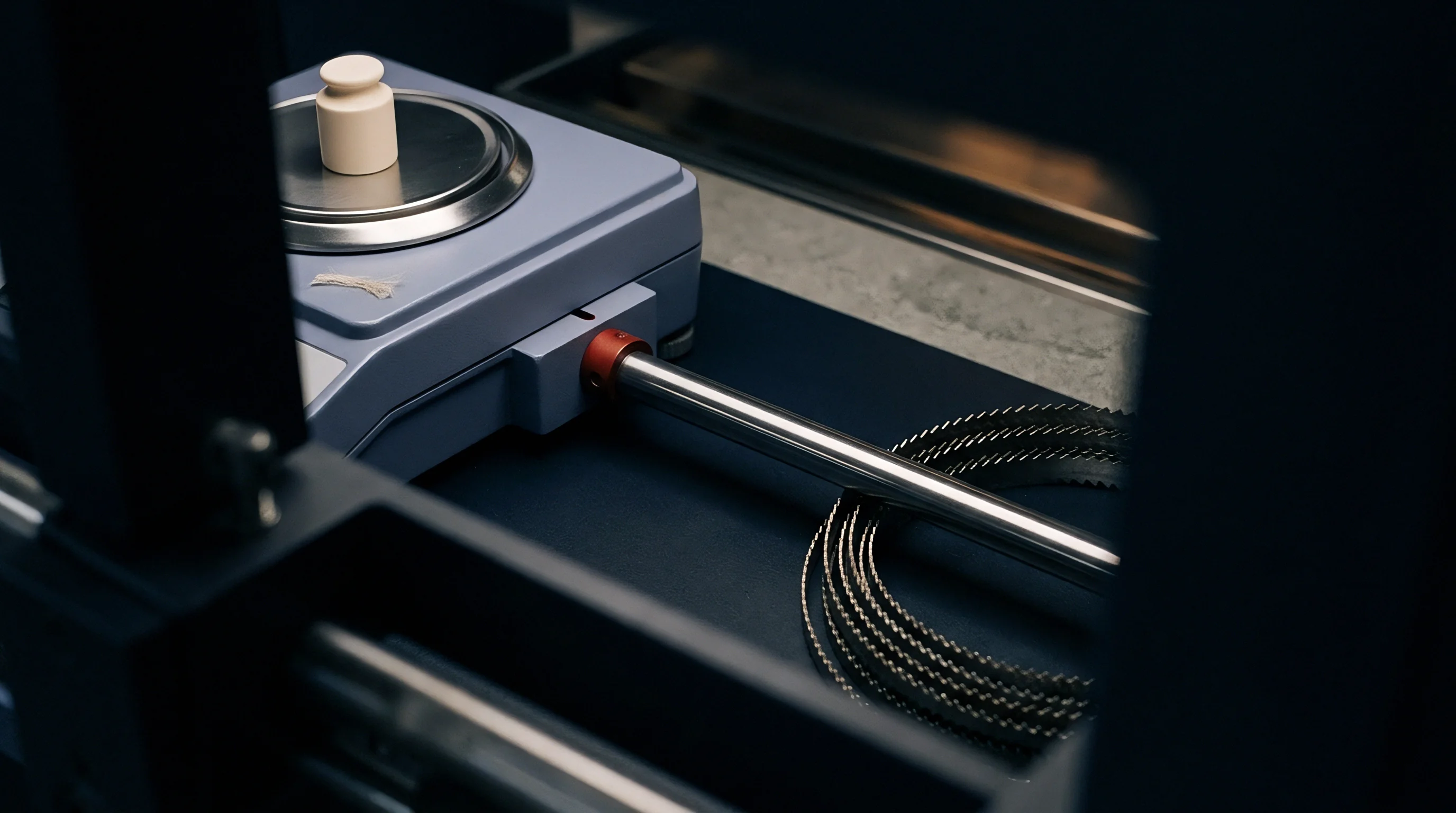

Sorption

Moisture Regain Differential in Intimate Bast Blends
Commercial transactions in blended bast fibres depend on precise moisture determination. Flax bundles contain a lumen, thick secondary cell walls, and pectinaceous middle lamellae that bind ambient water through distinct energetic mechanisms. When scutching tow or hackled line flax combines with polyester, lyocell, or combed cotton, each component pulls moisture along an independent sorption isotherm.
Standard oven-drying methods at 105 degrees Celsius treat the blend as a uniform mass, driving off surface moisture alongside volatile non-cellulosic constituents. Pectins, hemicelluloses, and residual processing lubricants degrade under prolonged thermal exposure, falsifying clean dry mass.
Water uptake in bast fibres occurs through capillary condensation within cell-wall voids and direct hydrogen bonding at free hydroxyl groups on the cellulose chain. Cotton exhibits a standard commercial regain of 8.5 percent, while dew-retted flax holds an official commercial regain allowance of 12.0 percent under ISO 6741-1. Polyester maintains an allowance near 1.5 percent, whereas regenerated cellulose fibres reach 11.0 to 13.0 percent.
Intimate card sliver blends subject to standard trade weight calculations incur substantial error if linear apportioning overlooks structural sorption interactions.
A three-percent shift in blend moisture equilibrium alters invoiced lot mass by several hundred kilograms per container load.
Bale storage history governs the sorption state. Bast fibres arriving at the mill balance along either an adsorption or a desorption trajectory depending on warehouse humidity history. Fibres drying down from a saturated retting field hold more water at 65 percent relative humidity than dry-stored fibres taking on moisture in the spinning shed.
This moisture hysteresis loop creates a permanent gap of 1.2 to 2.1 percent regain at identical ambient temperature and vapour pressure.
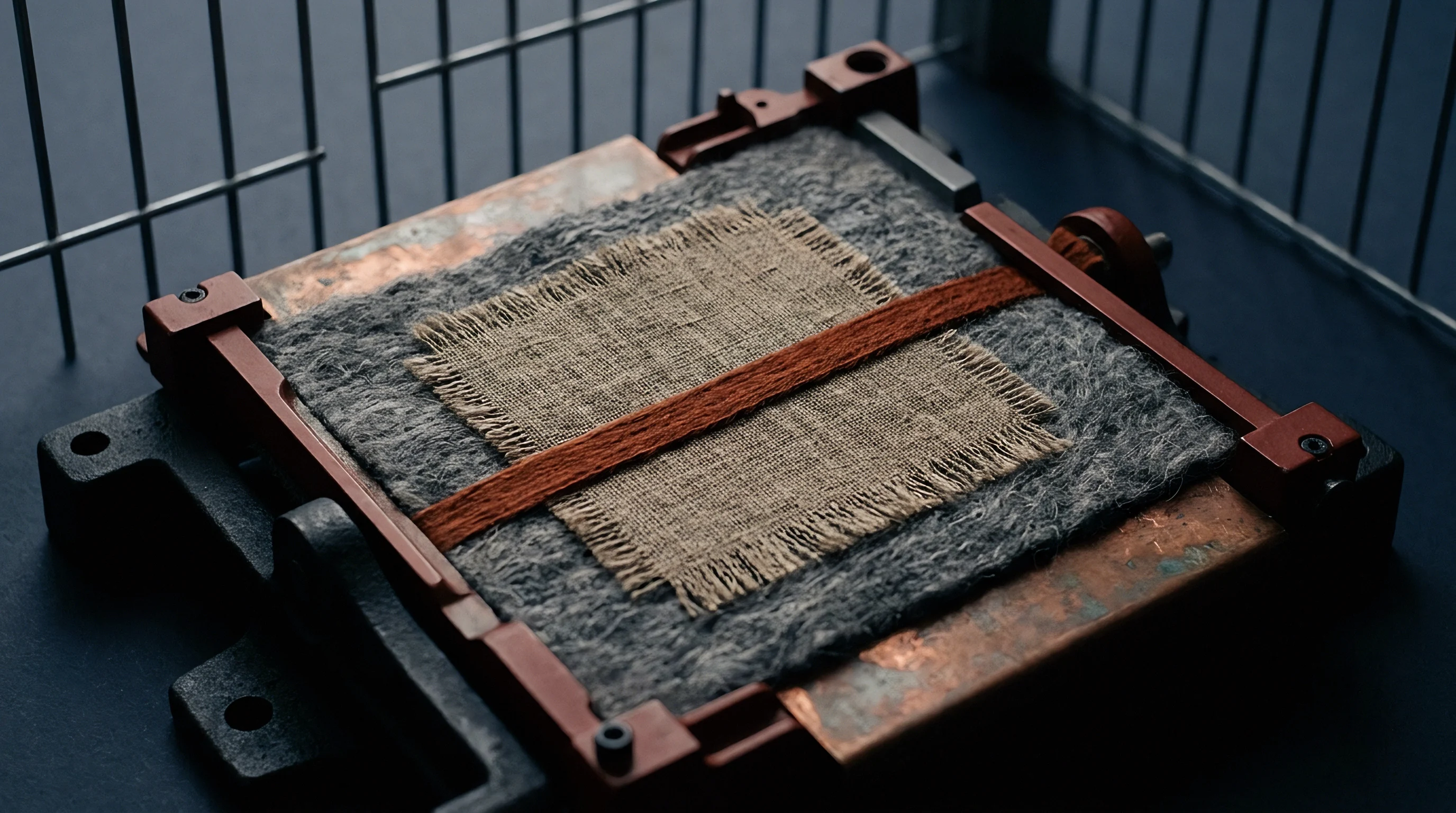
Where Do Adsorption Pathways Distort Delivered Tonnage?
Inward delivery mass verification falters when commercial mass formulas assume equilibrium along the adsorption boundary. If a Chinese wet-spinning mill takes delivery of French scutched flax blended with virgin polyester top, weighing the consignment at 20 degrees Celsius and 65 percent relative humidity without verifying the hysteresis pathway yields an inaccurate bone-dry basis. Water molecules held within the nanoporous flax cell wall during desorption require higher activation energy to dislodge than surface-condensed water on smooth synthetic filaments.
Direct gravimetric measurement fails to separate moisture evaporation from the thermal volatilisation of low-molecular-weight waxes. Scutched flax carries between 1.5 and 3.0 percent wax and pectin fractions that evaporate alongside water in forced-convection ovens. The resulting dry mass figure reads artificially low, inflating the calculated regain and shifting commercial settlement funds against the purchaser.

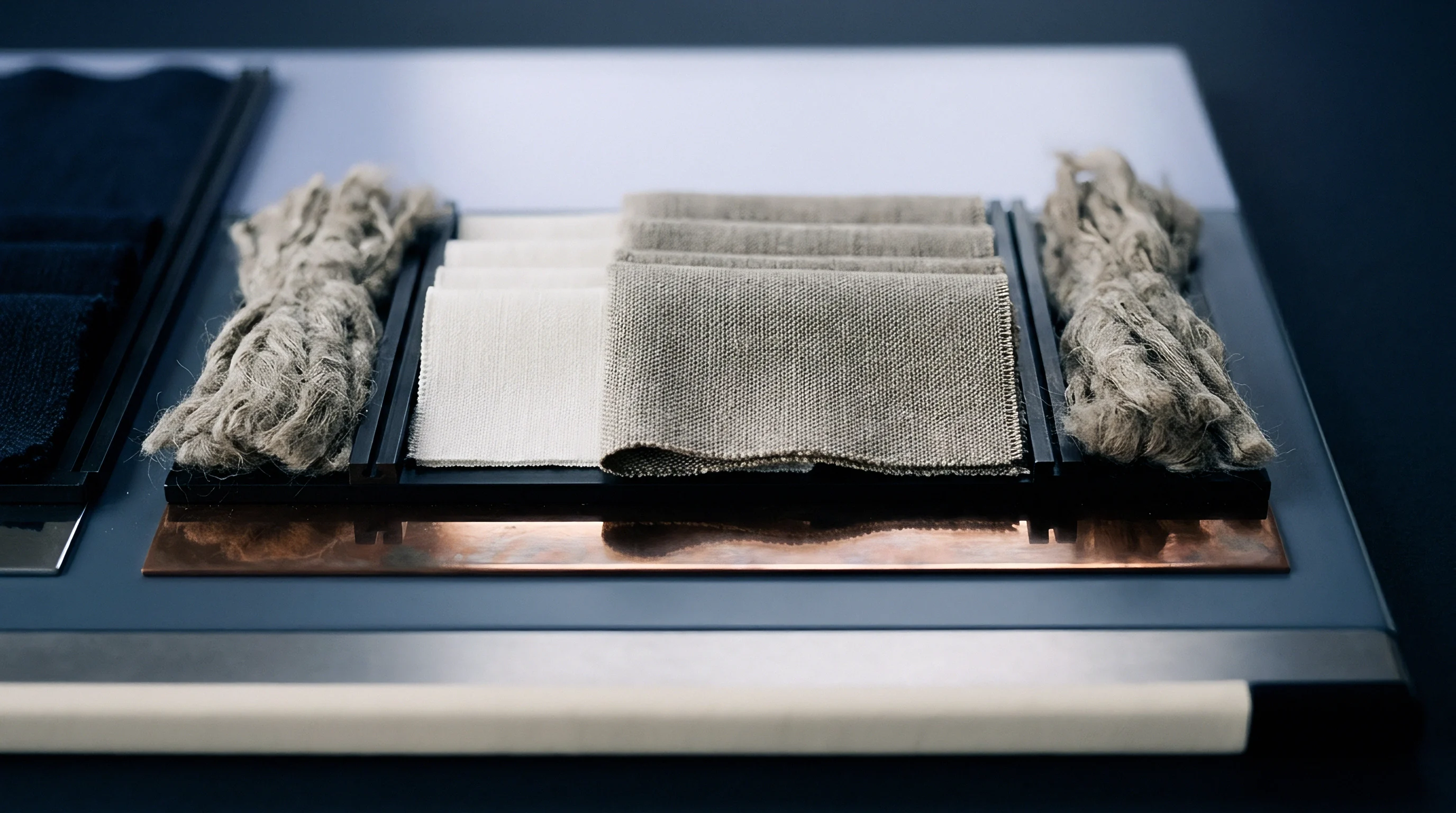
Crucible

Derivative Thermogravimetric Separation of Multi-Component Mass Loss
Thermogravimetric analysis resolves component regain and constituent ratios within a single analytical run. By heating a blended bast sample inside a sealed micro-furnace under continuous nitrogen purge, the balance records mass loss across discrete thermal zones. The instrument tracks mass loss from 25 degrees Celsius upward at a controlled rate of 10 degrees Kelvin per minute.
Surface water and weakly bound capillary moisture desorb fully between 40 and 110 degrees Celsius. Tightly bound crystalline hydrate water departs between 115 and 165 degrees Celsius, distinct from hemicellulose decomposition.
Derivative thermogravimetric curves display clear separation peaks for each organic fraction. Hemicellulose undergoes thermal scission between 220 and 315 degrees Celsius. Cellulose pyrolysis generates a sharp derivative peak between 320 and 390 degrees Celsius.
Lignin degrades across a broad spectrum from 200 to 520 degrees Celsius, leaving a carbonaceous char residue. Synthetic blending partners such as polyethylene terephthalate exhibit clean thermal degradation peaks between 410 and 480 degrees Celsius.
| Component Fraction | Temperature Range | Peak DTG Temperature | Decomposition Mechanism |
|---|---|---|---|
| Free Moisture | 35 to 105 °C | 72 °C | Evaporation of capillary water |
| Bound Hydrate Water | 108 to 160 °C | 134 °C | Desorption from internal cell lumen |
| Pectin and Waxes | 165 to 240 °C | 212 °C | Volatilisation of peripheral extractives |
| Hemicellulose | 245 to 315 °C | 288 °C | Cleavage of amorphous xylan chains |
| Cellulose Backbone | 320 to 395 °C | 362 °C | Depolymerisation to levoglucosan |
| Polyester Carrier | 410 to 490 °C | 448 °C | Pyrolytic ester chain cleavage |
Specifying high-resolution thermogravimetric instruments allows precise determination of dry blend composition. The method quantifies both the moisture mass fraction and the exact bast-to-carrier polymer ratio from a single ten-milligram specimen. Ten milligrams replaces twenty-kilogram conditioning oven samples, eliminating handling delays on the unloading dock.
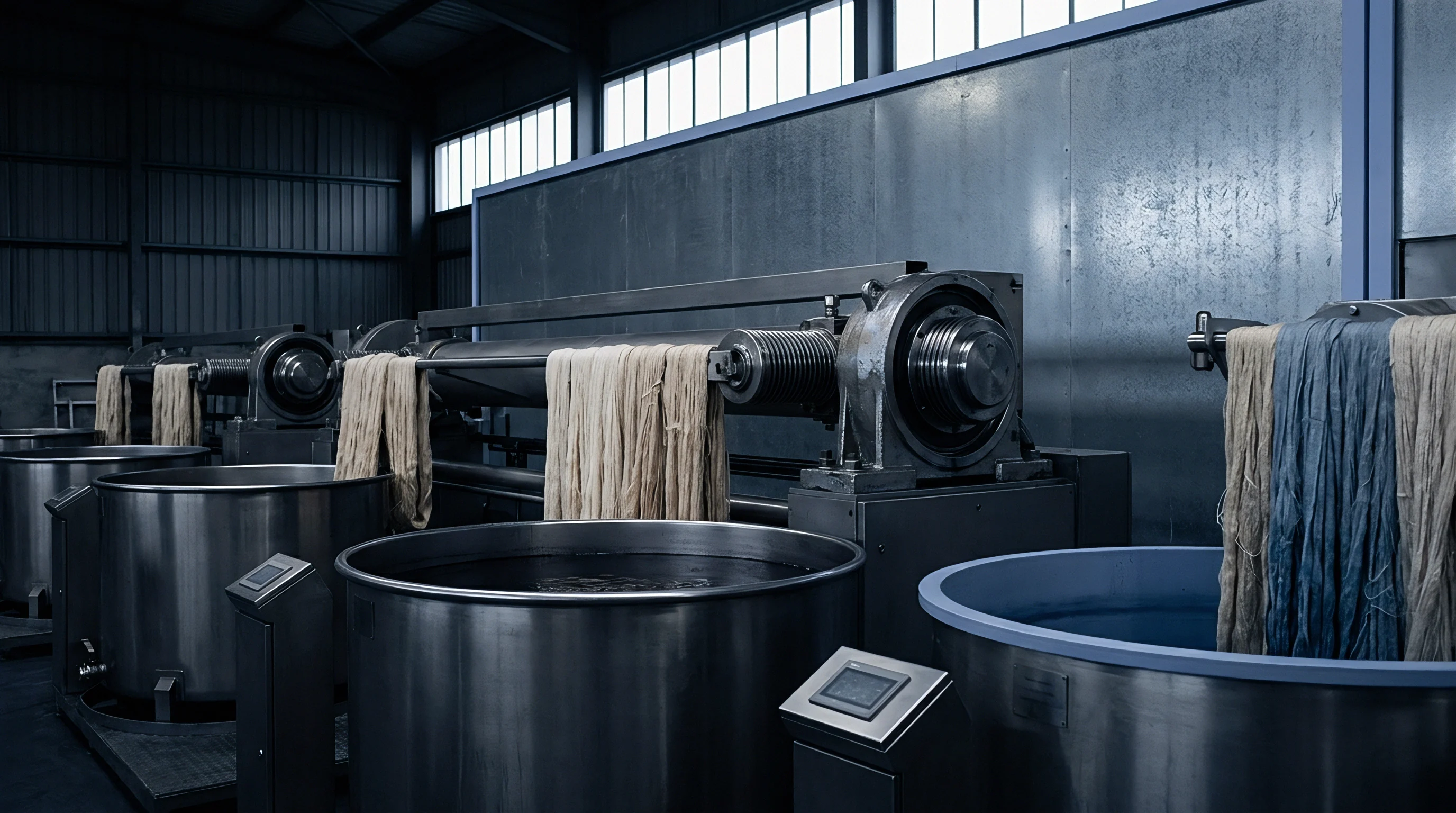
Which Thermal Regimes Isolate Surface Moisture?
Isothermal dwelling at 105 degrees Celsius within the thermogravimetric furnace stabilizes free moisture loss within eight minutes under a sixty millilitre per minute nitrogen stream. Shifting to an oxidative atmosphere above 600 degrees Celsius burns off the residual carbonaceous matrix, leaving pure inorganic ash. Inorganic silicates derived from soil contamination during dew retting settle as non-combustible residue, preventing their misclassification as combustible bast dry mass.
Oven methods misclassify volatile wax fractions as evaporated moisture.
Precise settlement terms demand strict analytical boundary definitions. Standard laboratory verification procedures dictate the following sequence:
- Specimen extraction cuts five discrete subsamples across bale cores using a clean biopsy punch to prevent friction-induced heating.
- Initial chamber purging clears oxygen using dry nitrogen at ninety millilitres per minute for five minutes before furnace ignition.
- Primary dehydration ramping drives off free capillary moisture by ascending at ten degrees Kelvin per minute to one hundred and five degrees Celsius.
- Isothermal hold equilibration maintains target drying temperature until sample mass delta falls below zero point zero one percent per minute.
- Polymer pyrolysis escalation raises chamber temperature to six hundred degrees Celsius to quantify exact dry component ratios.
Commercial contracts referencing ISO 6741-2 incorporate thermogravimetric residue verification to resolve cross-border blend composition disputes, binding both parties to instrumentally isolated dry cellulose fractions.

Curve

Hysteresis Correction across Sorption Trajectories
Bast fibres exhibit pronounced sorption hysteresis. The moisture regain value along the desorption boundary exceeds the adsorption boundary value across all relative humidity levels between 10 and 90 percent. A blend conditioned from an over-moist transit state retains more mass than an identical blend conditioned upward from a dry warehouse environment.
In trading settlements, applying a single commercial regain factor creates monetary imbalance.
A mathematical correction function reconciles this disparity. Let R represent the actual conditioned regain, R_ads the standard equilibrium adsorption regain, and R_des the desorption boundary regain at sixty-five percent relative humidity. The effective hysteresis loop width Delta R equals R_des minus R_ads.
For long-staple flax, Delta R measures 1.85 percent. For cottonized flax tow, Delta R narrows to 1.30 percent due to aggressive chemical decortication that strips amorphous hemicellulose regions.
| Fibre Type | Adsorption Regain | Desorption Regain | Hysteresis Delta | Official Commercial Allowance |
|---|---|---|---|---|
| Water-Retted Line Flax | 10.45 % | 12.30 % | 1.85 % | 12.00 % |
| Dew-Retted Scutched Flax | 9.80 % | 11.75 % | 1.95 % | 12.00 % |
| Cottonized Bast Tow | 8.60 % | 9.90 % | 1.30 % | 10.50 % |
| Combed Cotton | 7.20 % | 8.50 % | 1.30 % | 8.50 % |
| Lyocell Carrier | 10.80 % | 12.60 % | 1.80 % | 13.00 % |
| Polyester Carrier | 0.35 % | 0.45 % | 0.10 % | 1.50 % |
| Values derived under standard atmospheric conditioning according to ISO 139 test parameters. | ||||
When computing invoiced weights for flax and synthetic intimate yarns, the true dry mass m_0 serves as the anchor. Commercial mass equals dry mass multiplied by one plus the official commercial allowance divided by one hundred. If the commercial weight equation uses wet as-received mass without hysteresis trajectory correction, the resulting monetary adjustment favors whichever party controlled warehouse transit humidity.
Suppliers frequently maintain that environmental conditioning chambers automatically neutralize transport history within twenty-four hours.


Adjustment
Commercial Mass Settlement and Financial Reconciliation
Commercial settlement converts verified physical mass into invoiceable financial mass. Freight documents record gross delivery weight at the port. Invoicing calculations strip container tare, sample the true dry mass through thermogravimetric analysis, and reconstitute commercial weight using standard component regain allowances.
Discrepancies between billed mass and true commercial mass translate directly into raw material cost variances per spinning spindle.
Consider a commercial transaction of 20,000 kilograms gross delivered mass of a 55 percent dew-retted flax and 45 percent polyester combed sliver blend. Inward gravimetric testing measures received moisture content at 9.40 percent. Standard convention applies a straight proportional commercial regain allowance of 7.275 percent.
Thermogravimetric decomposition reveals the actual dry mass composition comprises 52.3 percent flax, 44.8 percent polyester, and 2.9 percent volatile extractives and mineral dust.
Settlement calculations proceed through sequential equations:
- True dry mass extraction separates volatile waxes from clean fibre solids inside the nitrogen micro-furnace.
- Component proportioning establishes exact synthetic to natural polymer ratios on a clean dry basis.
- Weighted commercial regain calculates theoretical regain using certified component percentages rather than declared blending targets.
- Commercial mass reconstitution scales bone-dry mass by the weighted allowance factor.
Applying exact thermogravimetric proportions adjusts the invoice commercial mass from 19,610 kilograms down to 19,080 kilograms. At five dollars and twenty cents per kilogram of combed sliver, this 530-kilogram correction represents a 2,756-dollar balance recovery on a single container.
Commercial mass calculations dictate the delivered cost per spinning spindle.
Uncorrected hysteresis and extraction errors accumulate across high-volume spinning programs. Mill accountants absorb these deviations as unidentified spinning room waste, masking fibre purchasing losses under operational spinning inefficiencies.
Whether international trade bodies will adopt micro-scale thermogravimetric protocols to replace bulk oven desiccation remains an open debate across commodity textile exchanges.