Evaluating Technical Bundle Length and Linear Density in Raw Flax
Technical bundle length and linear density fix hackling recovery, drafting limits, and finished yarn count economics in raw flax sourcing.

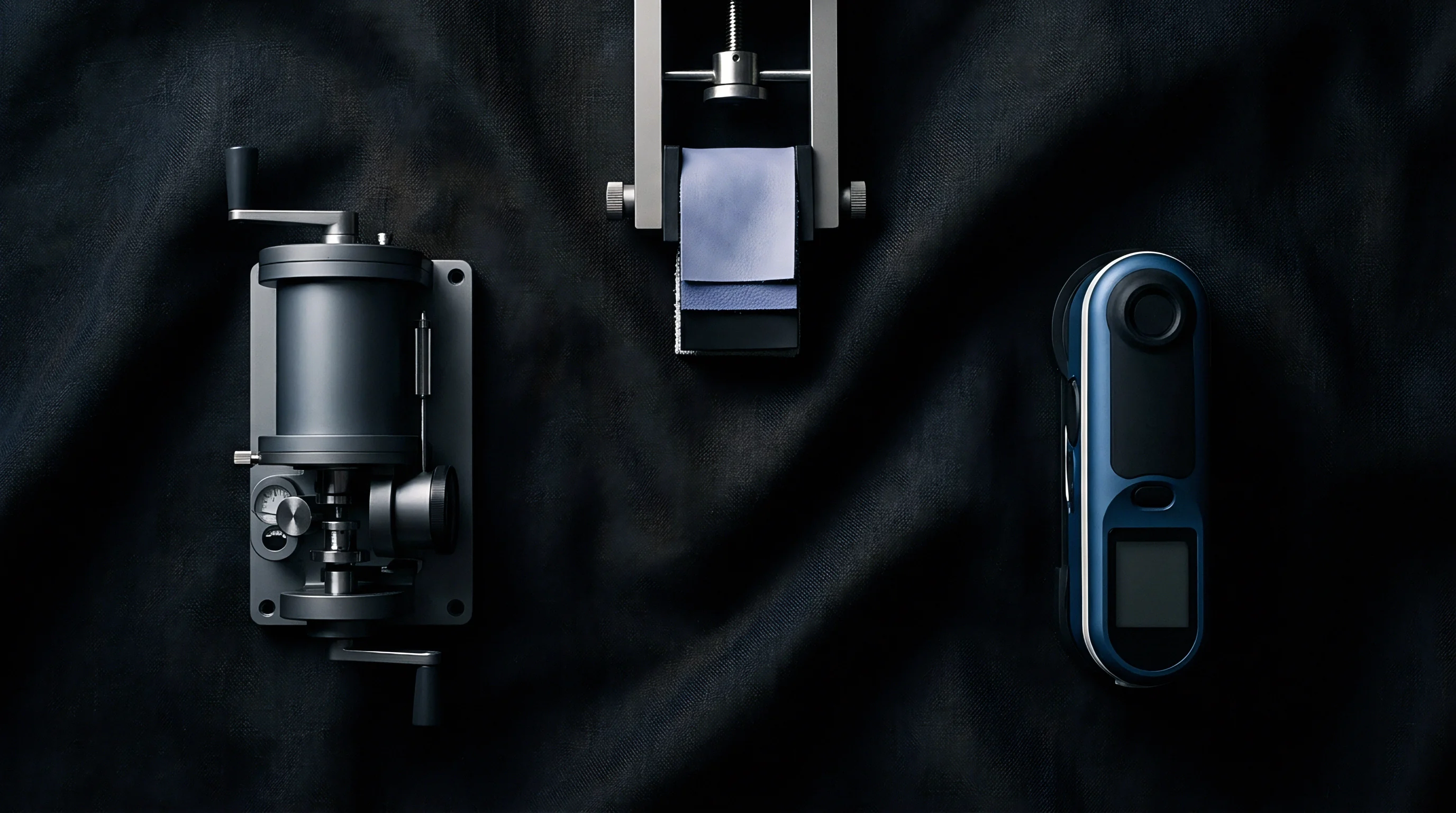
Strick
Bale sampling starts by drawing twenty long-line parcels across four quadrants of a compacted delivery. Technologists isolate each strand by hand along natural cleavage planes, separating the bound botanical sheath into testable units without snapping parallel cell walls. A raw flax reed contains concentric rings of structural tissue, with bast bundles embedded between the outer cortical parenchyma and the inner woody xylem core.
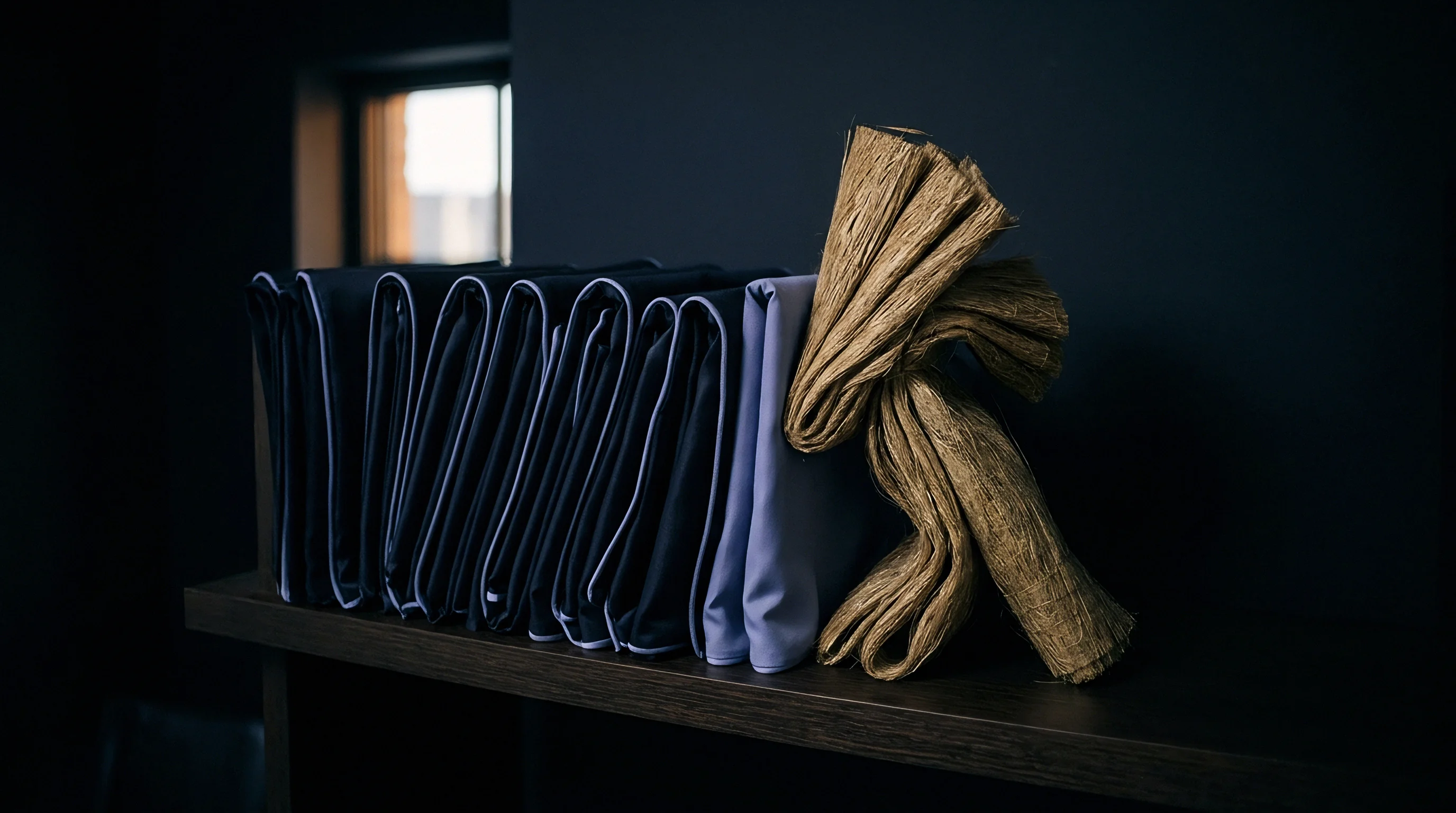
Anatomy of Bast Fibre Aggregates
Individual elementary cells measure between 10 and 40 millimetres in length, with transverse diameters of 12 to 28 micrometres. They never enter wet spinning as isolated filaments. Pectin cements the cell walls, while calcium and magnesium polygalacturonate salts form the middle lamella that glues elementary cells into technical bundles extending from 450 to 950 millimetres along the stem.
Commercial value depends on the integrity of these multi-cellular ribbons. A technical bundle functions as an independent tensile unit during mechanical scutching and hackling. Under-retting leaves excess inter-cellular pectin that holds bundles in thick, coarse aggregations resisting lateral splitting.
Over-retting lets cellulolytic fungi consume the primary cell walls of elementary fibres, causing premature bundle fragmentation during mechanical carding. Clean separation requires controlled retting.
| Commercial Grade Designation | Mean Technical Bundle Length (mm) | Bundle Length Span L25 (mm) | Bundle Length Span L50 (mm) | Short Fibre Content Below 150 mm (%) | Hackling Line Recovery (%) |
|---|---|---|---|---|---|
| Water-Retted Courtray Line I | 880 | 920 | 860 | 3.8 | 68.5 |
| Dew-Retted Normandy Line Prime | 760 | 810 | 740 | 5.2 | 62.0 |
| Dew-Retted Baltic Line Medium | 640 | 710 | 620 | 8.9 | 54.2 |
| Dew-Retted Heilongjiang Line B | 580 | 630 | 550 | 12.4 | 48.0 |
| Scutched Machine Tow Mix | 280 | 360 | 240 | 34.5 | 21.5 |
| Tested at 20 degrees Celsius and 65 percent relative humidity after 48 hours conditioning under ISO 139 atmosphere. | |||||
Length sorting on raw stricks requires comb-sorter array measurement based on an adapted Johannsen-Zweigle apparatus. Operators prepare an aligned tuft of 500 milligrams, clamping one end while dropped combs progressively isolate fibres into five-millimetre length categories. Plotting cumulative frequency against bundle length yields the staple diagram used to set the drafting zone on the gill-box draw frame.
If the front-to-back roller distance falls below the length of the ninety-fifth percentile bundle span, rapid roller clamping fractures the technical assemblies and fills the drawing zone with broken fragments.
Technical bundles drawn from the stem center show far greater dimensional uniformity than root or tip sections. The basal portion carries woody shive attachments that resist chemical softening, whereas apical sections contain immature, weakly lignified assemblies that break under minimal drafting force. Precision testing isolates the middle third of the harvested flax plant to establish the baseline caliber of the consignment.
Hand-hackled stricks yield a higher proportion of uninterrupted lengths than machine-scutched bundles. Scutching turbines introduce transverse bruises ~ knee-bends or kink-bands ~ along the cell walls of elementary fibres. Under polarized light microscopy, these stress fractures appear as distinct cross-markings along the bundle axis.
Every kink-band serves as a site of early mechanical failure under the high-speed pins of the hackling machine, converting potential long-line yield into low-value hackled tow.
Dry bundles slip past the classer’s fingers while oily bundles cling to the apron.
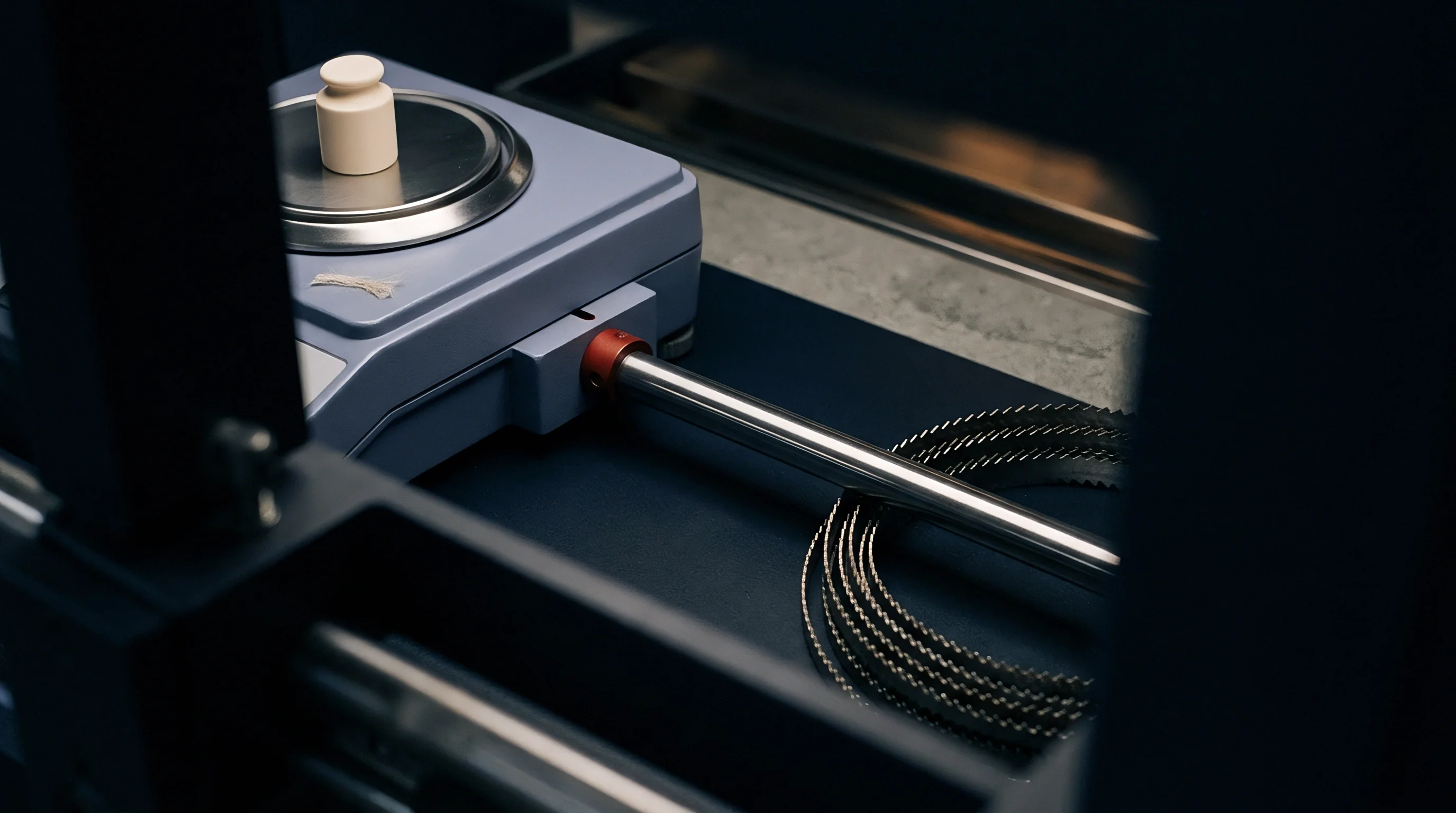

Airflow
Permeametry measures the resistance of a compacted plug of flax to a regulated gas stream. Under the ISO 2370 test protocol, an operator weighs a test specimen of five grams to an accuracy of one milligram, inserting the specimen into a cylindrical chamber of known volume. A calibrated pump directs dry air through the compressed mass at a constant pressure differential of 1.96 kilopascals, or 200 millimetres of water gauge.

Does Permeametry Accurately Gauge Coarse Bast Aggregates?
Surface area governs the volume of fluid passing through the sample chamber in a given unit of time. Fine bundles present a large specific surface area per unit mass, restricting gas flow and yielding low permeability readings. Coarse bundles pack with wide interstitial voids, offering reduced surface resistance and passing high gas volumes.
A 5.00-gram combed flax specimen conditioned at 65 percent relative humidity produces a flow rate of 14.2 litres per minute under an air pressure head of 200 millimetres water gauge.
Bast fibres complicate standard permeametry equations developed for round, individualised cotton cells. Technical flax bundles display irregular polygonal cross-sections with central voids, or lumina, surrounded by variable levels of residual pectin. Gravimetric linear density measurement remains the mandatory primary reference method when calibrating airflow apparatus for industrial raw flax contracts.
Determining gravimetric fineness under ISO 1973 adaptations involves counting and cutting aligned bundles to a strict length of 50 millimetres using a double-bladed guillotine cutter. Technologists count exactly 500 individual bundle segments under magnification, weigh the group on an analytical microbalance with 0.01-milligram precision, and calculate the mean linear density in millitex or tex.
- Incomplete middle lamella splitting produces broad, ribbon-like technical bundles that register falsely fine on permeameters due to surface channeling while behaving like coarse wires in yarn drafting.
- High shive debris content adds dead mass to gravimetric test specimens without contributing to the tensile cross-section, skewing linear density figures downward.
- Moisture regain variation alters both bundle diameter and airflow friction when conditioning periods remain below the mandatory 24-hour baseline.
- Crushed bundle geometry caused by overtight press rollers creates artificial flattened perimeters that distort specific surface calculations.
Vibroscopic determination of linear density under ISO 1973 functions reliably only on fully chemically cottonised flax fibres. When applied to technical bundles, non-uniform mass distribution along the 50-millimetre test length and the internal structural damping of pectin layers extinguish the fundamental resonant frequency. Operators attempting vibroscopic testing on raw bast bundles observe wild signal drift and rapid resonance decay, rendering the resulting data useless for engineering qualification.
Relying on airflow figures without gravimetric cut-and-weigh calibration causes high end-breakage rates in the spinning mill, forcing frames to run twenty percent below rated speed.


Cohesion
Internal friction governs how adjacent bundles slide past one another during roving attenuation. In a dry state, the static friction coefficient of raw flax bundles ranges between 0.38 and 0.44, dropping to 0.22 to 0.28 when technical bundles enter the heated water trough of a wet-spinning frame. Temperature-activated hydrolysis softens the rhamnogalacturonan-I backbones of the middle lamella, enabling controlled drafting of elementary cells without catastrophic fibre fracture.
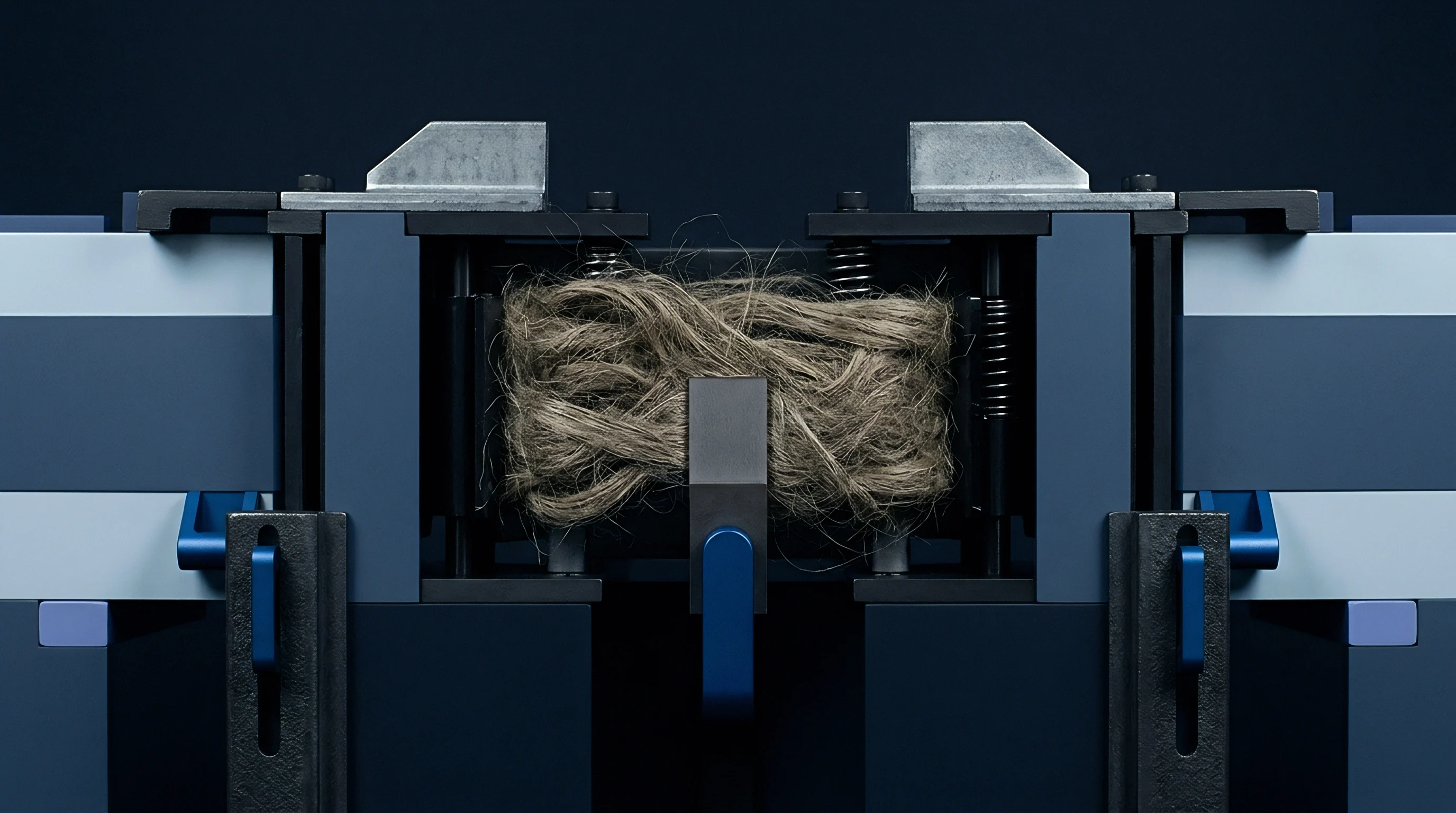
Can Gravimetric Sorting Isolate True Splitting Tendency?
Chemical composition dictates whether a bundle splits cleanly or pulls apart in clotted chunks. Pectin extraction profiles conducted across twenty industrial lots reveal that water-soluble and chelator-soluble pectins govern bundle subdivision under mechanical drafting pins. The ratio of technical bundle length to bundle linear density, termed the aspect ratio, serves as the engineering metric for spinnable limit.
The aspect ratio of technical flax bundles determines drafting velocity limits long before yarn twist enters the sliver.
High aspect ratios allow the drafting pins on an intersecting gill-box to hold and accelerate individual fibres uniformly. If a lot exhibits a low aspect ratio, indicating short, thick bundles, the inter-fibre contact area falls below the threshold needed to maintain drafting cohesion. The drafting zone produces drafting waves, characterised by alternating thick and thin sliver profiles that translate directly into irregular yarn counts.
| Mean Bundle Tex (g/km) | Mean Bundle Length (mm) | Calculated Aspect Ratio | Drafting Force at Nip (cN) | Roving Mass CV (%) | Spindle End Breaks Per 1000 Spindle-Hours |
|---|---|---|---|---|---|
| 1.85 | 780 | 421,600 | 145 | 8.2 | 18 |
| 2.40 | 720 | 300,000 | 180 | 9.6 | 26 |
| 3.10 | 650 | 209,600 | 225 | 12.4 | 42 |
| 4.50 | 580 | 128,800 | 310 | 16.8 | 78 |
| 6.20 | 490 | 79,000 | 440 | 22.5 | 145 |
When drafting raw flax sliver on gill-boxes, pin density and faller bar speed must match the linear density spread of the consignment. Faller pins penetrating a sliver composed of coarse bundles experience severe lateral deflection, distorting the pin field and allowing uncontrolled floating fibre bundles to pass into the delivery rollers.
Fibre cohesion also controls yarn packing fraction inside the ring spinning traveller. Fine technical bundles pack into a tight, dense core under twist insertion, achieving high single-end breaking strength. Coarse bundles resist circular deformation, creating a porous, hairy yarn surface that traps lint in weaving reed tunnels and produces high warp breakage during shedding.
The extent to which chemical enzyme scouring can alter drafting cohesion without degrading elementary cell cellulose remains an open operational question across industrial wet-spinning operations.

Disparity
Bale-to-bale variation represents the primary operating risk when buying raw scutched flax from agricultural growing cooperatives. Soil nitrogen levels, plant density per square metre, and regional rainfall patterns dictate the thickness of the flax phloem ring during vegetative growth. Dew-retting introduces further variance, as stalks lying on soil surfaces experience uneven colonization by indigenous fungal populations of Cladosporium herbarum and Epicoccum nigrum.
Stalks situated at the top of a retting swath receive full atmospheric exposure, drying rapidly after morning dew. Stalks resting against moist topsoil remain damp for prolonged durations, accelerating fungal enzymatic activity. The resulting scutched bale holds a blend of over-retted, easily fragmented bundles and under-retted, coarse ribbons.
Under-retted fibre lots require eighty percent higher drafting force at the drawing frame than matched lots harvested from uniform retting fields.
Auditing incoming deliveries involves pulling cross-sectional core samples from ten percent of the bales in a shipment. Technologists examine both linear density and bundle length distributions, plotting the coefficient of variation across each metric. A consignment with an acceptable mean length of 700 millimetres can conceal a coefficient of variation exceeding 45 percent, signaling erratic drafting behavior and high waste generation at the hackling comb.
- Mean linear density threshold caps bundle mass at 2.8 tex for consignments destined for wet spinning above metric count Nm 39.
- Coefficient of bundle length variation must not exceed 28 percent to prevent excessive floating fibre accumulation in gill-box drafting zones.
- Residual shive content ceiling limits non-fibre cortical tissue to 1.5 percent by weight under mechanical separation analysis.
- Bundle tenacity minimum demands a dry breaking force of 45 centinewtons per tex when tested on bundle clamps with a three-millimetre gauge length.
When spinning mills accept raw lots based solely on visual classing, the spinning floor pays for the oversight in cleaning downtime. Under-hackled, variable flax chokes the drawing frame fluted rollers with lap-ups, requiring manual cutting with brass knives.
- Cut banding wires on five sample bales per container and condition opened biscuits for 24 hours at 20 degrees Celsius.
- Extract twenty hand-stricks of 100 grams each across surface and core layers, discarding damaged outer wrap fibres.
- Comb each strick through a 14-pins-per-inch hand hackle to extract loose scutched tow and particulate shive.
- Measure 100 fully extended technical bundles using a black-velvet grading board equipped with a millimetre steel rule.
- Weigh five central 50-millimetre cut segments per sample on a calibrated microbalance to confirm linear density.
- Calculate mean values, standard deviations, and coefficients of variation before signing the delivery acceptance receipt.
CELC Master Flax Fiber contracts tie commercial settlement directly to the certified hackling yield percentage established during laboratory test combing.
Buyer complaints regarding high bundle disparity encounter the physical reality that seasonal weather fluctuations during late-summer retting make wide length and fineness variations an inherent characteristic of natural bast fibres.

Ledger
Commercial yields link raw fibre dimensions directly to the landed cost of spun yarn. Consider a 20-tonne consignment of dew-retted scutched flax purchased at 4.20 euros per kilogram landed at the mill gate. The contract specifies a wet-spun target count of metric count Nm 39, equivalent to English lea count 66, destined for a 140-gram plain-weave shirting fabric.
If the delivery exhibits a mean technical bundle length of 750 millimetres and a linear density of 2.2 tex, hackling line recovery reaches 64 percent, yielding 12,800 kilograms of long line and 7,200 kilograms of hackled tow. The hackled tow sells into secondary markets at 1.10 euros per kilogram, recovering 7,920 euros. The net raw material cost allocated to the 12,800 kilograms of hackled line totals 76,080 euros, producing an effective line cost of 5.94 euros per kilogram before drawing and spinning operations.
If bundle length drops to 580 millimetres with a linear density of 3.8 tex due to uneven retting and rough scutching, hackling recovery plummets to 48 percent. The yield generates only 9,600 kilograms of long line alongside 10,400 kilograms of tow. Recovering 11,440 euros from the tow leaves 72,560 euros assigned to the 9,600 kilograms of usable line fibre.
The effective raw material cost climbs to 7.56 euros per kilogram of spinnable sliver.
Spinning frames attempting to draw the coarser 3.8-tex bundles into Nm 39 yarn experience elevated spindle breakage rates, escalating from 22 to 85 end breaks per 1,000 spindle-hours. Frame speeds drop from 7,200 to 5,800 revolutions per minute to maintain spinning stability, increasing operating labor and energy allocations. The higher mass variance in the coarser sliver necessitates an additional three percent twist multiplier to meet the minimum single-end tensile strength specified by the weaving plant, reducing yarn delivery speeds at the front roller.
At the weaving mill, yarn spun from the coarser lot produces frequent warp stops. Single-end yarn tenacity drops from 28.5 to 21.0 centinewtons per tex, while count CV% increases from 11.2 to 16.5 percent. Weaving efficiency declines from 91 percent to 79 percent on air-jet looms, pushing the finished greige cloth manufacturing cost upward by 0.38 euros per linear metre.
Article 14 of the Standard European Bast Fibre Purchase Agreement stipulates that lots deviating by more than twelve percent from the agreed mean bundle linear density trigger a mandatory six percent price discount or allow unconditional buyer rejection at the port of entry.