Determining Flax Fibre Length Using Manual Comb Sorters
Manual comb sorters fractionate flax bundles across pinned bars to generate gravimetric staple arrays that govern wet-spinning reach settings and lot value.


Bench
Double-bank pin sorters establish the physical length distribution of scutched tow and cottonised flax bast bundles before spinning drafting frames receive the lot. Mill laboratories rely on dual-comb instruments, such as classical Baer or Zweigle units, to extract reproducible length arrays from heterogeneous bast bundles. The mechanical assembly mounts two parallel rows of precision-spaced comb bars carrying hardened steel needles.
Because low humidity stiffens the bast, ambient test conditions require strict adherence to twenty degrees Celsius and sixty-five percent relative humidity, conforming to ISO 139 atmosphere specifications. Bast fibres absorb moisture rapidly through their hydrophilic cellulose and hemicellulose amorphous regions, changing their flexural rigidity and surface friction during manual manipulation.
A conditioned test specimen of raw flax tow loses drafting cohesion when ambient relative humidity drops below fifty-five percent.
Technicians weigh an initial test specimen of exactly five grams on an analytical balance sensitive to zero point one milligram. To avoid bending the needles under heavy loads, specimen extraction follows ISO 6989 sampling guidelines, drawing pinches from twenty distinct locations across opened bale cross-sections to eliminate field packing bias. Flax fibres exist within the plant stem as poly-elementary bundles bonded by calcium pectate and lignin matrices.
The manual sorter separates these bundles mechanically without applying the high thermal or chemical shearing forces common to rotor spinning testers. Technicians align the bundle tips manually against an initial reference edge on the front comb set.

Atmospheric Conditioning and Bundle Preparation Standards
Relative humidity directly alters pin drag. When moisture levels exceed seventy percent, natural pectin gums turn tacky, causing individual technical fibres to clump and bridge across neighboring needle gaps. Conversely, dry laboratory air generates static charges that cause loose bundle ends to flare outwards from the comb bed, while clean jaws prevent slippage during preparation.
- Grip Alignment Forceps grasp bundle extremities without crushing individual filaments across the gripping face.
- Hardened Steel Needles maintain vertical rigidity under lateral combing forces up to five newtons per pin.
- Drop Bar Mechanisms lower successive comb sections cleanly to release longer sorted groups without disturbing lower layers.
- Velvet Deposition Boards provide a high-friction black surface where technicians lay out sorted fractions for optical scale verification.
Failure to calibrate comb alignment leads directly to erratic staple readouts, skewed distribution tails, and incorrect drawframe roller settings that destroy yarn regularity.


Fraction
Manual separation begins by clamping a conditioned five-gram tuft in broad-nosed drawing forceps lined with chrome-tanned leather. The operator pulls the fibre bundle slowly through the rear comb bank toward the front comb array, straightening bent fibres and trapping extraneous shive particles inside the pin interstices without damaging the pins. This initial transference isolates the longest fibre bundles, placing their forward extremities along a common baseline on the second comb bank.
The operator repeats this drawing and redepositing cycle three consecutive times, turning the specimen end-for-end to ensure true parallelization across the testing field.

Should Sorter Pins Vary across Bast Fractions?
Needle densities shift from coarse entry fields of five pins per centimetre to dense rear fields holding twenty pins per centimetre. Coarser pins handle the initial uncombed tuft without snapping the brittle middle lamellae that bind bast filaments together. Finer pins retain the shorter elementary fibres during the secondary combing phase, preventing them from falling between comb bars onto the instrument baseplate.
| Length Group Interval (mm) | Scutched Tow Retained Mass (g) | Scutched Tow Cumulative (%) | Degummed Flax Retained Mass (g) | Degummed Flax Cumulative (%) |
|---|---|---|---|---|
| Above 120 | 0.68 | 13.6 | 0.00 | 0.0 |
| 100 to 120 | 0.94 | 32.4 | 0.00 | 0.0 |
| 80 to 100 | 1.12 | 54.8 | 0.05 | 1.0 |
| 60 to 80 | 0.86 | 72.0 | 0.22 | 5.4 |
| 40 to 60 | 0.58 | 83.6 | 1.18 | 29.0 |
| 20 to 40 | 0.44 | 92.4 | 2.46 | 78.2 |
| Below 20 | 0.38 | 100.0 | 1.09 | 100.0 |
Successive comb bars drop away in steps of five or ten millimetres as the sorting sequence advances. Because pectins govern bundle cohesion, the operator draws out exposed fibre lengths using steady, horizontal forceps traction, depositing each length group into a dedicated tared weighing container. Rushing the extraction stroke induces mechanical breaks along weak transverse nodes in the flax cell walls, creating artificial short fibres that invalidate the test report.
Careful extraction along the natural fibre axis prevents artificial cell wall cleavage.
Flax bundles retain residual non-cellulosic matter that alters apparent mass fractions during dry laboratory sorting.
- Scutched Tow Bundles contain intact cortical tissue fragments that resist comb separation.
- Degummed Bast Filaments slide smoothly between pins owing to the chemical removal of inter-fibre pectins.
- Hackling Tow Fractions exhibit higher longitudinal uniformity than carded breaker waste.
- Reworked Sliver Waste shows elevated short fibre quantities caused by mechanical opener beating.
Gentle manipulation of the comb bed maintains the integrity of natural bundle lengths throughout manual fractionation.

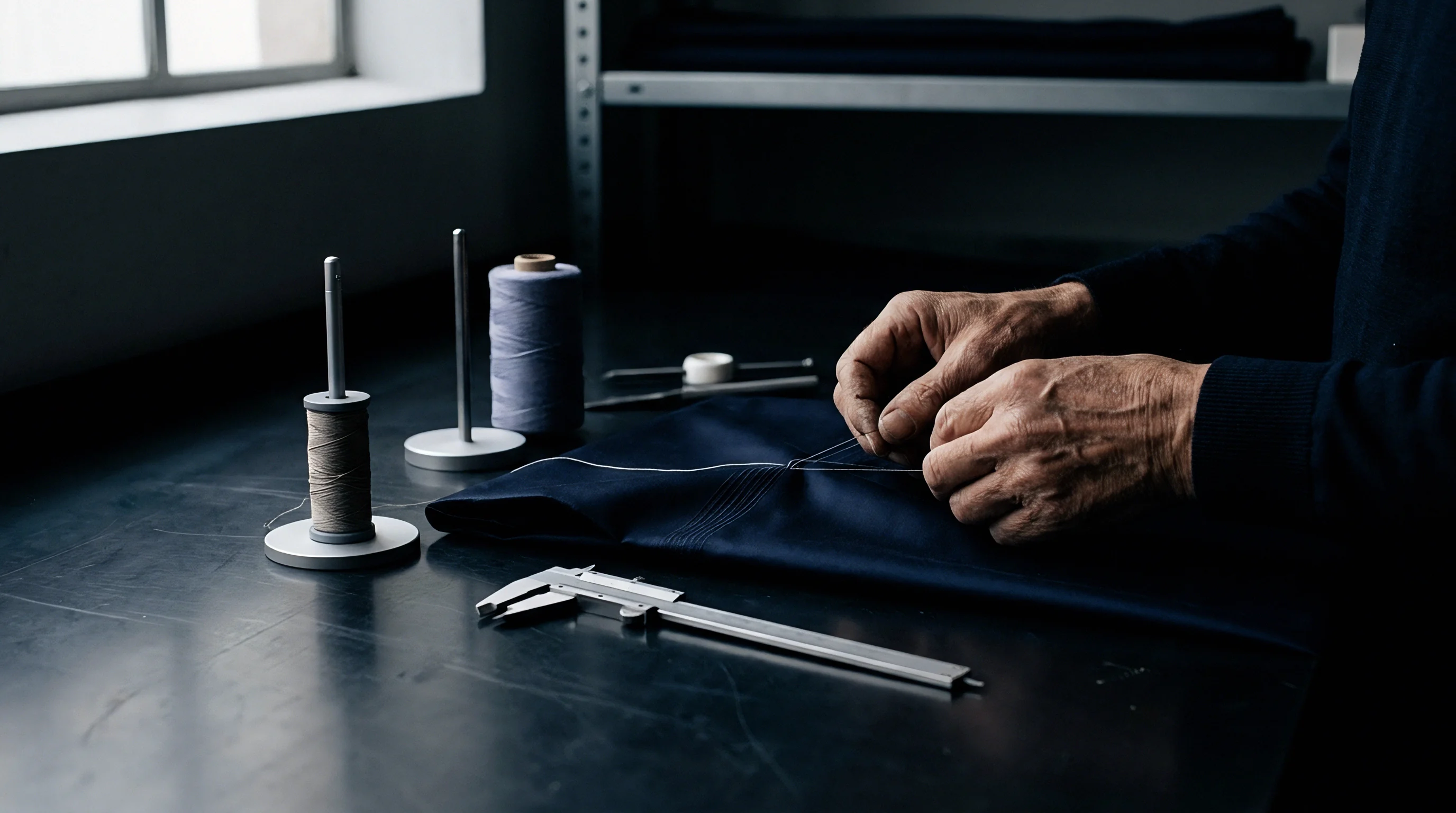
Diagram
Plotting cumulative fibre mass against descending length intervals generates the classical staple curve that dictates industrial drafting boundaries. Technicians record the gravimetric yield of each fraction on an electronic microbalance sensitive to four decimal places. Individual mass values are divided by total recovered specimen mass to yield fractional percentages.
Connecting these descending points produces the comb sorter diagram, also known as the staple array, displaying the absolute range from maximum bundle length down to discarded dust.

Mathematical Derivation of Span and Mean Lengths
Calculators extract the twenty-five percent span length, the upper half mean length, and the percentage of short fibre below twenty millimetres directly from the stepped array. Consider a typical five-gram evaluation of wet-spun dew-retted tow. The operator records the following parameters through arithmetic integration:
Mean length equates to the sum of the products of group mid-point lengths and their respective mass percentages, divided by one hundred. Upper quartile length represents the length value along the cumulative mass axis corresponding to twenty-five percent of total specimen mass. The short fibre content sums all mass fractions measuring below twenty millimetres in staple length.
A dew-retted tow lot displaying twenty-two percent short fibre content increases spinning end-breakage rates by forty percent at nominal wet-spun counts.
Fibre slippage flattens the cumulative curve. In a standard test run with an initial specimen of 5.0000 grams, cumulative recovery settles at 4.9200 grams, representing a recovery rate of 98.4 percent. The unrecovered 0.0800 grams represents micro-dust, shattered cuticle, and short fibrils lost beneath the lower comb pins.
Technicians recalculate mass fractions based on the recovered weight to prevent mathematical distortion of the cumulative curve.

Evaluating Short Fibre Proportions across Processing Stages
Carding operations increase the mass fraction of fragments under fifteen millimetres whenever cylinder wire angles become excessively aggressive. Technicians monitor the ratio between upper quartile length and mean length to assess bundle uniformity. A ratio approaching 1.0 indicates absolute length uniformity, an ideal state never realized in bast fibres.
Typical commercial flax tow lots yield ratios between 1.35 and 1.65.
| Fibre Material Type | Upper Quartile Length (mm) | Mean Length (mm) | Short Fibre Below 20 mm (%) | Maximum Spinnable Count (Nm) |
|---|---|---|---|---|
| Water-Retted Line Flax Tow | 88.5 | 62.4 | 8.2 | 48 |
| Dew-Retted Scutched Tow Grade 3 | 64.0 | 41.2 | 18.6 | 26 |
| Enzyme-Degummed Cottonised Flax | 34.2 | 26.8 | 14.5 | 36 |
| Coarse Dry-Spinning Flax Tow | 52.0 | 31.0 | 26.4 | 12 |
Excessive tension pulls the bundles apart. When the staple diagram exhibits a steep vertical drop on the left margin, the batch contains high quantities of intact long bundles suitable for fine wet roving. A long, flat tail extending beyond the eighty percent cumulative mass mark signals an excessive concentration of short fragments that will load the card flats and create drafting waves on the ring rail.


Reach
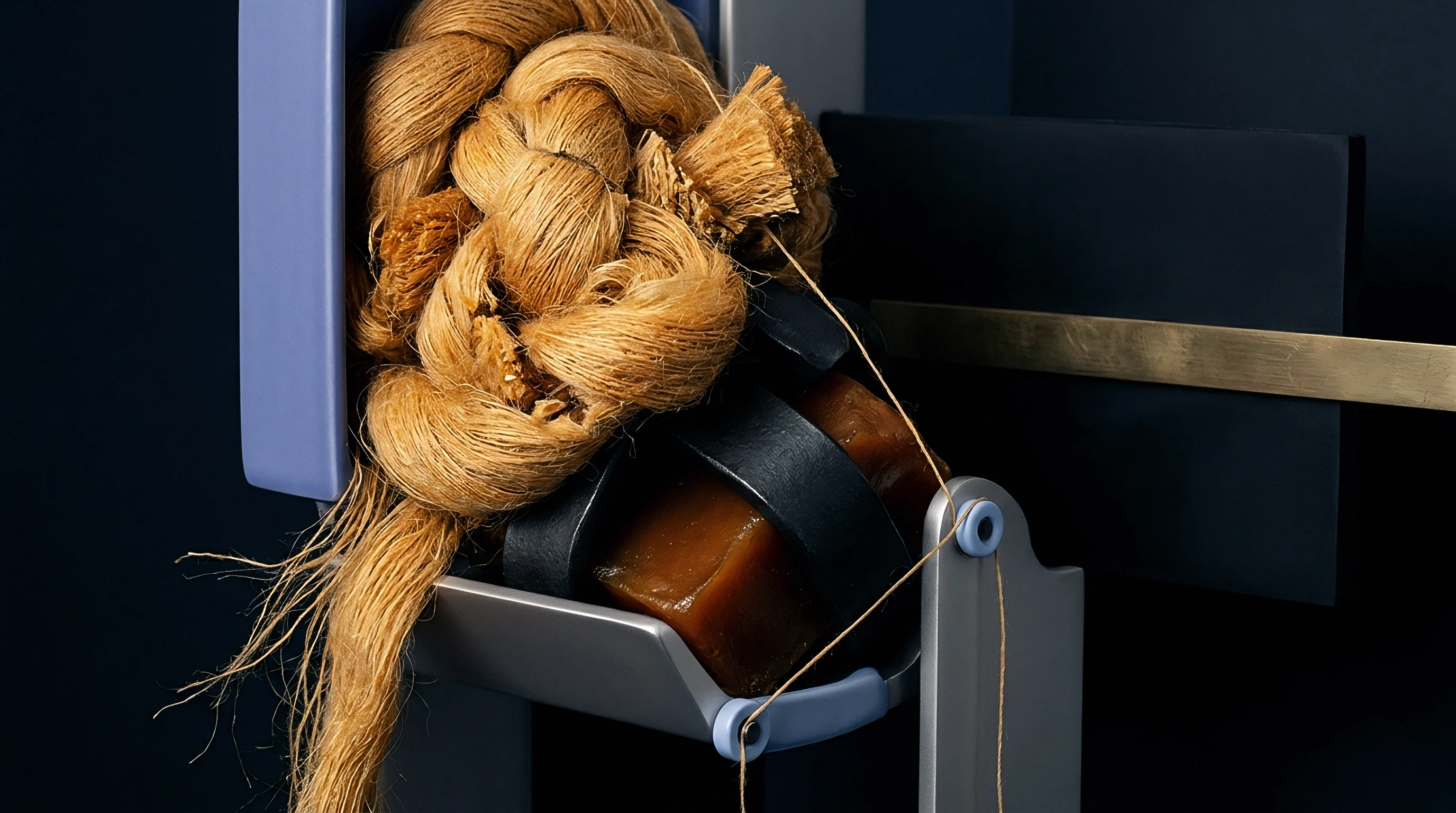
Spinning frames convert fibre length arrays into mechanical settings across the drawing zone. The distance between the retaining rollers and the drawing rollers, termed the reach, derives directly from the upper quartile length established on the comb sorter. Setting the reach shorter than the longest significant fibre group causes immediate bundle rupture, raising drafting resistance and breaking drafting drive gears.
Setting the reach excessively wide releases short fibres from roller nip control, generating irregular slubs, thick spots, and thin places throughout the delivered sliver.
Will Short Fibre Accumulation Break Wet Spinning Roving?
Floating fibres lacking contact with either nip roller drift erratically through the warm water trough. Wet spinning relies on bath temperatures between sixty and seventy degrees Celsius to soften remaining pectin adhesives, allowing elementary fibres to slide across one another under controlled drafting tension. Excessive quantities of fibres under twenty millimetres wash out into the trough water or ball up into spinning neps at the roving trumpet.
Uncontrolled slippage of short fibres produces periodic drafting waves and faults, which is why dry spinning requires longer stock.
- Roving Breakage Rates escalate sharply when short fibre content surpasses twenty percent of batch mass.
- Roller Lapping Frequency increases under high short fibre fractions that wrap around fluted bottom steel rollers.
- Yarn Tenacity Deficits appear when the mean fibre length falls below thirty-five millimetres in dry-spun tow yarns.
- Hairiness Index Surges occur when uncontrolled bundle tails protrude from the yarn core during twisting.
Aggressive field retting can yield natural fineness, though over-retting produces brittle fibres that easily fracture during combing and cause delivery discrepancies.


Penalty
Commercial settlement for raw tow and cut flax rests upon agreed staple tolerances written directly into purchasing contracts. When laboratory comb sorter analysis proves a delivered shipment carries shorter mean lengths than declared on the confirmation note, buyers enforce contractual price adjustments. Spinning mills calculate these deductions against projected yield losses at the hackler and the card, balancing the increased waste outturn against the raw material purchase price.

Commercial Valuation Adjustments for Fibre Length Deficits
Discrepancies between certified comb sorter arrays and mill dock testing trigger immediate price rebates per metric ton. A lot contracted at an upper quartile length of seventy millimetres that tests at fifty-five millimetres forces the mill to re-route stock to coarser yarn counts. Lowering spinnable yarn counts from Nm 39 down to Nm 26 reduces finished cloth yield per ton of purchased raw material, expanding total manufacturing expenditure per delivered metre of linen fabric.
Standard commercial arbitration clauses specify that comb sorter test discrepancies exceeding five millimetres on upper quartile length permit immediate lot rejection or a mandatory four percent invoice reduction per missing millimetre.
Standard purchase contracts incorporating the technical rules of the International Flax and Hemp Confederation specify that all length arbitrations rely exclusively on certified dual-comb sorter diagrams executed in accredited regional test facilities, superseding any visual hand-classing claims made at the loading dock.