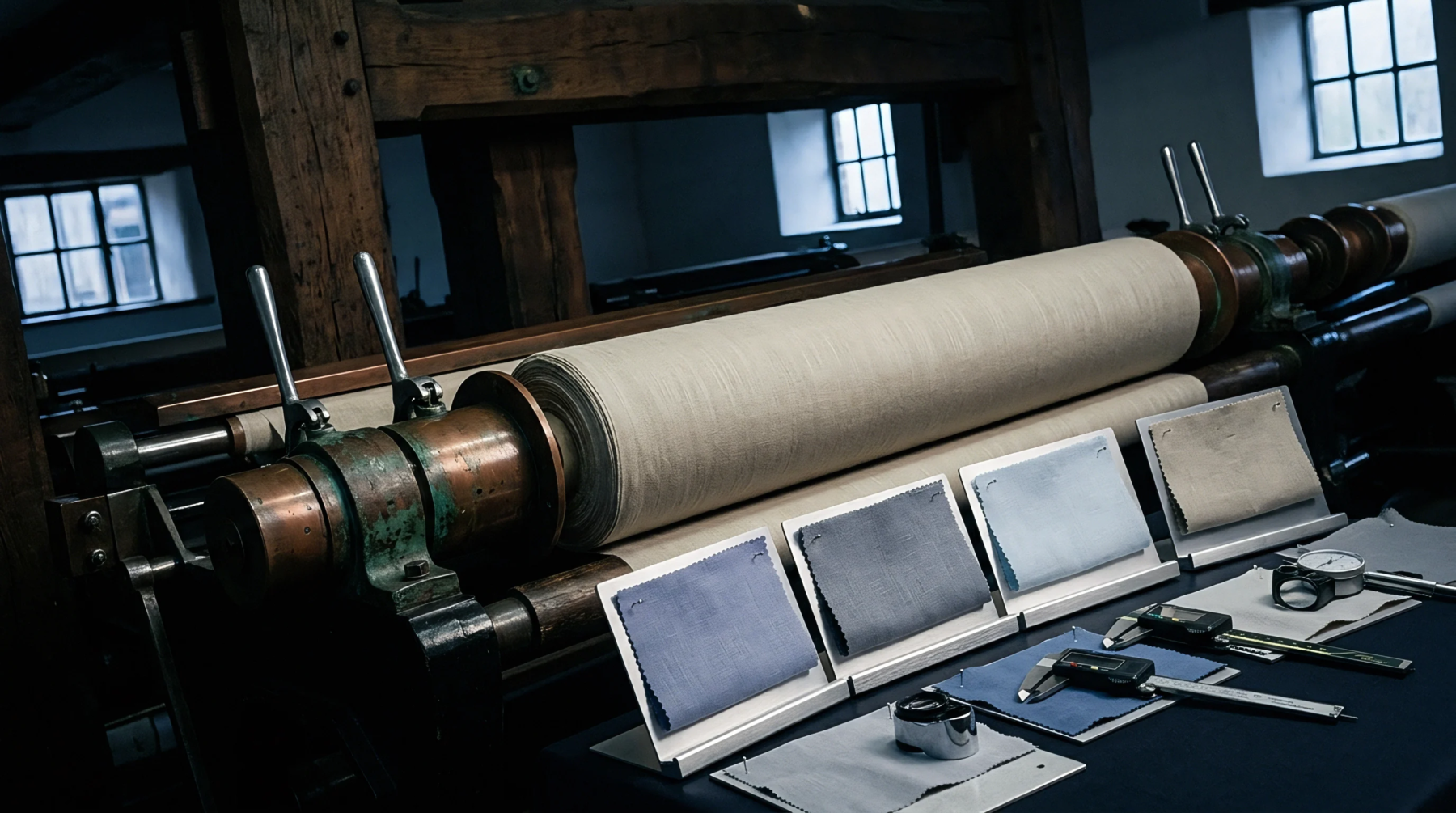
Structural Flaw
An irregular interlacing sequence caused by a missing or improperly inserted filling yarn represents a localized structural defect within textile cloth. During linen cloth production, mispick occurrences alter the intended binding architecture across the entire sheet width or within a specific design repeat. The error typically happens when a rapier head drops a stiff flax filling yarn mid-insertion or when a feeder sensor fails to arrest machine motion following a filling yarn snap.
Such disruption damages the visual and mechanical continuity of the finished textile surface.
Detection Method
Visual inspection under standard lighting arrays captures filling yarn errors during automated loom monitoring and final table examination. In Chinese linen mills, electronic stop motions detect filling breaks instantly, but a mispick occurs if the loom cycles an extra half-turn before the brake engages completely. When the operator restarts the loom without removing the damaged pick and resetting the shedding sequence, the faulty pick remains embedded in the cloth body.
Mill quality teams utilize off-loom illuminated inspection frames, recording pick discrepancies on intermediate cloth dockets with precise meterage coordinates. High-sett flax fabrics expose these irregularities prominently because flax yarns lack bulk, preventing adjacent filling picks from obscuring the gap.
Grading Penalty
Point allocation systems classify filling deviations according to length and visibility across the finished linen bolt. Under the standard four-point fabric inspection system, an uncorrected mispick exceeding nine inches incurs the maximum penalty of four points per occurrence. Accumulating such structural errors degrades fabric lots from first-quality export standard to domestic utility grading, triggering contractual discounts or outright shipment rejections.
Mispick prevention preserves structural uniformity across high-value linen textiles.