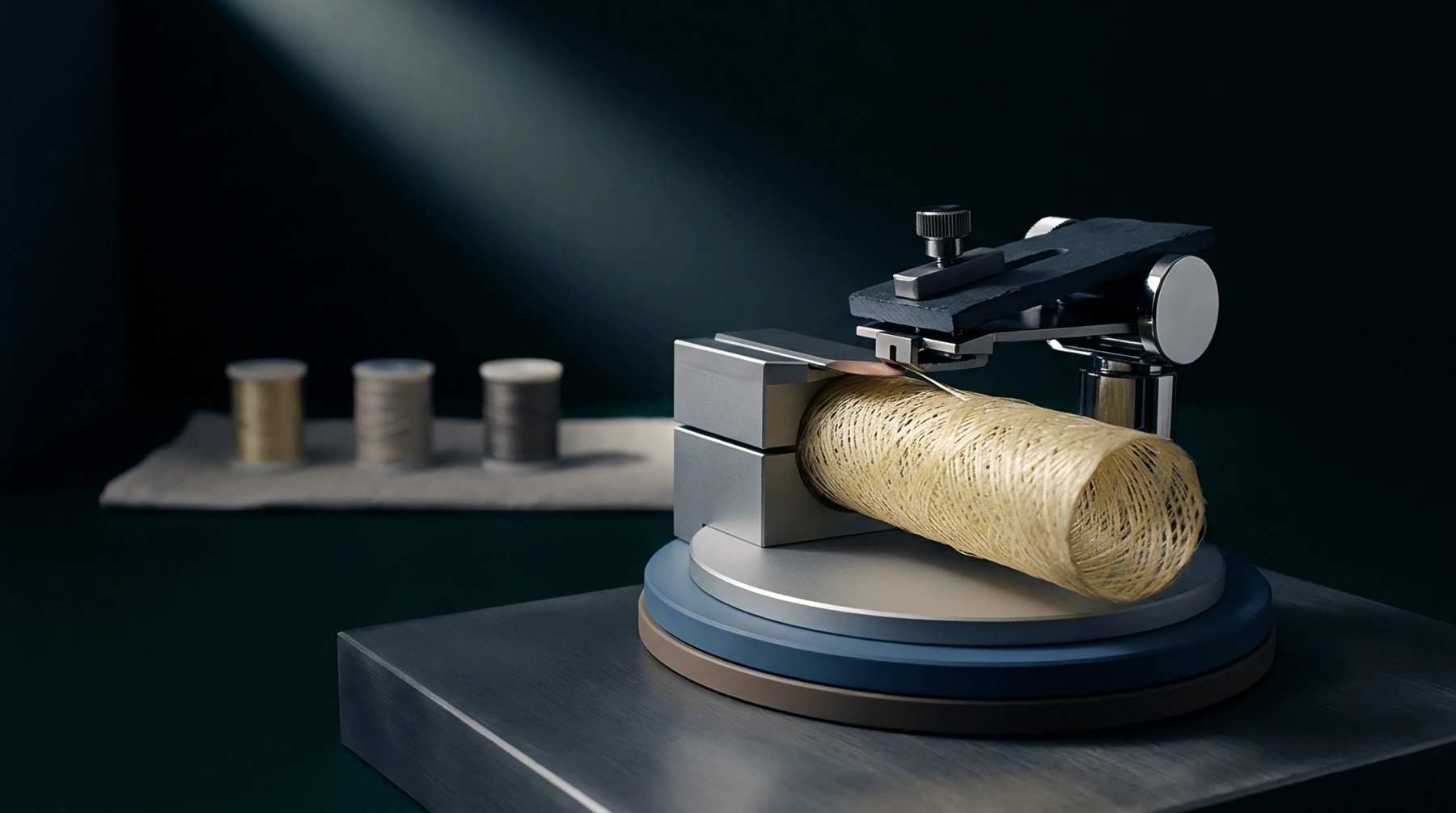
Weighing Precision
Gravimetric determination of single flax filaments relies on microbalance weighing to establish the linear density of raw bast material before drafting begins. Absolute mass quantification happens inside climate-controlled chambers where temperature fluctuations and ambient air currents risk throwing off milligram measurements. Drawn fiber lots face strict rejection thresholds whenever individual sample weights exceed the tolerance band defined by export contracts.
Acceptance criteria at this spinning stage demand higher fidelity than standard trade weights because downstream yarn strength depends entirely on linear mass uniformity.
Filament Assessment
Laboratory technicians isolate individual strands from the roving batch under optical magnification to prepare them for ultra-sensitive scale placement. Electrostatic charges on dry cellulose surfaces distort gravitational readings unless operators discharge the sample tray prior to every measurement cycle. Raw fiber grading separates premium long-line bast from tow waste according to mass per unit length ratios recorded during these trials.
Mill specifications enforce tighter margins on moisture-conditioned samples than those mandated by general buyers.
Batch Certification
Quality documentation records these single-fiber mass values inside the production ledger accompanying each export crate to verify compliance with mill standards. Certified weights accompany the spinning docket through the wet-spinning line to prove that raw material density remained within tolerance throughout the preparation phase. Final grade assignment for linen yarn relies on these initial mass distributions to forecast tensile performance under high-speed weaving loads.