Mixed Integer Allocation Optimization for Multi Loom Linen Production Sheds
Mixed integer programming prevents fractional loom errors in multi-loom linen sheds by resolving sequence-dependent changeovers against inelastic yarn limits.
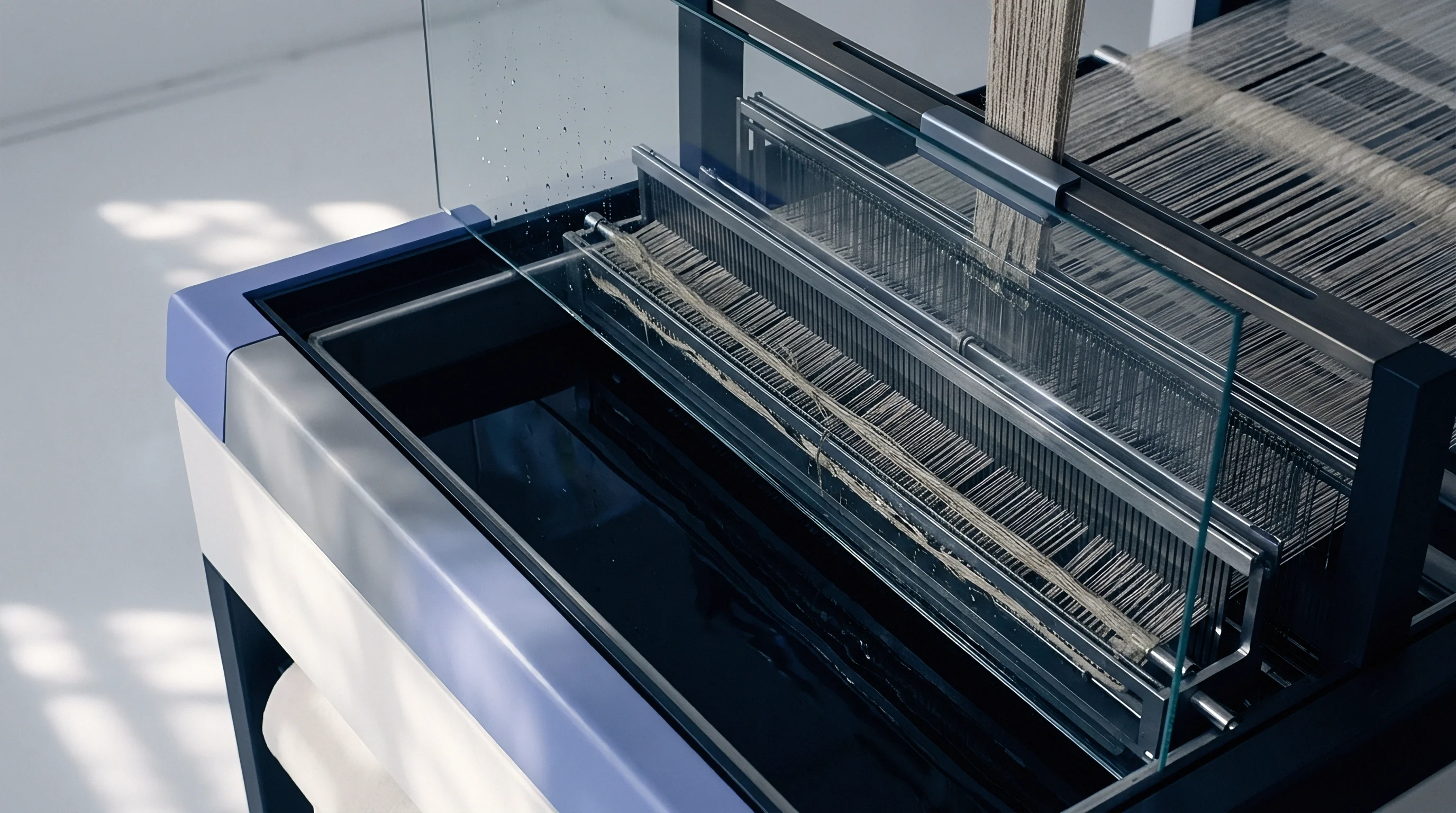
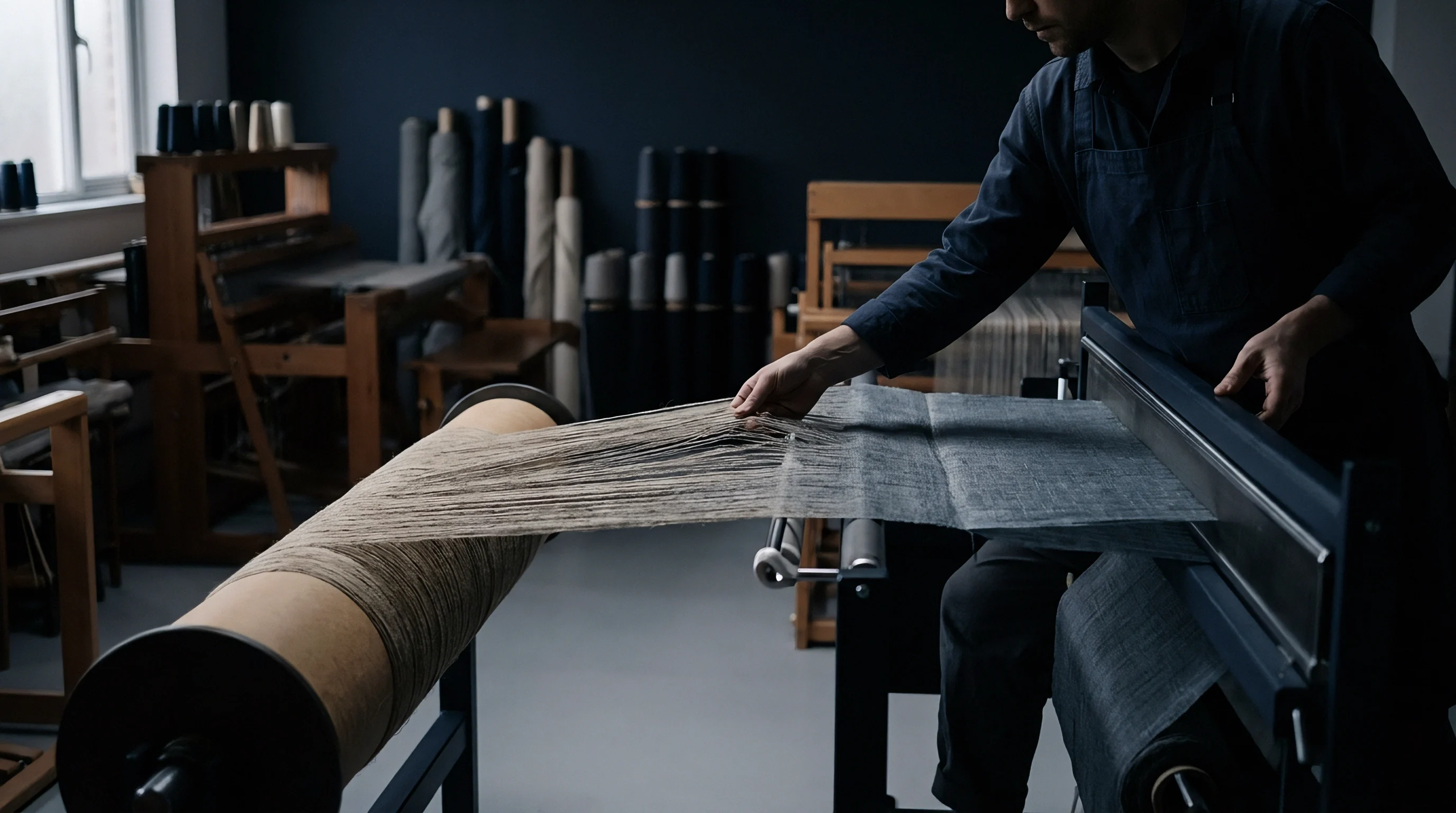
Dispatch
Scheduling a fifty-machine shed running pure wet-spun flax requires a fundamentally different mathematical approach than standard cotton scheduling. Linen yarns rarely exceed 2.2 percent ultimate tensile elongation in lea counts finer than 40 wet-spun lea (approximately 41.3 tex), which eliminates the mechanical stretch high-speed projectile and air-jet looms count on while opening the shed. Treating job allocation across mixed machine banks as a continuous linear program yields fractional loom assignments that make no physical sense.
Splitting an order across three rapiers and half an air-jet breaks warp change schedules and masks true changeover losses.
Mixed integer linear programming fixes this by coupling binary assignment variables with continuous yardage and timing values. The model matches individual customer orders ~ defined by finished linear metres, target pick densities, and reed widths ~ to specific frames built to withstand the necessary beat-up forces without stressing yarn past its yield point. For example, an order specifying a dense 54 lea warp at 24 picks per centimetre on a 220-centimetre reed needs a double-beam positive let-off and a reinforced sley.
Put that order on an older positive cam loom without active tension compensation, and the fabric will show severe periodic barre marks alongside warp end breaks above 18 stops per 100,000 picks.
Under ISO 7211-2 evaluation, yarn count variations exceeding five percent between supply packages generate immediate stripiness across plain linen surfaces when allocated across uncalibrated parallel frames.
Machine allocations directly set the shed labor burden. When jobs move between frames with different reed spaces, changeover hours swing based on beam flange adjustments, drop wire restringing, and heddle reallocations. Technicians track these setups through time studies that capture both the mechanical reset and the slow-speed trial phase where breaks peak.
Poor machine assignments compound delivery delays across multi-order contracts, pushing back downstream scouring and finishing until seasonal orders face cancellation.
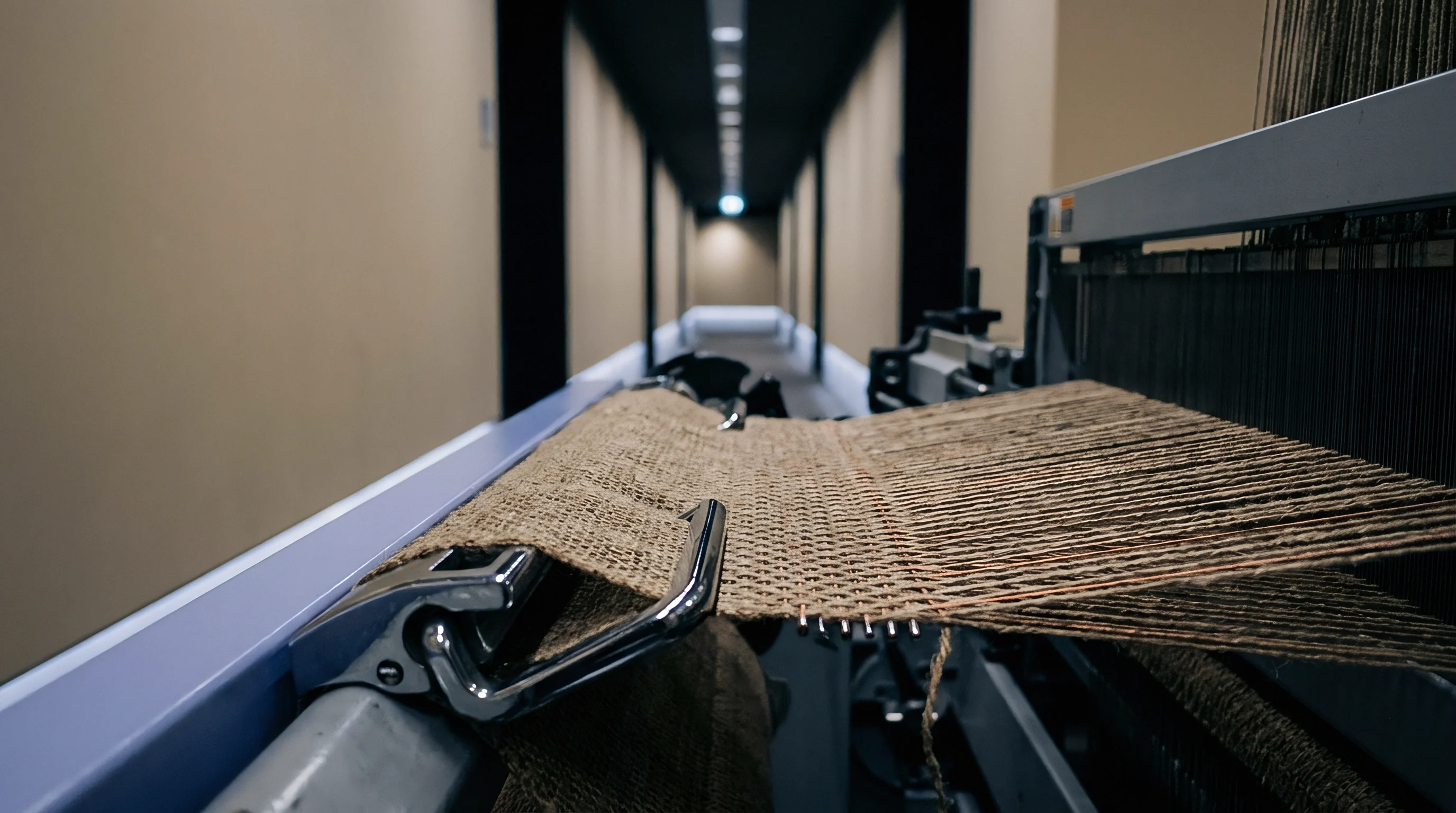
Friction
Flax fibers have a stiff, crystalline structure dominated by highly oriented cellulose microfibrils with almost no amorphous regions, leaving virtually no room for tensile stretch. Unlike ring-spun combed cotton, which shows a gradual yield zone, wet-spun flax yarn follows a linear stress-strain curve right up to breaking point. Peak tension surges across the warp line when the heddles lift to full shed clearance.
If that peak exceeds 40 percent of mean single-end breaking tenacity (typically 28 to 34 centinewtons per tex for quality wet-spun European flax), warp break rates spike exponentially.
Pure flax warps do not run well under air propulsion. Natural nodes and residual pectin slubs create an uneven yarn surface that disrupts the air jet’s boundary layer. Filling velocity drops sharply across widths wider than 140 centimetres, causing short picks, looped selvedges, and tip curl.
Positive mechanical rapier systems work far better, keeping a continuous grip on the yarn tip to draw the filling through under precise mechanical control.

Why Penalize Rapid Insertion Rates?
Pushing a 190-centimetre positive rapier from 380 to 480 picks per minute increases dynamic yarn tension by roughly 60 percent during transfer. Inelastic flax breaks easily under sudden shock load. Because end breaks climb along an empirical power curve rather than a straight line as insertion speed increases, the optimization solver requires heavy penalty weights whenever machine speeds exceed stable limits.
| Insertion System | Target Warp Count | Max Practical Speed | Warp Stop Rate | Loom Efficiency |
|---|---|---|---|---|
| Negative Flexible Rapier | 14 to 36 Lea (119 to 46 Tex) | 420 ppm | 3.8 per 100k picks | 84.5% |
| Positive Rigid Rapier | 20 to 60 Lea (83 to 28 Tex) | 360 ppm | 2.1 per 100k picks | 88.2% |
| Torsion-Bar Projectile | 10 to 28 Lea (165 to 59 Tex) | 310 ppm | 4.6 per 100k picks | 81.0% |
| Profile Reed Air-Jet | 40 to 80 Lea Blend (41 to 21 Tex) | 600 ppm | 9.4 per 100k picks | 68.5% |
Expected stop counts govern how many looms a single operator can handle. An operator managing six rapiers on heavy upholstery linen can clear about 15 mechanical stops an hour before patrol delays build up and downtime accumulates. Clustering three high-break jobs in the same floor zone overburdens the weaver, driving real efficiency far below target financial models.
- Excessive beat-up resistance occurs when high pick densities drive the cloth fell forward faster than the warp can relax, causing severe reed deflection and chatter.
- Yarn hairy entanglement causes adjacent warp ends behind the heald frames to cling together during shedding, holding ends open and preventing drop wires from falling cleanly.
- Dynamic peak snatching happens at the filling transfer zone when rapier clamps fail to dampen shock on inelastic wet-spun linen packages.
- Pectin gum accumulation deposits hardened sizing debris inside reed air spaces, pinching warp ends until shear breaks occur.
Single-end tensile testing according to ISO 13934 conditions proves that unconditioned linen warp yarn loses 18 percent of its dynamic knot resistance whenever weave shed relative humidity drops below 65 percent.
High room humidity alone will not compensate for elevated machine speeds, nor can excessive stops be dismissed as inevitable fiber variations beyond floor control.
Creel
Warp preparation for linen sheds operates under very different beam economics than synthetic continuous filament or rotor-spun cotton systems. Warping mills have to run flax yarn under strict, uniform tension across every creel spindle. Uneven package density from wet-spinning drying cycles creates tension bands that show up as slack ends across the beam width.
When a loom beam runs out, the allocation model decides whether to perform a direct warp tying-in or strip the frame for a full re-draw.
Automatic knotting carriages avoid manual re-drawing. When the next order shares the same warp sett, total end count, and draft through heddles and reed, a tying machine joins thousands of ends in under two hours. But switching from a 1/1 plain weave to a 2/1 twill with the same yarn requires moving drop wires, changing heald frames, and resetting harness timing ~ setups that take significant time and labor.
Setup Duration and Changeover Cost
A full changeover ~ replacing the reed, adjusting harness drops, and re-drawing ends ~ takes between 14 and 22 loom hours depending on total ends and heddle density. While the frame sits idle, overhead and maintenance costs accumulate. The mixed integer model captures this penalty through sequence-dependent transition variables.
Running a 36 lea warp directly after another 36 lea warp of equal width limits changeover to a simple tying-in, while switching from a 14 lea drapery warp to a 60 lea cambric requires a full harness strip, reed swap, and let-off recalibration.
- The planning team verifies warp beam stock status, confirming yarn lot matching, lease band integrity, and sizing add-on certificates.
- Floor technicians transport the replacement warp beam to the loom rear, leveling the beam gudgeons and setting the mechanical brake collars.
- The tying-in carriage tracks across the preparation frame, knotting tail ends to incoming ends under controlled clamp pressure.
- Operators slowly pull knotted joints through the drop wires and heald eyes using manual crawl controls to prevent yarn shearing.
- The technician re-sets warp stop motion sensitivities, levels harness crossings at shed closure, and inspects the first five metres of greige output against ASTM D5430 standards.
Successive warps run smoothest when identical yarn counts occupy the same heald frames across seasonal transitions.

Solver
Mathematical formulations for shed allocation balance delivery dates, inventory holding costs, and machine efficiencies against sequence-dependent setup losses. The core scheduling matrix relies on integer variables to enforce binary choices: a job either occupies a given loom during a specific scheduling window, or it does not. Relaxing these binary constraints yields fractional solutions that look optimal on paper but cannot be loaded onto a physical frame.
The objective function minimizes total landed cost, summing direct loom-hour operating expenses, changeover penalties, inventory holding costs for early runs, and daily late-delivery fines. Binary assignment variable x_ijk equals 1 if order i is assigned to loom j in production sequence position k, and 0 otherwise. Continuous variable y_ijk defines the actual linear metres woven under that assignment.

Will Secondary Slack Allocations Inflate Overhead?
If customer orders exceed overall shed capacity across the planning horizon, the solver introduces slack variables representing late yardage or rejected volumes. Setting penalty weights too high on these slack terms forces the algorithm to chase impossible delivery dates, triggering wasteful short-run setups across high-speed looms for minor quantities. Practical tuning bases penalty values on real contract cancellation terms and past commercial settlement rates.
| Variable or Parameter | Notation | Mathematical Type | Operational Domain | Standard Units |
|---|---|---|---|---|
| Assignment Decision | x_ijk | Binary Integer | Order i, Loom j, Sequence k | Zero or One |
| Woven Metres Produced | y_ijk | Continuous Real | 0 to Maximum Order Quantity | Linear Metres |
| Loom Operating Speed | S_j | Constant Parameter | Mechanical Machine Envelope | Picks Per Minute |
| Cloth Pick Density | P_i | Constant Parameter | Structural Cloth Specification | Picks Per Centimetre |
| Changeover Duration | T_ijm | Sequence Parameter | Between Order i and Order m on Loom j | Loom Operating Hours |
| Loom-Hour Cost Rate | C_j | Cost Parameter | Direct Power, Depreciation, Labor | Euros per Loom Hour |
| Methods note: Parameters reflect single-shed multi-machine allocations across rapier and projectile frames for running widths between 140 cm and 320 cm. | ||||
Big-M constraints link binary assignment decisions to continuous production volumes. Woven length y_ijk cannot exceed the target order quantity multiplied by binary indicator x_ijk. When x_ijk is zero, y_ijk drops to zero.
When x_ijk is one, production is bounded between minimum beam run thresholds ~ typically 800 linear metres for custom-dyed wet-spun flax warps to cover sizing costs ~ and maximum contract volume.
A loom allocation schedule running without sequence-dependent setup time penalties inflates actual finished shed capacity by 14 to 22 percent above verifiable floor performance.
The optimization solver uses branch-and-cut routines to search through millions of potential assignment permutations. At each node, it evaluates linear programming relaxations and generates cutting planes to eliminate fractional, non-viable options. Depth-first heuristic searches establish upper bounds quickly, while dual simplex pivots tighten the lower bound until the relative optimality gap falls below 0.5 percent.
When machine limits collide with delivery deadlines, plant managers must evaluate whether subcontracting greige preparation or paying second-shift surcharges yields the better marginal return.
Ambient shed humidity directly affects dry lea strength, raising the question of how well mathematical scheduling models account for real-world weather shifts that push plant conditions outside controlled limits and degrade weaving efficiency.
Outlay
Financial return in a multi-loom linen shed comes down to reconciling loom hours spent with invoiced yardage. Cloth is bought in machine hours and sold in metres. Every construction carries a fixed time requirement dictated by its pick density and practical operating speed.
For instance, a 100 percent linen upholstery canvas with a 14 lea wet-spun warp and a 10 lea tow filling, beaten up at 14 picks per centimetre, takes 23.3 picks per millimetre of cloth. On a rigid rapier running at 320 picks per minute with 82 percent efficiency, that frame outputs 7.33 metres of greige fabric per operating hour.
Loom operating rates in Western European and advanced Asian mills range between 28 and 42 Euros per running loom hour, covering energy, technician labor, facility overhead, and equipment depreciation. A machine producing 7.33 metres per hour at 34 Euros per loom hour incurs a base machine-time cost of 4.64 Euros per linear metre ~ before accounting for raw yarn, warping, sizing, or final inspection.
| Run Length (Metres) | Setup Time (Hours) | Operating Time (Hours) | Setup Cost per Metre | Total Machine Cost per Metre |
|---|---|---|---|---|
| 500 | 18 | 68.2 | 1.22 Euros | 5.86 Euros |
| 1,000 | 18 | 136.4 | 0.61 Euros | 5.25 Euros |
| 2,500 | 18 | 341.1 | 0.24 Euros | 4.88 Euros |
| 5,000 | 18 | 682.1 | 0.12 Euros | 4.76 Euros |
| 10,000 | 18 | 1364.3 | 0.06 Euros | 4.70 Euros |
Short warp runs drive up unit costs dramatically. When small orders force frequent changeovers, setup time eats up shed margins. Mixed integer optimization prevents mills from taking on custom luxury runs that fracture shed efficiency into unprofitable setup cycles.
By enforcing explicit minimum run lengths in the objective matrix, the model protects the continuous running hours needed to keep the plant profitable.