Laboratory Sampling and Moisture Content Determination Methods for Scutched Flax Shipments
Scutched flax moisture testing relies on oven desiccation at 105 degrees Celsius under ISO 2370 to adjust gross invoice weights to twelve percent regain.
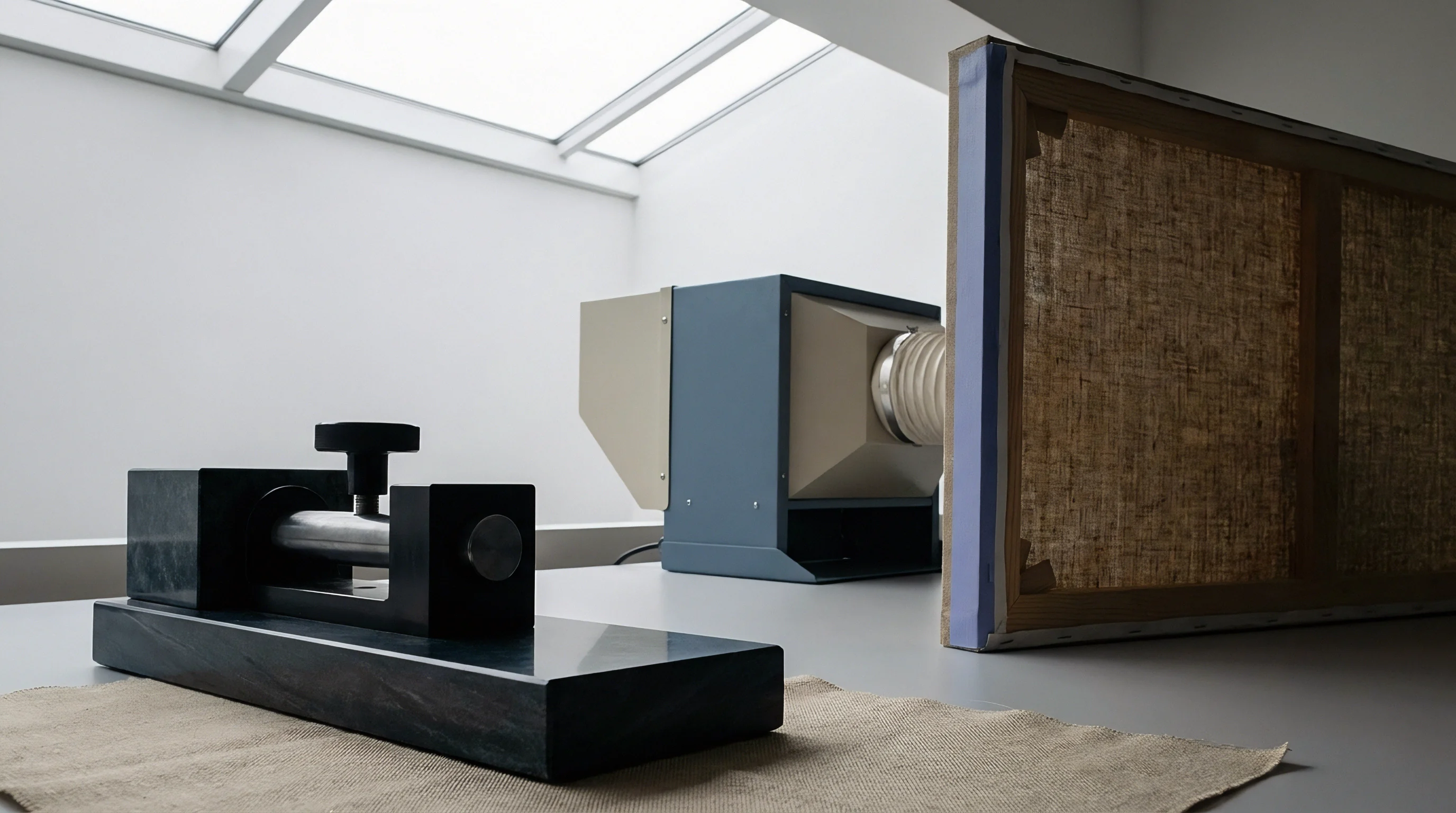

Bale
Container seals break on arrival at dockside terminals, exposing packed fiber bundles to ambient coastal air. Scutched flax moves across maritime routes inside high-density packages bound with steel wire or polyester strapping, typically compressed to four hundred kilograms per cubic meter. These packages hold tight environmental gradients between their outer exposed faces and their compressed centers.
Ambient temperature swings across ocean transit force air exchange through container vents, causing humidity cycling that concentrates liquid on peripheral strata. Dockside inspectors face immediate cargo heterogeneity before material enters spinning mill warehouses.
Moisture content in scutched flax governs both landed billing valuations and spinning performance, as water molecules bind directly to hydroxyl groups within cellulose chains and pectic inter-fiber lamellae. When incoming consignments exceed agreed humidity limits, buyers pay raw fiber prices for free liquid while accepting severe degradation risks during warehouse storage. Pectic matrices soften under excess moisture, accelerating anaerobic fungal activity that weakens bast fiber bundles within weeks.
Application of ISO 2370 across ocean shipments shifts financial title based strictly on oven-dry mass rather than ambient container scale weights.
Sampling consignments demands systematic stratification across container volumes rather than opportunistic retrieval of accessible packages. Standard trading rules under the Confédération Européenne du Lin et du Chanvre (CELC) specify representative lot extractions based on square-root calculations of total package counts. Inspectors draw primary laboratory increments immediately upon opening container doors, preventing ambient workshop humidity from altering the physical equilibrium of external fiber layers.
- Gross Consignment Stratification divides the full shipment into distinct moisture-risk layers across door, wall, center, and floor positions inside each container box.
- Package Exterior Penetration requires removing the outer seventy-five millimeters of fiber to bypass surface condensation generated against container steel walls.
- Core Increment Extraction uses mechanical hollow borers to draw fifty-gram fiber slivers directly from package centers without generating friction-induced heat.
- Hermetic Vapor Encapsulation secures drawn fiber increments inside heavy-gauge aluminum barrier pouches within sixty seconds of extraction to stop evaporation.
Standard commercial sales contracts govern moisture disputes through explicit specifications of invoice mass adjustments. Contracts referencing international flax trade rules stipulate that recorded invoice weights undergo mathematical reconciliation back to official commercial regain values, nullifying weight tickets taken at destination weighbridges whenever certified laboratory desiccation values diverge from shipping declarations.


Specimen
Laboratory intake teams receive hermetically sealed pouches and register ambient room conditions before package seals rupture. Technicians divide raw core extractions into discrete test specimens using mechanical shears, avoiding hand contact that transfers skin oils and localized heat to hygroscopic fibers. Subsampling raw fiber increments demands strict mass balancing to prevent the preferential loss of short cortical fragments and shive particles, which carry moisture at different rates than pure cellulosic bast bundles.
Flax fibers absorb ambient moisture rapidly. Handling exposed increments in non-conditioned environments invalidates subsequent analytical steps. Laboratories operate under ISO 139 atmosphere standards, maintaining twenty degrees Celsius and sixty-five percent relative humidity across preparation benches.
When raw fiber lots arrive with visible external wetting, technicians isolate damaged sections, weighing separated fractions independently to establish moisture damage profiles across the delivered consignment.
Container condensation runs down steel walls into perimeter packaging while central cargo remains desiccated.
The sequence for preparing analytical specimens from raw baled flax increments proceeds through controlled physical stages:
- Laboratory registration logs incoming pouch tare weights against field extraction manifests to verify seal integrity during transit.
- Technicians blend field increments from identical lot tiers inside conditioned clean chambers to produce one homogeneous gross specimen.
- Mechanical quartering divides the bulk composite into four analytical portions weighing precisely one hundred grams each.
- Secondary hermetic glass vessels receive the final analytical portions for transport to analytical balances reading to four decimal places.
Incorrect mass determination during analytical preparation distorts lot valuations across entire multi-container shipments. A calculation error of half a percent across a sixty-tonne consignment transfers thousands of dollars in unearned margin between counterparties while creating severe drafting irregularities in subsequent yarn preparation machinery.

Sampling Density across Maritime Fiber Consignments
Container shipments require stratified increment counts based on statistical lot sizing rules defined across European and international testing standards. The scale of extraction increases with total package volume to maintain reproducible precision limits.
| Consignment Size in Bales | Minimum Sampled Packages | Cores Taken Per Bale | Gross Specimen Mass | Laboratory Test Replicates |
|---|---|---|---|---|
| 1 to 10 | All packages | 3 | 450 grams | 4 |
| 11 to 50 | 10 packages | 2 | 600 grams | 4 |
| 51 to 200 | 15 packages | 2 | 900 grams | 6 |
| 201 to 500 | 25 packages | 1 | 1250 grams | 8 |
| 501 and above | Square root of total | 1 | 1500 grams | 10 |


Apparatus
Drying ovens provide the definitive reference baseline for textile moisture testing under global customs and trade codes. Forced-air convection ovens equipped with internal weighing balances dry scutched flax bundles at one hundred and five degrees Celsius with a tolerance of two degrees. Airflow sweeps through the drying compartment at thirty air exchanges per hour, carrying released water vapor out of the cabinet before saturation suppresses evaporation.
Analytical balances mounted outside the heated zone measure mass loss through heat-isolated suspension wires, allowing continuous weighing without opening cabinet doors.
Desiccation runs until successive weighings taken fifteen minutes apart show mass variation under zero point zero five percent. Technicians record this final stabilized figure as oven-dry mass. Rapid testing tools, including high-frequency dielectric instruments and near-infrared reflectance sensors, provide preliminary screening inside mill warehouses, but trade arbitration relies entirely on thermal mass loss determinations.
Commercial regain of scutched flax stabilizes at 12.00 percent when conditioned at twenty degrees Celsius and sixty-five percent relative humidity under ISO 139 parameters.
Volatile organic losses introduce minor measurement errors during high-temperature oven cycles. Raw scutched flax contains natural waxes, fatty acids, and pectic compounds that volatilize under prolonged thermal exposure above one hundred degrees Celsius. Standard test specifications balance total moisture release against organic breakdown by restricting maximum cycle times to four hours.
Alternative approaches utilize Karl Fischer volumetric titration to isolate water molecules chemically, isolating liquid moisture from volatilized plant solids.

Comparison of Analytical Measurement Systems
Laboratory managers choose testing configurations based on operational throughput requirements, analytical precision, and regulatory acceptance across commercial trade disputes.
| Analytical Method | Operating Temperature | Test Duration | Accuracy Band | Arbitration Acceptance |
|---|---|---|---|---|
| Vented Convection Oven | 105 °C ± 2 °C | 180 to 240 minutes | ± 0.08% | Universal Reference |
| Karl Fischer Titration | Ambient extraction | 15 to 25 minutes | ± 0.05% | Accepted for Chemical Lot Disputes |
| Dielectric Capacitance | Ambient | 10 seconds | ± 0.60% | Internal Factory Screening Only |
| Near-Infrared Reflectance | Ambient | 30 seconds | ± 0.35% | Secondary Sorting Verification |
| Method precision evaluated across scutched dew-retted flax lots conditioned under ISO 139 standard environments. | ||||

Does Core Extraction Distort Regain Figures?
Mechanical borers slice through compressed bast fiber walls, generating contact heat along the cutting edge of the steel tube. When extraction tools spin at excessive rotational speeds, friction elevates localized temperatures above seventy degrees Celsius, vaporizing moisture from the increment before containment inside sample bags. Technicians eliminate thermal losses by employing low-rpm borers with thin-walled stainless steel cutting rings, pushing the tool steadily through the fiber mass without pausing inside the bale interior.
Corers draw long fiber bundles along their transverse orientation. Fiber bundles compress ahead of the leading edge, concentrating fine dust, shive residues, and non-cellulosic matter inside the inner lumen of the borer tube. Operators clear the cutting head between individual penetrations to prevent cross-contamination across sampled consignments.
Core extraction data remains subject to dispute because mechanical boring can concentrate peripheral dust while missing dense interior moisture reservoirs formed during packing warehouse compression.

Hysteresis
Sorption curves for natural cellulose diverge substantially between wetting and drying cycles. When raw scutched flax arrives in an over-moist state and undergoes laboratory desiccation, it follows a desorption path that yields higher equilibrium moisture content than bone-dry fiber exposed to identical atmospheric conditions. This physical hysteresis reflects changes in internal hydrogen bonding among cellulose microfibrils.
Hydroxyl groups satisfy their valencies internally during progressive desiccation, reducing the total active binding sites available during subsequent water vapor reabsorption.
Fiber bundles harvested during humid retting seasons carry amorphous pectic polysaccharides that retain bound water, amplifying sorption hysteresis across normal industrial storage ranges. Between forty percent and eighty percent ambient relative humidity, the moisture spread between absorption and desorption equilibria reaches two full percentage points. Testing laboratories that pre-dry specimens prior to standard conditioning report lower regain figures than laboratories conditioning damp specimens directly from container cores.
Wet fiber in container cores generates mold before arbitration samples ever reach an analytical balance.
Uncontrolled sorption shifts undermine reproducibility between origin testing certificates issued in Western Europe and destination verification assays completed in East Asian port laboratories. Ocean transit through equatorial zones exposes containerized consignments to prolonged thermal cycling, altering the thermodynamic history of the bast fibers. Origin testing completed immediately post-scutching reflects fresh desorption equilibria, whereas testing at receiving ports measures fiber altered by months of enclosed environmental flux.

Can Atmospheric Hysteresis Invalidate Desorption Equilibrium?
Ambient humidity shifts alter the structural alignment of hemicelluloses within the flax cell wall. When laboratory technicians condition incoming test increments without knowing whether the fiber approached equilibrium from a wetter or drier initial state, measured equilibrium weights drift unpredictably. ISO 139 mandates pre-conditioning in dry atmospheres between ten percent and twenty-five percent relative humidity at fifty degrees Celsius to force all fiber specimens onto the absorption curve before final stabilization.
Skipping thermal pre-conditioning leaves fiber specimens stranded between sorption isotherms. Laboratory reports that omit documented pre-conditioning steps generate artificial variances between testing facilities, creating phantom discrepancies that complicate commercial settlement negotiations.
- Equilibrium Sorption Spread generates measurement gaps of one point two to one point eight percent between raw desorption and absorption states.
- Thermal History Erasure requires four hours of oven pre-conditioning at fifty degrees Celsius to reset internal cellulose hydrogen bonding networks.
- Hemicellulose Plasticization alters fiber bundle flexibility when ambient relative humidity crosses seventy percent during transit periods.
- Secondary Condensation Drift occurs when sealed shipping containers undergo twenty-degree day-night temperature swings in tropical sea lanes.
Whether destination laboratories can accurately reconstruct the exact moisture state of baled flax at the moment of European container loading remains an open physical debate across maritime testing circles, because thermal cycling during equatorial voyages permanently shifts the internal sorption capacity of raw bast cellulose.

Recourse
Commercial settlements hinge on reconciling actual delivered weight against invoiced mass using standardized moisture regain formulas. The international linen sector operates under the standard commercial regain allowance of twelve point zero zero percent for scutched flax fiber. The mathematical formula calculates commercial weight from laboratory dry mass:
Commercial Weight equals Dry Mass multiplied by one hundred and twelve, divided by one hundred.
When the actual delivered regain exceeds twelve percent, the buyer is paying for excess liquid. When delivered regain falls below twelve percent, the seller has delivered surplus dry matter without receiving compensation, unless the commercial invoice incorporates formal regain adjustment clauses. Mill offices apply mathematical adjustments directly to landed invoice tallies using certified third-party laboratory reports.
Consider a practical commercial scenario involving a standard sixty-tonne consignment of dew-retted scutched flax shipped from Antwerp to Qingdao. The supplier bills sixty thousand kilograms of fiber at eight dollars and fifty cents per kilogram, based on an assumed standard regain of twelve percent, yielding a total invoice value of five hundred and ten thousand dollars. The physical weighbridge at container arrival records exactly sixty-one thousand two hundred kilograms gross fiber weight.
Laboratory testing of representative core increments conducted under ISO 2370 reveals an average oven-dry content of eighty-four point five percent, corresponding to an actual moisture content of fifteen point five percent and a moisture regain of eighteen point three four percent. The calculation demonstrates significant water weight inflation:
Dry Mass equals sixty-one thousand two hundred kilograms multiplied by zero point eight four five, yielding fifty-one thousand seven hundred and fourteen kilograms.
Certified Commercial Weight equals fifty-one thousand seven hundred and fourteen kilograms multiplied by one point one two, yielding fifty-seven thousand nine hundred and nineteen point sixty-eight kilograms.
The invoiced mass of sixty thousand kilograms exceeds the certified commercial weight by two thousand and eighty point thirty-two kilograms. At eight dollars and fifty cents per kilogram, this excess water represents seventeen thousand six hundred and eighty-two dollars and seventy-two cents in unearned payment. The buyer submits the laboratory test dossier to the seller, debiting the invoice by that exact monetary sum.

Financial Adjustments across Moisture Tiers
The commercial impact of moisture variances scales directly with consignment volume and base fiber prices. Sourcing managers establish threshold deduction bands to automate invoice corrections during customs clearance.
| Tested Moisture Regain | Effective Dry Mass | Calculated Commercial Mass | Mass Variance vs Invoice | Financial Settlement Action |
|---|---|---|---|---|
| 10.00% | 55,636 kg | 62,312 kg | + 2,312 kg | Supplier invoice credit applied |
| 11.00% | 55,135 kg | 61,751 kg | + 1,751 kg | Supplier invoice credit applied |
| 12.00% | 54,642 kg | 60,000 kg | 0 kg | Payment executed at par |
| 13.50% | 53,920 kg | 60,390 kg | – 792 kg | Direct buyer debit note issued |
| 15.00% | 53,217 kg | 59,603 kg | – 1,565 kg | Direct buyer debit note issued |
| 17.00% | 52,307 kg | 58,584 kg | – 2,564 kg | Debit note plus processing claim |
| 19.00% | 51,428 kg | 57,600 kg | – 3,571 kg | Full consignment rejection option |
Excessive humidity damages more than balance sheets. Flax fibers received above sixteen percent regain exhibit rapid microbial degradation within sealed warehouse stacks. Cellulolytic bacteria and filamentous fungi colonize damp bast bundles, attacking primary cell walls and degrading cellulose degree of polymerization from typical values of four thousand down to twelve hundred within six weeks.
The resulting fiber suffers massive tensile strength collapse, generating excessive waste on hackling frames and reducing yarn yield.
Settlement procedures also account for freight costs. Ocean carriers calculate container freight charges based on gross weighbridge scale mass, meaning importers pay international maritime transit rates on hundreds of kilograms of surplus environmental moisture. Procurement contracts protect buyers by enforcing seller liability for proportional ocean freight surcharges whenever certified test results demonstrate moisture regain levels above thirteen point five percent.
Moisture testing protocols protect working capital by converting uncertain dockside scale masses into certified dry substance values. Buyers who verify moisture regain before paying commercial invoices protect both fiber spinability and processing margins.
Fiber dried below ten percent regain breaks in hackling machines while fiber delivered above fourteen percent rots in storage.