Laboratory Chemical Testing for European Flax Origin Verification
Laboratory chemical testing verifies European flax origin by measuring isotope ratios and mineral profiles after nitrating cellulose to isolate plant markers.


Isotopes
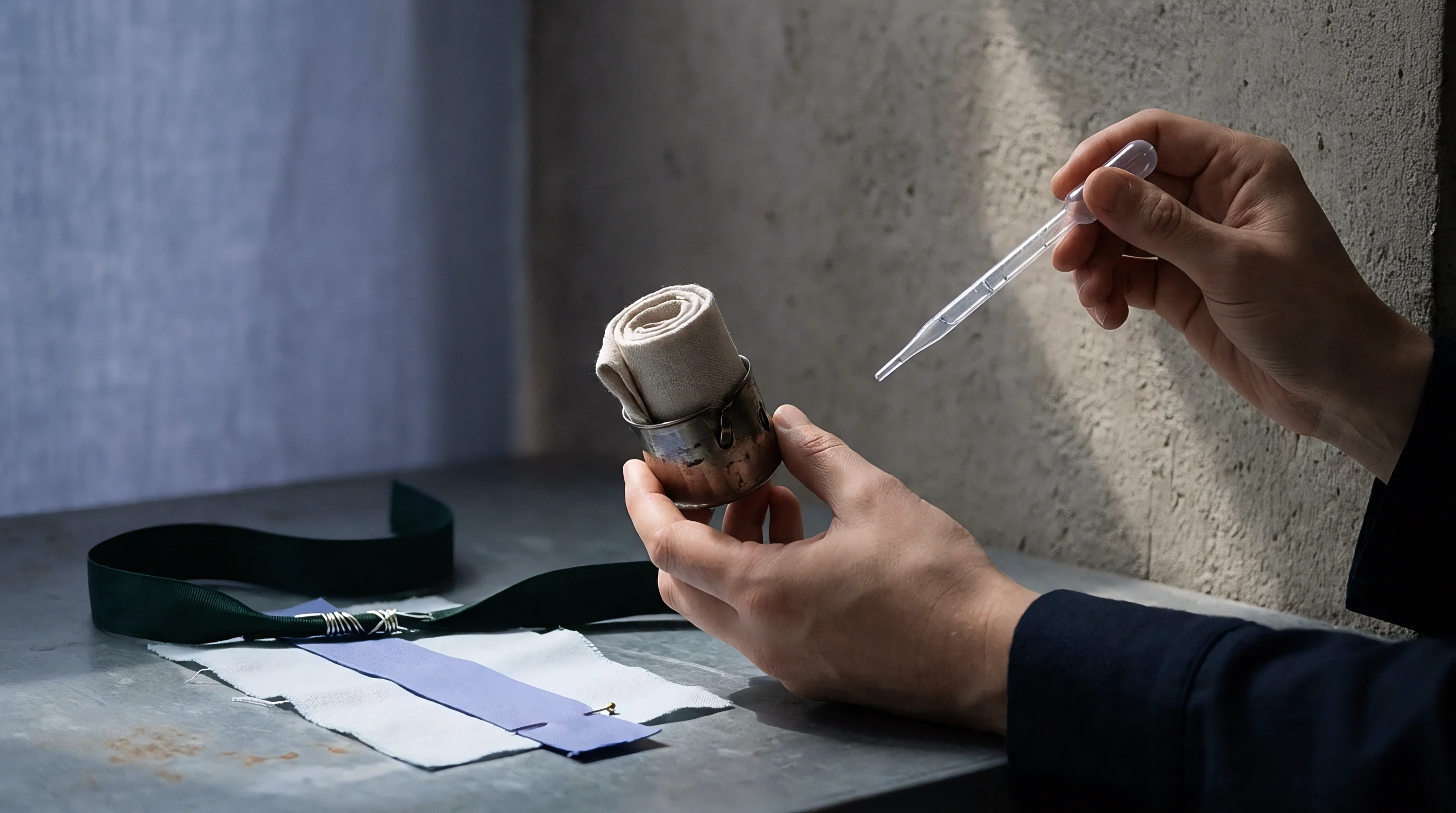
Geographic origin verification for bast fibres relies on the physical relationship between plant mass and regional hydrology. Flax stems absorb water directly from localized precipitation during their ninety-day growing cycle between April and July. The oxygen and hydrogen atoms within the resulting plant cellulose lock in the isotopic signature of that specific regional rainfall.
Oxygen-18 (δ18O) and deuterium (δ2H) concentrations across coastal Western Europe differ from those measured in inland Eurasian or East Asian flax cultivation zones. Coastal Normandy, Flanders, and the Netherlands experience maritime precipitation patterns influenced by the North Atlantic Oscillation, producing predictable δ18O isotope values between -4.5 per mil and -7.0 per mil relative to Vienna Standard Mean Ocean Water. Continental regions like Heilongjiang in China or the Volga Basin in Russia exhibit depleted δ18O values ranging from -9.5 per mil to -14.0 per mil due to inland atmospheric distillation.
Geographic Hydrology and Isotope Ratios
Precipitation across the maritime growing belt of Western Europe carries distinct heavy-atom concentrations. Hydrogen isotope ratios (δ2H) in unrefined European flax fibre yield stable baseline measurements between -40 per mil and -65 per mil. In contrast, flax harvested from drier, high-latitude regions displays δ2H depletion reaching -90 per mil.
Soil geology leaves permanent signatures. Beyond meteoric water isotopes, strontium isotope ratios (87Sr/86Sr) supply an independent geochemical coordinate. Western European flax fields lie predominantly on Cenozoic sedimentary deposits and Cretaceous chalk beds along the English Channel basin.
These soils yield 87Sr/86Sr values between 0.7085 and 0.7098. Older cratonic soils in Inner Mongolia or granite-derived soils in Scandinavia present 87Sr/86Sr ratios exceeding 0.7150. Evaluating strontium isotopes alongside stable oxygen and hydrogen ratios prevents misattribution caused by seasonal temperature anomalies during the growing phase.
- Sample Harvesting ~ Collection of minimum five-gram raw scutched fibre samples directly from incoming scutcher bales before any aqueous washing or chemical scouring occurs.
- Solvent Extraction ~ Removal of surface waxes, lipids, and external soil particles using a two-to-one toluene-ethanol mixture in a Soxhlet apparatus for six hours.
- Cellulose Nitration ~ Chemical conversion of purified flax cellulose into cellulose nitrate to eliminate exchangeable hydroxyl hydrogens that alter oxygen and hydrogen isotopic readings.
- Mass Spectrometry ~ Analysis of converted samples via Thermal Conversion Elemental Analyzer coupled to an Isotope Ratio Mass Spectrometry system under helium flow.
- Data Calibration ~ Normalization of raw isotope values against International Atomic Energy Agency reference materials including IAEA-CH-6 and IAEA-601 standards.
Geographic isotopic signatures remain permanent within the cellulose matrix only when exchangeable hydroxyl hydrogens are chemically isolated prior to mass spectrometry analysis.
Carbon isotope ratio (δ13C) testing provides an additional verification layer for flax origin auditing. Flax utilizes the C3 photosynthetic pathway, producing baseline δ13C values between -24 per mil and -28 per mil. While δ13C values do not isolate specific European provinces, they detect adulteration with C4 plant fibres such as sugarcane bagasse or synthetic petroleum-derived polymers mixed into flax yarn during spinning operations.
Laboratory verification protocols mandate evaluating all three isotopic axes (δ18O, δ2H, 87Sr/86Sr) simultaneously to construct a valid geographic coordinate domain. Single-isotope testing leaves origin determinations vulnerable to false positives caused by microclimate variations or localized irrigation practices. Whether annual shifts in North Atlantic weather oscillations could shift Western European baseline delta oxygen-18 values by more than one point five per mil during severe drought years remains under ongoing multi-year field evaluation.

Trace
Inorganic elemental profiling measures background soil mineral absorption within raw scutched flax. As flax roots absorb soil water, trace elements translocate into the stem bast tissues, becoming permanently bound within the cell wall matrix. Inductively Coupled Plasma Mass Spectrometry (ICP-MS) quantifies rare earth elements and alkali earth metals at parts-per-billion concentrations.
Normandy silt-loams impart a distinct mineral signature rich in rubidium and barium, with characteristically low concentrations of heavy lanthanides. Soil mineral absorption signatures contrast sharply with raw flax harvested from volcanic or cratonic soil profiles in Asia or South America. Retting methods alter mineral profiles.
Field dew retting in Western Europe allows soil microorganisms to break down pectins, transferring micro-scale mineral dust into the fibre bundle structure. Tank retting or enzymatic retting strips these surface soil markers while depositing chemical trace signatures unique to the processing facility water supply.

Elemental Benchmarks by Region
Soil chemistry varies significantly across major flax-producing continents. Quantitative multi-element profiling focuses on critical elemental pairs, including rubidium-to-strontium (Rb/Sr) and lanthanum-to-cerium (La/Ce) ratios. European flax cultivated in France, Belgium, and the Netherlands exhibits high rubidium uptake combined with tightly constrained 87Sr concentrations.
Asian flax varieties demonstrate elevated levels of light rare earth elements such as cerium and neodymium due to regional soil mineralogy. The table below presents verified elemental concentration ranges and isotopic benchmarks for raw scutched flax harvested across primary global supply regions.
| Geographic Region | δ18O Range (‰ VSMOW) | δ2H Range (‰ VSMOW) | 87Sr/86Sr Ratio | Rb/Sr Concentration Ratio | La/Ce Ratio |
|---|---|---|---|---|---|
| Western Europe (Normandy/Flanders) | -4.5 to -7.0 | -40 to -65 | 0.7085 to 0.7098 | 0.42 to 0.68 | 0.48 to 0.52 |
| East Asia (Heilongjiang/Xinjiang) | -9.5 to -14.0 | -75 to -105 | 0.7145 to 0.7180 | 0.15 to 0.32 | 0.35 to 0.42 |
| Eastern Europe (Volga/Belarus) | -8.0 to -11.0 | -65 to -85 | 0.7110 to 0.7135 | 0.28 to 0.45 | 0.44 to 0.49 |
| North Africa (Nile Delta) | +1.5 to -2.0 | -15 to -35 | 0.7075 to 0.7088 | 0.85 to 1.20 | 0.55 to 0.61 |
Laboratory chemical testing protocols for elemental provenance require careful discrimination between surface soil particles and intrinsic cellular minerals. Testing facilities wash raw fibre samples in dilute nitric acid solutions to strip non-bound soil minerals before microwave digestion. Acid digestion using trace-metal-grade concentrated nitric acid and hydrogen peroxide breaks down the lignocellulosic matrix completely.
The resulting liquid sample enters the ICP-MS plasma torch, where high-temperature argon plasma ionizes the constituent elements. Precision calibration against certified reference materials ensures detection thresholds below 0.01 milligrams per kilogram for rare earth metals.
- Acid Leaching Over-Extraction ~ Concentrated acid washes strip internal cell-wall minerals, leading to falsely low trace element readings during spectrometer analysis.
- Retting Water Mineral Overprint ~ Industrial tank retting introduces municipal water minerals that mask the natural soil elemental ratios of the grown fibre.
- Post-Harvest Chemical Spraying ~ Fungicide or pesticide applications add synthetic copper, zinc, or manganese traces that distort natural mineral baseline profiles.
- Cross-Contamination in Scutching ~ Processing non-European flax on uncleaned scutching lines transfers mineral-rich plant dust to certified European fibre lots.
Elemental data processing employs principal component analysis to group unknown yarn or fabric samples into geographic clusters. When multi-element concentration datasets plot outside the established Western European confidence ellipse, origin claims fail technical validation. Importers relying on elemental profiles must account for localized fertilizer applications, which can elevate phosphorus and potassium levels without altering the core lanthanide distribution signature.
Mistaking industrial soil contamination for geographic mineral markers leads to false origin rejections and invalidates valid commercial supply agreements.


Spectroscopy
Infrared molecular analysis evaluates non-cellulosic organic fractions retained within flax bast tissues. Raw flax contains approximately seventy to seventy-five percent cellulose, fifteen to twenty percent hemicellulose, two to five percent lignin, and one to three percent lipophilic waxes. The precise chemical composition of these minor components reflects regional growing conditions, plant maturity at harvest, and field retting microenvironments.
Attenuated Total Reflectance Fourier-Transform Infrared (ATR-FTIR) spectroscopy generates characteristic absorption spectra between wavenumbers 400 cm-1 and 4000 cm-1. Absorption bands at 1735 cm-1 correspond to carbonyl ester stretching in hemicellulose and plant wax, while bands at 1505 cm-1 and 1245 cm-1 measure aromatic ring vibrations specific to lignin. Hydrogen isotopes record local rainfall.
Spectroscopic testing identifies regional processing traits before destructive chemical digestion occurs.

Fungal Biomarkers in Dew Retted Fibre
Field retting exposes pulled flax stems to indigenous microflora unique to maritime coastal climates. In Normandy and Flanders, species such as Cladosporium herbarum, Epicoccum nigrum, and Alternaria alternata colonize the outer stem cortex during the four to six weeks flax lies in the field. Metabolic byproducts from these fungal strains leave residual enzymatic degradation markers within the residual lignin complex.
Pyrolysis-Gas Chromatography-Mass Spectrometry (Py-GC-MS) detects specific phenolic fragments, including syringyl and guaiacyl lignin derivatives, generated during microbial breakdown. Flax retted in drier continental climates relies on different fungal species, yielding distinct pyrolytic product ratios. Laboratory identification of European dew-retting biomarkers confirms both the geographic origin and traditional agricultural processing methods required by European Flax scheme definitions.
Quantifying Wax Profiles across Yield Samples
Testing raw yarn samples demonstrates distinct lipophilic wax compositions. Plant cuticular waxes consist of long-chain fatty acids, alkanes, primary alcohols, and wax esters. Gas chromatography with flame ionization detection (GC-FID) quantifies the carbon chain length distribution of n-alkanes extracted from raw bast fibres.
Western European flax displays a strong predominance of odd-numbered alkanes, with C29 (nonacosane) and C31 (hentriacontane) accounting for over eighty percent of the total alkane fraction. The ratio of C29 to C31 alkanes in Normandy-grown flax falls consistently within the 1.15 to 1.35 bracket. Higher ambient temperatures during the boll formation stage in southern growing regions shift biosynthesis toward longer chain lengths, increasing the proportion of C33 (tritriacontane) and C35 (pentatriacontane) alkanes above five percent of total wax mass.
Consider a quantitative analytical trial examining twenty yarn lots declared as one hundred percent Western European flax. Laboratory extraction yields an average total wax content of 1.82 percent by weight from raw grey yarn. Gas chromatography reveals a C29/C31 alkane ratio of 1.24 for sixteen lots, aligning with Normandy production baselines.
Four lots demonstrate a C29/C31 ratio of 0.82 alongside elevated C33 content reaching 8.4 percent of total waxes. Hydrolysis isolating free fatty acids indicates palmitic acid (C16) at 22 percent and montanic acid (C28) at 14 percent for the suspect lots, contrasting with European benchmarks where montanic acid remains below 6 percent. Spectroscopic absorbance at 1505 cm-1 shows reduced lignin peaks consistent with warm-water tank retting rather than European field dew retting.
Combining FTIR absorbance ratios with alkane chain distribution confirms that twenty-percent of the delivered consignment contains non-European flax blended into the spinning lot prior to export.
ISO 17025 accredited isotope testing nullifies origin declarations whenever the sample preparation log fails to document nitration yields above ninety-four percent.
Molecular spectroscopy offers rapid, non-destructive screening for incoming mill lots. Near-Infrared (NIR) spectroscopy systems calibrated against verified isotopic datasets scan raw fibre bales in under thirty seconds. Chemometric algorithms evaluate diffuse reflectance spectra across the 1100 nm to 2500 nm range, detecting anomalies in moisture binding capacity, cell wall crystallinity, and residual pectin structures.
While NIR screening cannot replace full isotope ratio mass spectrometry for legal customs disputes, it identifies suspect bales at the receiving dock. Spectroscopic proof of origin holds validity only when raw fibre samples undergo extraction before chemical identification.

Alteration
Industrial finishing operations introduce chemical reagents that shift primary plant analytical markers. Scouring removes pectin, waxes, and hemicellulose using hot sodium hydroxide solutions at pH 12 to 14. Bleaching with hydrogen peroxide or sodium hypochlorite oxidizes residual lignin, destroying the aromatic compounds used in spectroscopic origin profiling.
Mercerization under high caustic tension alters cellulose crystal structure from Cellulose I to Cellulose II, altering the hydrogen bonding network. These wet processes introduce foreign oxygen and hydrogen atoms from mill process water into the fibre surface, masking the native isotopic values recorded during plant growth.

Why Do Processing Solvents Alter Chemical Provenance Signals?
Caustic scouring and alkaline boiling strip extracellular waxes while exchanging labile hydrogen atoms in raw cellulose. Hydroxyl groups (-OH) positioned on the carbon-2, carbon-3, and carbon-6 atoms of the glucose monomer exchange hydrogen readily with ambient water molecules during industrial processing. If a European flax yarn undergoes scouring in a Chinese spinning mill using local municipal water with a δ2H signature of -85 per mil, the whole-fibre δ2H measurement shifts dramatically toward the local water value.
Testing facilities eliminate this exchangeability error by converting scoured cellulose into cellulose nitrate (C6H7O2(ONO2)3). Nitration replaces the three reactive hydroxyl group hydrogens with non-exchangeable nitro groups, preserving only the carbon-bound hydrogen atom at carbon-1, carbon-2, carbon-3, carbon-4, carbon-5, and carbon-6. Analyzing the δ2H of the resulting cellulose nitrate recovers the true original geographic signal of the raw flax plant.
- Pre-treat finished fabric or yarn samples with a zero point one molar sodium hydroxide wash at forty degrees Celsius to strip post-weaving sizing agents and softeners.
- Rinse the washed fabric three times in deionized water until the effluent conductivity falls below two microsiemens per centimetre.
- Dry the rinsed sample in a vacuum oven at sixty degrees Celsius for twelve hours to eliminate ambient atmospheric moisture.
- React dry cellulose with a ice-cold mixture of concentrated nitric acid and phosphoric anhydride for four hours under continuous agitation.
- Precipitate the synthesized cellulose nitrate in ice-cold distilled water, collect the solid by filtration, and wash with water until neutral.
- Dissolve the precipitate in acetone, filter out insoluble residues, and evaporate the solvent to yield purified cellulose nitrate flakes for mass spectrometry.
Enzymatic washing and reactive dyeing add complex organic molecules that obscure trace elemental profiles. Acid dyes and reactive dichlorotriazine dyes bind covalently to cellulose hydroxyl sites, adding synthetic aromatic structures and trace metal catalysts such as copper phthalocyanine. Testing laboratories isolate pure cellulose using copper-ethylenediamine (CUEN) dissolution followed by acid re-precipitation before performing trace element or isotopic testing.
Laboratory testing exposes origin fraud. Solvents used in sample purification must remain free of trace mineral contaminants to prevent false analytical readouts during final ICP-MS runs.
Bleaching alters raw elemental ratios. Mills frequently assert that aggressive hydrogen peroxide bleaching and soft wash treatments naturally eliminate all traceable biological markers from genuine European flax yarn.

Authentication
Reconciling physical laboratory measurements with supply chain documentation requires matching batch lot numbers against mass balance outputs. Scope certificates issued by certifying organizations validate that a scutching facility or spinning mill possesses the operational capacity to handle European Flax certified fibre. Transaction certificates track specific lot shipments between supply chain participants.
A document gap occurs when the volume of certified European flax yarn exported by a mill exceeds the net mass of certified raw scutched flax delivered to that mill, adjusted for mechanical processing waste. Scutching raw flax yields approximately twenty-five percent long fibre and fifteen percent short tow fibre. Combined spinning loss across carding, combing, and drafting accounts for an additional twelve to eighteen percent fibre scrap.
Physical chemical analysis verifies whether delivered yarn matches the declared input documents or represents uncertified material backfilled to cover volume deficits.

Document Alignment and Batch Verification
Transaction certificates issued by certifiers specify exact net weights of scutched fibre leaving European scutching facilities. Importers verify these quantities against mill intake logs and weighbridge receipts. When a spinning mill converts 10,000 kilograms of certified European scutched long flax into fine yarn, standard processing yields generate approximately 8,400 kilograms of finished grey yarn, 1,100 kilograms of comb noils, and 500 kilograms of unrecoverable dust and waste.
A mill declaring 12,000 kilograms of certified European flax yarn from that same 10,000 kilogram raw input has blended 3,600 kilograms of uncertified low-cost fibre into the production run. Chemical testing of yarn packages selected across the production lot exposes this dilution by detecting bimodal isotopic distribution curves within single yarn bobbins.
| Test Method | Target Chemical Marker | Sample Preparation Protocol | Geographic Resolution | Interference Factors |
|---|---|---|---|---|
| Cellulose Nitrate IRMS (δ18O, δ2H) | Non-exchangeable carbon-bound oxygen and hydrogen | Soxhlet wax extraction followed by nitration with HNO3/H3PO4 | High (Differentiates Western Europe from Eastern Europe & Asia) | Incomplete nitration yielding exchangeable hydroxyl retention |
| Geochemical ICP-MS (87Sr/86Sr, REE) | Soil strontium isotopes and lanthanide concentrations | Dilute HNO3 wash, microwave digestion in concentrated HNO3/H2O2 | Very High (Pinpoints regional soil geology) | External soil dust contamination, mineralized industrial process water |
| GC-FID / Py-GC-MS Profiling | Cuticular alkane chain length (C29/C31) and fungal lignin phenolics | Rapid chloroform wax extraction or direct controlled flash pyrolysis | Moderate (Confirms field dew retting microenvironment) | Enzymatic scouring, heavy silicone or paraffin yarn lubricants |
| ATR-FTIR Spectrometry | Lignin carbonyl and hemicellulose aromatic absorption bands | Solvent extraction to remove synthetic sizing agents and waxes | Low (Qualitative screen for fibre purity and retting type) | Peroxide bleaching, mercerization, reactive chemical dyes |
Document trails require physical proof. Integrating physical chemical testing into quality control programs mandates establishing a structured audit checklist for every incoming linen shipment.
- Verify Scope Certificate Status ~ Check the active validity dates and covered activity codes on the supplier scope certificate via the certifier database.
- Cross-Check Transaction Certificate Weights ~ Reconcile input raw fibre weights on transaction certificates against declared mill yarn output using standard yield loss formulas.
- Draw Representative Yarn Samples ~ Select random yarn bobbins from multiple crates across the shipment lot using ISO 2859-1 sampling plans.
- Execute Cellulose Nitration Screening ~ Perform chemical isolation of cellulose nitrate and run IRMS isotopic analysis for δ18O and δ2H baseline matching.
- Audit Trace Element Profiles ~ Analyze 87Sr/86Sr ratios and rubidium-to-strontium concentrations via ICP-MS to confirm regional soil signatures.
- Issue Origin Clearance Certificate ~ Authorize final commercial invoice payment only after chemical results fall within established Western European benchmark ellipses.
Unblended European scutched flax commands an average premium of zero point eighty-five US dollars per kilogram over Asian flax yarn at the spinning frame.
Discrepancies between certified documentation and laboratory chemical results trigger immediate audit procedures under ISO 17065 product certification rules. Certifiers conduct unannounced physical site inspections, sampling raw fibre stored in mill bale warehouses and reviewing spinning frame assignment logs. If laboratory testing reveals non-European isotopic signatures in yarns sold under certified scope documents, certifiers suspend the mill scope certificate, invalidating all associated transaction certificates.
Standard purchasing addendums requiring mandatory ISO 17025 isotopic clearance prior to letter of credit issuance transfer financial liability for origin misrepresentation back to the spinning mill.


Settlement
Commercial contracts for high-grade linen incorporate specific origin warranties tied to laboratory testing protocols. European flax fibre commands a raw material surcharge between $0.60 and $1.10 per kilogram over standard non-certified flax, driven by soil management costs, compliance overhead, and restricted regional acreage. On fine 14 Lea linen yarn, this raw material differential translates to a surcharge of $0.85 to $1.50 per kilogram of finished yarn.
Importers incorporating origin guarantees into purchase agreements specify that chemical isotope ratio testing serves as the binding referee method for origin disputes. Contractual clauses state that failure to meet established Western European isotopic thresholds constitutes a non-remediable defect, entitling the buyer to reject the shipment, recover full purchase funds, and claim reimbursement for testing fees.

Landed Cost Surcharges and Legal Remedies
Importers paying premium prices for European fibre protect their margins by establishing physical sampling routines. Testing costs for complete chemical origin verification average $600 to $1,200 per sample lot, including cellulose nitration, IRMS isotope ratio analysis, and ICP-MS trace mineral profiling. On a twenty-tonne yarn container valued at $240,000, analytical testing expenses represent less than zero point five percent of the landed cargo value.
Customs authorities in major importing jurisdictions, including the United States Customs and Border Protection and European Union customs administrations, employ isotopic and elemental profiling during post-clearance enforcement audits. Under Union Customs Code Article 60 non-preferential origin rules, textile goods undergo scrutiny to determine the country of origin where the last substantial, economically justified processing occurred. Surcharges reflect true regional origin.
Blending non-European flax into European-certified yarn constitutes origin misdeclaration, triggering cargo seizure, punitive tariffs, and civil monetary penalties under customs law.
Documentary certificates without physical chemical verification leave importers exposed to customs reclassification fines during post-clearance audits.
Quantifying financial risk exposure requires assessing potential customs penalties and commercial liability. Misdeclaring yarn origin to evade country-specific trade duties or to claim preferential trade agreement benefits exposes importers to penalties reaching up to eight times the duty differential. Commercial contracts mandate that spinning mills reimburse buyers for all direct customs fines, legal defense fees, and lost retail margins resulting from failed origin verification tests.
Integrating rigorous laboratory chemical testing into quality assurance workflows transforms document verification into an objective, physically defensible proof mechanism. Chemical verification anchors trade contracts. Establishing physical laboratory origin testing alongside mass-balance document audits provides importers with legal defense against customs penalty actions while preserving premium landed margins.