Applying Section XI Note 7 Criteria to Borderline Linen Goods
Applying Section XI Note 7 requires auditing mill edge finishes, drawn threads, and cutting geometry to prevent high-duty Chapter 63 customs reclassifications.
Hem
The finish on the edges of a flax web determines whether a shipment clears customs as woven fabric under Chapter 53 or as completed articles under Chapter 63. Across major import jurisdictions, customs authorities apply Section XI Note 7 of the Harmonized System to draw the line between unfinished piece goods and manufactured items. When pure or blended linen cloth comes off the loom, its perimeter structure dictates classification regardless of intended commercial use.
Minor edge treatments regularly push raw or semi-finished flax items across that statutory line into made-up goods.
Section XI Note 7 sets six physical conditions that move a textile item out of Chapter 53. Note 7(c) specifically covers hemmed edges, rolled edges, and knotted fringes, whereas woven selvages remain raw fabric. A standard fast selvage or tuck-in selvage produced during weaving preserves classification under Heading 5309.
If a mill adds a folded stitch, an overlock finish, or a glue-stabilized fold to prevent unraveling during transit, customs officers treat that finish as hemming under Note 7(c). The distinction hinges on whether the edge treatment merely provides temporary transport stabilization or represents permanent completion for end use.
Fringed borders carry substantial classification risk for importers of linen throws, tea towels, and table covers. Note 7(c) separates fringes created by unweaving warp or weft threads from those formed by knotting or adding separate decorative elements. Leaving loose, unwoven yarn ends at a cut edge does not constitute making up under Note 7(c), and uncut rolls remain under Heading 5309.
Once those loose warp threads are knotted ~ by hand or machine ~ Note 7(c) applies, instantly reclassifying the fabric as a made-up article under Heading 6304 or Heading 6307.
Customs declarations failing to identify knotted warp fringes trigger retroactive duty reclassifications back to the entry date.
Note 7(b) adds further complexity by covering items produced directly to size and ready for use. Certain linen towels and napkins are woven continuously on electronic jacquard or dobby looms with recurring separation zones marked by empty warp bands, contrasting dividing threads, or localized weave variations. An unseparated roll remains under Heading 5309 if simple cutting across the dividing threads releases individual pieces.
If the loom seals the cut edges or incorporates finished cross-hems during weaving, the roll loses its fabric status. The border between raw woven web and made-up article sits at the loom bed rather than the customs dock.
| Note 7 Clause | Physical Edge Criterion | Mill Execution Method | Tariff Result |
|---|---|---|---|
| 7(a) | Cut otherwise than rectangular | Die-cutting scalloped or round patterns | Heading 6307 |
| 7(b) | Finished and ready for use | Continuous weaving with sealed cut zones | Heading 6302 / 6307 |
| 7(c) | Hemmed or rolled edges | Single-fold or blind-stitch perimeter hem | Heading 6302 |
| 7(c) | Knotted fringe structures | Twisted and tied warp thread extensions | Heading 6304 |
| 7(d) | Drawn-thread work included | Extracted warp threads with hemstitching | Heading 6302 |
| 7(e) | Assembled by thermal bonding | Ultrasonic polymer edge sealing | Heading 6307 |
Ultrasonic edge sealing on pure linen or flax-rich blends creates a contested boundary under Note 7(e). Mills running synthetic edge-binding threads into raw flax borders attempt to prevent fraying without traditional stitching. Note 7(e) classifies textiles assembled by sewing, gumming, or otherwise as made-up goods.
Thermal fusion using low-melt synthetic fibers along a cut border satisfies the gumming or otherwise criterion when the fused zone forms a continuous, permanent structural border. A heat-sealed cut strip imported as raw material for downstream manufacturing falls under Chapter 63 if the seal eliminates the need for further edge finishing before end use.
Audit records from European flax processors reveal persistent friction between mill invoicing descriptions and customs declarations. Overseas weaving mills routinely label cut linen panels as piece goods to help buyers secure lower tariff schedules. Under audit, however, even a simple lockstitch along two edges of a rectangular linen panel negates piece-goods status.
- Incomplete selvage trimming leaves raw floating threads that customs inspectors treat as unhemmed fabric despite perimeter stitching.
- Temporary overcast stitching applied solely to survive dye-house scouring gets classified as permanent hemming when stitch density exceeds twelve stitches per inch.
- Ultrasonic edge fusing performed on synthetic-blended flax bolt ends creates a hardened seam that fulfills Note 7(e) bonding criteria.
- Unspun warp fringe extensions exceeding fifty millimeters without knotting spark customs disputes over intended article completion.
Customs authorities routinely reject arguments that perimeter stitching serves only to prevent cloth degradation during maritime shipping when the stitch pattern matches final consumer specifications.
Geometry
Dimensional cutting of woven linen cloth dictates classification under Section XI Note 7(a) whenever cut profiles deviate from standard rectangular forms. Rectangular rolls, square bolts, and straight-cut swatches remain within Chapter 53 provided no further finishing takes place. The moment a cutting die produces rounded corners, trapezoidal shapes, scalloped borders, or circular table covers, Note 7(a) removes the items from Heading 5309.
Straight perimeter lines define piece goods; intentional deviations from right-angle geometry convert raw flax web into an identifiable article component.
Misclassification occurs systematically regarding square and rectangular linen blanks imported for embroidery, framing, or specialized industrial end-uses. Note 7(a) contains a specific exception for items cut into rectangles or squares that undergo no further fabrication. A rectangular piece of pure linen fabric cut to fifty centimeters by eighty centimeters remains fabric under Heading 5309 if its edges remain raw or simply cut.
If that same piece features pre-punched mounting holes, cut-out interior sections, or tapered ends, Note 7(a) applies immediately. Physical form dictates classification regardless of whether the item requires subsequent sewing or embellishment.
Confusion frequently arises around drawn-thread work where warp yarns are removed prior to stitching. Note 7(d) explicitly addresses rectangular linen goods that feature drawn-thread work. Hemstitching, ladder stitching, and openwork borders created by pulling warp or weft threads out of the woven matrix elevate raw fabric to made-up status.
Even if a linen panel retains strict rectangular dimensions and lacks turned hems, the presence of drawn-thread work satisfies Note 7(d), moving the goods directly into Heading 6302 or Heading 6304.
- Inspect the long edges of the continuous strip to verify whether selvages are continuous or cut.
- Examine the cross-over zones separating repeating units for float threads or missing pick lines.
- Measure the thread density within the separation band relative to the primary body weave.
- Test the separation zone for thermal fusion or applied adhesive compounds along the cut path.
- Record whether simple cross-cutting leaves structural threads exposed or permanently bound.
Continuous length production creates recurring disputes during customs verification. Mills weave linen table runners, napkins, and tea towels in long unbroken rolls containing printed or woven cutting lines. These rolls enter as raw fabric if they require cutting along designated lines followed by hemming.
If the continuous roll features pre-woven, finished hems between units ~ requiring only thread severance to release ready-to-use towels ~ Note 7(b) governs. Functional separation lines produced on the loom transform bulk roll stock into a series of joined articles.
A continuous woven web containing finished transverse borders constitutes a consignment of joined made-up articles rather than piece goods.
Edge-seal polymer treatments along die-cut linen geometric patterns complicate physical inspection. Laser-cutting technology simultaneously cuts and fuses flax-polyester blended fabrics. When a laser cutter carves circular linen coasters or octagonal placemats from continuous bolt stock, heat from the beam melts the synthetic component to seal perimeter fibers.
The resulting edge resists fraying without thread stitching. Customs laboratories evaluate these edge seals against Note 7(e); if the fused edge demonstrates structural permanence under wash testing, the circular or octagonal shape combined with the sealed edge solidifies classification under Heading 6307.
Do drawn-thread openwork borders on uncut linen bolts strip the fabric of its Chapter 53 standing before final slitting takes place?

Transformation
Preferential origin determination across international customs regimes relies on precise origin criteria distinct from tariff classification rules. A shift in Harmonized System classification from Chapter 53 to Chapter 63 does not automatically grant non-preferential country of origin status to the location where hemming or cutting occurred. Customs authorities enforce substantial transformation rules to determine origin, evaluating whether secondary manufacturing alters the essential character of the linen.
In most cross-border trade agreements, the country where flax yarn is woven into fabric remains the country of origin, regardless of downstream cutting and hemming performed elsewhere.
Does Hemming Woven Linen Strips Trigger an Origin Shift?
Under European Union customs law established in Annex 22-01 of the Union Customs Code Delegated Regulation, non-preferential origin for made-up textile articles under Chapter 63 requires complete fabrication or substantial assembly. Simple hemming, folding, or perimeter trimming performed on imported linen fabric does not confer origin in the country where that work occurs. If raw linen cloth woven in China is shipped to Vietnam for cutting, drawn-thread work, and perimeter hemming, the resulting tablecloths retain Chinese origin for tariff and trade remedy purposes.
The classification shifts from Heading 5309 to Heading 6302, but origin remains tied to the loom shed.
United States customs regulations under 19 CFR 102.21 enforce rigid hierarchy rules for textile origin determination. For articles classified under Chapter 63, origin is conferred where the fabric was woven unless the specific rule for that heading permits an assembly-based origin shift. The general rule for Heading 6302 assigns origin to the single country where the underlying fabric was woven or knitted.
Hemming, edge knotting, and drawn-thread embellishments performed in a second country fail to shift origin away from the weaving location. Importers declaring a secondary country of origin based solely on hemming face severe administrative penalties under 19 U.S.C. 1592.
| Linen Product Category | Tariff Shift (HS Code) | EU UCC Origin Result | US 19 CFR 102.21 Origin Result |
|---|---|---|---|
| Unfinished Woven Fabric Bolt | Heading 5309 (No Shift) | Weaving Country | Weaving Country |
| Die-Cut Scalloped Panels | 5309 to 6307 | Weaving Country | Weaving Country |
| Hemmed Rectangular Napkins | 5309 to 6302 | Weaving Country | Weaving Country |
| Knotted Fringe Throws | 5309 to 6304 | Weaving Country | Weaving Country |
| Drawn-Thread Table Runners | 5309 to 6302 | Weaving Country | Weaving Country |
Preferential trade agreements present unique structural variations regarding origin shifts. Under the United States-Mexico-Canada Agreement, rules of origin for made-up linen goods incorporate strict yarn-forward or fabric-forward provisions. To qualify for preferential duty-free treatment, a linen napkin classified under Heading 6302 must typically be woven and assembled within the free-trade zone.
Evaluating the interaction between tariff reclassification under Note 7 and origin rules prevents supply-chain origin failures. A product can easily satisfy Note 7 criteria for reclassification into Chapter 63 while failing to qualify for preferential duty treatment under a bilateral trade structure.
Discrepancies between trade documentation and physical product conditions create exposure during post-clearance customs audits. Suppliers often execute multi-stage supply chains, shipping raw linen web through intermediate processing hubs for edge finishing, laundering, and packaging. Intermediate processors frequently issue certificates of origin claiming local status based on value added during hemming operations.
Customs auditors invalidate these certificates during verification inspections when the core transformation—the weaving of flax fiber into fabric—occurred outside the intermediate facility. Value-added calculations do not supersede explicit textile origin rules established by statutory frameworks.
Misapplying origin rules when importing hemmed or cut linen products generates long-term financial liabilities. When an importer misdeclares country of origin due to confusion over Section XI Note 7 reclassification, customs agencies collect back duties, anti-dumping surcharges, and statutory interest across all entries within the open audit window. Incorrect origin declarations invalidate trade preference claims, exposing the importer to full most-favored-nation duty rates alongside punitive compliance fines.
Clamp
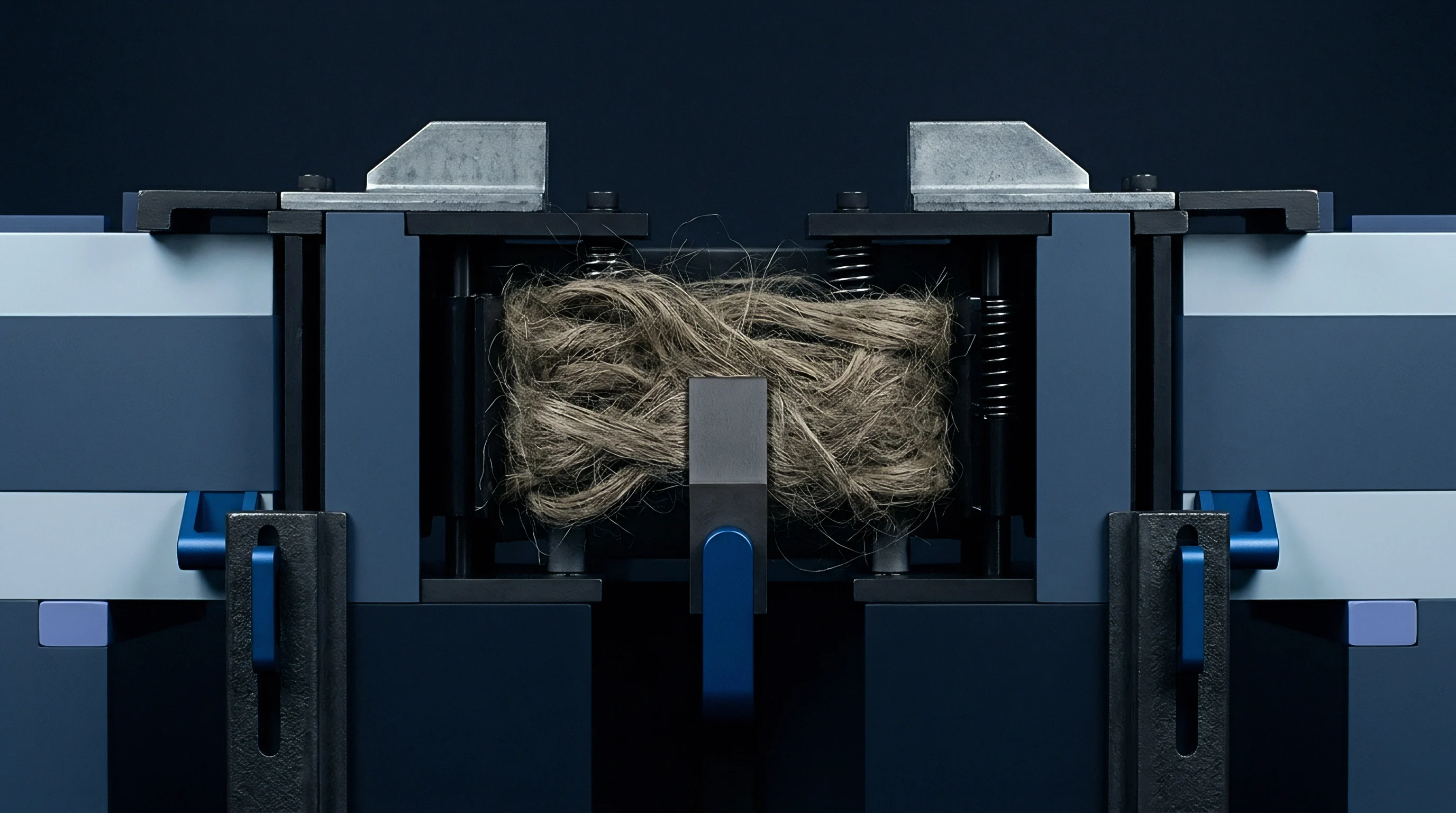
Mechanical laboratory evaluation of border stability and thread integration relies on standard test fixtures to determine whether an edge finish meets the structural threshold of Note 7. Technicians place linen samples in a pneumatic tensile clamp to measure the force required to dislodge edge threads or separate thermally fused borders. Clamp tension separates temporary edge finishes designed merely to survive processing from permanent finishes intended for end use.
Test parameters conform to ISO 13934-1 for tensile properties of fabrics, modified specifically to evaluate border tear resistance under standardized clamping pressure.
Thread density verification along cut edges requires optical magnification and digital microscopic analysis. Technicians examine the cross-sectional yarn count at the edge of a suspected made-up article. When a linen panel shows increased thread density along its perimeter from mechanical folding, the weave structure is evaluated to confirm whether the fold is stitched down or merely held by transient sizing agents.
Water immersion dissolves transient sizing agents, releasing the fold and proving the edge treatment was temporary. If the fold resists aqueous dissolution and retains its shape, the border satisfies Note 7(c) criteria for permanent hemming.
A perimeter seam retaining structural integrity after five standardized ISO 6330 wash cycles satisfies customs criteria for permanent making up.
Drawn-thread analysis focuses on structural changes made to the base fabric. Microscopic evaluation verifies whether warp or weft yarns were systematically pulled from the matrix or if empty channels were formed by spacing warp ends during weaving. True drawn-thread work involves manual or mechanical extraction of yarns post-weaving, followed by hemstitching to bind remaining exposed threads.
Loom-created spacing, which mimics drawn-thread work without thread extraction, fails to meet Note 7(d) criteria if exposed threads lack stabilizing stitches. Laboratory reports detail the precise yarn path to support tariff classification disputes.
- Stitch density counting measures structural lockstitches per centimeter along perimeter folds under optical magnification.
- Solvent immersion testing identifies chemical adhesives or low-melt polymers applied to stabilize raw cut linen borders.
- Tensile edge-pull testing quantifies the mechanical force required to pull edge threads out of fused or stitched borders.
- Fiber composition analysis confirms the ratio of pure flax to synthetic low-melt binding fibers in heat-sealed edge zones.
Ultrasonic edge seals undergo thermal stress and flex testing to verify durability. In pure flax fabrics, ultrasonic cutting without added synthetic polymers leaves charred fiber ends that disintegrate under minimal mechanical stress. Mills must introduce synthetic filaments—such as polypropylene or low-melt polyester—into the selvage zone to achieve a true fused seal.
Laboratory infrared spectroscopy identifies the presence and percentage of synthetic polymers within the cut zone. If synthetic polymer content exceeds two percent by weight along the edge, the seal forms a continuous bonded strip recognized under Note 7(e).
Uncertain edge finishes require mechanical testing rather than visual inspection to survive customs enforcement audits.

Disbursement
Financial calculations governing duty payments and administrative penalties shift dramatically when goods move from Heading 5309 to Chapter 63 headings under Section XI Note 7. Duty differentials between raw flax fabrics and completed textile articles vary significantly across primary import markets. In the United States, plain woven linen fabric under Heading 5309 incurs duty rates ranging from zero to less than three percent depending on fabric weight and flax content.
Completed linen bed linens, table linens, or towels under Heading 6302 carry duty rates between 6.5 percent and 11.4 percent. Importers declaring made-up goods as raw fabric face immediate duty underpayments upon audit discovery.
Failing a Section XI Note 7 inspection on edge seals can trigger a 12.2 percent tariff variance. Reclassification of an entry alters not only the base duty rate but also applicable trade remedy surcharges, merchandise processing fees, and regional tax obligations. When customs authorities reclassify an entry from Heading 5309 to Heading 6307, financial exposure compounds retroactively across all unliquidated entries.
Importers who fail to account for Note 7 criteria in landed cost models suffer severe margin compression when back duties are levied.
| Jurisdiction | HS 5309 Duty Rate (Woven Linen Fabric) | HS 6302 Duty Rate (Linen Table/Bed Goods) | Average Duty Differential | Statutory Audit Penalty Exposure |
|---|---|---|---|---|
| United States (USITC) | 0.0% – 2.7% | 6.5% – 11.4% | + 6.2% to + 8.7% | Up to 200% of unpaid duties |
| European Union (TARIC) | 4.4% – 5.8% | 12.0% | + 6.2% to + 7.6% | Back duties plus interest |
| United Kingdom (UKCA) | 4.0% – 6.0% | 12.0% | + 6.0% to + 8.0% | Civil administrative penalties |
Purchase order drafting and supplier agreements must explicitly define compliance obligations regarding Section XI Note 7 edge treatments. Mills in overseas manufacturing hubs routinely apply convenience stitching or perimeter overlocking without reflecting these operations on commercial invoices. Importers routinely incorporate explicit tariff classification indemnities into purchase contracts before issuing production deposits.
Contracts must state that any unilateral modification of edge geometry, stitch application, or fringe structure by the supplier that triggers Harmonized System reclassification renders the supplier liable for resulting duty differentials and regulatory fines.
Classification liabilities arising from undisclosed mill-side edge finishing rest entirely on the importer of record under statutory customs regulations.
Customs enforcement actions targeting textile misclassification carry severe statutory penalties beyond simple duty recovery. Under United States law, 19 U.S.C. 1592 penalizes material omissions and false statements on entry documentation. Declarations asserting that hemmed or drawn-thread linen articles are raw piece goods under Heading 5309 can be prosecuted under negligence, gross negligence, or fraud standards.
Penalties for negligent misclassification reach up to two times the unpaid duty amount, while fraudulent misclassification triggers penalties equal to the domestic value of the merchandise. Proper classification under Note 7 is an indispensable risk mitigation measure.
Importers must integrate rigorous technical specifications into supply-chain audits to catch borderline Note 7 edge finishes prior to export shipment. Mill-floor inspections must verify that unhemmed fabric bolts remain free of continuous lockstitching, drawn-thread work, and thermal perimeter seals unless the importer has budgeted for Chapter 63 tariff rates. Retaining lab test reports, physical swatches, and loom production sheets in the permanent import compliance file provides the documentary evidence needed to defend declared HS classifications during formal customs inquiries.
Purchase orders must include the clause: “Seller warrants that all fabric supplied under Heading 5309 features completely raw or untrimmed woven selvages, containing no hemstitching, perimeter overlocking, drawn-thread modifications, or thermal edge fusions that would trigger made-up status under Section XI Note 7, and Seller assumes full financial liability for any duty assessment resulting from a breach of this structural requirement.”