Wet Spinning Optimization for High Count Pure Linen Yarns
Optimizing wet-spun high-count linen requires scoured line sliver under 1.2 dtex, strict 70°C trough water, precise 60mm ratch, and controlled balloon tension.
Flax
Count Ceilings and Fibre Selection
Spinning pure wet-spun linen finer than metric count Nm 39 (English lea 23, approximately 25.6 tex) requires long-line hackled flax sliver of consistent quality. The wet-spinning frame immediately exposes bundle coarseness and uneven retting: once the drafted strand attenuates toward Nm 60, Nm 75, or Nm 100 (16.7 to 10.0 tex), the cross-section contains only 18 to 22 technical fibres. At that thickness, an unseparated technical bundle or stiff piece of shive breaks the drafting ribbon right at the delivery roller.
Clean long-line flax with an airflow fineness of 1.10 to 1.35 dtex per elementary fibre serves as the baseline for counts past Nm 40.
Dew-retted West European line flax from Normandy or Flanders, graded from 10 to 14 under traditional scutching classifications, provides both low lignification and manageable residual pectins. Lower grades and tow from scutching waste introduce excessive short fibres under 120 mm. In the drafting zone, these short fractions float without control, generating mass variation, slubs, and immediate ends down under high mechanical draft ratios.
Airflow fineness readings between 1.10 and 1.35 dtex determine whether a flax bundle can survive drafts above twenty-five.
Spinning pure flax past Nm 60 requires thorough laboratory inspection of hackled sliver lots before release to the floor. Slivers with poor cohesion lead to collapsed balloons and frequent roller laps. Mills set hard minimums on mean staple length and maintain narrow tolerances on fibre diameter variance.
| Target Yarn Count (Nm / Lea) | Minimum Mean Staple Length (mm) | Maximum Elementary Fineness (dtex) | Maximum Permissible Shive Content (% mass) | Bundle Tenacity (cN/tex, dry clamp) |
|---|---|---|---|---|
| Nm 39 / Lea 23 | 380 | 1.55 | 0.80 | 28.5 |
| Nm 60 / Lea 35 | 440 | 1.30 | 0.35 | 34.0 |
| Nm 75 / Lea 44 | 480 | 1.18 | 0.20 | 38.5 |
| Nm 100 / Lea 59 | 520 | 1.08 | 0.10 | 42.0 |
Bales with the brittle feel of over-retting or the stiff, greenish cast of an incomplete ret split poorly during wet drafting. Classers select lots showing an even golden-grey lustre, where fungal action dissolved the middle lamella pectins without attacking the secondary cellulose walls. Excessive coarse bundles in the sliver rapidly push end-break rates past viable operating limits.
If mean staple length falls below 400 mm when running Nm 60 or finer, breaks exceed forty per thousand spindle hours, cutting operative output and generating heavy creel waste.

Scour
Alkaline Boiling and Pectin Solubilization
The processing window between roving and ring spinning depends on how thoroughly the roving is boiled in alkali. Raw scutched and hackled line flax carries roughly 2 to 4 percent residual pectins, hemicelluloses, natural waxes, and lignin. Dry drawing and roving frames cannot divide these composite bundles down to single elementary cells without fibre damage.
Scouring the roving on perforated stainless steel tubes at controlled density softens and extracts enough intercellular pectin for elementary fibres to slide past each other at the drafting rollers in the spinning trough.
Mills boil packages in sodium carbonate (soda ash, 4 to 8 g/L) or dilute caustic soda (NaOH, 1 to 3 g/L), blended with non-ionic wetting agents and chelators to handle water hardness. Caustic baths require holding temperatures strictly between 85°C and 95°C for 60 to 90 minutes. Excessive caustic hydrolyzes cellulose chains, dropping the degree of polymerization under 2000 and weakening yarn tenacity.
Under-scoured roving, by contrast, retains glued bundle junctions that will not attenuate under high drafts.
Package density on the perforated bobbins governs liquor flow between the inner core and outer wraps. Densities above 0.38 g/cm³ cause channeling, where liquor bypasses the core to over-extract and weaken the outer layers while leaving core bundles stiff. Bobbins must be cross-wound with soft shoulders to hold density within 0.30 to 0.34 g/cm³.
After scouring, a sour bath containing 0.5 to 1.0 g/L acetic acid neutralizes residual alkali before hot and cold rinse cycles.
Unneutralized alkali carried over in roving packages degrades synthetic rubber cots on the spinning frame, swelling the elastomer and grooving the nip within seventy operational hours.
Bath
Trough Dynamics and Temperature Gradients
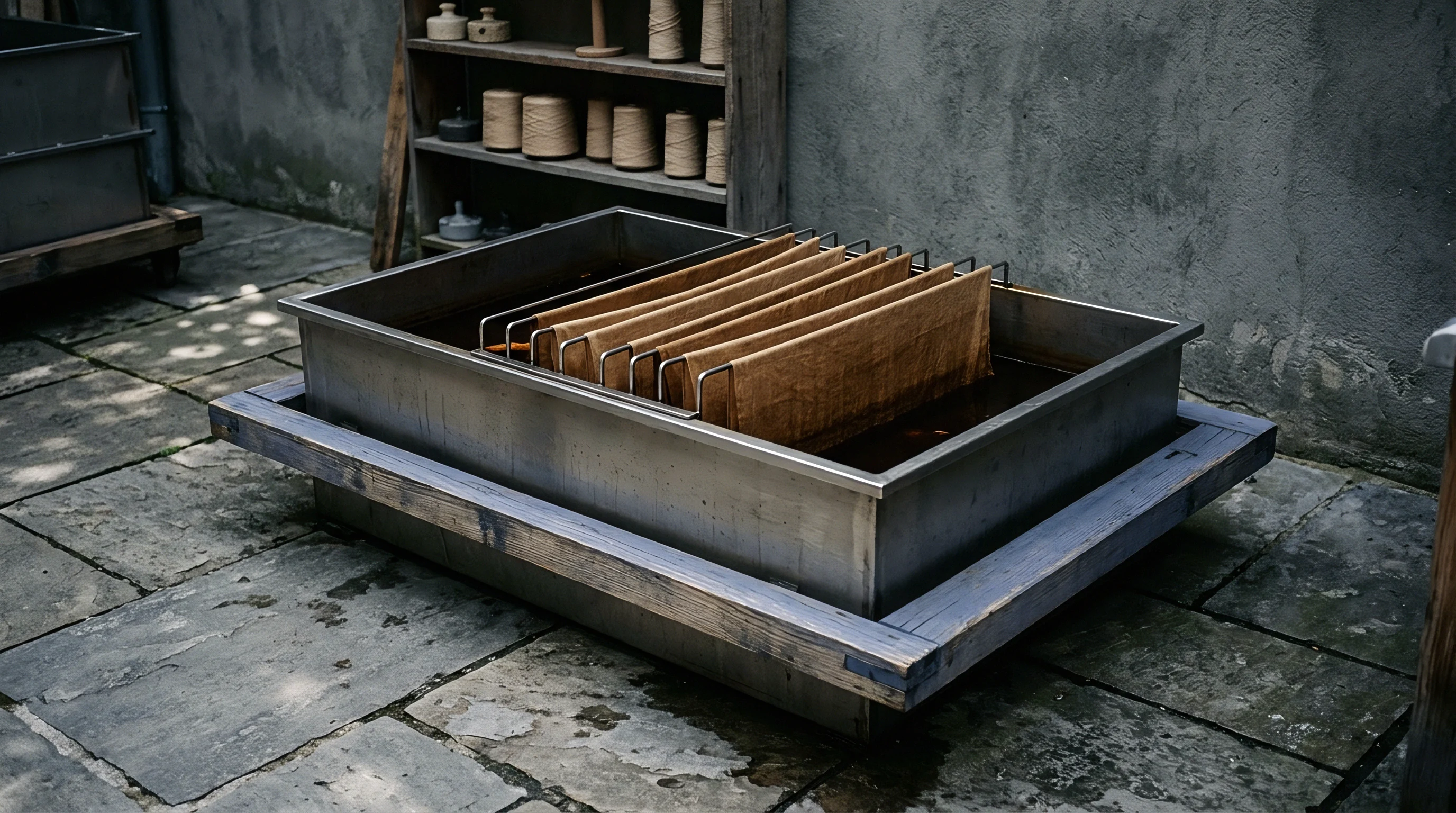
Roving passes through a heated water bath immediately before entering the drafting zone of the wet-spinning frame. This submersion softens remaining gums right at the nip, providing lubrication as fibres draw past one another. The trough acts as both a physical and chemical preparation zone, where bath temperature directly controls fluid viscosity and the plasticity of residual pectins.
While coarse counts run in baths held at 40°C to 50°C, fine counts from Nm 60 upward require temperatures stabilized between 65°C and 75°C. At 70°C, water viscosity drops to 0.404 mPa·s compared to 1.002 mPa·s at 20°C, allowing moisture to penetrate the roving core during its brief 1.2 to 2.5 seconds in the trough. Operating below 60°C causes erratic stick-slip motion during drafting, creating cyclic thick-and-thin faults visible as drafting waves on capacitive testers.
Water quality parameters within the trough exert direct influence on fibre cohesion and machine corrosion:
- Total water hardness maintained below 3 German degrees (dH) to avoid calcium salt precipitate deposition on yarn guides, rings, and rollers.
- Conductivity kept under 250 microsiemens per centimeter, preventing buildup of conductive mineral crusts across guide rods.
- Surface tension modifying agents introduced continuously at 0.1 to 0.2 mL/L to stabilize instantaneous fibre wetting without foaming inside the recirculation circuit.
- Bath replacement rate balanced at 15 to 25 liters per frame-hour to extract washed-out pectins before liquor turns viscous and foul.
Running high-count troughs without fresh water turnover causes dissolved pectin to concentrate. Once dissolved solids rise above 2.5 degrees Brix, the viscous liquor carries over onto the drafting rollers, hydroplaning the top cots and producing severe drafting slip.
Variations in seasonal intake water temperature destabilize yarn CV% values across morning shifts if automated heat exchangers are bypassed.

Draft
Ratch Length and Drafting Zone Kinematics
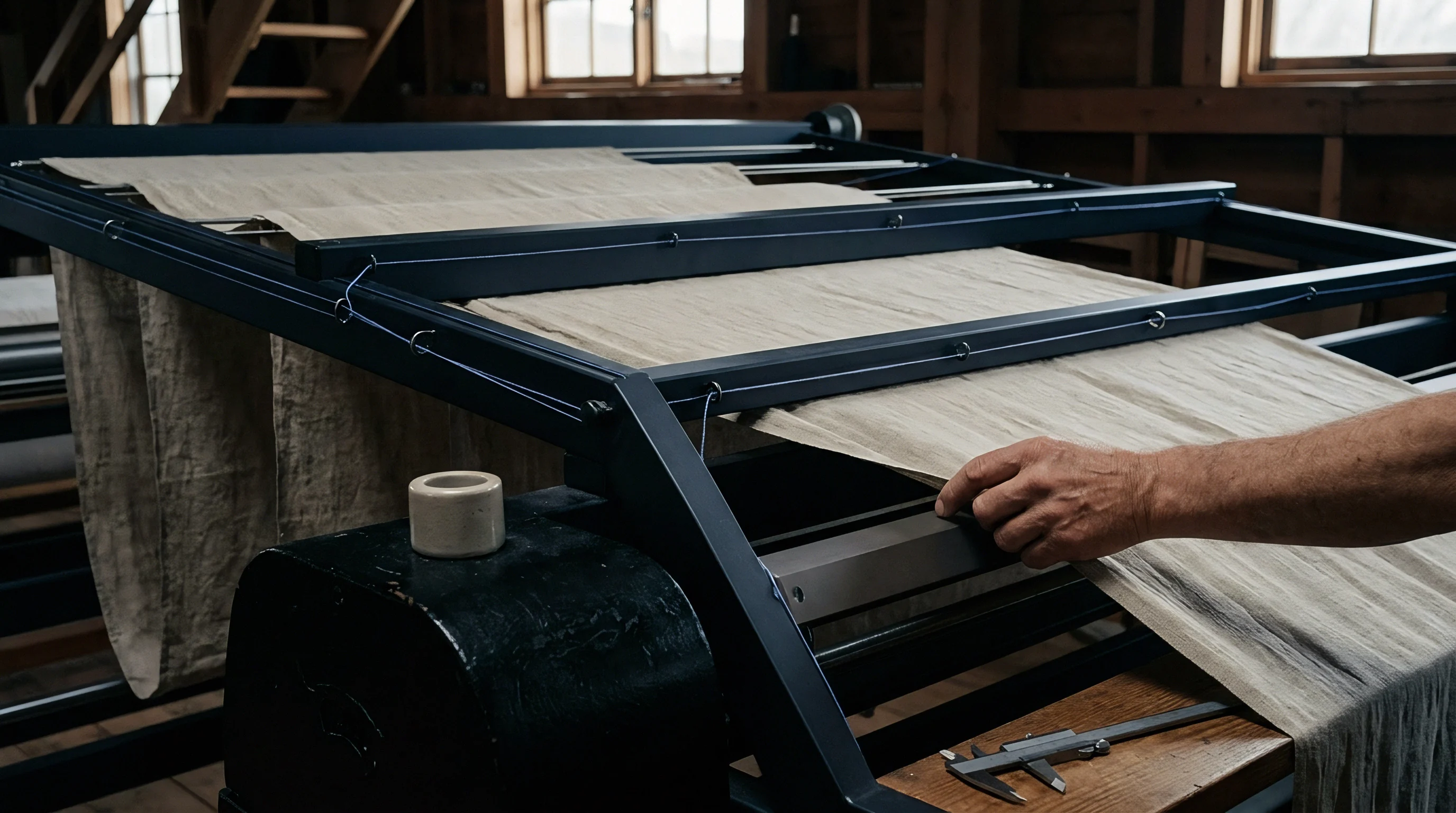
Drafting wet bast fibres involves mechanics unlike those of short-staple cotton frames. The drafting zone consists of a slow back feed roller, intermediate condensers or guide pins, and high-speed front delivery rollers. The nip-to-nip distance forms the ratch.
On high counts, setting this distance requires accounting for elementary fibre lengths: individual elementary cells measure 20 mm to 40 mm, whereas the intact technical bundles entering the back rollers reach 400 mm.
With proper roving scouring and trough wetting, drafting pulls individual elementary cells out of the bundle matrix through sliding rather than breaking fibres. Ratch settings for fine yarns run between 55 mm and 75 mm, matching the tail of the elementary length distribution. Opening the ratch past 80 mm leaves an unsupported gap where released fibres float and cluster into neps and slubs.
Ratch settings shorter than 50 mm pinch elementary cells at both ends, shearing them and dropping yarn breaking tenacity.
Ratch distances below fifty millimeters sever elementary cell walls and reduce yarn breaking force by half.
Drafting ratios for yarns up to Nm 100 run between 18 and 32. Holding control across these drafts demands high nip pressure at the delivery point, where fluted steel bottom rollers run against precision-ground rubber top cots. Cot hardness and alignment dictate nip stability:
- Cot hardness checked daily with a Shore A gauge, rejecting any roller testing outside 82 to 88 Shore A hardness.
- Top roller spring or pneumatic weighting calibrated to maintain exactly 220 to 260 N per nip point across all drafting positions.
- Fluted bottom rollers inspected for micro-pitting and rust under magnification, as localized corrosion tears wet drafting ribbons.
- Traverse mechanism stroke set between 8 mm and 12 mm to distribute wear evenly, preventing rapid localized grooving of the rubber cots.
Cots ground out of round impart periodic mass variations to the yarn, creating visible diamond patterns in plain-weave fabrics downstream.

Ring
Spinning Geometry and Traveller Dynamics
Twist inserts into the drafted strand between the front roller nip, the pigtail guide, the traveller, and the ring. Surface water from the front rollers changes how the traveller rides the ring. Cotton and worsted rely on fibre wax and graphite lubrication, but wet linen forms an actual hydrodynamic water wedge between the traveller inner profile and the ring flange.
This environment requires curved ring sections, like Hz or curved-conical profiles, paired with nickel-plated or stainless travellers that resist both hydroplaning and wet acid wear.
Spindle speeds on fine wet linen must balance output against centrifugal yarn tension. Cotton frames run past 18,000 RPM, but wet linen at counts from Nm 60 to Nm 100 runs restricted between 5,500 and 7,500 RPM. Centrifugal tension climbs with the square of spindle speed; although wet flax has good tensile strength, its shear resistance over the traveller horn is poor.
Operating above 8,000 RPM strips elementary fibres off the yarn surface, generating heavy hairiness, sloughing, and rapid traveller burnouts.
| Parameter | Nm 39 (25.6 tex) | Nm 60 (16.7 tex) | Nm 75 (13.3 tex) | Nm 100 (10.0 tex) |
|---|---|---|---|---|
| Ratch Setting (mm) | 72 | 65 | 60 | 56 |
| Draft Ratio | 18.5 | 22.4 | 26.8 | 30.5 |
| Twist Factor (alpha metric) | 115 | 120 | 125 | 132 |
| Spindle Speed (RPM) | 7,200 | 6,800 | 6,200 | 5,600 |
| Ring Diameter (mm) | 48 | 45 | 42 | 38 |
| Traveller ISO Number | 40 ~ 50 | 28 ~ 35 | 20 ~ 25 | 14 ~ 18 |
| Cot Hardness (Shore A) | 85 | 85 | 83 | 82 |
Balloon control rings placed midway between the guide and ring divide balloon height, preventing airborne droplets from collapsing the yarn path under drag. As twist inserts, the wet strand throws off fine mist; frames use enclosed spindle rails, drainage gutters, and splash panels to keep water off drive tapes and neighbouring bobbins.
Every increase in spindle speed beyond seven thousand revolutions increases traveller changeout frequencies to twenty-four hour intervals.
Twist factors (alpha metric) for fine wet-spun linen sit higher than dry-spun counts, typically between 120 and 135 (an English twist multiplier of 3.8 to 4.3). High twist locks elementary fibre ends into the yarn body to resist slippage once dry. Excessive twist, however, leads to active snarling off the bobbin and makes finished greige cloth harsh and boardy.
Running travellers with incorrect weight or flange clearance causes localized overheating on the ring, creating micro-welds that snag and shred fine yarn.
Cure
Conditioning and Residual Moisture Control
Fresh bobbins off the wet-spinning frame contain 25 to 35 percent water by weight. Winding or boxing this yarn wet leads to mildew within 48 hours and causes uneven shrinkage that crushes cardboard and plastic tube inserts. Wet bobbins must pass through conditioning and controlled drying before winding, clearers, and lab testing.
Drying wet-spun packages requires low-temperature convection or radio-frequency (RF) dielectric units. Standard drying ovens over 90°C scorch the linen, carmelizing residual gums so adjacent wraps bond together. Yarns baked this way unwind with erratic tension spikes that snap fine counts during high-speed package winding.
Radio-frequency heating works through the entire package volume at once, driving moisture from the core outward without overheating surface wraps. Packages must finish between 10.5 and 12.0 percent moisture to meet commercial linen regain standards.
Post-drying winding operations onto conical paper packages incorporate electronic clearing systems set to eliminate critical defects:
- Capacitive thin place clearing tuned to register cross-sectional drops exceeding -40% over 20 mm, catching broken bundle slippage.
- Thick place channels configured at +50% over 15 mm to cut out drafting slubs and shive contamination.
- Nep channels calibrated to sever tight hard entanglements exceeding +150% over 2 mm.
- Mechanical splicing cycles substituting knots with wet pneumatic splices, as mechanical knots fail downstream warp shedding clearances.
Winding tension on fine linen must stay within 8 to 12 percent of single-end breaking strength. Flax has minimal elasticity, reaching only 1.8 to 2.5 percent elongation at break. Over-tensioning during cone winding causes internal fractures that go unnoticed until warp yarns break under tension on the loom.
Clearer cut logs per 100 km reveal directly whether preparation, scouring, and drafting settings held tolerance across the lot.

Margin
Yield Economics and Defect Penalties
Past count Nm 60, cost distribution shifts from raw scutching tow toward combed line preparation and spinning power. The financial impact shows clearly when tracking one metric ton (1,000 kg) of high-grade dew-retted line flax through preparation and wet spinning into Nm 75 yarn.
Assumptions for the baseline model:
- Raw hackled line flax cost sits at $8.50 per kg landed.
- Hackling combing yield produces 55% long-line combed sliver suitable for Nm 75, with 40% combing tow diverted to coarse spinning, and 5% unrecoverable dust/shive waste.
- Combing tow credit value sits at $2.20 per kg.
- Roving scouring weight loss accounts for a 7.5% dry mass extraction of residual pectins and impurities.
- Spinning and winding waste generates 4% pneumatic roller waste and 2% hard clearing waste, recoverable as rework value at $1.00 per kg.
- Machine operational cost runs $4.20 per kg of delivered yarn, reflecting low spindle speeds and energy-intensive trough heating.
Calculating the material cost per delivered kilogram of Nm 75 yarn:
Starting with 1,000 kg raw flax: Combing produces 550 kg fine sliver, 400 kg tow (credit: $880), and 50 kg waste. The net material cost allocated to the 550 kg combed sliver equals $8,500 minus $880 tow credit, arriving at $7,620 ($13.85 per kg sliver). The scouring extraction drops the 550 kg of sliver to 508.75 kg of scoured roving.
The spinning process applies 6% total waste, delivering 478.2 kg of cleared, finished Nm 75 yarn on cones. The clearing waste credit generates $30.55. Net raw material cost equals $7,589.45.
Adding total processing operational costs ($4.20 multiplied by 478.2 kg = $2,008.44), the total production cost for 478.2 kg of yarn lands at $9,597.89. The delivered factory cost per kilogram of Nm 75 linen yarn reaches $20.07.
In high-density plain-weave apparel fabrics, such as 120 g/m² finished cloth requiring warp and weft of Nm 75 at 32 ends/cm and 28 picks/cm, raw yarn represents over 65 percent of greige fabric cost. If brittle straw drops combing yield by five percent, or if high ends down raise winding cuts from two to five percent, yarn cost passes $23.50 per kg, wiping out mill margins.
Commercial contracts routinely include clear penalty lines stating that yarn lots exhibiting evenness coefficient of variation (CVm%) greater than 22.5% on capacitive testers trigger an automatic twelve percent invoice debit, covering loomshed downtime and mending labor.