Loom Kinematic Deformation
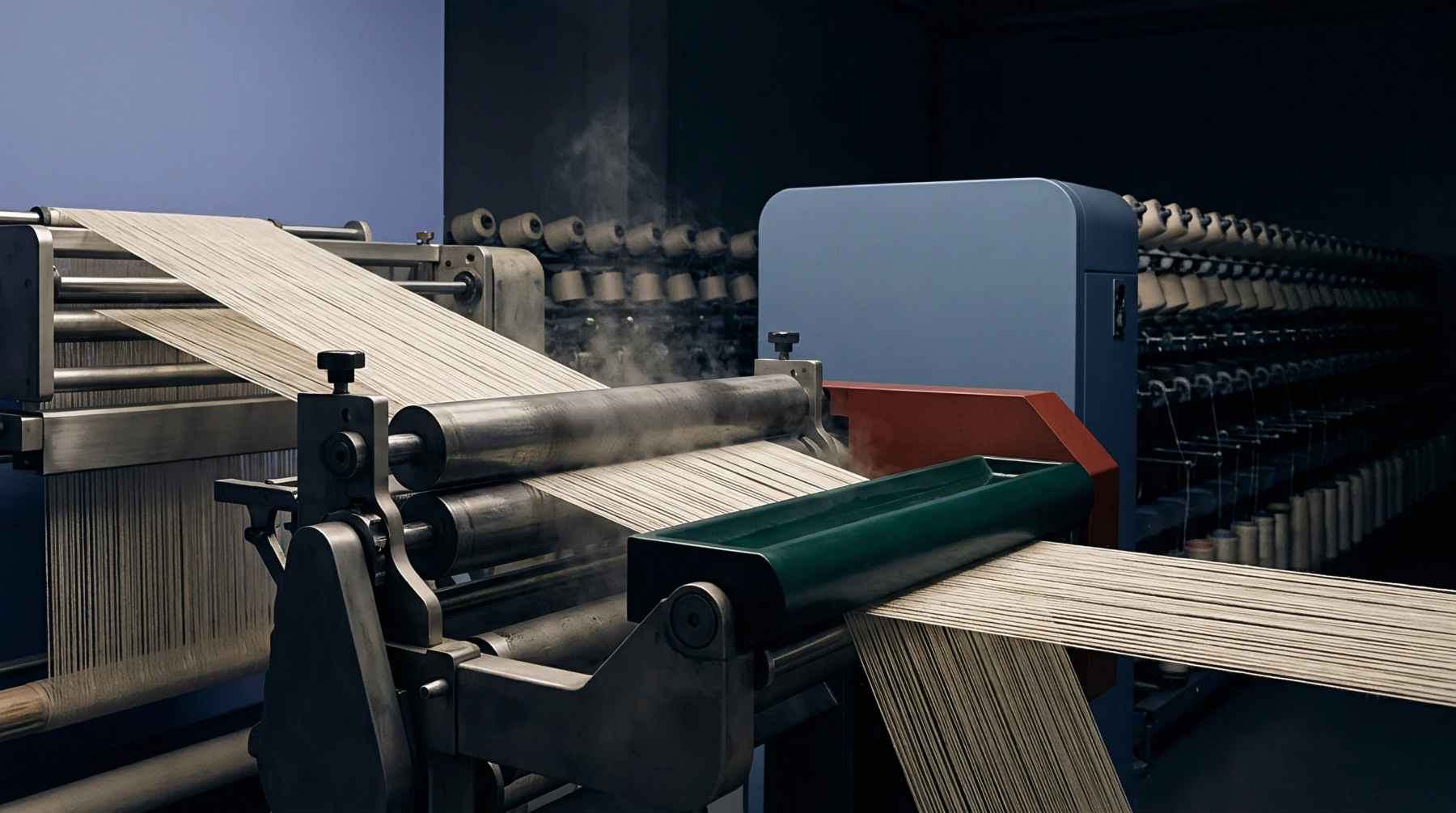
Mechanical tensile elongation imposed across parallel warp threads during heald frame displacement quantifies cyclic loom kinematic deformation. Peak cyclic tension arises when shedding strain forces alternating yarn sheets into open geometry to clear an insertion path for rapier heads or air jets. The geometric displacement stretching from the cloth fell point back to the back-rest roller governs the amplitude of this deformation.
Because bast fibers possess lower ultimate elongation than cotton or polyester, linen warps experience high mechanical stress under identical harness lift settings. The calculation of this mechanical strain stops at the beat-up strike point, where reed impact introduces instantaneous compression rather than angular harness displacement.
Geometric Harness Timing
Weaving machinery mechanics manipulate back-rest height, harness lift profiles and shed closing timing to moderate warp tension. Asymmetric shedding lowers bottom shed tension during shuttle or rapier transit, preventing friction failure against race boards. Shedding strain magnifies internal fibre stress within unevenly sized linen yarns, causing micro-crack propagation across the outer starch size layer.
Over-tightened shed openings snap weak fibre splices, creating immediate loom halts and degrading fabric production efficiency. Loom data loggers register warp tension curves via load-cell sensors mounted below the oscillating whip roll, highlighting peaks during shed transitions.
Defect Frequency Controls
Cloth inspection sheets record warp stop counts alongside physical fabric defect classifications per roll. Weaving supervisors track shedding strain effects by recording breakage distribution across the width of the reed bed. Excess strain triggers fuzz ball aggregation behind heald eyes, creating warp crossover misdraws and fabric float flaws.
Fabric buyers reject continuous linen bolt lots that display multiple warp stop marks caused by prolonged shed opening during machine stops. Loom mechanics adjust harness stroke depth to the minimum clearance height demanded by weft insertion devices, minimizing fatigue on inelastic bast cellulose.