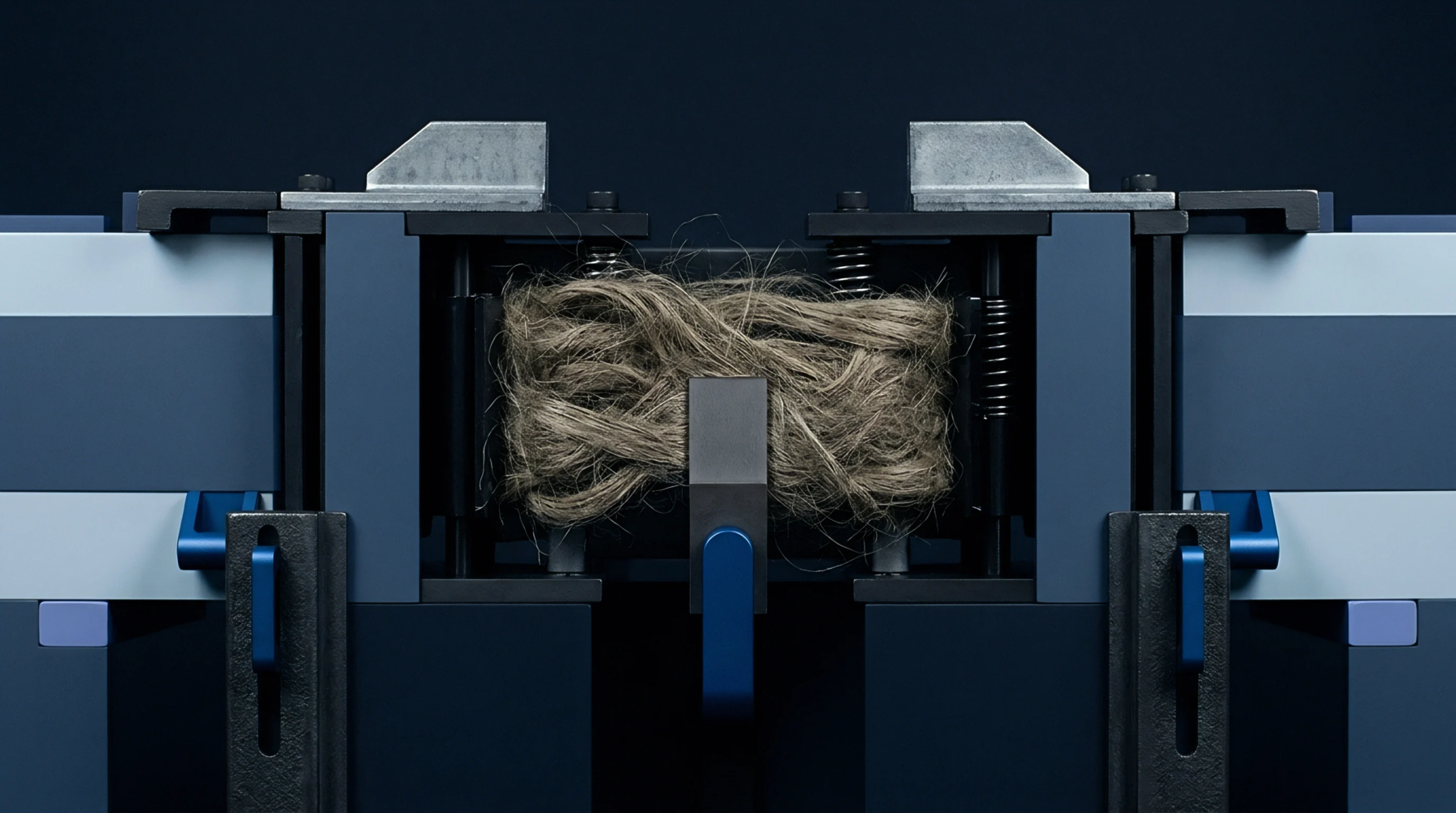
Kinematic Failure
Intermittent or continuous loss of frictional traction between rotating drafting rollers and an advancing fibrous strand produces uncontrolled slippage inside the attenuation zone. Designated as drafting nip slippage, this operational defect occurs when bundle resistance overcomes normal clamping force at the contact line between steel and rubber-covered rollers. The phenomenon defines a failure of positive mechanical grip on drawing frames, roving frames, and wet spinning frames.
Its scope stops where roller surfaces lose mechanical contact entirely or when the driving motor stalls under mechanical overload.
Traction Mechanics
Surface roughness of fluted steel rollers, rubber cot Shore hardness, top roller spring loading, and process lubrication govern contact friction across the drafting zone. In linen wet spinning, water carry-over from the roving trough introduces boundary lubrication that lowers interfacial grip, predisposing the assembly to drafting nip slippage. Rubber cots softened by prolonged water exposure or grooved by hard flax bundles fail to exert uniform pressure across the width of the roving.
The consequence is irregular strand attenuation, generating heavy undrafted sections followed by fragile, thin regions in the spun yarn. On the mill floor, spinning technicians monitor front-roller surface speed against actual yarn delivery velocity using optical tachometers. Deviations indicate slippage, prompting immediate top arm pressure recalibration or cot re-grinding against the mill maintenance schedule.
Daily maintenance records track cot service hours and roller pressure settings to preserve front-roller grip.
Specification Limits
Fabric inspection criteria grade uneven cloth defects caused by upstream drawing slippage under international point systems during grey fabric grading. Buyer acceptance documents for export linen set strict zero-tolerance ceilings on repeated mass variations attributable to drafting nip slippage.