Resonant Frequency Couplings between Jacquard Gantry Frames and High Speed Spring Return Harnesses
Dynamic resonance between Jacquard gantries and spring return assemblies distorts shed timing, requiring stiff structural isolation to prevent mispicks.


Amplitude
Operating above six hundred picks per minute, overhead Jacquard machines subject floor-anchored steel portal frames to continuous cyclic vertical and lateral loads. Every downstroke of the knife assembly drives kinetic energy through thousands of spring return units linked to individual heddle cords. If these driving frequencies align with the structural natural frequencies of the gantry, dynamic deflection pushes physical displacement past designed elastic limits and throws warp alignment off.
Total force transmitted to the gantry equals the dynamic knife acceleration combined with the total tension from all compressed return springs. On a ten-thousand-hook shedding system running at eight hundred picks per minute, spring return assemblies exert aggregate cyclic forces over twenty-five kilonewtons at top shed. Under this load, structural flex in the overhead cross-beams skews the shed opening geometry, creating phase lag between the Jacquard lifting hooks and the physical position of the heddle eye, which ultimately causes mispicks.
A gantry deflection exceeding zero point five millimetres at eight hundred picks per minute introduces unacceptable warp tension peaks across outer selvedges.
Uncontrolled frame movement causes immediate operational disruption across high-density linen weaving sheds, propagating from the structural steel down to warp shed geometry:
- Heddle bounce at bottom shed causes warp end cross-overs during reed passage, producing longitudinal floating pick faults.
- Shed opening displacement phase lag creates late shed clearance for rapier entry, increasing yarn abrasion against the race board.
- Accelerated spring recoil fatigue breaks lower anchor eyes within three hundred operating loom hours.
- Gantry weld cracking at corner gussets releases structural pre-load and shifts frame fundamental frequency lower into the operational speed range.
Continuous dynamic deflection along long cross-beams accelerates bolt loosening at column connection plates as inertial loads multiply.
Shed distortion is often attributed to incorrect yarn sizing or uneven warp tension, though structural flexure in the overhead mounting frame is frequently the true cause.


Damping
Damping kinetic forces in high-speed shedding motions comes down to structural elasticity and material energy dissipation. Because steel portal frames have low intrinsic damping factors ~ typically between zero point zero one and zero point zero three ~ harmonic excitation from knife reversing mechanisms passes directly into the floor and neighboring weaving machines unless dedicated damping elements absorb those peak loads.
Choosing effective energy absorption media requires mapping mechanical excitation frequencies across the full speed range. Main driving frequencies match the loom shaft rotation, with secondary harmonics produced by shedding knife acceleration curves and spring snap-back impulses that alter shed symmetry when the frame shifts.
| Operating Speed (PPM) | Excitation Frequency (Hz) | Peak Acceleration (g) | Mispick Rate (per 10k picks) | Dynamic Phase Lag (deg) |
|---|---|---|---|---|
| 600 | 10.0 | 1.2 | 0.02 | 1.5 |
| 700 | 11.7 | 1.8 | 0.08 | 2.8 |
| 800 | 13.3 | 3.1 | 0.45 | 5.2 |
| 900 | 15.0 | 5.4 | 2.10 | 9.6 |
| 1000 | 16.7 | 8.2 | 6.80 | 14.8 |
Installing elastomeric damping pads between gantry column bases and shed foundations disrupts the energy transmission path, while viscous dissipation in the spring assemblies dampens high-frequency chatter in heddle cords during shed dwell. Proper structural isolation breaks this coupling before resonance takes hold.
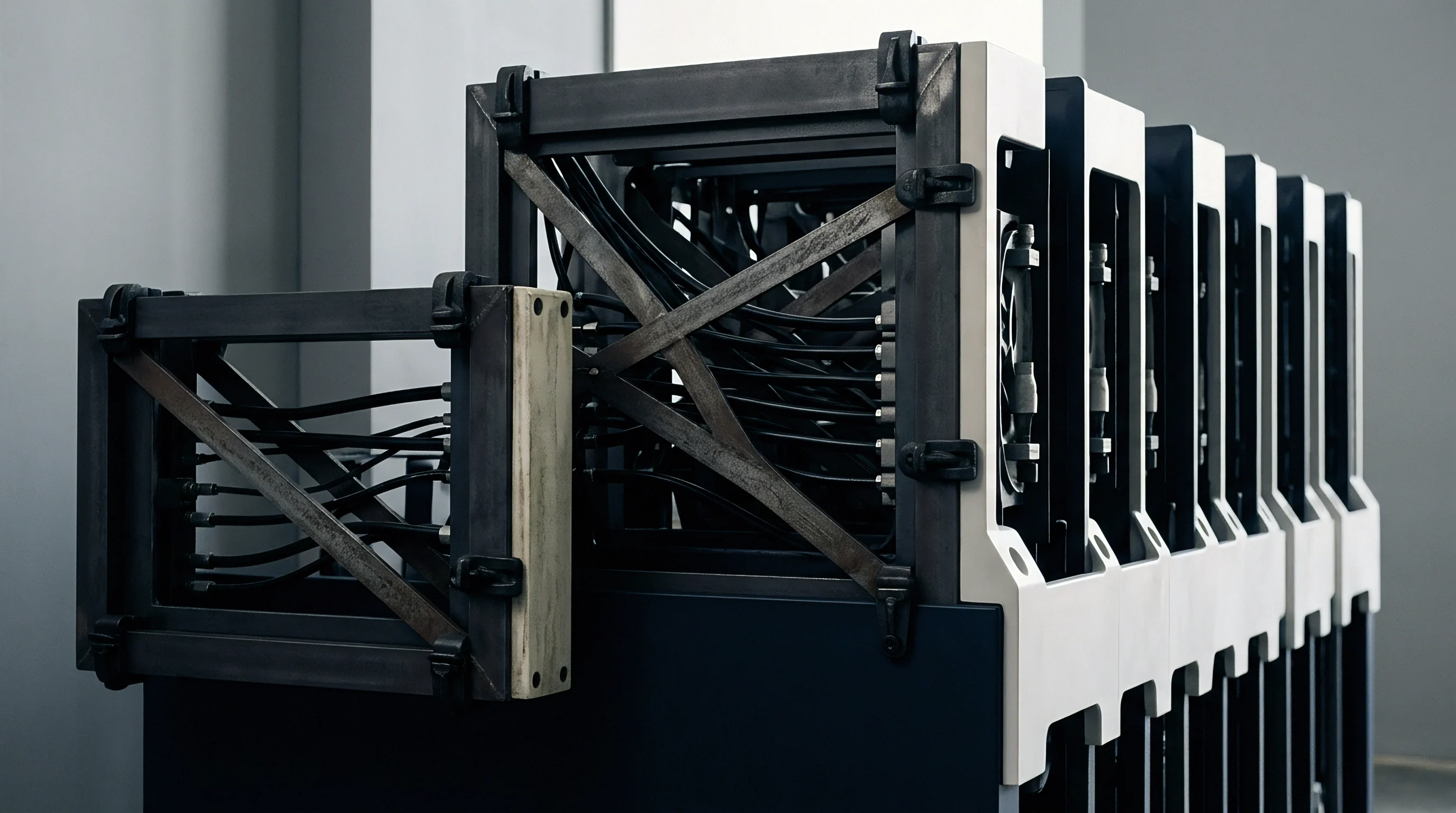
Structural Vibration Isolation Strategies
Designing stable overhead supports requires isolating mechanical excitation without compromising structural alignment:
- Viscous elastomeric isolator selection decouples low-frequency floor transmission while maintaining vertical gantry alignment under static weight.
- Spring material hysteresis grading dissipates energy during rapid spring snap-back without altering force curves.
- Combed comber-board positioning limits transverse whip in long heddle cords at maximum knife stroke.
- Diagonal structural bracing angles shift gantry natural modes above twenty-five hertz.
Rigid portal mounts reduce frame whip, and properly matched damping coefficients prevent amplitude buildup over long production runs on dense flax warps.
Higher spring return stiffness increases shed opening speed while increasing cyclic impact forces on the overhead framework.
Adding mass to an unstable overhead frame simply shifts the critical vibration band down to lower operating speeds; it does not eliminate the destructive peak energy.

Stiffness
Structural rigidity dictates how well an overhead portal frame handles excitation from double-acting shedding knives. Steel beams flex dynamically under heavy cyclic tensile loads, pulling the frame’s resonant frequency right into operational weaving speeds. When a horizontal cross-beam’s fundamental bending mode lands between ten and twenty hertz, running high-speed Jacquards creates immediate instability as peak forces stress corner welds.
Stiffness directly sets the ceiling on loom speed. Stiffening the main transverse beams stops cross-sectional distortion and torsional twisting under eccentric knife acceleration, preventing resonance from tearing through spring anchors.

Mechanical Excitation Spectrum in Electronic Shedding
Electronic Jacquard shedding motions generate complex force profiles. The primary force pulse occurs at the shedding cycle frequency, accompanied by higher-order harmonics from drive linkage geometry, knife deceleration, and spring recoil impulses, where shaft torque pulses excite frames and unchecked excitation accelerates bearing wear.
What Natural Frequencies Trigger Destructive Gantry Resonance?
Frequencies between twelve and eighteen hertz regularly trigger first-mode flexural resonance in standard rolled-steel portal frames. Higher-order torsional modes between twenty-four and thirty-six hertz couple with knife reversal acceleration peaks, twisting the bedplate and binding vertical guide tracks.
Measuring frame behavior under full load pinpoints the exact speed zones where resonance develops. Technical teams follow a standard testing sequence to establish baseline vibration parameters:
- Mount triaxial accelerometers directly onto the central cross-beam of the overhead Jacquard support frame.
- Run the weaving machine without warp yarn from four hundred picks per minute up to maximum rated speed in fifty-rpm increments.
- Record peak acceleration amplitudes across vertical and transverse axes at each step to identify operational resonant peaks.
- Fasten stiffening gussets or tuned mass dampers to structural nodes exhibiting displacement maximums exceeding target tolerances.
Proper energy dissipation prevents structural fatigue while dynamic isolation preserves production time.
ISO 10816 vibration severity levels above four point five millimetres per second velocity root-mean-square trigger immediate machine shut-down clauses in supply agreements.
Ignoring frame excitation peaks leads to weld failures, damaged drives, and persistent fabric defects in high-density linen weaves.

Plank
Overhead support members are the mechanical foundation for high-speed shedding equipment, spanning weaving machines with steel I-beams, box girders, or composite sections. Beam cross-section geometry governs both static deflection under multi-ton Jacquard heads and dynamic response to high-frequency spring return inputs, where controlled frame motion helps maintain lower yarn tension and reduce breakages.
Balancing mass against dynamic stiffness is what keeps the overhead structure stable. Heavy steel profiles offer high static rigidity, but they drop the assembly’s fundamental natural frequency down into operational speed ranges, where dynamic stiffness sets the real ceiling on loom speed.
| Beam Material Profile | Mass per Metre (kg/m) | Fundamental Frequency (Hz) | Transmissibility Ratio at 15 Hz | Dynamic Deflection at 800 PPM (mm) |
|---|---|---|---|---|
| Standard I-Beam (HEB 200) | 61.3 | 14.2 | 4.8 | 0.85 |
| Reinforced Box Girder (200×10) | 58.2 | 19.6 | 1.6 | 0.28 |
| Structural Steel Lattice Bridge | 42.5 | 24.1 | 1.2 | 0.18 |
| Carbon Fiber Hybrid Truss | 18.4 | 38.5 | 1.05 | 0.06 |
Optimizing overhead structures requires precise specifications for both dynamic and static performance, detailing clear construction criteria:
- Structural profile section modulus specifying minimum resistance to vertical bending loads under cyclic spring tension.
- Mounting plate bolt torque specs guaranteeing zero joint slip during continuous maximum dynamic shear loading.
- Isolation pad dynamic durometer rating calibrated to operating frequency ranges to prevent energy buildup.
- Cross-bracing anchor geometry setting angular support vectors that neutralize lateral torque generated by knife reversing drives.
Properly anchored cross-bracing converts lateral shear forces into linear compressive loads directed straight down into floor footings.
Composite overhead beams absorb high-frequency energy effectively but alter baseline thermal expansion values across multi-width sheds.
Whether active electromagnetic vibration attenuation can economically replace heavy mechanical stiffening on wide portal frames running above eleven hundred picks per minute remains an open question.


Toll
Capital investment in isolated overhead structures pays off through higher loom operating speeds and lower greige fabric defect rates. Uncontrolled resonant vibration forces mills to throttle machinery speeds, forfeiting shed capacity and stretching out lead times. A plant running twenty high-speed rapier looms with ten-thousand-hook Jacquards loses substantial billable output when forced to drop speeds from eight hundred to six hundred and fifty picks per minute to avoid resonance.

Loom Hour Accounting for Resonant Speed Limits
Take a weaving shed operating twenty Jacquard rapier looms producing high-density linen fabric at seventy-five percent efficiency. At eight hundred picks per minute, each loom turns out eleven point five two metres per hour at fifty picks per centimetre. Dropping loom speed to six hundred and fifty picks per minute cuts hourly output to nine point three six metres, losing two point one six metres per loom hour across the shed.
Assuming a target loom-hour cost of twenty-eight Euros per machine hour, that lost output adds zero point eight five Euros per finished metre in overhead absorption. Over an annual run of two million picks per loom, these speed penalties accumulate an unrecoverable loss of forty-three thousand two hundred metres ~ representing one hundred and two thousand Euros in lost shed margin. By comparison, installing high-stiffness lattice gantry frames with dynamic elastomeric isolation at fourteen thousand Euros per loom portal yields a full capital payback within eighteen operational months.

Maintenance and Component Wear Overhead
Dynamic stresses from resonance drastically shorten the service life of overhead mechanisms and loom components. Unattenuated peak vibrations boost spring return failure rates by three hundred percent, consuming forty-eight additional spring packs per loom each year. Mechanical fatigue in heddle cords, harness cords, and comber-board inserts adds four hundred Euros per loom in annual replacement parts, along with sixty hours of emergency downtime maintenance.
Purchase contracts specifying gantry rigidity standards increasingly include mandatory runability guarantees that link peak vibration velocity directly to maximum allowable mispicks per hundred thousand picks.