Linear Viscoelastic Parameter Identification for Spun Linen Yarns
LVE parameter fitting predicts linen warp relaxation rates, establishing exact strain limits to prevent loom stop marks and permanent fiber creep.

Mechanics
The axial loading of spun flax yarn produces both immediate deformation and time-dependent viscous flow, a dual response driven by cellulosic elementary fibers bound within an amorphous pectin and hemicellulose matrix. Below an axial strain threshold of 0.6 percent, structural response remains proportional to load over short time scales. Beyond this limit, micro-void growth begins within the middle lamella.

Deformation Kinetics in Elementary Flax Bundles
Inside technical flax strands, crystalline cellulose microfibrils align at a spiral angle of ten degrees along the fiber axis. Viscoelasticity stems from shear stress relaxation across the non-crystalline polymer phase between these microfibrils. Under sustained loading, applied tension induces shear strains in the pectin matrix that drive energy dissipation, while the twist imparted during ring or wet spinning converts axial tension into radial consolidation forces that alter matrix shear constraints.
Tensile loads applied under 20 milliseconds stretch the cellulosic crystalline backbone elastically without disrupting matrix hydrogen bonds. Extended loading, however, triggers sliding along elementary fiber boundaries to produce measurable creep. Wet-spun yarns exhibit higher instantaneous elastic moduli than dry-spun yarns because of tighter pectin cohesion and better aligned elementary fibrils.
Failing to enforce ISO 13934 strain-rate limits during viscoelastic profiling leads to a thirty percent error in predicted warp tension decay on high-speed rapier looms.

Where Does Linear Viscoelasticity Break down in Flax?
Quasistatic tensile trials reveal a distinct shift in yarn compliance once axial elongation exceeds 0.7 percent. At higher strain rates, structural reorientation within technical fiber bundles alters the effective relaxation spectrum and invalidates linear superposition. Loading beyond this threshold causes micro-cracking in the pectin-rich middle lamella, introducing non-linear creep components reflected in permanent set measurements.
| Yarn Count (Nm) | Spinning Process | Instantaneous Modulus E1 (GPa) | Delayed Modulus E2 (GPa) | Retardation Viscosity eta2 (GPa·s) | Free Viscosity eta1 (GPa·s) |
|---|---|---|---|---|---|
| Nm 26 | Wet Spun | 7.82 | 2.15 | 14.30 | 185.00 |
| Nm 39 | Wet Spun | 8.50 | 2.40 | 18.60 | 240.00 |
| Nm 60 | Wet Spun | 9.20 | 2.85 | 22.10 | 310.00 |
| Nm 26 | Dry Spun | 5.40 | 1.50 | 8.90 | 110.00 |
Designing a warp shedding cycle on uncorrected elastic models leads to uncontrolled warp sag, severe reed marks, and frequent loom stoppages that drive up weaving costs per metre.


Clamp
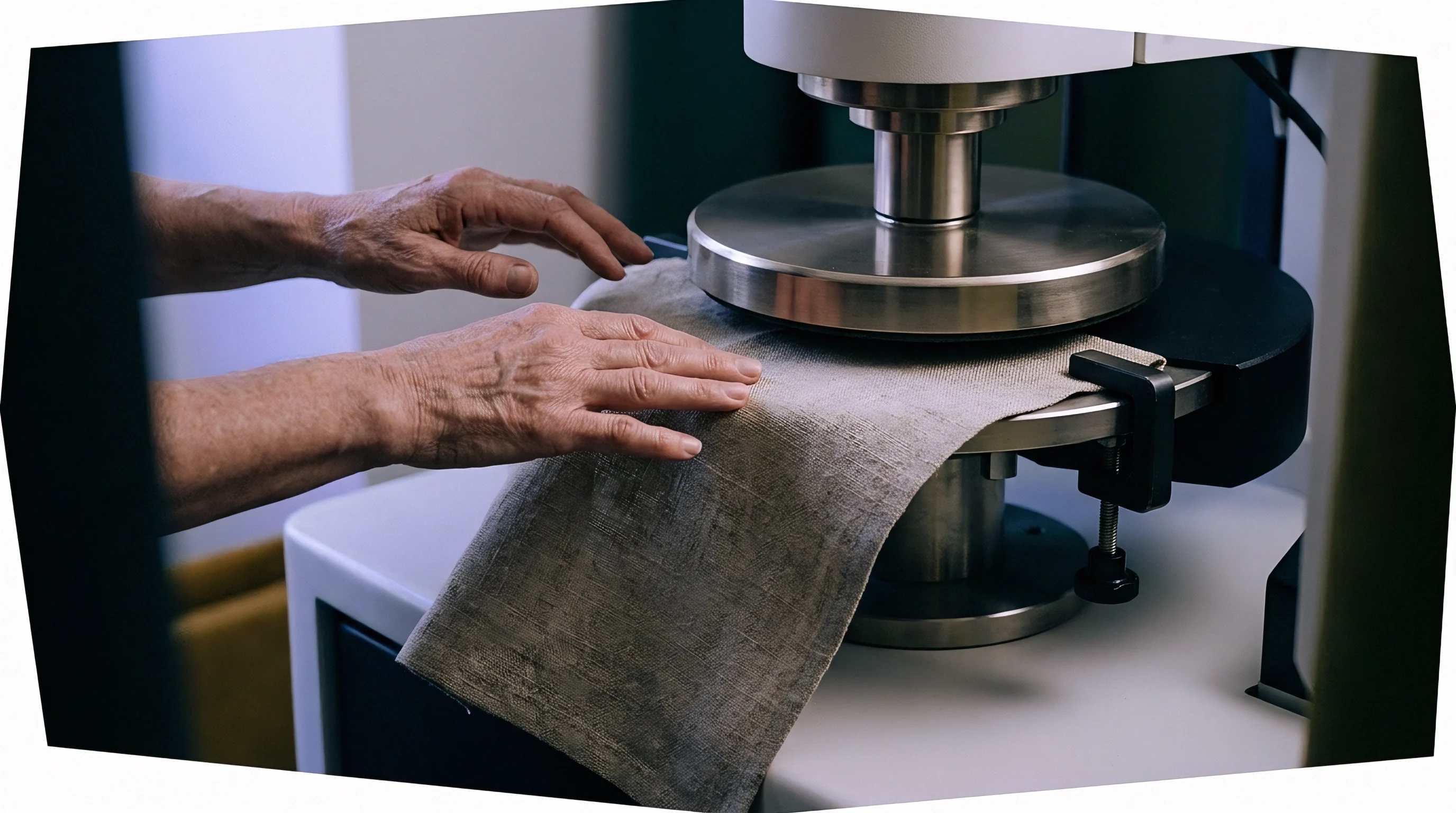
Fixture geometry dictates experimental precision when measuring stress relaxation in spun plant strands. Flat-faced pneumatic jaws introduce stress concentrations that cause localized necking or subtle yarn slippage inside the grip zone. By contrast, capstan fixtures with cushioned contact faces distribute tensile forces across a smooth parabolic arc before securing the terminal tail.

Fixture Kinematics and Gripping Mechanics
Gauge length selection determines whether measured relaxation reflects true yarn properties or local mass irregularities. Standard test spans of 250 millimetres accentuate thin spots where concentrated stress accelerates apparent relaxation. Extending sample spans to 500 millimetres averages out mass variations over longer lengths to yield consistent viscoelastic parameters, while maintaining pneumatic clamping pressure at 0.4 MPa prevents fiber slippage without crushing the protective outer sheath.
Capstan jaws reduce local shear peaks by guiding incoming yarn along a smooth metallic radius. Pre-tensioning protocols eliminate initial slack before the specimen locks in place; applying a pre-load of 0.5 cN per tex seats the yarn structure before high-speed step strain is introduced.

Dynamic Mechanical Spectrum Profiling
Frequency sweeps from 0.1 Hz to 50 Hz resolve storage and loss moduli under controlled sinusoidal strain amplitude. Temperature sweeps between 15°C and 45°C show thermal softening in the amorphous pectin phase, shifting glass transition thresholds as moisture regain changes. Testing yarn at 50 percent relative humidity increases instantaneous stiffness and suppresses viscous dissipation compared to standard 65 percent relative humidity environments.
- Capstan Slippage creates artificial step drops in relaxation modulus curves during initial loading ramps.
- Jaw Crushing fractures brittle outer flax elementary fibers, accelerating apparent long-term viscous dissipation rates.
- Thermal Drift alters bench transducer sensitivity during extended multi-hour static creep evaluations.
- Pre-load Overdrive exceeds the linear strain limit prior to test launch, distorting identified Maxwell elastic parameters.
Discrepancies in measured relaxation times are frequently attributed to variations in field retting conditions rather than uncalibrated bench gripping systems.

Arithmetic
Parameter identification translates experimental stress decay curves into discrete mathematical matrices for numerical loom simulation. Exponential series fitting converts continuous relaxation spectra into finite generalized Maxwell elements operating in parallel with a spring element.

Prony Series Fitting for Time Dependent Spectra
Extracting viscoelastic parameters requires minimizing the sum of squared errors between experimental relaxation modulus values and the finite Prony summation. Selecting three relaxation time constants across three logarithmic decades isolates rapid initial dissipation alongside long-term static decay.
- Apply a step strain of 0.5 percent within a 10-millisecond ramp window.
- Record stress decay over a 1000-second logarithmic time grid.
- Normalize stress response by initial strain to construct the relaxation modulus curve.
- Solve the non-linear least-squares optimization problem to extract Prony parameters.
In an Nm 39 wet-spun linen yarn subjected to an instantaneous step strain of 0.005 on a high-speed tensile frame, initial stress reaches 42.5 MPa, establishing an instantaneous modulus E0 of 8.50 GPa. Over extended time scales, stress decays to an equilibrium value of 25.5 MPa, fixing the long-term elastic modulus E_infinity at 5.10 GPa.
Nonlinear regression identifies two parallel Maxwell branches. The first yields an elastic stiffness E1 of 2.00 GPa paired with a relaxation time tau1 of 1.20 seconds, reflecting rapid matrix shear relaxation. The second branch gives an elastic stiffness E2 of 1.40 GPa with a relaxation time tau2 of 45.00 seconds, accounting for long-term fiber bundle reorientation.
The relaxation function takes the form:
E(t) = 5.10 + 2.00 exp(-t / 1.20) + 1.40 exp(-t / 45.00) GPa.
At t = 1.0 second, the calculated modulus reaches 6.58 GPa; at t = 10.0 seconds, it drops to 6.22 GPa, eventually stabilizing at 5.25 GPa at t = 100.0 seconds. Converting these parameters into Maxwell spring-dashpot elements yields a primary dashpot viscosity eta1 of 2.40 GPa·s and a secondary dashpot viscosity eta2 of 63.00 GPa·s.
Higher delayed elastic moduli in wet-spun yarns correlate directly with tighter yarn structure and reduced beat-up marks.
These derived coefficients feed directly into warp dynamics algorithms, establishing precise boundary conditions for high-speed shedding simulations.


Motion
Shed opening on high-speed rapier looms imposes cyclic tension peaks at frequencies up to 10 Hz. Warp threads undergo hundreds of thousands of extension cycles during beam exhaustion, accumulating irreversible elongation whenever peak forces surpass linear elastic limits. Viscoelastic damping within the yarn absorbs part of this cyclic energy, dampening harness-induced vibration.

Shedding Dynamics and Cyclic Fatigue Accumulation
High harness lift angles stretch warp ends past their linear range during every shed clearance. Yarns with short relaxation times recover quickly enough during lower shed dwell to maintain uniform tension. Conversely, yarns with long relaxation times accumulate residual strain over successive picking cycles, leading to slack warps and harness interference.
| Shedding Mechanism | Loom Speed (rpm) | Peak Tension per End (cN) | Strain Amplification Factor | Residual Creep Rate (percent/10k picks) |
|---|---|---|---|---|
| Positively Driven Dobby | 350 | 145 | 1.12 | 0.042 |
| Negative Dobby | 280 | 165 | 1.25 | 0.068 |
| High-Speed Rapier | 550 | 210 | 1.48 | 0.125 |
| Air-Jet Insertion | 700 | 245 | 1.62 | 0.185 |
Higher strain amplification factors on air-jet shedding lines accelerate structural creep in the yarn, forcing frequent adjustments to warp stop motions to keep fabric density within tolerance.
Wet-spun flax yarns operating at 550 picks per minute dissipate fourteen percent of harness strain energy as shear heat within the pectin matrix.
Incorporating ISO 13934-2 creep limits into gray goods purchase orders obligates the spinner to guarantee yarn relaxation stability under continuous loom loading.


Tension
Static loads imposed on a tied-over warp beam dissipate gradually while the weaving machine stands idle during shift changes. Storage time on the loom beam converts elastic strain into permanent set, reducing initial tension across the warp sheet upon restart. This loss of static pre-load alters beat-up resistance, causing severe stop marks in high-density linen fabrics.

Sizing Formulations and Viscoelastic Modifiers
Applying film-forming native starches increases instantaneous yarn stiffness while restricting matrix mobility. Adding polyvinyl alcohol derivatives extends the relaxation spectrum, enabling the composite yarn structure to absorb dynamic shed shocks without micro-fibrillar failure.
- Relaxation Time Window defines the allowable decay in warp tension during standard shift stoppages without initiating reed marks.
- Creep Compliance Ceiling sets maximum permissible permanent extension under continuous 180 cN static warp sheet load.
- Sizing Penetration Index controls the ratio of core fiber flexibility to surface film stiffness in high-count warps.
How the interaction between ambient humidity oscillations and long-term creep stress affects residual beam tension on wide-width jacquard looms remains an open question for technical weavers.