Calculating Warp Stop Downtime in High Density Weaving
Warp stop downtime combines mechanical repair duration with operator interference queuing, calculated from break frequency per hundred thousand picks.

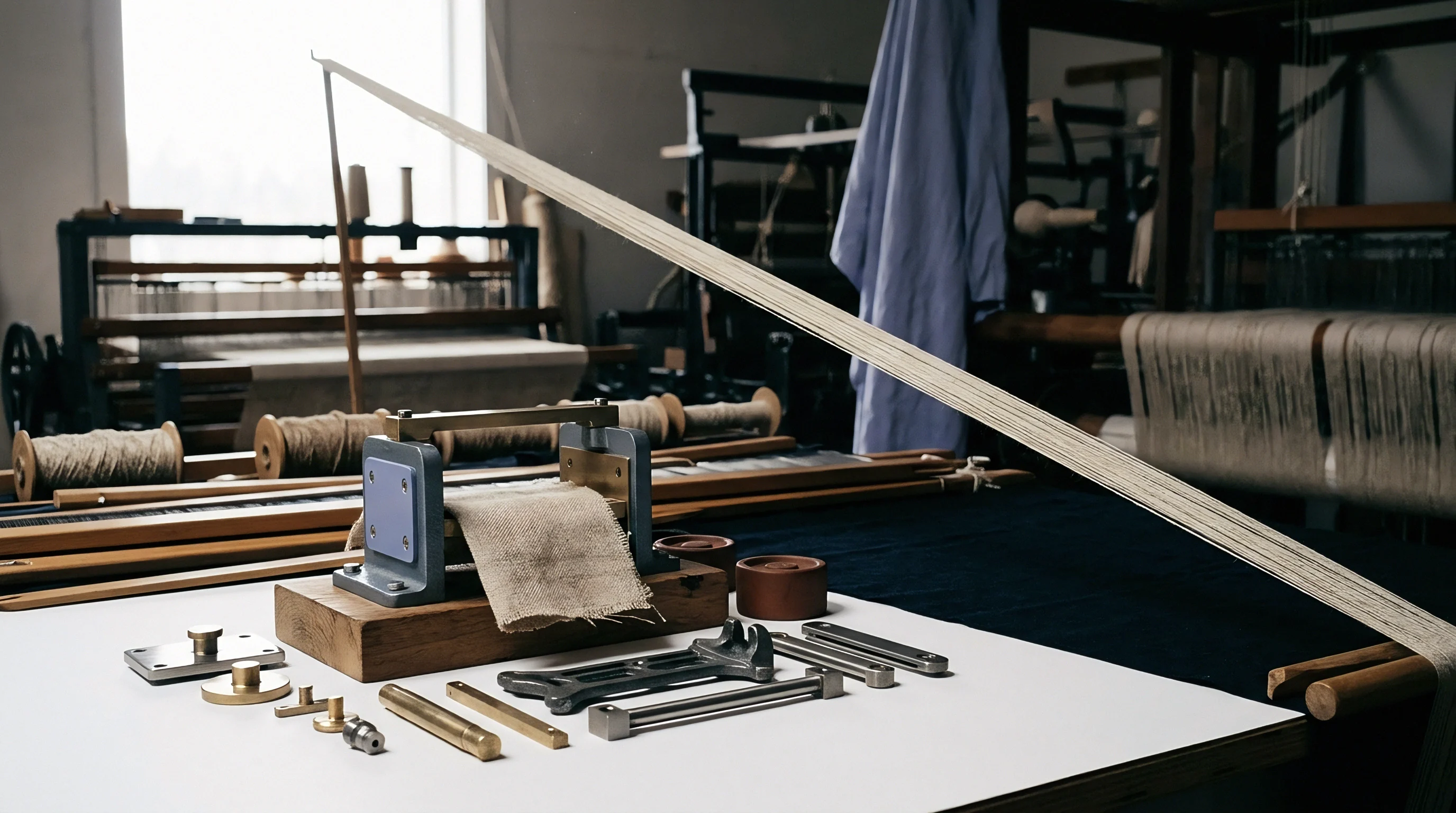
Stoppage
An air-jet loom running sixty ends per centimetre of Ne 60/1 combed cotton at eight hundred picks per minute halts on dropwire twelve, stopping within fifty milliseconds of yarn failure. Calculating total warp stop downtime requires breaking that halt event down into four sequential phases: electrical detection, operator travel and reaction delay, piecing or knotting, and shed restart latency. In dense constructions with warp cover factors over twenty-two on the Peirce scale, close yarn proximity creates clinging fibres that prolong physical repair.
The baseline downtime calculation separates this mechanical stop frequency from the human restoration cycle.
Warp break frequency measures yarn ruptures per unit of production, standardized internationally per one hundred thousand picks. Raw downtime per shift is calculated as:
Total Downtime Minutes = (Ends Counted × Total Picks Inserted × Break Rate per 100,000 End-Picks × Mean Time to Repair) / (100,000 × Machine Running PPM × 60)
Clean sheds prevent crossed ends. At loom speeds around nine hundred picks per minute, manual piecing takes longer as fine filaments entangle in the harness dropwires. While a single end repair on coarse sheeting takes twenty seconds, the same break on high-density poplin or fine linen cambric requires fifty-five seconds.
A break frequency exceeding one point five stops per one hundred thousand picks depresses single-operator battery output below commercial viability.
Total downtime modeling must account for machine interference when a single weaver manages multiple looms. As density climbs, warp stop frequency rises non-linearly due to adjacent end abrasion. While single-machine models simply multiply stop frequency by repair time, multi-machine sheds introduce operator queuing delays.
Lost production time per loom hour builds across five distinct operational phases:
- Signal registration phase begins when the fallen steel dropwire closes the low-voltage contact bar, triggering electromagnetic braking within one shaft rotation.
- Patrol transit phase covers the physical distance the technician walks down the alley, adding delay when neighbouring looms stop simultaneously.
- Fault identification phase requires visually isolating the broken end through densely packed heald eyes, which takes longer when lint bridges adjacent paths.
- Knotting execution phase joins the broken end with a mechanical knotter or manual weaver knot, drawing the tail through the dropwire and correct reed dent.
- Tension balance phase pulls the repaired end onto the take-up roll to match adjacent warp tension, preventing start marks at beat-up.
Accurate downtime calculations depend on empirical data from active production. Table 1 outlines five dense constructions across air-jet and rapier looms, highlighting the gap between nominal stop frequencies and actual line losses.
| Construction Specification | Loom Type | Running PPM | Stops per 100,000 Picks | Mean Repair Seconds | Hourly Downtime Minutes |
|---|---|---|---|---|---|
| Ne 80/1 Cotton Plain 52 × 36 /cm | Air-Jet 190cm | 850 | 1.85 | 48 | 0.75 |
| Ne 60/1 Cotton Sateen 68 × 44 /cm | Air-Jet 220cm | 780 | 2.40 | 58 | 1.08 |
| Nm 39/1 Wet Spun Linen 28 × 22 /cm | Rapier 210cm | 460 | 3.80 | 65 | 1.14 |
| Nm 50/1 Wet Spun Linen 34 × 28 /cm | Rapier 190cm | 420 | 5.20 | 78 | 1.71 |
| Ne 100/2 Gassed Cotton 72 × 48 /cm | Air-Jet 190cm | 900 | 1.10 | 42 | 0.42 |
High fabric density aggravates yarn chafing. Calculating downtime without separating operator travel from mechanical knotting leads to flawed efficiency forecasts. Shift-level digital monitoring systems track lost capacity directly, logging exact pick losses the moment contact is made.


Dent
Reed blade thickness and air space dictate the mechanical friction on each warp end during beat-up. In high-density warps, packing multiple ends into a single reed dent intensifies inter-yarn shearing. A reed count of twenty dents per centimetre with three ends per dent generates severe lateral contact during shed movement, stripping sizing polymers and forming filament fuzz balls directly behind the reed wires.

Can Higher Reed Density Accelerate End Entanglement?
Warp yarns moving through restricted reed air spaces encounter high friction that degrades tensile strength. When ends are crowded in narrow dent channels, loose surface fibrils entangle across neighbouring yarns; as the shed opens, this tension breaks the weaker end near the dropwires. Consequently, breakage rates climb sharply whenever reed air space falls below forty-five percent of total reed width.
Warp downtime models must factor in this dent geometry.
Shed clear opening limits determine whether adjacent warp ends clear each other cleanly during alternate harness motion.
Four primary mechanical fault modes dominate stoppage records on dense warps:
- Entanglement clusters form when trailing fibres interlock between neighbouring ends in the same dent space, preventing clean shedding.
- Reed abrasion breaks sever filaments directly at the fell of the cloth under high beat-up resistance.
- Heald eye shearing strips protective sizing film from single yarns during rapid harness shaft reversals.
- Dropwire contact snags occur when high warp tension causes micro-grooving on the internal surfaces of steel dropwires.
Calculating downtime from reed crowding requires evaluating the ratio of yarn diameter to available dent width. For example, fitting three yarns of zero point two millimetre diameter into a zero point five millimetre dent space increases frictional cycles per centimetre by thirty percent compared to an open layout. Sizing recipes must therefore increase film elongation to withstand these cyclic loads.
Reed friction calculations are frequently overlooked when loom efficiencies are quoted on sixty-end constructions. Theoretical output calculated from open-sett baselines often reveals twenty percent efficiency losses during mill trials. Uncorrected reed crowding causes persistent yarn peeling and repeated stoppages, ultimately doubling projected manufacturing time.

Interference
Multi-machine assignments create overlapping stoppage delays when one loom sits idle waiting for an operator who is repairing another. This multi-loom interference can turn a three-minute piecing job into a twelve-minute operational loss: if loom fourteen stops on a warp break while the technician is servicing loom six, loom fourteen remains idle, letting queuing delays compound production losses.
Will Sizing Lubricants Suppress Shedding Abrasion?
Formulations with high-grade synthetic waxes and modified potato starches reduce the dynamic friction along yarn surfaces. In dense linen and cotton fabrics, lower surface friction reduces yarn cling and cuts concurrent stops across the weaver set. Sizing add-on levels must balance film strength against flexibility, as excessive sizing leaves brittle coatings that shatter under harness motion, producing dust that clogs dropwires and triggers false stops.
Calculating machine interference downtime requires mathematical modeling using Ashcroft numbers or Erlang queuing equations. The interference percentage factor depends on the ratio of servicing time to running time, expressed as:
ρ = Mean Repair Time / Mean Running Time between Stops
When ρ exceeds zero point zero five in a battery of twenty-four looms per weaver, interference downtime surpasses primary stoppage time. The machine spends more time waiting for service than undergoing actual repair. Planning desks rely on operational controls to limit these multi-loom queues:
- Staggered beam replenishment avoids concurrent warp run-outs across adjacent machines assigned to a single technician.
- Automated knotting wagons execute mechanical tying across the shed to shorten average repair cycles.
- Optoelectronic stop detectors identify broken ends instantly to eliminate technician search delays.
- Zoned patrol routes organize loom assignments in circular loops that minimize technician travel distance.
Dropwires accumulate lint that slows fall times and generates false mechanical signals.
Relative humidity in the weave room must stay between sixty-five and seventy-two percent for dense cotton, and seventy-five to eighty percent for wet spun linen. Dry air generates static and makes yarn brittle, driving up break rates across all active frames. Temporary drops in humidity are frequently dismissed as minor climatic variations rather than operational failures, with resulting production losses blamed on spinning lot variations.
Workload
Weaver allocation balances payroll expenditure against capital asset utilization. Assigning forty looms to one weaver cuts labor costs but severely inflates interference downtime on dense fabrics. On a high-density linen run, a forty-loom assignment drops machine efficiency to fifty-five percent, whereas assigning twelve looms per operator raises efficiency to eighty-four percent, maximizing yardage from fixed equipment.
The mathematical evaluation of weaver workload relies on the cycle timing of standard operator tasks. Table 2 details the impact of battery size and stop frequency on interference losses, calculated across eight-hour shifts on two-hundred-centimetre rapier machines running dense linen cloth.
| Looms per Weaver | Stops per Loom Hour | Active Repair Share | Interference Loss | Net Loom Efficiency | Weaver Workload Rate |
|---|---|---|---|---|---|
| 8 | 2.5 | 28.5% | 4.2% | 86.8% | 32.7% |
| 12 | 2.5 | 42.7% | 8.6% | 81.4% | 51.3% |
| 16 | 2.5 | 57.0% | 14.8% | 74.2% | 71.8% |
| 20 | 2.5 | 71.2% | 23.5% | 63.8% | 94.7% |
| 12 | 4.0 | 68.4% | 21.2% | 65.4% | 89.6% |
| 16 | 4.0 | 91.2% | 38.4% | 48.6% | 100.0% |
When break frequencies reach four stops per hour, a sixteen-loom assignment pushes operator workload to full capacity. The technician remains in continuous motion, yet interference downtime still consumes nearly forty percent of available machine operating time.
Determining the economic balance point requires weighing weaver wages against fixed loom overhead and power costs. If an idle machine costs thirty dollars per hour in facility overhead, saving five dollars an hour in direct labor by increasing set size creates a net loss. The key operational question is whether automated knotters and optical feelers can reduce manual repair times enough to support larger loom sets on fine yarns.

Settlement
Landed fabric costs depend on actual loom hours consumed rather than theoretical yield formulas. Planning schedules allocate machine capacity using assumed operational efficiencies. When dense warps drop output from eighty percent to sixty percent, the mill requires thirty-three percent more loom hours to produce the target yardage.
Buyers who contract on finished metre prices without stipulating baseline operating efficiencies end up absorbing these losses through delayed shipments and unexpected surcharges.
Standard capacity reservation terms assign unallocated stoppage hours beyond the ten percent threshold directly to the commissioning buyer.
Weaving capacity is a perishable asset measured in reed hours. Assessing financial exposure starts with auditing greige inspection records under ASTM D5430 standards. Frequent stops produce visible start marks and pick-density variations at each restart; beyond lost capacity, this degrades first-quality yields and raises the unit cost of usable fabric.
Omitting warp stoppage estimates during initial costing leaves projects vulnerable to major cost overruns at delivery.
Standard master sourcing agreements address capacity allocations through clear production risk clauses. The International Chamber of Commerce commercial terms require rigorous drafting around machine allocation benchmarks:
Contractual settlement terms establish that if greige loom production efficiency falls below seventy-five percent due to warp break frequencies exceeding three stops per one hundred thousand picks, the production facility retains liability for excess loom hours, barring buyer-directed alterations to yarn counts or warp sett densities.