Tariff Classification Rules for Imported Made up Linen Products
Made-up linen tariff classification requires verifying edge-finish status under Legal Note 7 and confirming yarn mass fractions via ISO 1833-11 solvent testing.

Schedule
Importers entering flax products into foreign commerce face an immediate binary division between Chapter 53 textile fabrics and Chapter 63 completed goods. The Harmonized Tariff Schedule assigns raw, unhemmed, or continuous-roll woven flax cloth to headings 5309 or 5311, whereas items subjected to cutting, hemming, edge-finishing, or specialized shaping move into Chapter 63. Crossing this structural boundary alters both the baseline ad valorem duty rate and the administrative scrutiny applied at entry.

Section Notes and the Definition of Made up Goods
Harmonized System Legal Note 7 to Section XI dictates when a piece of woven cloth transitions into a finished article. The standard covers items cut otherwise than into squares or rectangles, items produced in finished state ready for use without sewing, and items with hems, rolled edges, or knotted fringes. A continuous bolt of pure raw flax fabric sits under heading 5309 at a standard duty rate of 3 percent.
Cutting that bolt into discrete rectangular lengths and applying a simple single-needle hem on all four borders transforms the product into a made-up article under heading 6302. Customs authorities routinely reject declarations that attempt to classify hemmed bedsheets or kitchen towels as woven piece goods under Chapter 53.
- Measure the length and width of the article to confirm defined geometric boundaries.
- Inspect all edges for mechanical binding, continuous overlock stitching, or turned-in hand hems.
- Quantify the flax fibre mass fraction using standard chemical solvent dissolution.
- Compare the finished construction against Legal Note 7 criteria to verify completed status.

Harmonized System Code Mapping for Household Linens
Classification under heading 6302 requires precise separation between bed sheets, table runners, and kitchen towels based on end-use construction. Bed linen carries subheadings 6302.21 through 6302.39 depending on yarn composition and printing status. Table linen falls under 6302.40 through 6302.59, where pure flax constructions attract specific statistical suffixes.
Kitchen and toilet linens sit under 6302.60 and 6302.99, distinguished strictly by terry towelling structure or flat-woven construction.
| HS Heading | Product Category | Key Construction Criteria | Flax Mass Threshold | Duty Assessment Basis |
|---|---|---|---|---|
| 5309.11 | Unbleached Woven Fabric | Continuous roll, raw selvedge, unhemmed | 85 percent or more by weight | Net fabric weight in kilograms |
| 6302.29 | Printed Bed Linen | Cut and sewn, printed design, finished edges | Under 85 percent mixed composition | Number of physical units and net mass |
| 6302.59 | Other Table Linen | Hemmed table cloths, runners, napkins | Predominant by weight over other fibers | Surface area in square metres and mass |
| 6304.99 | Furnishing Articles | Curtains, cushion covers, wall hangings | Flax predominant or structural face yarn | Customs value and item counts |
Misclassifying finished bed sheets as unfinished piece goods under Chapter 53 risks immediate seizure at the port, retroactive duty assessment at peak non-preferential rates, and administrative fines up to double the total entered commercial value.

Blend
Multi-fibre textiles complicate customs entries because classification depends strictly on predominant yarn mass proportions. Pure flax products contain 100 percent linen fiber by total dry weight. Commercial textile production frequently blends flax with cotton, viscose, or polyester to alter fabric drape, tensile strength, or wash performance.
The Harmonized Tariff Schedule enforces numerical thresholds that dictate whether a blended item enters under a flax-specific subheading or a general mixed-textile line.
Flax yarns comprising at least 85 percent by weight of total fiber content attract a standard non-preferential duty rate of 5.3 percent under HS heading 5309.
General Rules for Interpretation and Essential Character
When an article incorporates multiple yarn types, GRI 3(b) assigns the tariff line according to the material that imparts its chief functional identity. Flax fiber density, moisture absorption, and thermal performance typically define the physical performance of table and bed linens. If a table runner contains 52 percent flax and 48 percent cotton by dry weight, the flax content governs classification under Section XI subheadings reserved for linen.
Equal splits of 50 percent flax and 50 percent cotton fall to GRI 3(c), forcing entry under whichever numerical heading occurs last among those equally deserving consideration.
- Mass Threshold Variance Textile lots declared at 55 percent flax that test at 48 percent lose primary classification under heading 6302.21.
- Yarn Count Inconsistency Wefts utilizing coarse rotor-spun cotton alter the overall weight ratio away from flax dominated status.
- Finishing Weight Distortion Heavy chemical softeners or starch coatings artificially inflate yarn mass during physical weighing.
- Moisture Content Disparity Linen holds up to twelve percent ambient moisture, shifting relative weight percentages when weighed without oven-dry correction.
Quantitative Fibre Analysis for Flax Content
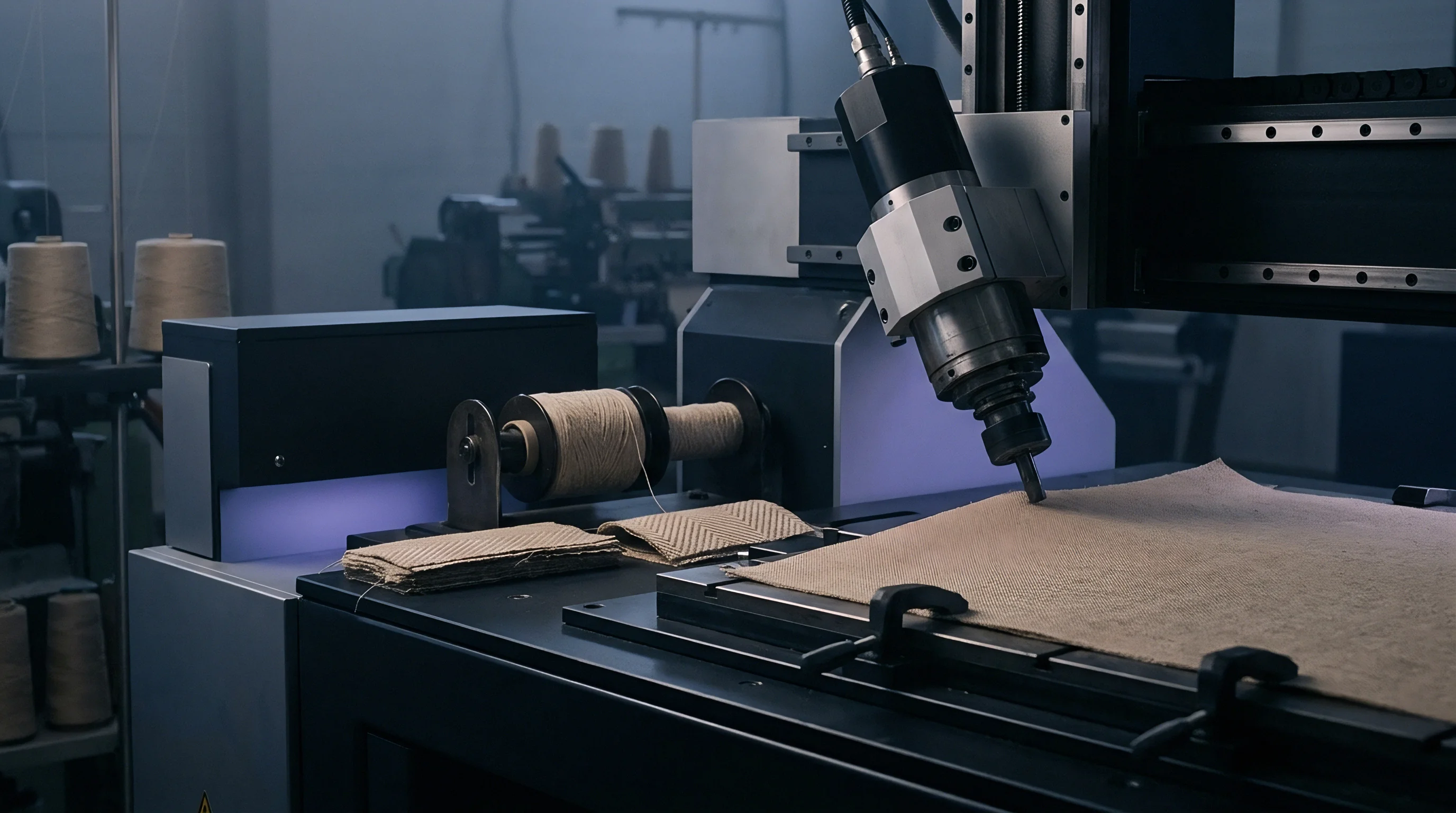
Customs laboratories verify declared yarn breakdowns by dissolving non-cellulosic components in zinc chloride or cupriethylenediamine solutions. ISO 1833-11 specifies the chemical procedure for separating flax and cotton mixtures. Standard atmospheric condition testing relies on an oven-dry mass comparison corrected by commercial moisture regain allowances: 12 percent for raw flax versus 8.5 percent for cotton.
Failing to calculate regain factors correctly skews laboratory test results, triggering improper reclassification from pure flax to blended tariff lines.
When yarn mass proportions sit near equality, customs officers systematically assign classification to the material carrying the highest standard duty rate.
Origin
Determining where a finished tablecloth was produced demands an examination of every manufacturing step from scutched fiber to sewn hem. Non-preferential origin dictates marking requirements and determines exposure to anti-dumping actions or section-specific safeguard tariffs. Preferential origin establishes whether an entry qualifies for duty-free treatment under free trade agreements.
Simple processing operations conducted in third countries fail to transfer origin across international borders.
How Do Processing Thresholds Shift Non Preferential Status?
Customs regulations across major importing jurisdictions mandate that simple cutting and hemming in a third country fail to confer nationality on imported goods. Cutting continuous woven cloth into table runner lengths and hemming the ends represents minor finishing. Non-preferential origin attaches to the country where the fabric was woven.
If grey linen fabric is woven in China, shipped to Vietnam for cutting, hemming, and packaging, the final article remains a product of China for customs valuation and tariff entry purposes.
Contracts specifying ISO 1833-11 testing obligate the seller to reimburse duty surcharges triggered by quantitative flax content variances greater than two percent.

Double Transformation in Textile Trade Agreements
Preferential trade regimes mandate that raw flax must undergo both yarn spinning and fabric weaving within participating member states to qualify for zero-tariff entry. European Union free trade protocols require that the yarn spinning stage and fabric weaving stage occur within regional partner territories for household linen products entering under preferential tariffs. Importing finished table linen cut and sewn in a partner state from Chinese-spun yarn violates the double transformation rule, exposing the importer to preferential duty clawbacks during post-clearance verification checks.
| Origin Regime | Governing Legal Criteria | Fibre to Yarn Rule | Fabric Weaving Rule | Cut and Sew Rule |
|---|---|---|---|---|
| Non-Preferential | Substantial Transformation | Does not confer origin | Confers primary origin | Insufficient to shift origin |
| Generalized System of Preferences | Single Transformation / Local Value | Optional regional origin | Mandatory within beneficiary | Mandatory local assembly |
| Regional Trade Agreements | Double Transformation Rule | Mandatory regional spinning | Mandatory regional weaving | Mandatory local finishing |
| Special Trade Sanctions | Country of Origin Marking Act | Traces raw scutched fiber | Traces loom shed site | Traces final port of export |
Incorporating Section 4.2 of the International Linen Import Standards into purchase orders shifts financial liability for re-classification duties directly onto the overseas vendor.


Dock
Border entry clearance requires parallel declarations of commercial value, physical mass, and total surface area. Customs brokers input specific tariff lines alongside weight metrics into entry summary documentation. Discrepancies between physical manifest weight and calculated dry weight alert border protection officers to possible duty evasion or improper fibre classification.
Container inspections involve physical sampling, weight audits, and physical dimension verification.
Single-needle hem stitching applied to cut rectangular fabric permanently shifts classification from woven piece goods to made-up articles.

Supplementary Measurement Metrics and Weight Discrepancies
Customs authorities utilize both kilograms and square metres to evaluate unit values and detect false invoice declarations. Entry declarations missing supplementary units face immediate system rejections at regional clearance portals. Net mass calculations exclude packaging cardboard, plastic film wraps, and wooden shipping pallets.
Linen absorbs ambient moisture during ocean transit, causing gross container weight to exceed invoice mass by three to six percent. Importers present pre-shipment dry mass certificates to justify transit weight gains during physical port inspections.
- Verify Gross Mass Weigh incoming shipping crates before customs filing to prevent mismatch against master bill of lading numbers.
- Audit Surface Area Calculate exact square meterage across all bed and table linen lines prior to generating customs manifest data.
- Reconcile Moisture Levels Adjust physical container weighments for ambient humidity uptake during sea transit.
- Check Container Seals Match physical seal numbers against port clearance papers to prove untampered custody during ocean freight.

Valuation and Physical Port Examination Procedures
Customs inspectors target containers where declared unit weights deviate by more than five percent from established historical baselines. Physical sampling requires pulling three finished articles from separate cartons within the container. Field agents examine edge construction, stitch counts per centimetre, and yarn consistency.
Samples head directly to customs analytical laboratories to test fiber composition under standardized conditions. Clearance delays average fourteen business days when laboratory testing is ordered at the port.
| Declared Metric | Mandatory Tariff Unit | Acceptable Variance | Inspection Trigger Conditions | Required Paperwork Proof |
|---|---|---|---|---|
| Net Fiber Weight | Kilograms (kg) | Plus or minus 3 percent | Weight gain exceeding 5 percent | Oven-dry mass certificate |
| Surface Area | Square Metres (m2) | Plus or minus 1 percent | Dimensional mismatch to invoice | Cutting pattern breakdown |
| Commercial Value | Declared Currency Value | Zero variance allowed | Unit value below raw fiber cost | Wire transfer invoice proof |
| Item Count | Number of Units (u) | Zero variance allowed | Carton count mismatch on bill | Packing list per pallet |
Marine humidity during transpacific shipment expands total bale mass beyond invoice specifications, leading to weight discrepancies at the port.

Dossier
Defending an entered tariff line during a post-clearance audit requires an unbroken paper chain connecting finished goods to raw scutched flax. Customs agencies audit entries up to five years after physical goods cross the border. Paperwork must substantiate yarn counts, fiber origins, finished article dimensions, and actual transaction values.
A missing mill certificate exposes the importer to total duty reassessment.
Customs inspectors reclassify hemmed table runners missing fibre percentage disclosures to the highest applicable synthetic tariff line.
Audit Records and Mill Level Proofs
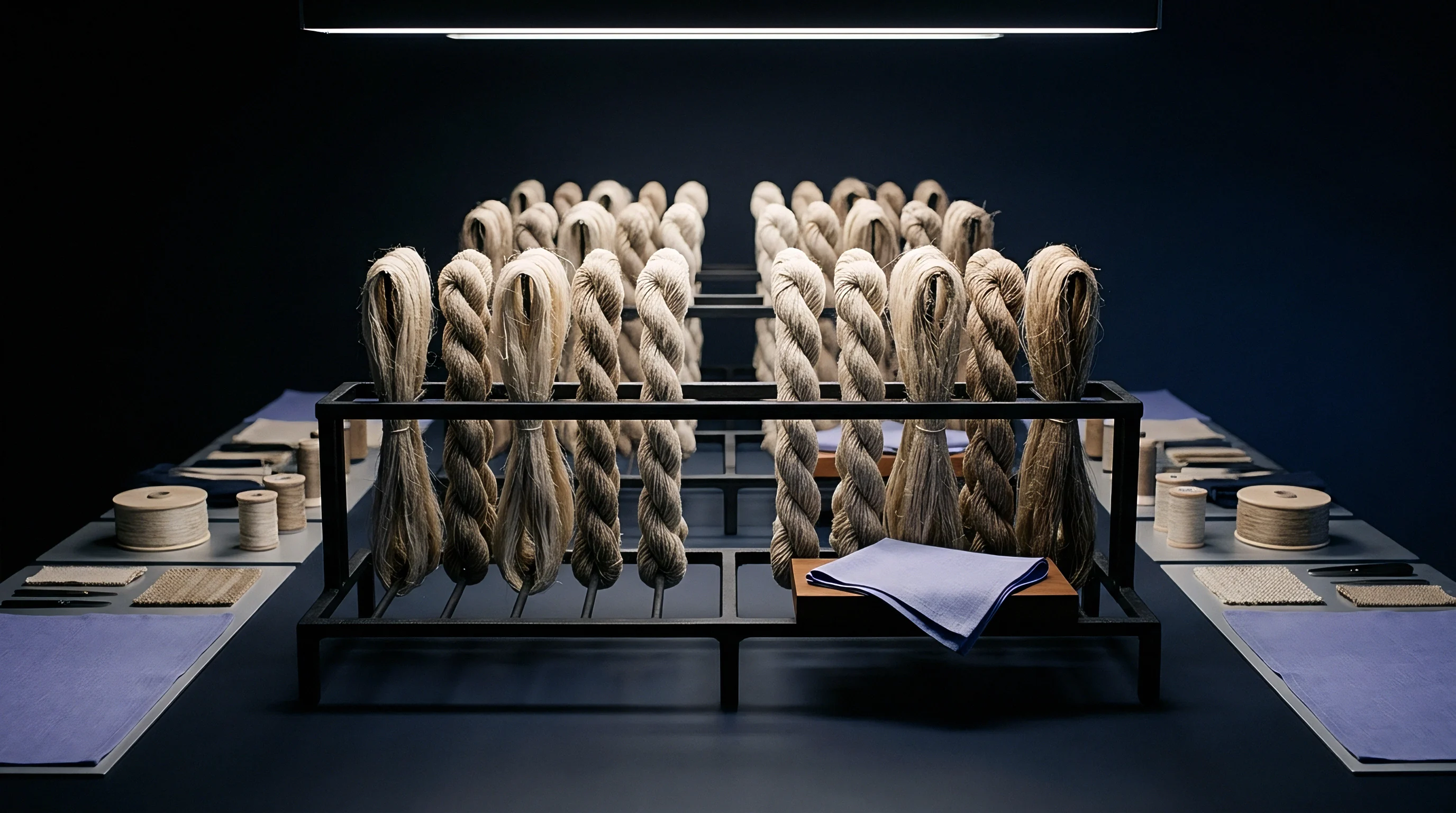
Linen importers compile raw material weighbridge tickets, spinning room batch cards, and loom production logs to prove genuine fiber origin. Bales of European flax carry individual tracking numbers linked to scutched fiber grading reports. Chinese spinning mills purchasing European flax must preserve import declarations, raw fiber storage ledgers, and yarn spinning registers.
Customs auditors trace lot numbers from final cut-and-sew packing slips back to grey cloth rolls and raw yarn shipments to confirm declared origin claims.
- Bale Tag Identification Barcoded labels affixed to raw flax bales recording harvest year, scutcher facility, and fiber grade.
- Spinning Batch Logs Mill ledger sheets detailing raw bale consumption per spun yarn lot number.
- Weaving Shed Schedules Loom output registers linking specific yarn lots to grey cloth roll numbers.
- Finishing House Receipts Bleaching, dyeing, and soft-wash batch records reflecting fabric weight changes.

Transaction Certificates and Scope Verification
Documentary chains remain valid only when transaction documents explicitly list batch lot numbers matching physical commercial invoices. Scheme certificates without batch numbers carry zero legal weight during customs audits. European Flax scope certificates certify mill processing infrastructure but do not prove that a specific shipment contains certified fiber.
Transaction certificates must explicitly reference invoice numbers, container marks, yarn lot numbers, and net fiber weights. Discrepancies between certified volumes and cleared volumes invalidate origin claims across the entire shipment.
Whether customs authorities will accept mass-balance reconciliation data from non-certified Chinese spinning mills without physical lot segregation remains uncertain.

Ruling
Obtaining formal classification decisions from customs authorities eliminates commercial exposure prior to high-volume container shipments. Binding Tariff Information decisions lock in specific tariff classification codes across European customs territories for three years. In the United States, prospective ruling letters issued by Customs and Border Protection provide legally binding classification protection.

Binding Tariff Information Application Mechanisms
Importers submit detailed physical samples, weave construction diagrams, and chemical lab breakdowns to national customs headquarters. The application detail must disclose precise fiber percentages, edge finishing methods, end-use intended functions, and origin processing paths. Issuing authorities conduct independent laboratory testing prior to publishing official ruling letters.
Once published, the binding ruling protects the importer against retroactive reclassification fines at port locations, provided the physical goods match the submitted ruling sample exactly.

Customs Penalties and Administrative Dispute Settlement
Reclassification decisions issued during post-clearance reviews trigger retroactive duty adjustments plus compound interest accrued from entry dates. Severe misclassifications involving origin fraud or intentional tariff code manipulation attract civil fraud penalties under customs law. Importers file administrative protests within statutory deadlines to challenge adverse classification rulings.
Protests present independent laboratory fiber analysis, weaving mill manufacturing records, and legal arguments built upon Harmonized System legal notes.
Securing advance classification decisions and maintaining audited lot-level test reports protects cross-border shipments against arbitrary reclassification at the port of entry.