Laboratory Oven Drying Protocol and Bale Core Moisture Settlement Adjustment
Laboratory oven drying of flax bale core samples establishes true dry mass to convert gross landed weights into contractually adjusted commercial invoice values.

Heat
The release of bound water from raw flax bundles is driven by thermal kinetics. Within the fibres, water molecules are held inside amorphous zones and inter-crystalline pore networks, bound to the hydroxyl groups of cellulose chains by hydrogen bonding that breaks down at elevated temperatures. Because dry mass measurements depend entirely on complete vaporization, forced air circulation inside the test chamber is used to sweep moisture from sample surfaces and maintain a continuous vapor pressure differential against the fibre core.

Thermal Kinetics of Bound Moisture Removal
Water remains trapped within microfibril channels via hydrogen bonding on the cellulose chains. Thermal extraction proceeds in two stages: free surface water evaporates first as temperatures approach boiling, followed by the slower diffusion of structurally bound moisture from deep within the bast fibre bundles, which requires sustained heat to overcome its molecular sorption energy.
Standard laboratory testing keeps drying temperatures strictly between 105 °C and 110 °C. Dropping below 105 °C leaves capillary water trapped inside dense flax bundles, artificially inflating the measured dry mass and lowering the calculated regain. Going above 110 °C, however, starts to break down non-cellulosic constituents.
Temperature Thresholds and Pectin Thermal Degradation
Exceeding recommended thermal thresholds leads to permanent loss of non-cellulosic binder mass. Flax technical fibres carry substantial amounts of pectin, hemicellulose, lignin, and plant waxes; of these, pectin compounds undergo pyrolytic breakdown during extended exposure above 112 °C. The resulting volatile organic compounds and chemical decomposition water evaporate along with the physical moisture, distorting the dry weight and overstating total moisture loss.
To prevent localized hot spots, precision temperature controllers hold spatial variation within ±1.5 °C across all drying shelves. Calibrated platinum resistance thermometers positioned next to sample trays track thermal distribution throughout multi-hour drying runs.
Temperature control within narrow physical bands prevents thermal decomposition of non-cellulosic binder matter during moisture extraction.
Because overheating degrades pectin polymer structures, maintaining drying chamber air flow at 20 to 30 volume changes per minute is essential to remove vaporized moisture before localized saturation slows extraction.
As capillary moisture falls past critical limits, fibre samples approaching structural equilibrium exhibit non-linear drying curves.


Bore
Taking representative core specimens from 350 kilograms compressed bales requires high-torque mechanical drives. Hydraulic baling creates dense outer walls that block passive air movement, trapping moisture deep inside the bale. Surface sampling is unreliable here, as outer layers continuously exchange water vapor with ambient air throughout transit.
| Probe Characteristic | Technical Specification | Operational Purpose |
|---|---|---|
| Inside Diameter | 19.0 mm to 25.4 mm | Prevents compression shear of flax technical fibres during penetration |
| Effective Barrel Length | 800 mm to 1200 mm | Reaches geometric center of standard 350 kg compressed bales |
| Tip Construction | Hardened stainless steel with scalloped edge | Cuts cleanly through dense fibre bundles without heat generation |
| Rotational Speed | 400 RPM to 600 RPM | Minimizes friction heating that drives off volatile moisture during coring |
| Container Integrity | Vapor-tight aluminum or double-barrier seal | Eliminates evaporative mass loss prior to initial bench weighing |
Penetration Geometry in High Density Bales
Density inside compressed flax bales can reach 400 kilograms per cubic meter near the core. To cross internal moisture boundaries accurately, sampling tools must enter along the longitudinal axis, perpendicular to the compressed fibre layers. High core density restricts moisture transfer, leaving outer layers to dry much faster than the interior.
If driven parallel to the fibre layers, probes tend to drift along density gradients and miss the central pockets where moisture collects. Technicians must advance coring tubes to two-thirds of total bale length to obtain a representative profile.

Container Sealing to Prevent Evaporative Bias
Fibre taken from bale interiors sheds moisture rapidly when exposed to dry room air. The thermal gap between warm extracted cores and cooler laboratory space drives surface evaporation within seconds, making immediate sealing essential before initial weighing.
Standard procedures require transferring extracted cores straight into tared, air-tight aluminum containers or zero-headspace polyethylene bags. Containers must be sealed immediately as the probe is withdrawn, and initial gross mass recorded within two minutes to prevent room air from skewing the wet mass baseline.
- Inadequate penetration depth failing to reach the central core zone where residual retting moisture concentrates after pressing.
- Thermal loss during coring caused by dull probe cutting edges operating at excessive rotational speeds that heat extracted fibres.
- Delayed container sealing allowing ambient laboratory environment exposure to dry wet core samples before recording baseline weights.
- Uncalibrated container tare mass introducing systematic weighing errors across multiple core sample batches.
- Non-random bale selection sampling only outer pallet positions while ignoring interior container stacks exposed to distinct thermal histories.
Failing to maintain air-tight containment between coring and initial balance weighing causes unrecorded moisture loss. This inflates calculated dry mass, understates moisture adjustments, and directly causes unrecoverable under-billing for the buyer.


Regain
Raw linen trade relies on a clear distinction between dry matter content and baseline moisture addition. While moisture content expresses water mass relative to total wet mass, commercial moisture regain calculates water mass as a percentage of completely dry fibre mass. Converting correctly between these two metrics prevents systematic errors during invoice settlement.
Mathematical Distinction between Content and Regain
Moisture content measures water mass relative to initial wet mass, whereas regain references that same water against oven-dry mass. Because flax fibres absorb water deep into structural pores, complete oven drying is required to drive off free moisture entirely.
For example, a wet sample of 100 grams yielding 88 grams of dry fibre contains 12 grams of water. Expressed as moisture content, this is 12 percent. Expressed as regain, dividing 12 grams by the 88 grams of dry matter gives 13.64 percent.
Confusing the two metrics understates billable dry mass adjustments.
| Processing Stage | Standard Regain (%) | Contractual Reference Standard |
|---|---|---|
| Scutched Raw Flax Fibre | 12.00 | ISO 6741-1 / CILC Standard Terms |
| Hackle Tow Fibre | 12.50 | ISO 6741-1 / Trade Specification |
| Boiled or Bleached Flax Yarn | 12.00 | BISFA Standard Rules |
| Grey Raw Linen Yarn | 12.00 | ISO 6741-2 / European Flax Rules |
| Finished Linen Fabrics | 8.50 to 10.50 | Commercial Buyer Agreement |
Contractual Regain Baselines across Processing Stages
Standard moisture benchmarks set by international trade rules reflect the natural hygroscopic equilibrium of different textile stages. Scutched raw flax carries a standard commercial regain allowance of 12.00 percent under European Flax guidelines and ISO 6741 provisions; any shipment delivered above this level carries excess weight that must be deducted from invoiced billable mass.
Spinning mills calculate purchase terms using standardized commercial mass, defined as oven-dry mass multiplied by one plus the contractual standard regain percentage. Delivering fibre below the standard regain produces a commercial mass higher than the physical weighbridge scale weight, entitling the supplier to a contractually valid upward invoice adjustment.
ISO 6741-1 mandates standard commercial regain allowances for raw scutched flax at exactly 12.00 percent calculated on anhydrous dry mass.
Under standard international commercial rules, raw flax delivery invoices must be settled strictly on calculated commercial mass rather than raw weighbridge scale weights.

Desiccation
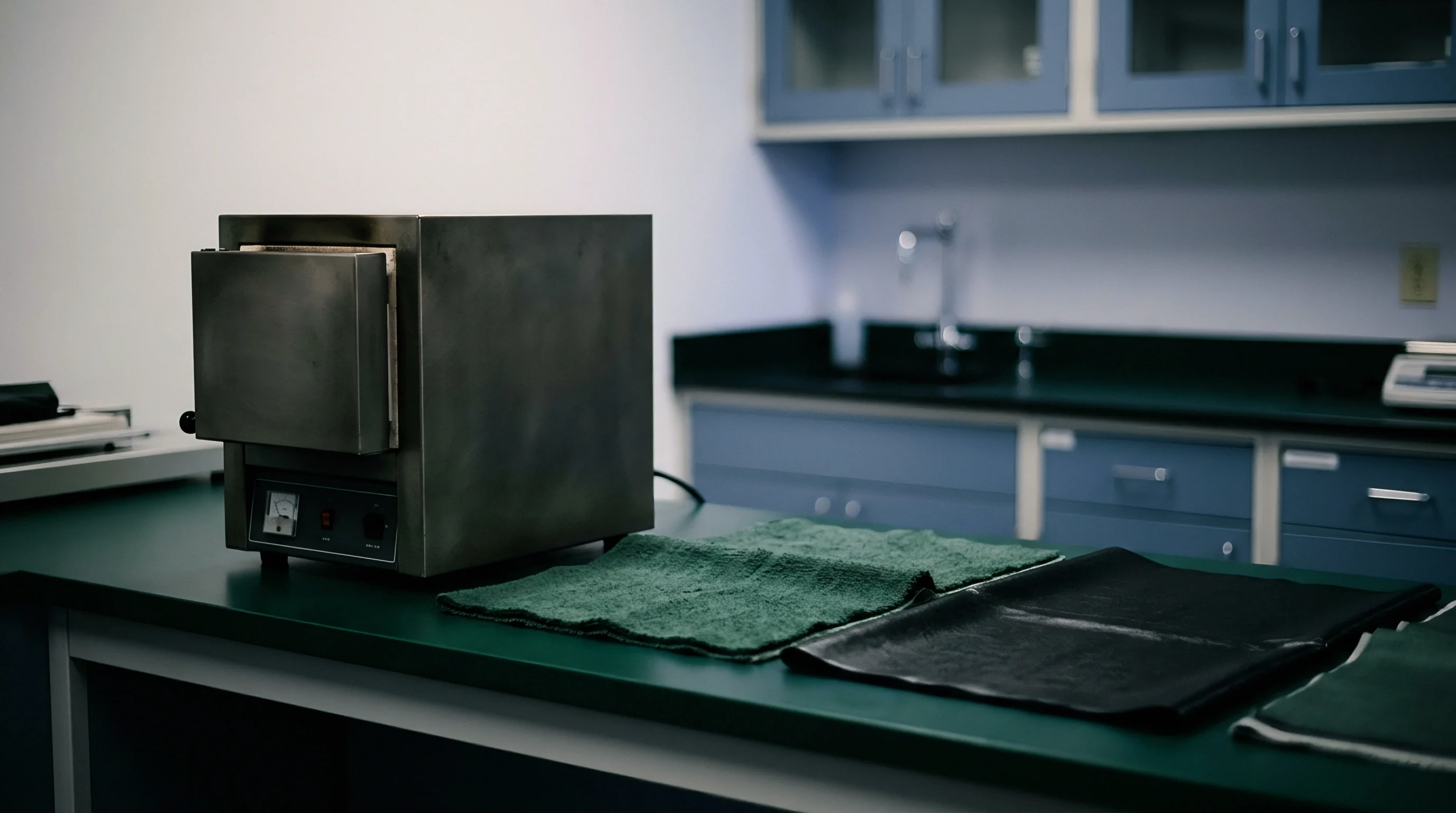
Laboratory ovens operating under ISO 6741-2 use forced air circulation to dry samples to a constant state. Testing protocols require continuous heating until successive weighings show mass variation below strict precision limits. Afterwards, containers cool inside sealed desiccators with active silica gel or molecular sieves to prevent moisture reabsorption.
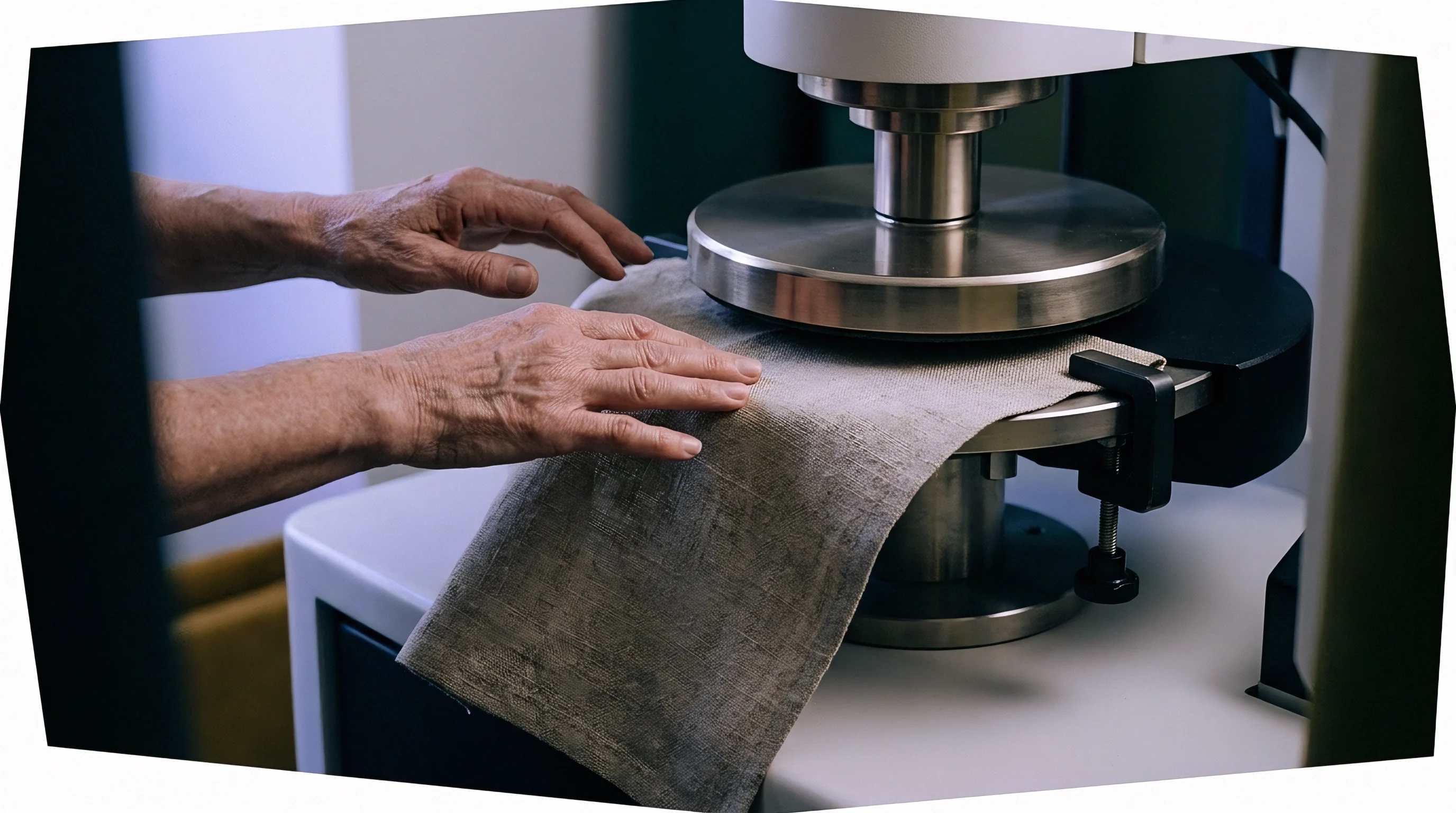
Constant Mass Determination Procedure
Timed consecutive mass readings confirm that volatile moisture has been fully driven off. Using calibrated analytical balances, initial oven heating runs for at least four hours at 105 °C.
- Extract core specimens using a clean pneumatic probe and seal them immediately inside tared metal weighing bottles.
- Weigh the sealed bottle containing wet fibre to 0.001 gram precision to establish baseline gross mass.
- Uncap the weighing bottle inside the drying oven chamber, placing the lid beneath the container base.
- Maintain chamber temperature at 105 °C ± 2 °C with continuous forced ventilation for four hours.
- Cap the bottle inside the oven chamber using insulated forceps prior to container removal.
- Transfer capped bottles to a desiccator cabinet containing fresh silica gel for thirty minutes of cooling.
- Weigh the cooled container on an analytical balance protected from draft currents.
- Repeat one-hour heating, cooling, and weighing cycles until successive weighings differ by less than 0.05 percent of sample mass.
Atmospheric Reabsorption and Tared Container Protocols
Anhydrous flax absorbs moisture within seconds if exposed to ambient laboratory air, as dried cellulose acts as a strong desiccant. Opening warm sample containers outside a desiccator draws room air inside, artificially inflating final dry mass readings.
Desiccator performance depends on fresh media. When indicating silica gel turns from deep blue to pink, it is saturated and requires thermal reactivation at 150 °C. Ground-glass joints and silicone seals should be checked weekly to verify container tightness during sample cooling.
Ambient ocean transit humidity can naturally increase bale scale weights during voyage without altering the underlying dry fibre mass delivered under contract terms.

Settlement
Commercial invoice reconciliations convert laboratory moisture test data into adjusted billable weights. Physical landed weights recorded at mill weighbridges are only starting operational inputs; unadjusted scale weights often misrepresent actual billable fibre. Financial settlement formulas calculate corrected commercial mass by combining verified laboratory dry mass with agreed standard regain figures.

How Does Commercial Regain Shift Invoice Values?
Financial adjustments arise whenever delivered physical weights diverge from the contractual moisture regain baseline. If bales arrive at 14.50 percent actual regain against a 12.00 percent contract specification, the buyer is paying for excess water. Laboratory oven drying quantifies this surplus, establishing true dry weight to calculate mandatory price deductions.
Conversely, consignments delivered at 9.50 percent actual regain contain more dry cellulose per scale kilogram than specified. Adjusting for low regain increases final billable weight, entitling the supplier to an upward invoice settlement. Calculating adjustments on true dry mass protects both counterparties from ambient shipping variations.
| Parameter | Measured / Defined Value | Calculation Basis |
|---|---|---|
| Delivered Gross Scale Mass (M) | 20,000.00 kg | Verified Destination Weighbridge Ticket |
| Laboratory Actual Moisture Regain (Ractual) | 14.50 % | ISO 6741-2 Core Sample Oven Test Average |
| Contractual Standard Regain (Rstd) | 12.00 % | Contract Baseline Specification |
| Calculated Oven Dry Mass (MD) | 17,467.25 kg | MD = M / (1 + (Ractual / 100)) |
| Corrected Commercial Mass (MC) | 19,563.32 kg | MC = MD × (1 + (Rstd / 100)) |
| Settlement Weight Adjustment (Δ M) | -436.68 kg | Δ M = MC – M |
| Contract Unit Price | $5.20 / kg | Agreed CIF Destination Port Rate |
| Final Financial Settlement Adjustment | -$2,270.74 Credit | Buyer Invoice Deduction Issued to Seller |

Commercial Settlement Formula and Invoice Recalculation
Standard mathematical conversions convert gross scale mass into corrected invoice weight. The dry mass formula divides physical delivered weight by one plus the actual regain percentage expressed as a decimal; multiplying this result by one plus the contractual standard regain percentage yields the final commercial mass on which debits or surcharges are based.
Because factors like sampling depth and drying air circulation directly influence test readings, commercial fibre transactions rely strictly on verified dry mass as the base calculation for moisture settlement adjustments.
- Log destination weighbridge weights immediately upon vehicle arrival, recording gross, tare, and net vehicle scale values.
- Extract core samples within 24 hours of arrival following geometric core sampling protocols across selected bales.
- Execute oven drying tests to constant mass using 105 °C forced-air desiccators and calibrated analytical balances.
- Calculate dry mass values by applying laboratory regain averages across total net weighbridge delivered tonnage.
- Derive commercial settlement mass using standard contractual regain baselines and issue formal credit or debit claims within established contract timeframes.
A delivered 20-tonne flax consignment tested at 14.50 percent actual regain generates a contractually mandatory $2,270.74 invoice deduction at $5.20 per kilogram.
Settlement claims backed by certified ISO 17025 laboratory test certificates move directly to accounting reconciliation, with formal debit notes issued against open seller balances within thirty calendar days of vessel discharge.
Arbitration
Disagreements between flax sellers and spinning mills over core moisture findings require formal arbitration protocols. Contracting parties designate referee laboratories certified under ISO 17025 to perform binding re-tests, relying on retained reference samples stored under controlled atmospheric conditions and double-sealed security to resolve financial disputes.
Retained Reference Sample Integrity and Retention
Duplicate core specimens collected during initial sampling serve as referee stock for commercial disputes. Sampling teams divide cores into three identical portions ~ one for immediate buyer testing, one for seller verification, and one sealed referee sample held by an independent warehouse keeper. Storing the referee sample in heat-sealed, foil-laminated aluminum bags maintains original moisture levels for up to ninety days.
Tamper-evident seals with unique serial numbers protect referee containers against unauthorized access. Opening or damaging container seals without both counterparties present invalidates the sample’s standing in formal arbitration.
| Parameter Variance | Tolerance Band | Commercial Action Triggered |
|---|---|---|
| Regain Discrepancy < 0.30% | Acceptable Range | Original buyer test result governs settlement without adjustment |
| Regain Discrepancy 0.30% to 0.75% | Moderate Variance | Mathematical average of buyer and seller test results applied |
| Regain Discrepancy > 0.75% | Significant Discrepancy | Referee sample dispatched to accredited ISO 17025 test laboratory |
| Weight Scale Variance > 0.20% | Weighbridge Error | Third-party weighbridge calibration check required before invoice settlement |
Tolerance Thresholds for Third Party Laboratory Claims
Contracts specify explicit percentage thresholds before independent testing can overrule initial factory core results. Discrepancies below 0.30 percent moisture regain between buyer and seller tests fall within standard laboratory measurement uncertainty; under these conditions, parties accept the buyer’s initial core determination without further invoice adjustment.
When variances exceed 0.75 percent moisture regain, either party may submit the sealed referee core sample to an agreed third-party laboratory. Standard trade rules make the referee laboratory result final and binding, with the losing party covering all testing fees and administrative expenses.
What structural modifications occur within high-density flax bales during long ocean voyages under extreme equatorial thermal cycling that alter core moisture distribution beyond the reach of standard core sampling models?