Nonlinear Hydrodynamic Permeability Models for Heterogeneous Bast Fibre Bundles with Variable Shive Content
Nonlinear permeability in bast bundles depends on shive-induced inertial drag and hygroscopic swelling, making sub-two-percent shive essential for fast infusion.

Void
Differential pressure readings across an unretted flax mat clamped at sixty percent target volume fraction drift upward within twenty seconds of constant-flux injection. Calibrated silicone oil circulating through a circular Darcy cell at twenty-three degrees Celsius records a baseline permeability of 4.2 multiplied by ten to the minus eleven square metres under low-velocity creeping flow. Accelerating superficial fluid velocity past three millimetres per second reveals a marked departure from standard linear Darcy behavior: inter-bundle capillary gaps compress under fluid friction while dense intra-bundle lumens remain dry, producing an irregular wetting envelope that distorts the flow front.
Bast fibre architectures present dual-scale porous structures. Elementary fibres with mean diameters between twelve and twenty-eight micrometres assemble into technical bundles measuring forty to eighty micrometres across, held together by pectinaceous middle lamellae. Mechanical processing leaves variable fractions of woody shive debris interspersed between these bundles.
Fluid pathways divide into inter-bundle macro-cavities and tight intra-bundle micro-channels, establishing two competing permeability domains that respond dissimilarly to incoming viscous drag.
A porous fibrous bed composed of heterogeneous bast bundles divides liquid passage between high-velocity macro-cavities and capillary-driven intra-bundle channels.
Permeability values reported on standard supplier technical datasheets routinely assume homogeneous media described by the Kozeny-Carman relation, an assumption that fails inside technical bast textiles. The Kozeny constant varies continuously between 3.5 and 9.2 across differing compaction levels because the packing arrangement of irregular polygonal bundles shifts during mold closure. When shive fragments enter the array, the local geometric arrangement distorts further, changing the effective hydraulic radius and introducing tortuous dead-end pockets.
A rigorous hydrodynamic analysis classifies the empty space within the packed bed into three distinct structural volumes that dictate fluid conveyance:
- Inter-bundle macro-cavities convey the bulk viscous stream along bundle perimeters where low drag coefficients yield high superficial velocities during initial mold filling.
- Intra-bundle micro-channels generate high capillary suction pressures exceeding two bar that draw fluid slowly into compact elementary clusters through transverse wicking.
- Intra-shive cellular pores trap stagnant liquid inside stiff xylem lumens, starving adjacent active flow fronts and delaying complete composite wet-out.
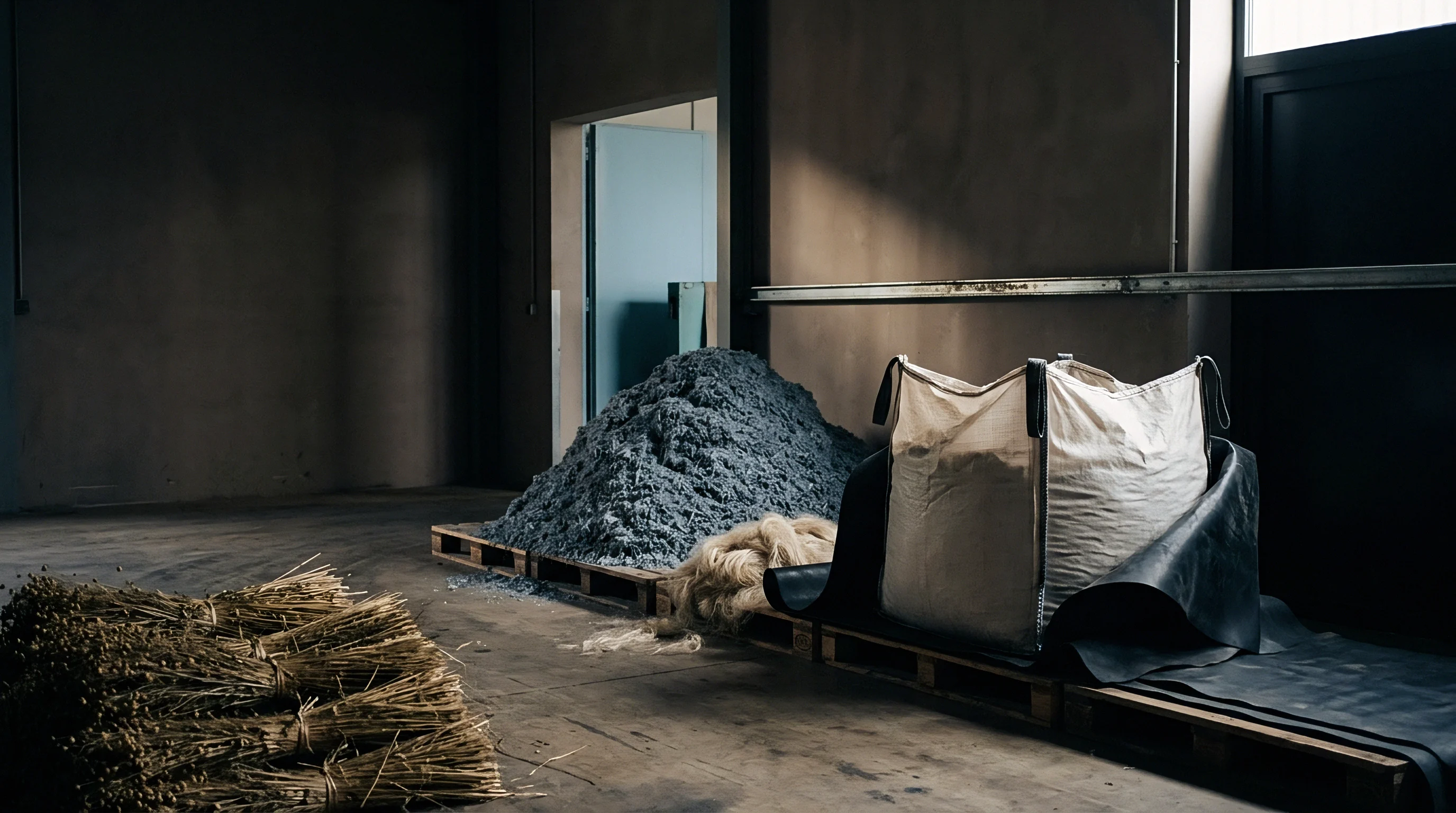
Bale graders who inspect incoming scutched flax routinely dismiss low-level shive contamination as a cosmetic defect easily extracted at the carding head.

Hurd
Decortication efficiency determines the residual proportion of shive, commonly termed hurd, retained within the technical fibre bundle stream. ASTM D5103 gravimetric separation combined with optical scan sorting quantifies hurd content, which fluctuates from 0.8 percent in premium hackled line to over 14.5 percent in unrefined tow. These xylem particles exhibit rigid, porous, cellular structures composed of lignified parenchyma tissue and hollow vessels.
Their mechanical stiffness prevents them from conforming to the laminar flow pathways established by compliant, elongated bast bundles under out-of-plane compression.
Local packing mechanics shift dramatically around each rigid inclusion. When a roving or needle-punched mat undergoes mechanical compaction inside a rigid mold, bast bundles bend around the stiff shive particles, creating localized low-porosity zones directly above and below the inclusion where pressure gradients steepen immediately. Simultaneously, tangential high-porosity run-off channels develop along the flanks of the shive particle, allowing fluid to bypass the obstruction through low-resistance tracks and destabilizing macroscopic resin progression.
Rigid woody particles distort adjacent flexible bundles to open low-resistance bypass tracks that cause uneven wetting fronts.
Interior cellular cavities in the xylem fragments contain open pits that absorb liquid through capillary imbibition, acting as local sinks that deplete fluid mass from the primary pressure wave. Because shive fragments lack the mechanical flexibility of degummed bast filaments, they resist transverse consolidation during vacuum debulking, creating regional variations in packing fraction that span fifteen to twenty-five percent across distances of less than five millimetres.
| Lot Designation | Shive Content Mass Fraction | Bed Compaction Pressure Bar | Bulk Porosity Value | In-Plane Permeability K1 Square Metres | Kozeny Constant Value |
|---|---|---|---|---|---|
| Line Flax Dew-Retted Grade A | 0.012 | 2.5 | 0.48 | 6.4e-11 | 4.12 |
| Line Flax Water-Retted Grade B | 0.028 | 2.5 | 0.47 | 5.1e-11 | 4.68 |
| Scutched Tow Dew-Retted Grade C | 0.065 | 2.5 | 0.45 | 3.2e-11 | 5.85 |
| Unrefined Decorticated Tow Grade D | 0.124 | 2.5 | 0.42 | 1.4e-11 | 7.94 |
| Crude Bast Ribbon Industrial | 0.185 | 2.5 | 0.39 | 6.8e-12 | 10.35 |
Quality grading protocols executed at the dry-processing stage verify contamination thresholds through calibrated sampling steps that link directly to hydraulic stability:
- Gravimetric furnace ashing tracks inorganic dirt and surface contaminants against organic woody biomass, setting the baseline mineral tare.
- High-resolution planar imaging scans five-hundred-gram flattened slivers across flatbed optical arrays, registering shive surface area ratios and particle aspect dimensions within fifteen minutes.
- Transverse air-flow permeability measurement establishes baseline gas conductance through the dry sliver column prior to liquid exposure, identifying dense localized chokes.
- Compression platten deflection testing records consolidation strain under four-bar clamping loads, identifying unyielding hurd clusters that threaten final laminate thickness uniformity.
Downstream liquid molding operations that admit unmonitored shive fractions run into unfill defects, severe void accumulation along macro-capillaries, and premature resin gelation before the furthest reinforcement boundaries achieve saturation.

Regime
Creeping laminar flow characterized by Darcy conditions breaks down inside heterogeneous natural textiles long before pore-scale Reynolds numbers reach unity. As superficial injection velocity increases, convective acceleration through converging and diverging inter-bundle bottlenecks introduces microscopic inertial losses, requiring quadratic and cubic momentum resistance terms in the governing hydrodynamic model to reconcile pressure dissipation across high-speed resin transfers.
Modified Forchheimer formulations express the macroscopic pressure gradient as an explicit polynomial expansion of velocity. The hydrodynamic balance balances the linear viscous dissipation governed by the second-order permeability tensor with a non-linear inertial dissipation coefficient. In beds containing variable shive, this inertial coefficient scales inversely with the square root of the intrinsic permeability while rising with shive fraction.
The presence of abrupt, bluff-bodied wood fragments induces flow detachment and micro-scale wake vortices in the interstitial fluid paths.
Pore-scale Reynolds numbers exceeding 0.08 generate measurable inertial pressure losses that undermine classical linear Darcy assumptions during composite vacuum infusion.
Brinkman boundary formulations describe the shear stress exchange occurring at the interface between high-permeability macro-cavities and dense intra-bundle porous zones. Fluid shearing along the exterior boundary of a flax bundle transfers momentum into the stagnant intra-bundle fluid, dragging viscous mass through tightly packed elementary fibres without relying entirely on capillary action. Effective fluid viscosity inside the Brinkman term deviates from bulk resin viscosity due to wall exclusion phenomena and mechanical filtration of macro-molecular polymer chains at the bundle boundary.
| Flow Condition | Pore Reynolds Range | Dominant Resistance Mode | Mathematical Formulation | Applicable Bed Region |
|---|---|---|---|---|
| Creeping Viscous | Below 0.01 | Viscous shear against walls | Grad P equals minus mu divided by K times v | Tight intra-bundle channels |
| Brinkman Boundary Layer | 0.01 to 0.08 | Coupled bulk shear and drag | Grad P equals minus mu divided by K times v plus mu_eff times Laplacian v | Macro-micro interface perimeter |
| Weak Inertial Forchheimer | 0.08 to 0.45 | Viscous drag plus convective momentum | Grad P equals minus mu divided by K times v minus beta times rho times v squared | Inter-bundle macro-cavities |
| Strong Non-Darcian Inertial | Above 0.45 | Form drag and interstitial separation | Grad P equals minus mu divided by K times v minus beta times rho times v squared minus gamma times rho squared divided by mu times v cubed | Shive wake vortex regions |
Worked hydrodynamic models demonstrate the magnitude of error introduced when engineers omit non-linear momentum terms during high-pressure liquid injection. Assume an in-plane unidirectional resin transfer molding trial: scutched flax tow reinforcement exhibits a baseline Darcy permeability K equal to 3.5 multiplied by ten to the minus eleven square metres and an inertial Forchheimer coefficient beta equal to 8.4 multiplied by ten to the fifth metres to the minus one. Fluid viscosity mu measures 0.15 Pascal-seconds, and fluid density rho is 1120 kilograms per cubic metre.
Superficial velocity v operates at 0.015 metres per second across a flow path length of 0.8 metres.
Calculating the pressure drop through the linear Darcy relation yields:
Delta P_Darcy equals (mu multiplied by L divided by K) multiplied by v
Delta P_Darcy equals (0.15 multiplied by 0.8 divided by 3.5e-11) multiplied by 0.015 equals 51,428 Pascals, or 0.514 bar.
Evaluating the inertial correction through the Forchheimer quadratic term yields:
Delta P_Forchheimer equals beta multiplied by rho multiplied by L multiplied by v squared
Delta P_Forchheimer equals 8.4e5 multiplied by 1120 multiplied by 0.8 multiplied by (0.015 squared) equals 169,344 Pascals, or 1.693 bar.
The total hydrodynamic pressure drop sums to 2.207 bar. Relying strictly on the linear Darcy calculation underestimates the actual injection pressure penalty by more than seventy-six percent under these processing parameters. When shive contamination increases the inertial parameter beta past 2.1 multiplied by ten to the sixth metres to the minus one, mold clamping fixtures engineered solely around Darcy estimates experience seal blowouts and platen separation.
Dual-scale saturation adds a transient temporal non-linearity to the process. Intra-bundle micropores fill far slower than adjacent macro-cavities. At the advancing macroscopic front, liquid races ahead through the empty lanes between bundles, encapsulating the bundle clusters before transverse capillary wicking can evacuate interior air.
The local sink term in the continuity equation acts as a dynamic volumetric drain that siphons fluid away from the leading edge, decelerating the macroscopic boundary until internal bundle saturation approaches equilibrium.
What remains unanswered in current multi-scale hydrodynamic formulations is the exact mathematical function describing how local capillary sink terms decay once high injection pressures forcibly compress the compressible gas trapped within the intra-bundle core.

Swell
Moisture transfer between injected polar liquids and dry lignocellulosic walls triggers rapid dimensional distortion of the pore architecture. Elementary flax cells contain hydrophilic amorphous cellulose, hemicellulose, and pectin networks that absorb hydroxyl-compatible penetrants through hydrogen bonding, causing radial swelling that constricts the micropores. Transverse expansion rates of flax bundles reach twenty-five to thirty-five percent within four minutes of contact with polar fluids, while axial bundle elongation remains under 1.5 percent.
Swelling alters hydrodynamic permeability dynamically during the actual infusion cycle. As technical bundles expand radially into the macro-cavities, the open volume fraction available for bulk convective transport shrinks. Concurrently, internal bundle lumens expand or collapse depending on wall turgor and local confining pressures, rotating the permeability tensor.
Over an infusion run lasting thirty minutes, the absolute in-plane permeability of a dew-retted bast mat exposed to aqueous or polar thermoset matrices decays by twenty to fifty percent relative to initial dry-gas baseline measurements.
Woody hurd fragments respond with volumetric swelling kinetics distinct from bast filaments. Shive tissue absorbs liquid rapidly through open xylem vessels but exhibits lower ultimate transverse expansion due to its rigid, cross-linked lignin matrix. This dimensional mismatch causes local structural rearrangements: expanding bast fibres pinch against rigid shive chunks, narrowing adjacent passage channels while buckling neighbouring filaments into the remaining open tracks.
Laboratory testing of dynamic permeability requires tight control over fluid-fibre interactions to prevent experimental artifacts from corrupting hydrodynamic coefficients:
- Test fluid compatibility screening identifies whether test fluids exhibit non-reactive, non-swelling characteristics, preferring certified hydrocarbon calibration oils over polar aqueous media during baseline structural benchmarking.
- Continuous flow decay logging tracks real-time pressure escalation at constant volumetric delivery over sixty minutes, isolating hygroscopic swelling coefficients from mechanical particle migration.
- Pre-conditioning humidity stabilization equilibrates incoming test mats to precisely sixty-five percent relative humidity at twenty degrees Celsius, neutralizing initial moisture disparities across differing agricultural lots.
When assessing fluid penetration through unrefined bast preforms, rapid initial wetting along bundle perimeters gives way to progressive flow choking as internal cell walls expand into the transport gaps.
Ledger
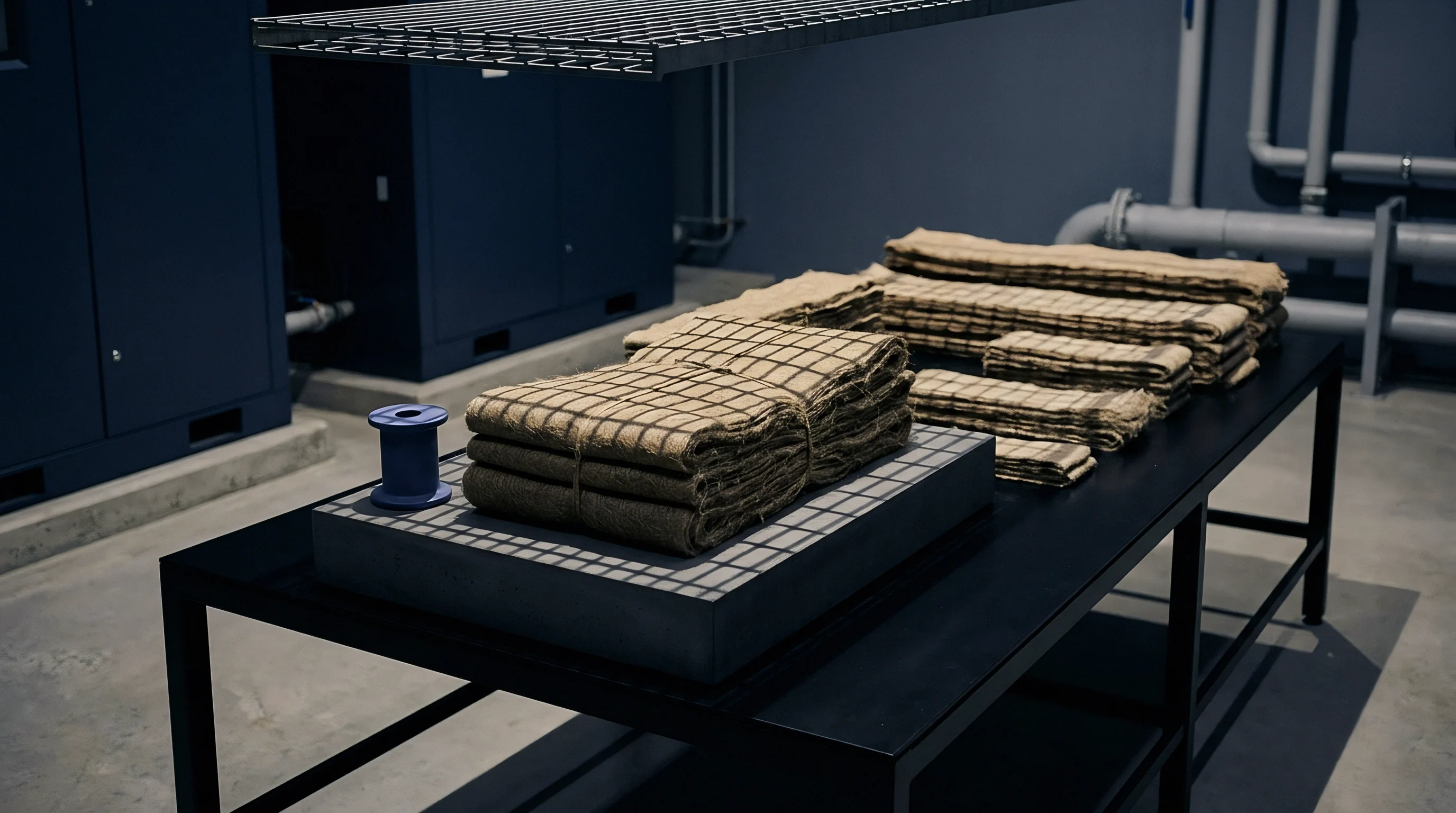
Material costs for reinforcement textiles reflect upstream cleaning rigor. Dew-retted scutched flax tow carrying eight to twelve percent shive trades at approximately 2.80 to 3.40 euros per kilogram at European shipping ports. Passing that raw tow through repetitive carding, combing, and refining operations to drop shive below 1.5 percent produces high-grade hackled sliver commanding 6.20 to 8.50 euros per kilogram.
A buyer balances this raw mass expenditure against production scrap rates and cycle times recorded at the composite press.
The presence of unrefined shive degrades process yield across the manufacturing floor. In resin infusion operations producing technical panels of five-millimetre thickness, localized flow disruptions from shive inclusions generate dry spot scrap rates averaging 8.5 percent when tow mat is used without refinement. Elevating raw reinforcement purity to combed line standards drops dry spot defects below 0.5 percent while shortening cycle infusion duration from twenty-six minutes down to eleven minutes, permitting three times the daily mold turnover to spread tooling overhead across significantly higher finished output.
Commercial supply agreements for composite-grade bast sliver mandate gravimetric shive thresholds below two percent to prevent cycle time escalation and infusion dry spots.
Resin consumption provides an additional cost variance. Porous xylem tissue in residual hurd fragments absorbs high-cost epoxy or vinyl ester resin through dead-end capillary uptake without contributing to tensile strength. A reinforcement mat containing ten percent shive fraction increases resin intake by 140 grams per square metre compared to clean line flax reinforcement at identical fiber volume fractions.
At an average formulated epoxy price of 5.80 euros per kilogram, this parasitic absorption adds 0.81 euros of wasted matrix cost to every square metre of finished composite laminating.
| Fibre Material Grade | Reinforcement Cost Euros per Kilogram | Parasitic Resin Loss Grams per Metre | Infusion Cycle Duration Minutes | Laminate Scrap Rate Percent | Delivered Part Cost Euros per Metre |
|---|---|---|---|---|---|
| Crude Scutched Tow 12 Percent Shive | 3.10 | 165 | 28.5 | 9.2 | 18.40 |
| Carded Bast Mat 6 Percent Shive | 4.40 | 85 | 18.0 | 4.5 | 16.85 |
| Refined Sliver 2 Percent Shive | 6.80 | 22 | 11.5 | 1.2 | 16.10 |
| Combed Line Flax 0.8 Percent Shive | 8.20 | 8 | 9.0 | 0.4 | 17.30 |
The optimal commercial balance settles on refined sliver carrying between 1.5 and 2.5 percent residual hurd. While crude tow appears cheap on initial purchase invoices, downstream cycle penalties, unfill discards, and parasitic matrix waste elevate the net square-metre manufacturing cost well above that of cleaned material. High-end combed line flax achieves the lowest scrap and fastest cycle, but its high purchase price per kilogram raises finished part costs beyond the commercial envelope demanded by mass-market transportation components.
Master supply agreements stipulate that deliveries exceeding 2.5 percent hurd by gravimetric test trigger automatic rebate deductions of twenty cents per kilogram for every excess percentage point.