Determining Flax Fibre Fineness Using Standard Air Flow Instruments
Airflow instruments measure specific surface area to rapidly determine flax bundle metric count, predicting spinning limits and hackling yield.
Permeability

Air Flow Mechanics in Bast Bundles
Airflow testing on flax measures fluid resistance through a packed porous plug rather than examining isolated fibres. When gas is forced through the cylindrical chamber, pressure drops across the length of the specimen. The Kozeny-Carman equation governs this laminar regime, tying specific surface area directly to permeability.
Fine filaments present a large external boundary per unit mass, constricting viscous flow and raising backpressure. Coarser aggregates leave broader channels between bundles, letting air pass with far less resistance.
Cotton micronaire methods do not transfer cleanly to bast fibres. A single cotton cell has relatively uniform boundaries and a tight density distribution. Flax, by contrast, arrives as composite technical bundles held together by middle lamella pectins and hemicelluloses, with dozens of individual ultimates running parallel along the stem axis.
The effective diameter captured by an airflow meter therefore depends on the degree of split achieved during retting and mechanical scutching. Incompletely decorticated bundles present artificially low surface areas, reading on the manometer as falsely coarse fibres.
Under standard conditioning at 20 degrees Celsius and 65 percent relative humidity, a two-gram shift in moisture regain moves the apparent airflow fineness by five percent.
Direct gravimetric methods remain the baseline reference for these pneumatic models. The cut-and-weigh procedure under ISO 2370 uses a fixed guillotine gauge to isolate central bundle sections and establish metric count. Airflow gauges substitute that slow, destructive tally with an immediate pressure reading.
High-throughput mills rely on these tests to settle blend ratios before bales ever reach the carding head.
Bast cross-sections rarely resemble clean cylinders. Flax ultimates are polygonal with irregular lumens, and the technical bundles have heavily creviced perimeters. Air moving past these profiles sets up uneven boundary layers that increase drag.
While those irregularities complicate absolute diameter calculations, the measured hydrodynamic surface area tracks closely with drafting resistance on the spinning frame. A lot with high airflow resistance packs hard into the drawing gills, which forces an adjustment to the draft ratio.
Industrial laboratories operate several standard air permeameters across quality control stations:
- WIRA Fibre Fineness Meter utilizes a calibrated rotameter tube and a variable compression chamber designed for long animal and bast staples.
- Sheffield Micronaire applies a fixed atmospheric depression across a constant volume cylinder originally configured for upland cotton plugs.
- Shirley Fineness Maturity Tester sequences two distinct compression heights to calculate cross-sectional perimeter alongside wall development.
- Port-Ar Enclosed Permeameter employs dual flow rates to measure specific external surface without altering cylinder geometry.
Fibre maturity introduces another complication into the flow calculation. Flax pulled before the seed matures has thin primary walls that collapse under pneumatic pressure. Over-mature straw produces thick, heavily lignified walls that resist cylinder compression.
Testing at two different plug densities allows technicians to separate these wall-development shifts from simple bundle coarseness.
Raw dew-retted tow is sometimes rated alongside dressed line flax for pneumatic fineness, though bundle separation differs markedly between them.

Calibration
Establishing Metric Fineness Scales
Calibrating airflow manometers against gravimetric standards ties the instrument back to commercial trade metrics. Bast trading uses metric count ~ metres of fibre per gram ~ or linear density in millitex. Cotton micronaire figures do not translate over directly.
A functional calibration curve requires at least five reference flax lots verified by microscopic cut-and-weigh runs across multiple operators, with the technician plotting manometer fluid height against known metric count to build the regression line.
| Lot Designation | Fibre Classification | Mean Metric Count (Nm) | Linear Density (dtex) | Manometer Drop (mm WG) | WIRA Scale Index |
|---|---|---|---|---|---|
| FL-BEL-2201 | Water-Retted Line | 1850 | 5.4 | 142 | 7.8 |
| FL-FRA-2208 | Dew-Retted Line | 1420 | 7.0 | 118 | 6.2 |
| FL-FRA-2244 | Hackled Tow | 980 | 10.2 | 84 | 4.4 |
| FL-CHN-2311 | Cottonised Bast | 2400 | 4.2 | 176 | 9.6 |
| FL-EGY-2302 | Scutched Tow | 620 | 16.1 | 52 | 2.8 |
Instrument drift is typically caused by dust and plant waxes settling on internal surfaces. Flax sheds epidermal wax and calcium salts during testing, and over time these fine particles coat the flow nozzles and porous bronze plates, narrowing the apertures. Laboratories guard against this by running daily checks with certified non-hygroscopic standards, such as sintered metal discs or synthetic filament arrays, before approving production runs.
Moisture alters readings in two separate ways. Water absorption swells the fibres and chokes the voids between adjacent strands, while simultaneously adding weight that does not correspond to solid structural volume. Testing unconditioned stock produces substantial errors.
Samples must sit in controlled atmospheres under ISO 139 for 24 hours before weighing.
ISO 2370 specifies moisture equilibrium conditioning at 20 degrees Celsius with a relative humidity of 65 percent before cutting bundles for gravimetric verification.
Compression load also alters how bundles sit within the chamber. If the plug is loaded carelessly, air bleeds down the cylinder walls rather than through the fibre matrix. This wall channelling drops overall flow resistance and gives a falsely coarse result.
Standard procedure requires careful layering and alignment to avoid mechanical bridging across the cylinder bore.
A loose packing routine generates preferential air paths that mimic a coarse grade, ruining the test validity entirely.


Plug

Specimen Mass and Packing Geometry
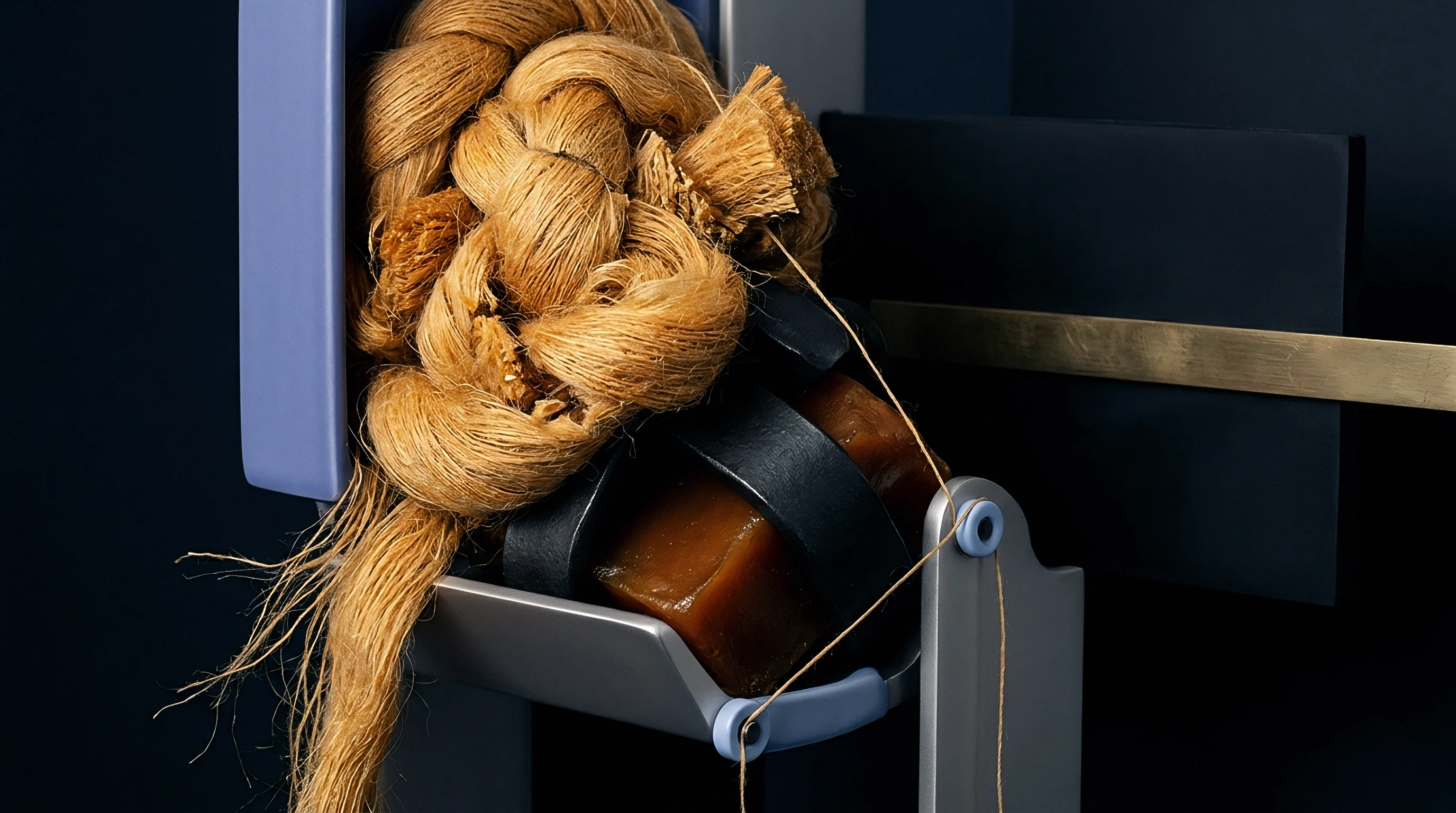
Building the specimen requires thorough mass isolation and gentle preparation. The operator draws small tufts across multiple bales to assemble a representative hand. Residual shive, seeds, and dirt distort the balance by adding weight without contributing meaningful surface area.
The sample must be carded or hand-combed through a coarse pin field to dislodge this cortical debris without breaking the underlying bundles.
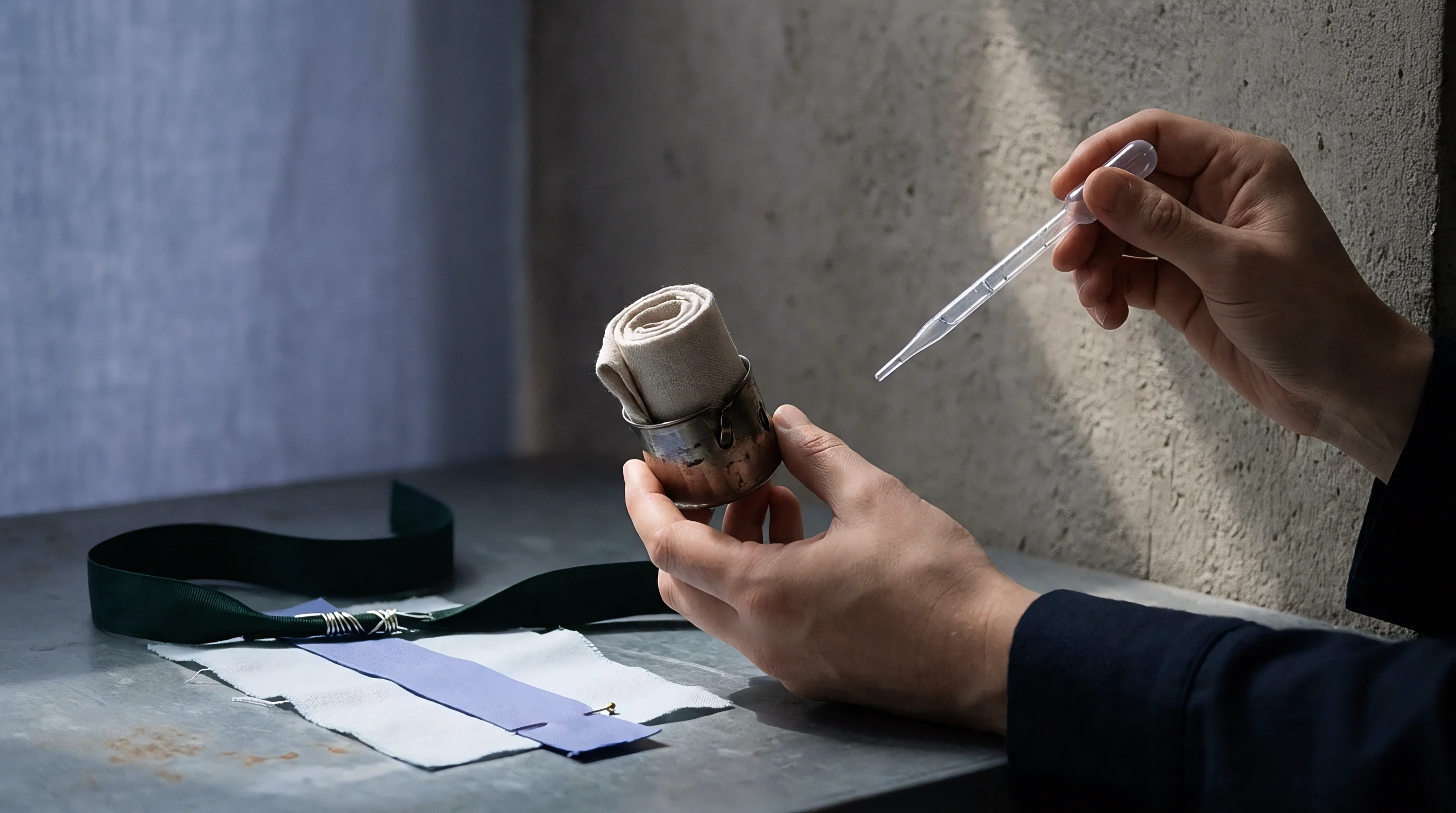
Specimen mass must match the nominal instrument requirement precisely, usually 2.500 or 5.000 grams weighed to within one milligram on an analytical balance. The operator rolls the parallel fibres into a slug sized to the chamber bore. Tangled fibers cause localized density pockets that disrupt flow lines, and fibres sitting perpendicular to the stream generate noticeably higher resistance than those aligned with the axis.
Chamber loading proceeds through a strict physical sequence:
- The operator weighs five grams of conditioned flax on an analytical balance reading to 0.001 grams.
- Hand-combing removes residual shive and non-fibrous foreign fragments without breaking the long technical bundles.
- The technician divides the weighed mass into three equal slivers and aligns them longitudinally into a parallel bundle.
- The assembled bundle is folded into a continuous plug matching the instrument chamber internal diameter.
- The operator introduces the specimen into the test cylinder and compresses the mass using the vented plunger until the mechanical stop engages.
Lowering the plunger establishes the precise volume required for constant-volume testing, and the mechanical stop keeps operator pressure from influencing the pack density. Perforated plates at the base of the plunger and the cylinder floor disperse air evenly across the plug face. Once the chamber seals, the vacuum or air valve opens, and the technician waits for the upstream manometer to stabilize.
Elastic recovery dictates how well the plug maintains contact with the cylinder walls. Supple fibres expand outward and maintain an even density across the section. Stiff, poorly retted flax creates voids near the bronze screens, which causes erratic differential pressure readings when testing repeat hands from the same lot.
ASTM D1448 dictates that cotton plugs test within 0.1 micronaire units across duplicates, but flax contracts require an expanded 0.3 unit variance band to accommodate bundle non-uniformity.
Aperture

Why Do Bast Retting Variations Shift Pneumatic Readouts?
Retting relies on fungal or bacterial enzymes to break down the middle lamella between cells. If the process is halted too early, residual polygalacturonic acids and lignins leave the ultimates locked in coarse bundles. These thick bundles form large gaps in the test plug and lower the pressure drop.
Thorough tank retting separates the strands into fine technical bundles, significantly expanding total surface area; the resulting drag pushes the manometer column higher, registering a finer metric count.
Dew-retted straw shows far wider lot-to-lot variation than straw from controlled warm-water tanks. Stems left in fields face fluctuating weather and patchy fungal colonization, often leaving base sections well-retted while the tips remain under-processed. The airflow test averages these disparities across the whole plug.
While the mean metric count remains useful, it hides the true dispersion within the sample, and a broad standard deviation usually foreshadows drafting trouble on the ring frame.
| Retting Method | Mean Metric Fineness (Nm) | Specific Surface Area (m2/g) | Residual Pectin Content (%) | Pneumatic Reading Variance (%) |
|---|---|---|---|---|
| Dew Retting Field Standard | 1250 | 0.48 | 2.8 | 14.2 |
| Warm Water Industrial Tank | 1680 | 0.62 | 1.4 | 6.5 |
| Enzyme Formulation Bio-Ret | 1950 | 0.74 | 0.9 | 8.1 |
| Under-retted Drought Harvest | 780 | 0.31 | 4.6 | 22.0 |
Chemical processing further alters bundle dimensions before rotor or dry spinning. Alkaline boils strip out pectins, waxes, and hemicelluloses, opening the technical bundles into finer elements. Scoured or cottonised flax can produce airflow values up to three times higher than raw scutched material.
Quality teams track this jump to monitor chemical extraction lines, because patchy scouring leaves residual gum that manifests as unsteady, wide-ranging manometer swings.
The extent of bundle division determines how slivers behave during drafting. Finer strands provide the friction needed for smooth attenuation through the drafting zone without bunching. Coarse, unretted clumps slide unevenly through the rollers and create periodic thin and thick spots in the sliver.
Catching these variations on an airflow meter helps prevent quality faults before yarn clearing channels flag them downstream.
The spinning manager faces excessive yarn breaks when retting variations force the pin gill to draft mixed bundle widths.

Yield
Spinning Count Limits and Economic Outturn
Bundle fineness governs the finest yarn count a mill can run. A stable yarn requires at least 25 to 30 individual fibres in its cross-section to spread mechanical load and hold together under drafting tension. Coarser lots simply cannot supply enough ends at lower yarn linear densities.
Trying to spin fine yarn from coarse scutched tow produces constant ends-down on the spinning frame, which makes rapid airflow screening essential before lots are cleared for production.
The maximum spinnable count follows directly from the measured bundle fineness. Take a commercial long-staple line flax lot reading 1500 Nm on a calibrated WIRA meter, which works out to a linear density of 6.67 dtex. If a wet-spinning line targets a yarn count of 45 Nm (222 dtex), the average number of fibres in the yarn cross-section is straightforward to calculate:
Fibres per cross-section = 222 dtex / 6.67 dtex = 33.3 fibres.
At 33.3 fibres, the strand clears the standard 30-fibre minimum needed for reliable wet spinning. If the test instead turns up an under-retted lot at 900 Nm, bundle density climbs to 11.1 dtex, leaving only 20 fibres in that same 45 Nm yarn. Running that lot will cause continuous ends-down at the ring rail.
| Airflow Fineness (Nm) | Target Yarn Count (Nm) | Spinning System | Cross-Section Fibre Count | Hackling Yield (%) | Waste Margin (USD/kg) |
|---|---|---|---|---|---|
| 800 | 24 | Dry-Spun Tow | 33.3 | 48 | 0.35 |
| 1200 | 36 | Modified Wet | 33.3 | 54 | 0.48 |
| 1600 | 48 | Classic Wet-Spun | 33.3 | 62 | 0.65 |
| 2000 | 60 | Fine Wet-Spun | 33.3 | 68 | 0.85 |
| 2400 | 72 | Ultra-Fine Wet | 33.3 | 71 | 1.15 |
Valuations on continental European flax exchanges follow fineness and hackling yield directly. Dressed line flax testing at 1800 Nm commands a 40 percent premium over standard 1100 Nm stock. Spinning mills accept that difference because finer bundles raise total yarn output per metric ton.
Higher surface contact also permits lower twist multipliers for a given target strength, allowing spinning frames to operate at faster delivery speeds.
Combing losses during hackling correlate inversely with initial bundle fineness. Heavy, undivided bundles break against the comb pins and generate higher percentages of lower-value tow. Pliant, fine bundles slip through the pins with far less breakage, preserving the valuable long line fraction.
A low purchase price on raw bales rarely compensates for the extra comb waste generated downstream.
A raw material saving of fifty cents per kilo disappears when hackling tow generation increases by four percent across the comb line.
Mill purchase contracts routinely specify minimum airflow fineness values, with automated price deductions applied when incoming shipments miss the agreed metric count. Catching under-retted or poorly scutched shipments at receiving keeps spinning operations from absorbing agricultural grade variations on the floor.
Whether mechanical airflow measurement can isolate true biological wall dimensions from bundle subdivision mechanics without visual image analysis remains an active dispute in international standardization bodies.