Correlation between Machine Vision Sliver Particle Counts and Long Term Hackling Lignin Variability
Optical sliver particle counts correlate with long-term hackling yield only when calibrated against chemical middle-lamella lignin content in bast fibre bundles.


Shive
Optical sliver inspection systems operating over high-speed drafting frames capture high-resolution surface topographies of scutched and carded flax strands. High-speed line-scan cameras running at 300 metres per minute isolate bark fragments, epidermis shive, and neps through transmitted backlight and dark-field illumination. Machine vision channels convert these physical dark inclusions into a continuous particle count per unit mass of sliver.
Flax fibres demand precise calibration. Raw particle counts alone fail to reflect long-term processing limits unless correlated directly to the chemical composition of the bast bundle. Residual wood particles, known as shive, represent core stem fragments adhering to the technical fibre bundles due to incomplete pectin and lignin breakdown during retting.
Optical particle counting measures the projected two-dimensional surface area of shive fragments per 100 grams of sliver passing through the inspection zone. Laboratory wet-chemistry protocols, specifically acetyl bromide lignin determination and acid detergent lignin assays, quantify the total weight fraction of structural and intercellular lignin within the same lot. A strong positive correlation exists between machine vision sliver particle counts and total lignin content, yet the relationship is non-linear across harvest years.
In field-retted straw subjected to weather fluctuations, outer stem parenchyma breaks down unevenly. This micro-structural variation creates batches where high optical particle counts match high outer-bark lignin, whereas other lots exhibit low shive counts despite holding dense intercellular lignin within the internal technical fibre bundles.
Lignin binds the cellular wall. Retting degree governs bundle splitting. Shive fragments cause yarn breaks.
Machine vision units log inclusions sized between 50 micrometres and 2.5 millimetres. The table below illustrates raw camera counts alongside chemical lignin content across standard scutched flax sliver grades before hackling comb passage.
| Sliver Grade Designation | Optical Particle Count (Particles/100g) | Mean Particle Surface Area (mm²) | Acetyl Bromide Lignin (% Dry Mass) | Acid Detergent Lignin (% Dry Mass) |
|---|---|---|---|---|
| Grade A Dew-Retted Line | 120 – 240 | 0.08 | 2.1 – 2.6 | 1.4 – 1.8 |
| Grade B Standard Line | 250 – 520 | 0.15 | 2.7 – 3.4 | 1.9 – 2.5 |
| Grade C High-Shive Tow | 530 – 1100 | 0.32 | 3.5 – 4.8 | 2.6 – 3.6 |
| Grade D Under-Retted Tow | 1110 – 2400 | 0.65 | 4.9 – 6.2 | 3.7 – 4.9 |
When spinning mills rely exclusively on optical particle counts without testing chemical lignin fractions, high-speed drawing frames experience unexpected roll wrapping and localized drafting resistance. The machine vision system detects the visible surface shive, but leaves the invisible intercellular lignin matrix unmeasured, leading directly to higher end-breakage rates at the wet-spinning frame and severe yarn count variation.

Matrix
Intercellular lignin residing inside the middle lamella acts as the primary structural cement binding elementary flax fibres into long technical fibre strands. Elementary fibres measure 20 to 50 millimetres in length with cell diameters ranging from 15 to 25 micrometres. Technical fibres, assembled into bundles through pectinous and lignified cross-links, extend up to 900 millimetres down the stem.
Mechanical hackling combs split these thick technical bundles into finer sub-units. The mechanical comb pins depend on controlled cleavage along the middle lamella. Excessive lignin content increases middle lamella shear strength beyond 45 Megapascals, preventing pin penetration and causing the hackling pins to snap long technical fibres into short tow fragments.
Dew-retting relies on indigenous fungal species, primarily Cladosporium herbarum and Epicoccum nigrum, to degrade middle lamella pectins and non-structural carbohydrates. Weather variations across growing seasons alter fungal enzyme secretion rates. Rainy retting cycles accelerate pectin degradation while leaving recalcitrant aromatic lignin rings intact.
Sunny dry conditions halt enzyme action early, producing under-retted flax rich in both un-degraded pectin and structural lignin. Long-term hackling performance fluctuates in response to these seasonal shifts. Machine vision particle counters measure the macroscopic shive detached during initial scutching, providing an indirect indicator of how far the retting process dissolved the middle lamella.
Optical particle density above 450 counts per 100 grams of hackled sliver correlates with a 1.8 percent increase in long-staple fibre breakage during passage through fine hackling pin fields.
Variability in hackling lignin levels alters the fine-structure geometry of the spinnable strand. A high-lignin lot retains rigid, coarse bundles with high bending stiffness. Low-lignin lots yield flexible, fine bundles capable of slipping smoothly past one another during drawing.
The table below details the physical and chemical shifts observed when processing bast fibre slivers across distinct lignin concentration bands.
| Lignin Class | Bundle Tensile Modulus (GPa) | Middle Lamella Shear Resistance (MPa) | Hackling Line Yield (%) | Optical Detection Sensitivity Limit (µm) |
|---|---|---|---|---|
| Low Lignin ( | 18 – 24 | 12 – 22 | 68 – 74 | 50 |
| Medium Lignin (2.5% – 3.8%) | 25 – 31 | 23 – 35 | 61 – 67 | 50 |
| High Lignin (> 3.8%) | 32 – 42 | 36 – 50 | 48 – 60 | 75 |
Fibre suppliers frequently explain away high yarn irregular count figures by claiming that raw sliver particle counts met the contract threshold, ignoring the un-retted intercellular lignin matrix that stayed hidden within the bundle cores during optical inspection.


Threshold

Optical Detection Parameters and Defect Classification Methods
Line-scan cameras deployed on silver carding equipment utilize spatial resolution targets down to 25 micrometres per pixel to categorize non-cellulosic impurities. System software segregates particles into dark shive fragments, light cortical tissue, and tangled neps based on grayscale intensity gradients and aspect ratios. High-contrast backlighting isolates opaque woody shive from translucent flax filaments.
Camera calibration requires stable ambient lighting, clean optical windows, and fixed web thickness to maintain quantitative accuracy across multi-shift production runs. Dust accumulation over lens assemblies degrades image contrast, suppressing raw particle counts and masking real sliver quality declines.
Why Does Residual Shive Area Shift during Wet Spinning?
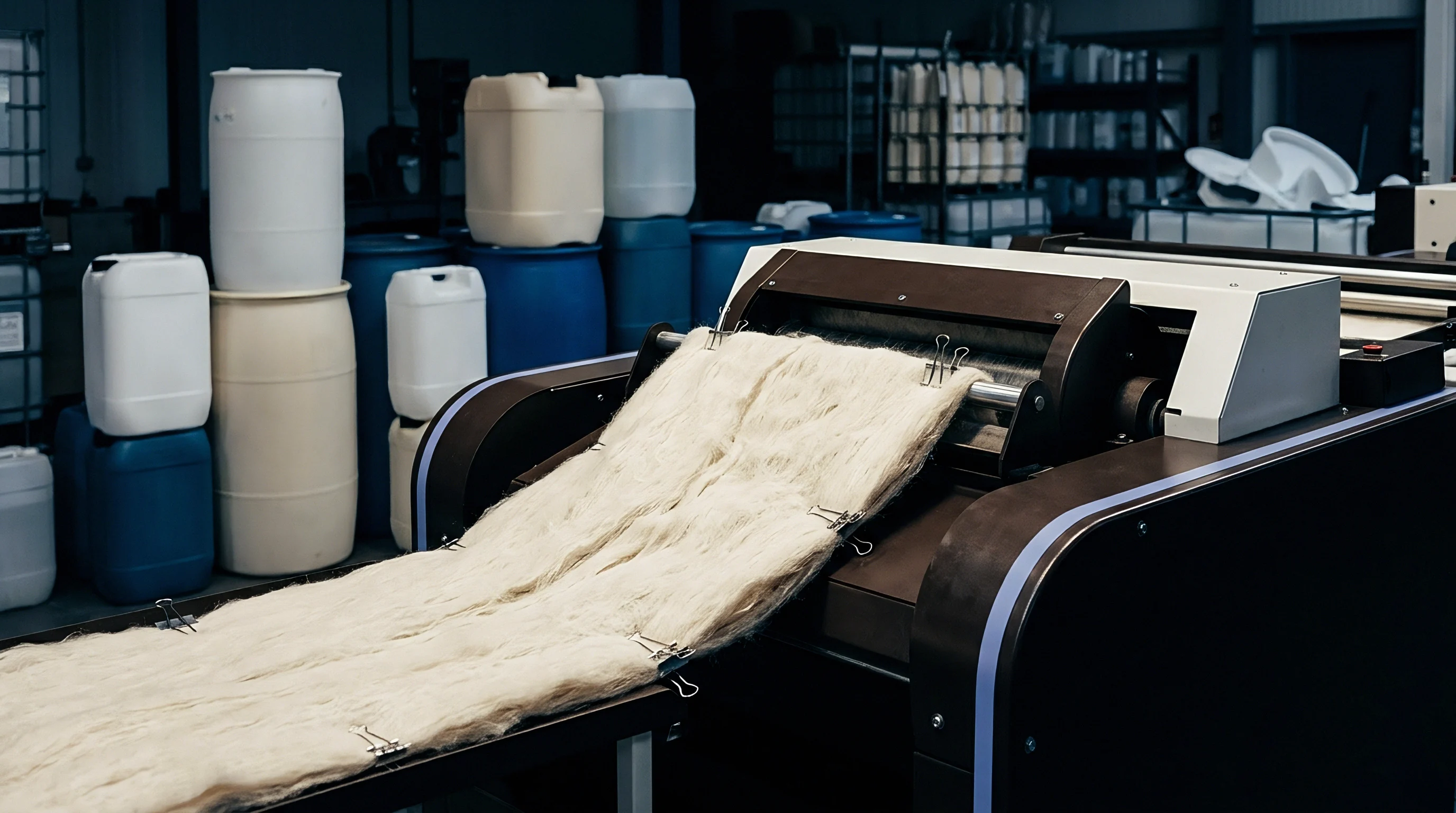
Wet-spinning machinery submerges roving strands in hot water baths maintained between 65°C and 85°C prior to drafting. Hot water softens residual pectinaceous binders, permitting elementary fibres to slide along their longitudinal axes inside the drafting zone. Lignin does not dissolve in hot water.
Lignin possesses a glass transition temperature exceeding 110°C under wet conditions. High-lignin bundles remain rigid inside the 70°C wet-spinning trough, resisting thermal softening and resisting draft attenuation. The optical particle area recorded on dry sliver expands during wet drafting when rigid shive inclusions force surrounding fibres apart, generating localized nep clusters and thick yarn defects.
Process control systems monitor particle distributions by binning inclusions into specific size bands. The list below details primary defect mechanisms triggered when specific particle size thresholds are exceeded in the sliver.
- Coarse Woody Shive (> 1.0 mm length): Causes immediate yarn breakage at the drafting apron by blocking the flyer orifice during high-speed twisting.
- Micro-Shive Inclusions (100 µm to 500 µm): Embeds within the twisted strand core, creating un-dyeable specks that surface during fabric finishing.
- Epidermal Bark Strips (High aspect ratio > 5:1): Wraps around lower drafting rollers, accumulating static charge and causing continuous sliver lapping.
- Lignified Nep Agglomerates ~ Distorts yarn cross-sectional roundness, reducing thin-place resistance and lowering single-strand tensile strength.
Standard purchase specifications rejecting lots with particle counts over 300 per 100 grams reduce wet-spinning frame end-breakage by 42 percent on metric yarn count 40.
Unresolved questions remain regarding whether real-time spectral imaging using short-wave infrared illumination can isolate internal lignin distribution without relying on superficial shive particle counts as a indirect proxy.

Cohesion

Fibre Drafting Kinetics under Lignin Variance
Inter-fibre friction governs the drafting stability of flax line and tow slivers. As sliver passes between drafting rollers operating at differential surface speeds, bundle cohesion dictates whether drafting occurs uniformly or in chaotic gulps. Intercellular lignin concentration directly alters the surface friction coefficient of individual fibre strands.
Clean, fully retted fibres exhibit a smooth surface friction profile, permitting controlled drafting at draft ratios between 10 and 25. High particle counts match rough, highly lignified bundle surfaces that exhibit stick-slip dynamics during drafting. High drafting tension ruptures filaments.
Slippage occurs unevenly, driving yarn mass CV percentage upward.
Mill audits demonstrate that long-term lignin variability creates substantial shifts in spinnable count limits. A lot carrying an average lignin content of 2.2 percent spins smoothly to a fine metric count of Nm 60 (16.6 tex). Increasing the lignin content to 4.2 percent limits the spinnable count to a coarse Nm 26 (38.4 tex) on the same wet-spinning frame.
Wet spinning dissolves pectin binders. Fine counts require low lignin. Cohesion varies across the lot.
High particle counts lower yield. Clean sliver lowers waste tariffs. Unretted stems resist comb pins.
Cold water retarding halts degradation. Raw bale weight fluctuates.
| Quality Tier | Optical Shive Density (Count/100g) | Acetyl Lignin (% Dry Mass) | Maximum Spinnable Count (Nm) | Uster Mass Variation (CV %) |
|---|---|---|---|---|
| Fine Line Prime | Nm 60 – Nm 80 | 11.2 – 12.5 | ||
| Standard Commercial Line | 150 – 400 | 2.2 – 3.2 | Nm 39 – Nm 59 | 12.6 – 14.8 |
| Coarse Tow Blend | 401 – 850 | 3.3 – 4.5 | Nm 18 – Nm 38 | 14.9 – 18.5 |
| Industrial Tow | 850 | 4.5 | 18.5 |
Verification of sliver readiness requires a systematic bench routine before releasing raw bales into the hackling line. The routine below outlines the standard validation sequence executed on incoming fibre lots.
- Extract ten representative sliver samples weighing 50 grams each from varied locations across five opened bales within the landed shipment.
- Pass each sample through a calibrated optical line-scan inspection channel at 50 metres per minute to establish total surface particle counts and mean inclusion area.
- Perform an acetyl bromide spectrophotometric assay on a 2-gram sub-sample to measure total structural lignin dry weight percentage.
- Subject a 100-gram combed strand to a bundle tensile test according to ISO 2370 to establish tenacity in Centinewtons per tex.
- Compare measured optical particle counts and chemical lignin figures against the master contract tolerance envelope before approving mechanical drafting.
Unretted fibre bundles holding high lignin concentrations demand elevated drafting roller pressures, accelerating synthetic apron wear and driving mechanical maintenance costs up.
Low shive counts coupled with low lignin fractions guarantee low drafting force and superior yarn evenness.

Yield
Yield calculations in linen yarn production depend on the ratio of hackled line fibre to secondary tow extracted during comb passages. High shive particle counts indicate raw straw that will shed excessive mass as hackling tow. Standard hackling line yield for high-grade dew-retted flax averages 65 percent long-line fibre and 30 percent hackling tow, with 5 percent lost as shive dust and short fly fibre.
When incoming slivers exhibit optical shive counts above 600 particles per 100 grams, hackling line yield drops to 52 percent as aggressive pin actions break rigid, lignified strands into short tow. The Count Economist tracks every percentage point shift in line yield, because long-line fibre commands three times the market value of tow per kilogram.
Consider a sourcing scenario involving a 20,000-kilogram lot of scutched flax landed at $4.80 per kilogram. A standard yield profile produces 13,000 kilograms of long-line fibre priced at $6.50 per kilogram and 6,000 kilograms of tow priced at $2.10 per kilogram, generating $97,100 in total output value against a material cost of $96,000. If long-term lignin variability increases shive particle counts to 750 particles per 100 grams, long-line yield drops to 50 percent (10,000 kilograms) while tow yield increases to 43 percent (8,600 kilograms).
The output value drops to $83,060, inflicting a net loss of $12,940 on the processing run due entirely to unmeasured lignin-induced bundle brittleness.
Managing commercial risk requires embedding clear quality parameters into raw fibre supply contracts. Sourcing managers utilize target thresholds to enforce financial accountability across supply partners. The checklist below defines mandatory technical metrics for high-count wet-spinning applications.
- Maximum Permissible Shive Count ~ Enforces an upper limit of 250 particles per 100 grams of hackled sliver measured via optical line-scan camera.
- Chemical Lignin Limit ~ Caps total acetyl bromide lignin at 2.8 percent dry mass based on ISO 13906 test protocol compliance.
- Hackling Line Yield Guarantee ~ Specifies a minimum 62 percent long-line fibre yield recovery across standard 12-pin comb configurations.
- Spinnable Limit Threshold ~ Mandates delivery of fibre capable of maintaining fewer than 15 end-breaks per 1,000 spindle-hours at Nm 50 wet spinning.
A one percent increase in total residual lignin content reduces long-line hackling yield by 4.2 percent, turning profitable fibre lots into net manufacturing losses.
Standard purchase contracts incorporating ISO 6741 conditioning norms allow buyers to reject shipments or apply a 3.5 percent invoice deduction whenever optical particle counts exceed 400 per 100 grams alongside lignin fractions above 3.5 percent dry weight.