Azimuthal Peak Analysis for Flax Microfibril Angle Determination
Azimuthal peak analysis of WAXS reflections determines flax microfibril angle to predict single-fibre stiffness, hackling yield, and maximum spinnable yarn count.


Beam
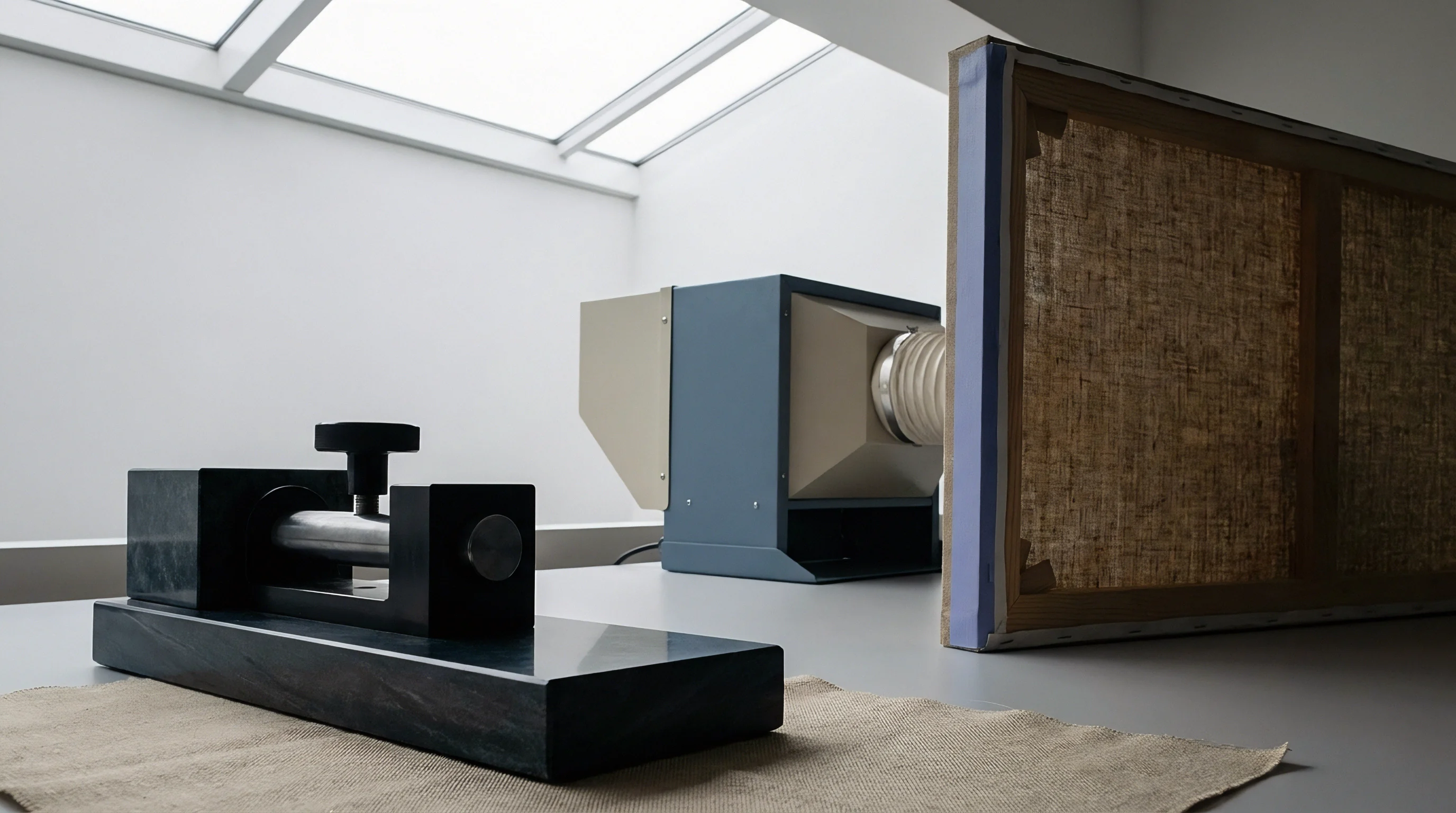
Transmission geometry X-ray scattering provides direct structural measurements inside the secondary cell wall of technical bast fibres. Specimen holder alignment governs diffraction data quality long before peak integration begins. Technical flax bundles consist of individual ultimate cells held together by a pectin and lignin middle lamella.
Each ultimate cell contains an outer primary wall and a thick secondary wall where crystalline cellulose microfibrils align in a steep helical pattern. Obtaining clear azimuthal diffraction intensity profiles requires mount geometry that holds fibre axes perfectly perpendicular to the incident monochromatic radiation path.
Flax cell walls hold stiff cellulose microfibrils. X-ray transmission requires parallel fibre bundles. The primary optical configuration relies on copper K-alpha radiation generated at a wavelength of 0.15418 nanometres.
X-ray optics isolate the parallel beam while collimators narrow the spot diameter to 0.5 millimetres. This diameter spans hundreds of individual cell walls within a mounted bundle, averaging local anatomical variations while preserving microstructural orientation profiles. Precise tensioning during sample mounting prevents macro-curvature without over-straining individual ultimate cells.
Improper mounting tension distorts azimuthal reflections. Excessive clamp pressure crushes cell walls, altering natural orientation angles and broadening diffraction peaks. Insufficient tension permits fibre curvature within the beam path, creating false azimuthal spreading that masks the true crystallite orientation distribution.
Laboratory conditioning at 20 degrees Celsius and 65 percent relative humidity stabilizes sample moisture equilibrium prior to exposure.
Bundle tensioning during transmission geometry holder clamping prevents artificial azimuthal peak broadening caused by physical fibre curvature.
- Preload force maintains straight bundle geometry inside the X-ray path without distorting the internal microfibrillar lattice spacing.
- Bundle gauge thickness stays below 0.5 millimetres to prevent intensity attenuation and secondary scattering artifacts.
- Fibre parallelism alignment within the clamp plane prevents artificial expansion of azimuthal intensity distributions across the detector face.
Positioning errors in the goniometer center shift equatorial reflections away from standard two-theta angular positions. Such positioning flaws alter calculated azimuthal width parameters, generating misleading structural data that causes technical managers to reject prime long-line flax lots that meet mechanical requirements.
Scatter
Equatorial intensity diffraction pattern profiles register the crystalline reflections of native cellulose I polymorphs. The strong equatorial reflection corresponding to the (200) lattice plane appears near a two-theta scattering angle of 22.7 degrees. Azimuthal intensity scanning samples diffraction intensity along this specific two-theta ring across a 360-degree range.
Secondary cell wall microfibrils produce two distinct azimuthal intensity peaks located 180 degrees apart, centered on the equatorial axis.
Orientation governs ultimate tensile stiffness. Background radiation shifts the baseline peak. Azimuthal intensity profiles show distinct symmetry.
Raw diffraction images carry background scattering contributions from air, amorphous cell wall polymers, and instrument optics. Amorphous pectin and hemicellulose generate a broad diffuse halo beneath crystalline Bragg reflections. Removing this amorphous background through baseline subtraction isolated the pure crystalline scattering profile of the (200) reflection prior to peak width calculations.
At 22.8 degrees 2-theta, prime Belgian long-line flax exhibits an azimuthal peak full width at half maximum of 14.2 degrees under controlled 65 percent relative humidity.
Quantifying crystalline orientation utilizes the Hermans orientation factor derived from azimuthal intensity distributions. The Hermans factor ranges from zero for randomly oriented crystallites to unity for perfect alignment parallel to the fibre axis. High orientation factors correspond to tight helical arrangements within the S2 cell wall layer, yielding superior axial mechanical properties in long-line fibre grades.
| Grade Classification | Retting Route | Reflection Angle (2-Theta) | Azimuthal FWHM (Degrees) | Hermans Factor |
|---|---|---|---|---|
| Prime Long Line | Dew Retted | 22.78° | 13.8° | 0.942 |
| Standard Long Line | Dew Retted | 22.71° | 15.4° | 0.925 |
| Hackled Tow | Dew Retted | 22.65° | 18.9° | 0.881 |
| Enzyme Treated Tow | Enzyme Retted | 22.69° | 21.2° | 0.854 |
Fibre suppliers frequently claim that broad azimuthal reflections stem from microstructural retting variation rather than inherent genetic or growing anomalies.

Profile
Numerical curve fitting transforms raw azimuthal intensity data into quantitative microfibril angle values. Mathematical functions isolate overlapping crystalline reflections and resolve instrumental broadening. Raw azimuthal peak profiles exhibit shapes positioned between pure Gaussian and pure Lorentzian statistical distributions.
Employing Voigt function profile fitting accommodates crystallite size broadening while capturing microfibrillar helical distribution variance.
Deconvolution models split the azimuthal intensity distribution into symmetrical component peaks. Cave’s empirical formulation links the azimuthal full width at half maximum of the (200) reflection directly to the mean microfibril angle. Multiplying the measured full width at half maximum by an empirical calibration coefficient yields the mean microfibril tilt relative to the longitudinal fibre axis.
Calibration coefficients vary slightly depending on whether the measurement system utilizes single fibre or bundle transmission geometry.

Where Does Deconvolution Fail on Immature Flax?
Immature bast fibres contain lower crystalline cellulose ratios and higher amorphous fractions within incomplete cell wall layers. Amorphous background halos overlap the (200) diffraction ring, creating non-linear baseline shifts. Standard Voigt fitting algorithms fail to resolve true peak boundaries under high amorphous background conditions, skewing full width at half maximum values upward and overestimating the true microfibril angle.
- Extract two-dimensional diffraction image frames from the area detector using calibrated beam center spatial coordinates.
- Integrate azimuthal intensity around the (200) equatorial reflection ring from 0 to 360 degrees in 0.5-degree steps.
- Subtract baseline linear background fitted to non-diffracting azimuthal regions at two-theta angles of 20 and 25 degrees.
- Fit twin symmetrical Voigt functions to dual azimuthal intensity peaks positioned 180 degrees apart.
- Extract the full width at half maximum parameter from optimized Voigt profile parameters.
- Multiply full width at half maximum values by the Cave scale factor to determine mean microfibril angle.
ISO 2062 breaking tenacity drops below 55 centinewtons per tex when the mean microfibril angle derived from WAXS azimuthal deconvolution exceeds 11.5 degrees.
Whether micro-focus synchrotron radiation can resolve local microfibril angle variations across individual cell wall dislocation zones without damaging delicate bast tissue remains unresolved.
Modulus
Single-fibre mechanical axial stiffness directly mirrors the helical orientation of internal cellulose fibrils. Microfibrils aligned parallel to the fibre axis transfer tensile loads along covalent backbone chains of cellulose molecules. When microfibrils spiral at wider angles relative to the longitudinal axis, tensile loads force shear deformation within the softer hemicellulose and lignin matrix.
This structural shift lowers axial Young’s modulus and increases breaking elongation.
Gaussian functions model symmetric peak broadening. Voigt profiles account for crystallite size. Lower microfibril angles increase fibre stiffness.
Coarser yarns tolerate wider angle distributions. Hackling waste increases with structural disorder. Bast fibre stress-strain curves display clear bi-phasic linear regions governed by microfibril realignment under axial load.
Lower initial microfibril angles minimize internal realignment strain, yielding immediate high-modulus response during yarn drafting and tensile loading.
| Mean MFA Range | Tensile Modulus (GPa) | Break Strain (%) | Max Spinnable Count (Nm) | Hackling Line Yield (%) |
|---|---|---|---|---|
| 6.0° – 8.0° | 68.5 – 78.0 | 1.4 – 1.8 | Nm 60 | 68.5% |
| 8.1° – 10.0° | 54.0 – 67.0 | 1.9 – 2.3 | Nm 40 | 63.2% |
| 10.1° – 12.0° | 41.0 – 52.0 | 2.4 – 2.8 | Nm 26 | 55.8% |
| 12.1° – 15.0° | 28.0 – 39.0 | 2.9 – 3.5 | Nm 14 | 46.1% |
Consider a 10-tonne procurement lot of scutched flax intended for wet spinning into fine Nm 50 yarn (20 tex). Lot A features a mean microfibril angle of 7.2 degrees with an azimuthal full width at half maximum of 12.0 degrees. Hackling yield reaches 68 percent, yielding 6,800 kilograms of long-line flax sliver.
Wet spinning operates smoothly with an end-breakage rate of 12 breaks per 1,000 spindle hours, achieving target yarn strength of 58 centinewtons per tex.
Lot B features a mean microfibril angle of 12.4 degrees with an azimuthal full width at half maximum of 20.7 degrees. During hackling, brittle fibre snapping across wider microfibrillar shear planes reduces long-line yield to 54 percent, generating 5,400 kilograms of line flax and increasing low-value tow waste by 1,400 kilograms. When spun toward Nm 50, low axial fibre modulus causes excessive drafting slippage and raises end-breakage to 48 breaks per 1,000 spindle hours.
The spinner must slow frame speed by 25 percent and cap yarn fineness at Nm 26 (38.5 tex).
High microfibril tilt forces tensile stress onto the amorphous hemicellulose matrix during drafting.
- Early drafting slippage occurs when low longitudinal stiffness permits excessive fibre elongation under ring-frame drafting zone tension.
- Fibre fibrillation increases during hackling as shear stresses cleave bundles along tilted microfibrillar interface lines.
- Yarn count variance broadens because uneven microfibril alignment produces inconsistent drafting force resistance across sliver cross-sections.
Denser crystalline alignment along the fibre axis consistently yields stronger spun yarns with lower waste generation during hackling.

Discount
Procurement valuation adjustments protect yarn spinners against mechanical performance drops in raw bast shipments. Traditional hand-classing measures staple length, color, and cleanliness but fails to detect internal crystallite misalignment. Integrating wide-angle X-ray diffraction azimuthal peak analysis into raw fibre purchasing specifications establishes objective physical criteria for pricing structures.
Metric count drops as stiffness degrades. Disordered microfibrils reduce dry spinning limits. Contractual limits bound allowable angle variation.
Buyers incorporate statistical threshold limits into purchase contracts, defining maximum allowable mean microfibril angles and variance parameters across incoming bale shipments. Testing protocol mandates selecting five representative bundle samples per 500-kilogram bale lot, submitting samples to wide-angle X-ray diffraction azimuthal integration under standard environmental conditions.
| MFA Target Range | Azimuthal Variance | Target Application | Raw Fibre Discount ($/kg) | Fabric Cost Shift ($/m) |
|---|---|---|---|---|
| MFA ≤ 8.5° | σ² ≤ 1.2° | Fine Wet Spun (Nm 50-80) | Base Price ($4.80) | Base ($0.00) |
| 8.6° – 10.5° | 1.3° ≤ σ² ≤ 2.0° | Medium Wet Spun (Nm 26-40) | -$0.65 | +$0.18 |
| 10.6° – 12.5° | 2.1° ≤ σ² ≤ 3.5° | Coarse Dry Spun (Nm 10-20) | -$1.40 | +$0.42 |
| MFA > 12.5° | σ² > 3.5° | Non-Woven / Tow Rejection | -$2.25 | +$0.85 |
- Azimuthal peak width limits enforce maximum allowable microfibril angle spread across batch samples to guarantee drafting stability.
- Hermans factor thresholds establish minimum crystalline orientation benchmarks required for fine count wet-spinning qualification.
- Rejection boundaries define microfibril angle limits above which long-line flax lots drop automatically to coarse tow pricing schedules.
Contract clause 14B specifies that long-line flax deliveries exhibiting mean microfibril angles above 10.5 degrees trigger an automatic price reduction of $1.40 per kilogram to compensate for reduced hackling yield and lower spinnable count limits.