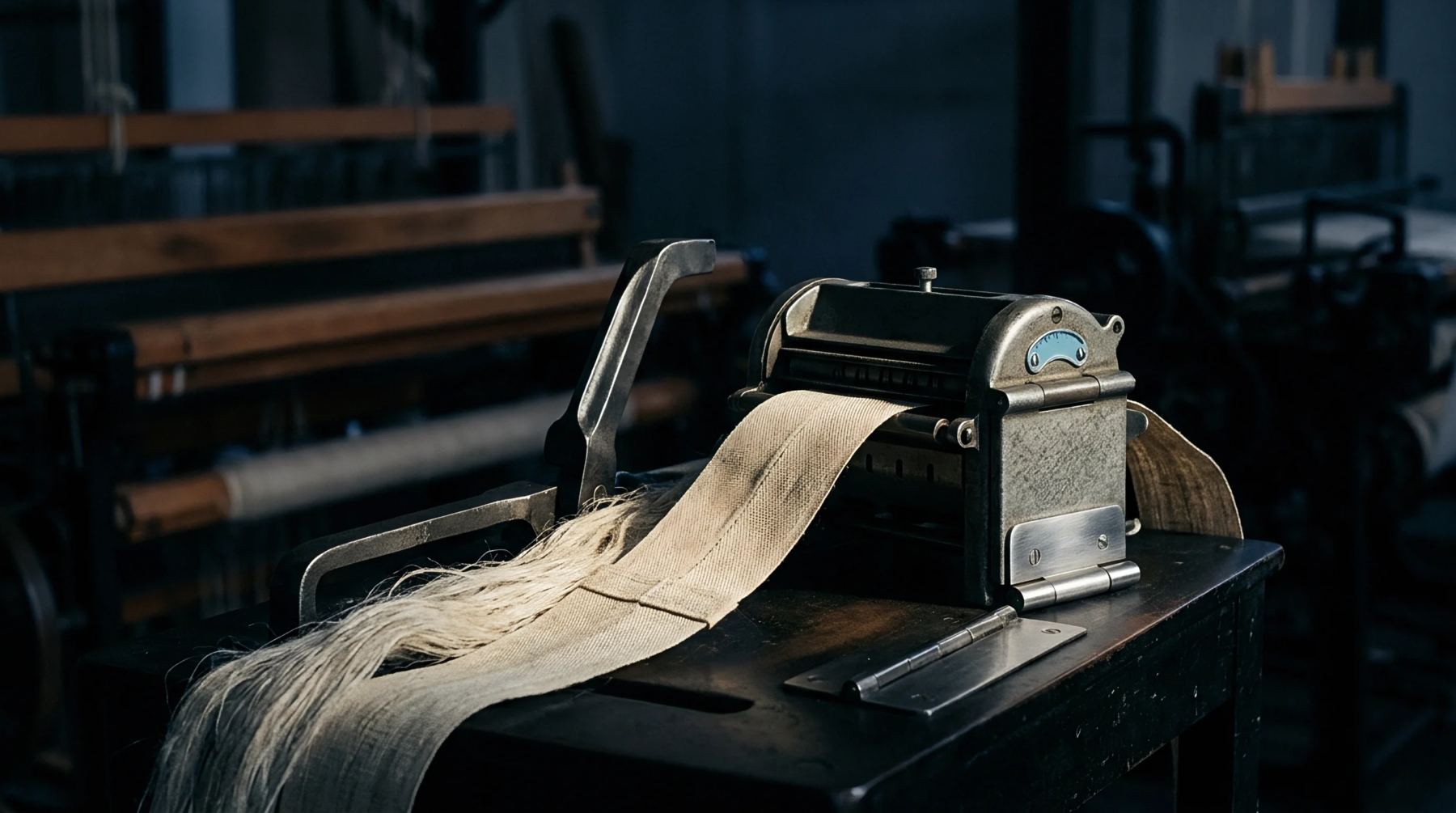
Material Deformation
The point at which a flax fibre transitions from temporary elastic stretching to permanent plastic deformation under applied load represents a fundamental limit of the material. Within the context of linen finishing, viscoelastic yield threshold defines the maximum tension that the fabric can endure during drying or calendering without losing its dimensional stability. Stretching a fabric beyond this point causes the molecular chains within the cellulose to slide past each other permanently.
Finishing Regulation
Control systems on the stenter frame or sanforizing machine must be calibrated to keep the processing tension below this critical value. If the viscoelastic yield threshold is exceeded, the linen fabric will exhibit excessive shrinkage when later washed by the consumer. This occurs because the internal stresses locked into the fibres during over-tensioned processing are released when the material is wetted again.
Mills use sensors to monitor the fabric width and length in real-time, adjusting the overfeed mechanisms to maintain the integrity of the textile structure. This precision is required to meet the strict dimensional tolerances specified by international garment brands.
Durability Testing
Laboratory analysis of the finished cloth confirms that the material has not been damaged by excessive tension during the finishing stages. The result is documented in the final quality report to verify that the linen retains its shape and strength.