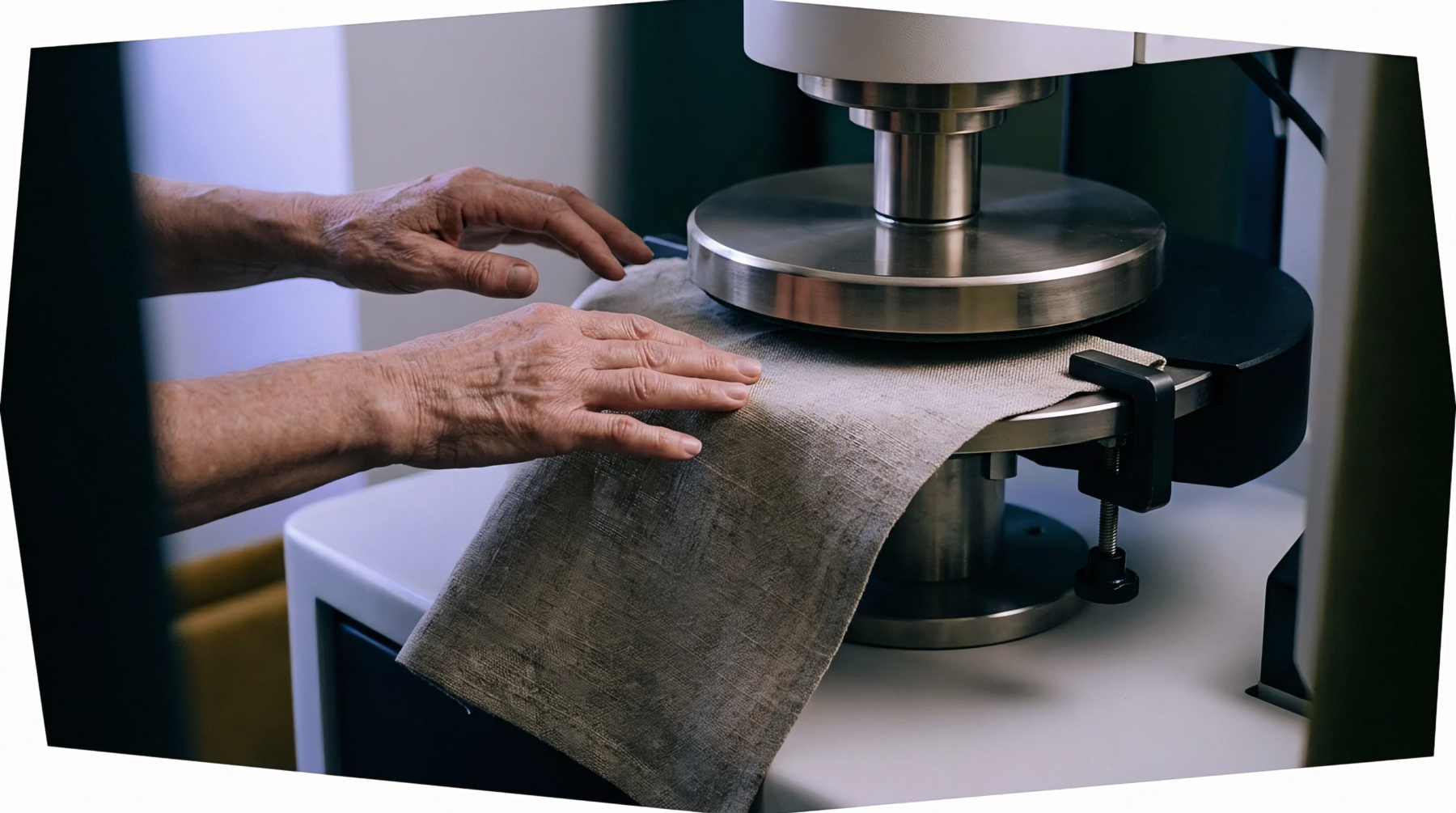
Chemical Stain
Zinc chloriodide solution acts upon unbleached flax and hemp fibres to differentiate lignified cell walls from pure cellulose through selective colouration. Aqueous zinc chloride and potassium iodide combine with iodine to formulate the Herzberg Reagent, which stains pure cellulose blue and high-lignin tissues yellow or brown. Technicians apply this liquid directly onto microscope slides containing teased filaments from scutched flax stalks during preparatory quality checks.
Bast fibre batches arriving at the spinning mill undergo this microscopic examination to verify that retting removed sufficient non-cellulosic encrustants prior to drawing frames.
Cellulose Differential
Pure polysaccharide structures absorb iodine molecules within their swelling cellulose matrices to produce an indigo hue, whereas associated lignin and hemicellulose complexes react with the zinc halide to shift absorption spectra toward yellow and brown tones. Analysts operating in the mill laboratory observe these distinct colour transitions to evaluate retting uniformity across random fibre bundles sampled from different bales. Inconsistent chemical conversion indicates under-retted shive or over-retted weak spots that will break during subsequent drafting stages.
Maturity Index
This staining reaction establishes the boundary between acceptable spinning stock and degraded raw material rejected for high-grade linen yarn production. Over-macerated flax fibres display a uniform pale blue without the amber contrast that signals adequate structural integrity in the secondary cell wall. Mill supervisors rely on these microscopic observations to adjust biological or chemical retting parameters before processing entire shipments into roving.
Accurate compositional mapping prevents defective yarn from entering wet spinning baths where weak bonds rupture under high spindle tension.