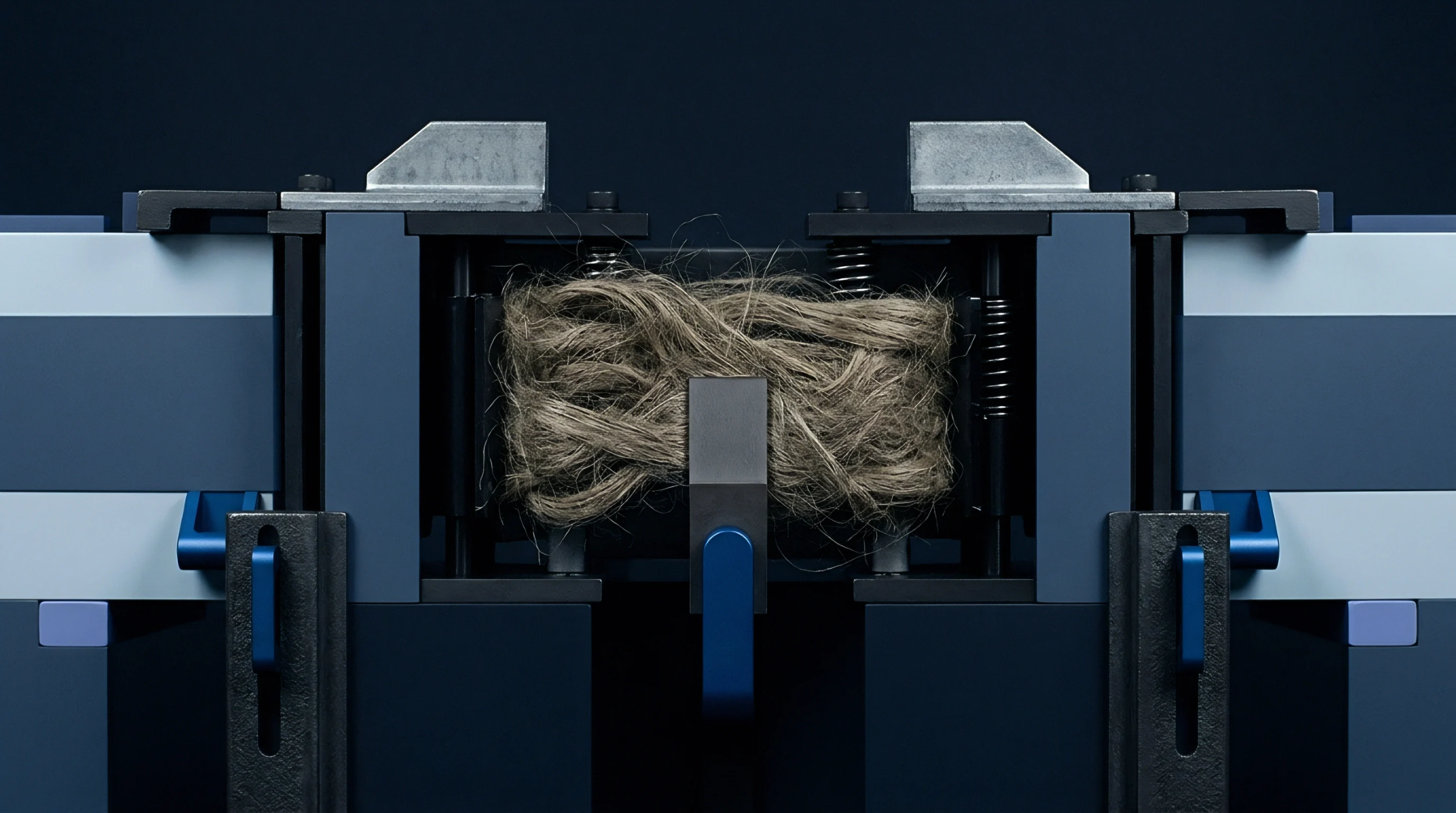
Drafting Operation
Intermediate mechanical preparation in flax sliver production reduces linear density through controlled velocity ratios between sequential roller sets. Within the gilling section of a Chinese flax mill, gill box attenuation controls the ratio between front roller delivery speed and back roller feeding speed. Intersecting faller bars hold the long flax fibers in alignment, preventing uncontrolled fiber slipping as drafting forces pull individual strands past each other.
Proper draft distribution prevents thick and thin places in the sliver prior to roving frame processing.
Sliver Regulation
Processing long line flax sliver requires precise adjustment of pin densities and faller speeds to accommodate variations in natural fiber length. When gill box attenuation is set too high for a given fiber bundle length, short fibers float uncontrolled between the faller beds and create periodic sliver irregular mass accumulation. Conversely, insufficient draft settings produce dense, unoriented fiber bundles that clog downstream spinning nozzles.
Technicians calibrate faller bar speed ratios against input sliver weight to maintain constant linear density. Continuous monitoring with electronic sliver weight sensors provides real-time feedback to autoleveller systems, which adjust draft ratios automatically during operation.
Production Record
Mill batch routing sheets record targeted and actual draft settings for each gilling passage. The gill box attenuation parameter establishes the total reduction ratio across drawing operations to verify sliver uniformity before spinning.