Isotopic Profiling Standard Practices for Raw Flax Fiber Provenance Verification
Empirical isotope profiling via EA-IRMS and MC-ICP-MS exposes flax origin fraud and fiber blending that administrative transaction certificates routinely conceal.


Signal
A sealed sample envelope from a spinning mill in Jiangsu carries a declared European Flax certificate number, yet the elemental analyzer records a delta 18O value of +18.2 per mil and an 87Sr/86Sr ratio of 0.7115. That isotopic signature separates the bale from coastal Normandy’s marine-influenced soils, whatever the accompanying transaction certificate asserts. Isotopic profiling relies on plants assimilating stable isotopes from local precipitation, atmospheric carbon dioxide, and bedrock during growth.
The resulting multi-isotopic fingerprint stays locked in the cellulosic structure of Linum usitatissimum, surviving scutching, hackling, and wet spinning intact.
Buyers verifying raw fiber origin evaluate five primary isotopic signals. Light stable isotopes of hydrogen, oxygen, carbon, and nitrogen trace regional climate, hydrology, and crop management, while radiogenic strontium ratios reflect the age and weathering of the underlying bedrock. When customs officials or commercial auditors challenge an origin claim, paper documents show administrative intent, but isotopic data records the plant’s actual biology.
| Production Zone | delta 13C VPDB (per mil) | delta 18O VSMOW (per mil) | delta 2H VSMOW (per mil) | 87Sr/86Sr Ratio |
|---|---|---|---|---|
| Western Europe (France, Belgium, Netherlands) | -30.8 to -27.2 | +23.1 to +27.6 | -68.0 to -48.0 | 0.7078 to 0.7098 |
| Heilongjiang Province, China | -27.0 to -24.1 | +16.4 to +20.8 | -98.0 to -78.0 | 0.7108 to 0.7135 |
| Nile Delta, Egypt | -25.2 to -22.4 | +27.8 to +32.4 | -32.0 to -14.0 | 0.7065 to 0.7082 |
| Baltic Belt (Lithuania, Belarus) | -29.5 to -26.8 | +19.5 to +22.8 | -84.0 to -65.0 | 0.7120 to 0.7152 |
Cretaceous limestone along the French littoral yields 87Sr/86Sr ratios clustering below 0.7092, whereas continental interiors ~ such as the granitic and loess-heavy soils of northeastern China or the Belarussian plains ~ consistently generate exchangeable strontium values above 0.7110.

Strata
Precipitation isotopes draw the continental boundary between maritime European fields and landlocked growing regions. Rainwater carries deuterium-to-hydrogen and oxygen 18-to-oxygen 16 ratios governed by Rayleigh distillation. As Atlantic moisture tracks inland across the continent, heavy isotopes condense out first, depleting inland rain in both oxygen 18 and deuterium.
Flax cultivated along the English Channel and the North Sea therefore takes up surface water noticeably enriched in heavy isotopes compared to crops grown across continental Eurasia.
Soil hydrology and regional atmospheric moisture balance set the baselines buyers use when screening suspect fiber. Through photosynthesis, plants incorporate oxygen atoms from soil water directly into cell-wall glucose, locking local hydrological conditions straight into the structural cellulose.
A stable isotope reference map functions reliably only when tied directly to the harvest year of the fiber lot.
Geological strontium provides a second verification layer that weather cannot alter. Because strontium ions substitute for calcium in plant vascular tissue, the fiber matches the bioavailable strontium of the root zone. Soil age largely dictates the resulting ratio:
- Marine sedimentary limestone yields bioavailable strontium ratios between 0.7075 and 0.7095, characteristic of the primary Western European flax basin.
- Ancient continental granitic shields produce weathering residues with ratios typically exceeding 0.7125, widespread across the Baltic Shield and northeastern Asian growing areas.
- Quaternary basaltic and volcanic deposits register ratios between 0.7030 and 0.7060, observed in select Southern European and East African river valleys.
- Alluvial silt formations display mixed isotopic signatures dominated by upstream drainage geology, typical of the lower Nile basin.
Groundwater shifts, rooting depth, and seasonal rainfall raise practical questions about how localized drought anomalies affect the isotopic variance band across European growing districts over successive harvests.

Scour
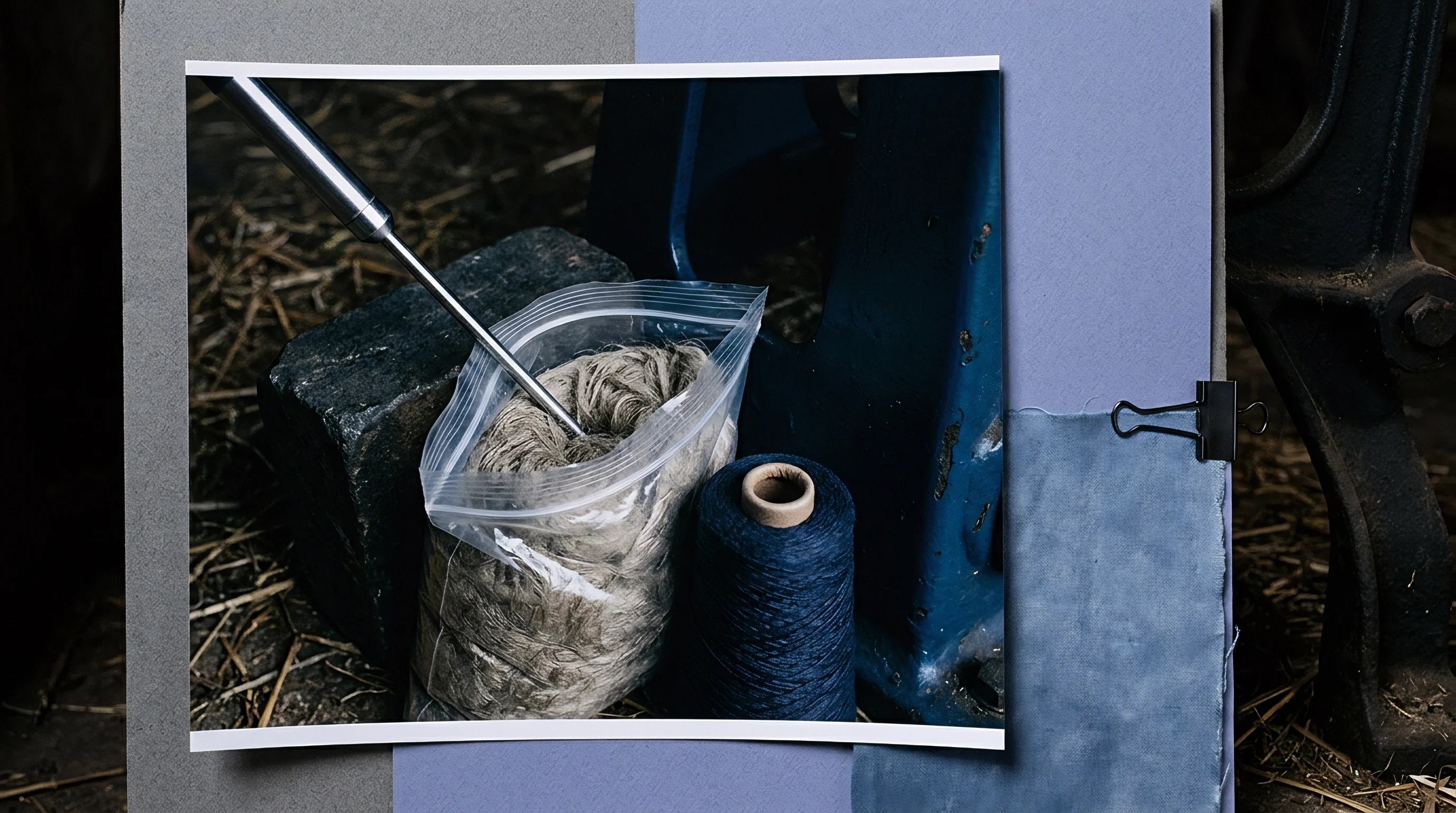
Raw flax arrives at the spinning mill coated in non-cellulosic matter with its own isotopic baseline. Pure bast cellulose accounts for roughly seventy percent of scutched fiber mass; the remaining thirty percent is pectin, hemicellulose, lignin, cuticular wax, and mineral dust gathered during retting. Because each fraction carries a distinct fractionation factor, analyzing crude fiber without thorough chemical separation introduces significant analytical skew.

Does Dew Retting Alter Oxygen Ratios?
Field retting exposes stems to saprophytic fungi that break down pectin rings to free the fiber bundles. During dew retting, fungal metabolism and ambient moisture exchange surface oxygen atoms, shifting whole-stem delta 18O downward by as much as 1.2 per mil relative to green straw. Tank retting in warm river or bore water goes further, exchanging hydrogen and oxygen in surface cellulose with the soaking medium and imposing an isotopic shift that reflects the local water supply rather than the field where the crop grew.
Chemical scouring shifts crude fiber carbon thirteen signatures by 1.4 per mil while leaving the structural strontium lattice unaltered.
Downstream wet processing changes crude fiber chemistry again. Boiling raw sliver in sodium hydroxide strips waxes and non-cellulosic polymers, concentrating the alpha-cellulose fraction.
| Processing Stage | Dominant Chemical Phase Analyzed | delta 13C Shift (per mil) | delta 18O Shift (per mil) | 87Sr/86Sr Delta |
|---|---|---|---|---|
| Green Flax Straw | Whole plant tissue | 0.00 | 0.00 | 0.00000 |
| Scutched Long Flax | Crude bast fiber bundle | -0.35 | -0.85 | +0.00002 |
| Hot Alkali Scoured Tow | Isolated alpha-cellulose | +1.40 | +1.15 | -0.00001 |
| Bleached Wet-Spun Yarn | Pure oxidized cellulose | +1.55 | +1.90 | +0.00003 |
Strontium stays bound within the crystal lattice of cellulose microfibrils, fractionating negligibly through scouring. Light isotopes, by contrast, shift predictably under chemical processing and preferential bond cleavage. Skipping the removal of non-cellulosic fractions before analysis yields distorted numbers that can easily misidentify European fiber as Asian crop during an origin audit.

Sieve
Routine laboratory testing demands rigorous sample clean-up before combustion or mass spectrometry. Measurement relies on two platforms: Elemental Analyzer Isotope Ratio Mass Spectrometry (EA-IRMS) for carbon, nitrogen, hydrogen, and oxygen, and Multicollector Inductively Coupled Plasma Mass Spectrometry (MC-ICP-MS) for radiogenic strontium. Without isolated preparation lines for cellulose extraction, laboratories risk cross-contamination from residual spinning oils and sizing agents.
The extraction sequence isolates structural alpha-cellulose through sequential solvent and chemical stripping to eliminate surface contamination:
- Cut representative raw bast fibers into two-millimeter lengths using clean surgical steel blades to prevent metal shear contamination.
- Extract lipids, waxes, and spinning finishes in a Soxhlet apparatus using a two-to-one toluene-ethanol mixture for eight hours.
- Rinse the extracted fiber cake three times in deionized water and dry at sixty degrees Celsius for twelve hours.
- Digest hemicellulose and residual lignins using acidified sodium chlorite solution at seventy-five degrees Celsius for four hours, repeating until the fiber reaches absolute white.
- Treat the holocellulose residue with seventeen percent sodium hydroxide solution to strip residual beta-cellulose and gamma-cellulose, leaving pure alpha-cellulose.
- Homogenize the dried alpha-cellulose powder in a cryogenic ball mill to ensure complete homogeneity across subsamples.
To prevent residual spinning oils from introducing exogenous carbon, the laboratory weighs target amounts of prepared cellulose into silver capsules for pyrolytic cracking at 1450 degrees Celsius (for oxygen and hydrogen) and into tin capsules for combustion at 1020 degrees Celsius (for carbon). Strontium preparation relies on microwave digestion in nitric acid and hydrogen peroxide within sealed PTFE vessels, followed by chromatographic separation on strontium-specific resin prior to plasma nebulization.
ISO 17025 accreditation covers the specific fiber matrix only when the laboratory standard operating procedure defines cellulose digestion step by step.
Laboratories report delta values against recognized international reference materials: Vienna Pee Dee Belemnite (VPDB) for carbon, Vienna Standard Mean Ocean Water (VSMOW) for oxygen and hydrogen, and NIST SRM 987 for strontium. Competent facilities maintain analytical standard deviations below 0.15 per mil for carbon, 0.30 per mil for oxygen, 1.5 per mil for hydrogen, and 0.00005 for the 87Sr/86Sr ratio. Diligent cellulose purification prevents false geographic assignments.

Dispute
A persistent vulnerability in the linen trade is the blending of cheaper domestic tow into imported European long fiber. Spinning operations in Zhejiang or Shandong routinely buy scutching tow from Heilongjiang or import discounted fiber from Egypt, blending it into Western European hackled sliver to trim yarn costs while relying on transaction documents under a European Flax certificate.

Will Sizing Residues Distort Strontium Signatures?
Starch and polyvinyl alcohol sizing carry carbon and oxygen values distinct from bast fiber, but routine preparation washes them away before they can distort the cellulose readings. Polyvinyl alcohol leaves no elemental strontium behind. Strontium analysis cuts through modern sizing additives cleanly to read the plant tissue underneath.
Linear mass-balance equations expose blending in finished yarns. Consider a consignment of wet-spun 14 lea yarn declared as pure Western European origin, where baseline European stock averages a delta 18O of +25.5 per mil and an 87Sr/86Sr ratio of 0.7086. Regional Chinese tow from Heilongjiang tests at +18.5 per mil for oxygen 18 and 0.7122 for strontium.
If a sample of the finished yarn returns a delta 18O of +22.7 per mil and an 87Sr/86Sr of 0.7099, the mass balance reveals a thirty percent inclusion of non-European fiber.
Multi-element discriminant equations detect adulteration thresholds down to fifteen percent when the reference library covers both regional end-members.
Chemometric models evaluate these multi-isotope profiles in tandem, using principal component analysis and linear discriminant functions to test fiber lots against databases built from authentic farm-level harvests:
- Delta 13C and delta 15N cross-plots differentiate intensive synthetic nitrogen fertilization regimes common in Asian production from typical Western European crop rotations.
- Delta 18O and delta 2H regression lines separate continental interior growth zones from maritime temperate coastal microclimates along the French-Belgian border.
- Strontium isotope ratios paired with barium trace concentrations establish exact geological bedrock compatibility, isolating limestone valleys from alluvial or granitic zones.
- Rare earth element distribution patterns provide secondary confirmation when weathering profiles overlap across geographically separated growing belts.
When documentation conflicts, commercial buyers use multi-element discriminant models to settle disputed origin claims before clearance at customs.

Warranty
Protecting against origin fraud requires moving beyond paper intake to forensic qualification terms in purchase contracts. A scope certificate confirms only that a spinning mill maintains an audited chain-of-custody system, not that any individual shipment contains the declared material. A transaction certificate merely asserts that an identified lot changed hands.
Isotopic testing verifies whether fiber in the bale actually matches the soil chemistry of the declared growing region.
At roughly six hundred dollars per test, isotopic verification fits easily into routine quality and compliance budgets on major orders. Core-testing five representative samples from a forty-metric-ton container of hackled flax sliver costs around three thousand dollars in laboratory fees. On a shipment worth over three hundred thousand dollars, verification adds less than one percent to landed costs while guarding against seizure at the border.
| Instrument Type | Issuing Authority or Body | Commercial Cost per Evaluation | Turnaround Schedule | Enforcement Durability |
|---|---|---|---|---|
| Isotopic Fingerprint Dossier (EA-IRMS + MC-ICP-MS) | ISO 17025 Accredited Mass Spectrometry Lab | $550 to $850 per lot | 10 to 18 working days | Irrefutable empirical proof of geographic growth zone |
| European Flax Scope Certificate | Third-party certifier (Bureau Veritas, Control Union) | $2,500 to $4,500 annual audit fee | Annual renewal | Confirms facility procedures; excludes lot-level physical verification |
| European Flax Transaction Certificate (TC) | Scheme certifier on vendor declaration | $45 to $90 per document | 3 to 7 working days | High administrative weight; vulnerable to paper laundering |
| Chamber of Commerce Certificate of Origin (CO) | Exporting country trade body | $30 to $75 per certificate | 1 to 2 working days | Minimal evidentiary value under customs scrutiny |
United States Customs and Border Protection and European customs authorities increasingly draw on isotopic databases to enforce country-of-origin rules, forced-labor restrictions, and preferential tariff classifications. When import declarations rest solely on merchant paperwork, an isotopic failure exposes the importer of record to retroactive duty assessments, shipment confiscation, and statutory penalties.
Because European Flax paperwork cannot prevent substitution during spinning, supply contracts require explicit warranty terms that place provenance liability squarely on the seller. Buyers tie invoice settlement to passing independent isotopic testing at an ISO 17025 accredited laboratory, shifting testing fees and disposal liabilities directly to the supplier if 87Sr/86Sr or delta 18O values fall outside established Western European baselines.